What Makes Post-Surgical Recovery Worse in Dogs? (Causes)
Post-surgical recovery in dogs gets worse when activity restriction breaks down, pain goes undertreated, the incision is licked or infected, nutrition is inadequate, and rehab never starts. Most setbacks are mechanical and behavioural rather than surgical. Consistent confinement, veterinary pain control and structured rehabilitation protect the repair while tissue remodels.
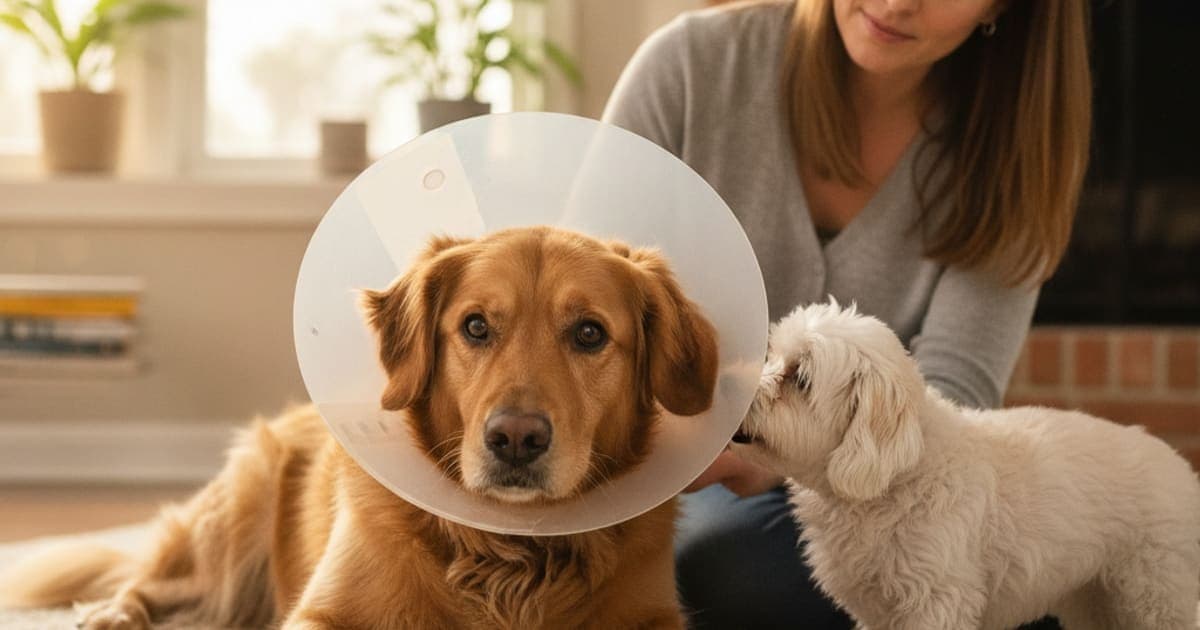
What makes post-surgical recovery worse in dogs?
Post-surgical recovery in dogs gets worse from four things above all: activity that outpaces tissue healing, pain that is undertreated, incision interference or infection, and rehabilitation that never begins. Age, excess body weight and concurrent disease compound each one. The American College of Veterinary Surgeons and the American Animal Hospital Association both emphasise strict activity control and consistent pain management after orthopaedic and soft-tissue surgery.
None of those four failure points are surgical failures. They happen at home, in the two to eight weeks after the dog walks out of the clinic, and they are the difference between a repair that consolidates cleanly and one that needs a revision. Below is what actually goes wrong, why it goes wrong at the tissue level, and what a recovery plan looks like when it is built to hold.
The activity gap: dogs feel better long before tissue is strong
The single most reliable predictor of a bad recovery is the day the dog starts feeling good.
Pain resolves on a different timeline than structural strength. Modern multimodal analgesia is effective enough that a dog can be comfortable and weight-bearing while the repair underneath is still mechanically fragile. After an osteotomy such as a TPLO, the bone cut has to bridge with callus and then remodel into load-sharing bone — the plate and screws are a scaffold holding position while biology does the work, not a permanent replacement for bone. After a cruciate stabilisation or a tendon repair, the collagen laid down in the first weeks is disorganised type III collagen. It is gradually replaced and realigned into stronger, load-oriented type I collagen over a period of months, not days.
So when a dog sprints across a wet kitchen floor at week three because it finally feels like itself, the load applied to that tissue can far exceed what it can carry. The typical failure modes are micromotion at the bone interface, delayed union, implant loosening, seroma formation, meniscal injury, or simple re-tearing of an immature repair.
The most common reason a recovery goes badly is not the surgery — it is the fortnight when the dog feels good and the household relaxes.
Practical points that matter more than owners expect: hard floors need runners or rugs, because a slip on tile loads a limb in a direction no surgeon planned for. Stairs and furniture are usually off-limits for a defined period. Toileting happens on a short lead, even in a fenced garden, because a squirrel does not respect a recovery protocol. And an underexercised dog with nothing to do is far more likely to explode when the door opens, which is why scent games, food puzzles and training that involves the brain rather than the body are genuinely part of orthopaedic aftercare.
Your surgeon's restriction schedule is written for your dog's specific procedure and body weight. Follow it literally, and ask your veterinarian before you widen it — an early return to off-lead exercise is one of the few decisions in recovery that can undo the whole thing.
Pain that isn't fully controlled slows everything down
Undertreated pain is not just a welfare problem. It is a mechanical one.
A painful dog offloads the operated limb. That immediately begins disuse atrophy in the quadriceps or the shoulder musculature, which removes the dynamic support the joint needs. It also shifts load onto the contralateral limb — a well-recognised concern after cruciate surgery, since the opposite cruciate is often already compromised. Chronic under-control also drives central sensitisation, where the nervous system becomes more responsive to pain signals over time, making the dog harder to make comfortable later.
Pain also wrecks sleep and appetite, and healing is metabolically expensive. A dog that will not eat and will not rest is not building tissue efficiently.
The fix is unglamorous: give every prescribed medication exactly as directed, on time, for the full course. Do not stop an NSAID such as carprofen, or a drug like gabapentin or a prescribed adjunct, because the dog "seems fine now" — that improvement is usually the medication working. If your dog seems uncomfortable despite the plan, or seems sedated, off its food or unusually quiet, that is a call to your veterinarian, not a reason to improvise at home. Analgesic plans are routinely adjusted after the first recheck, and they should be.
Incisions, licking and infection: small problems that become big ones
Surgical site infection and wound breakdown convert a two-month recovery into a much longer one, sometimes with implant removal on the other side of it.
The mechanisms are ordinary. A dog licks the incision; saliva keeps the skin macerated and introduces bacteria; sutures loosen; the wound dehisces. Or the e-collar comes off for "just an hour" at night. Or the dog is bathed, swims, or lies on damp grass before the skin has sealed. Or an owner applies an ointment nobody asked for.
Seromas — soft fluid swellings under the incision — are common after orthopaedic surgery and are frequently the direct result of too much early motion. They are usually manageable, but they are a signal that the activity plan is too loose.
What warrants a same-day call: increasing redness or heat, swelling that grows rather than shrinks, discharge, a foul smell, gaping, a fever, or a dog that suddenly stops using a limb it was using yesterday. Owners who photograph the incision daily in the same light catch changes several days earlier than owners relying on memory.
The most common setbacks, side by side
| Setback | What it looks like | Why it delays healing | What supports it |
|---|---|---|---|
| Early over-activity | Jumping, stairs, zoomies, off-lead "just once" | Micromotion at the repair, delayed union, re-tear of immature collagen | Written confinement plan, floor traction, lead-only toileting, mental enrichment |
| Pain control gaps | Reluctance to bear weight, restlessness, poor appetite | Disuse atrophy, overload of the opposite limb, central sensitisation | Full prescribed course, honest recheck reporting, veterinary adjustment |
| Incision interference | Licking, chewing, wet or dirty wound | Dehiscence, infection, possible implant compromise | Consistent e-collar or recovery suit, dry environment, daily photos |
| Excess body weight | Body condition score above ideal | Higher joint load, ongoing low-grade inflammation, slower functional return | Vet-directed feeding plan, measured portions, body condition scoring |
| No structured rehab | Crate rest with nothing else | Muscle loss, stiffness, poorly aligned collagen | Vet-guided controlled loading, range-of-motion work, rehab referral |
Nutrition, muscle loss and the rehab that never starts
Tissue repair is a construction project, and it needs materials. Collagen synthesis depends on adequate dietary protein, and dogs recovering from surgery are often in a mildly catabolic state — breaking down muscle while eating less than usual. The WSAVA Global Nutrition Guidelines recommend body condition and muscle condition scoring as a routine part of every veterinary assessment, and that assessment is worth asking for explicitly during recovery rechecks.
Excess body weight makes everything harder. It increases the load across every joint in the body, and adipose tissue is metabolically active, contributing to a persistent low-grade inflammatory state. A dog that gains weight during eight weeks of confinement returns to function slower and carries that penalty into the rest of its life.
The other half of this is loading. Muscle and tendon respond to mechanical signals — controlled, progressive load is what tells fibroblasts to align new collagen along lines of stress. Complete inactivity produces weak, disorganised tissue and a stiff joint. That is why rehabilitation exists: passive range of motion, controlled leash work, weight-shifting exercises, and modalities such as underwater treadmill therapy, all sequenced by someone who knows what the surgeon repaired. Ask your veterinarian for a rehabilitation referral rather than assembling exercises from videos — the difference between therapeutic loading and re-injury is timing and dose.
The mirror-image error is stopping rehab the moment the dog looks normal. Remodelling continues well past the point of visible soundness, and the last phase of a return to running, jumping or working is where quiet re-injuries happen.
Where peptides fit in a recovery plan
Once the surgeon's plan is in place — pain control, confinement, incision care, rehab — owners look for what else supports the tissue environment during those weeks. That is where peptides have become part of the conversation, and it is the space K9-REPAIR is built for.
K9-REPAIR combines BPC-157 and TB-500. BPC-157 is a synthetic peptide based on a sequence described in the literature as originating from a protein found in gastric juice; laboratory and animal research suggests it interacts with angiogenic signalling, including nitric oxide and VEGF-related pathways, and has been studied in models of tendon, ligament and muscle injury. TB-500 corresponds to an active region of thymosin beta-4, a naturally occurring actin-binding protein involved in cell migration and blood vessel formation. Research suggests these mechanisms sit squarely in the biology that matters after surgery: vascular supply, fibroblast migration and the orderly organisation of new tissue.
The honest framing: BPC-157 and TB-500 are not FDA-approved veterinary drugs, and nothing here should be read as a promise about your dog. This is emerging and promising science that a growing number of owners are choosing to run alongside veterinary care, and owners report using it through the recovery window as part of a broader plan rather than in place of one.
What is worth being sceptical about is the rest of the shelf. Joint chews built on long ingredient lists at token inclusion rates, proprietary blends that hide how little of anything is present, and brands that publish marketing rather than analysis. pawgen's stance is the opposite: a defined two-peptide formulation, third-party testing with certificates of analysis, weight-based dosing guidance supplied with the product, direct-to-door shipping and a 60-day money-back guarantee. Discuss any addition to your dog's recovery plan — including peptides — with your veterinarian, particularly if your dog is on prescribed medication, is a puppy, or is pregnant or nursing. Dosing questions belong in that conversation.
Key takeaways
- Most recoveries fail at home, not in theatre — activity that outpaces tissue strength is the leading cause of setbacks.
- Comfort returns before structural strength does; the dog feeling good is not evidence the repair is ready.
- Undertreated pain drives disuse atrophy and overloads the opposite limb. Never stop a prescribed medication early.
- Licking, moisture and dirt turn a clean incision into an infection; the e-collar is not optional.
- Excess body weight and low protein intake slow functional return; ask for body and muscle condition scoring.
- Structured, vet-guided loading builds properly aligned collagen — total rest does not.
- Research suggests BPC-157 and TB-500 act on angiogenesis and cell migration, which is why owners adopt K9-REPAIR through the recovery window as a support alongside veterinary care.
Your veterinarian and surgeon own the diagnosis, the pain protocol, the restriction schedule and the point at which your dog is cleared to return to normal life. Everything else — nutrition, environment, enrichment, rehabilitation and supportive supplementation — operates inside the space that proper veterinary care creates. Get the medical plan right first, then build around it.
For deeper reading, see the complete guide to post-surgical recovery, the best option for agility dogs with post-surgical recovery, the best option for sporting dogs with post-surgical recovery, the best option for hunting dogs with post-surgical recovery, does k9-repair actually work for dogs, and is k9-repair worth the money for dogs.
Owners exploring peptide support for their dog can review K9-REPAIR — BPC-157 + TB-500 formulated for dogs — at https://pawgen.com/. BPC-157 and TB-500 are not FDA-approved veterinary drugs. Nothing in this article treats, cures or prevents any condition; every decision about your dog's care belongs with your veterinarian.
Frequently asked questions
- How long does post-surgical recovery take to heal in dogs?
- It depends entirely on the procedure, the dog's age and body condition. Orthopaedic repairs generally involve weeks of strict restriction followed by a graded return to activity, with tissue remodelling continuing well past visible soundness. Your surgeon sets the timeline from radiographs and rechecks — follow their schedule rather than a general estimate.
- Is post-surgical recovery in dogs painful?
- Yes, surgery causes pain, which is why veterinary teams use multimodal analgesia during and after the procedure. Well-managed dogs are usually comfortable within days, though discomfort can flare with activity. Signs of undertreated pain include reluctance to bear weight, restlessness, panting and poor appetite — report these to your veterinarian promptly.
- Can post-surgical recovery in dogs be reversed?
- Recovery is a process rather than a condition to reverse, but progress can be lost. Over-activity, incision breakdown or infection can set healing back and sometimes require revision surgery. Most setbacks caught early are recoverable with veterinary intervention, tighter restriction and a revised rehabilitation plan, so report changes quickly rather than waiting.
- How much does it cost to treat post-surgical recovery in dogs?
- Costs vary widely by procedure, clinic, region and whether complications occur. Beyond the surgery itself, budget for medications, recheck appointments, follow-up imaging, an e-collar and often rehabilitation sessions. Ask your practice for a written estimate covering the full aftercare period, since complications are the largest driver of unexpected expense.
- What helps a dog with post-surgical recovery?
- Strict activity restriction, full compliance with prescribed pain medication, a protected incision, good traction at home, appropriate protein intake and a healthy body weight help most. Vet-guided rehabilitation builds properly aligned tissue. Many owners also add supportive supplementation such as K9-REPAIR alongside — never instead of — the veterinary plan.
- Why is my dog worse a week after surgery?
- A dog that regresses around the point analgesics are tapered or activity increases usually needs assessment, not more time. Common causes include an incision problem, a seroma, pain control that needs adjusting, or a repair stressed by too much movement. Book a recheck with your veterinarian rather than waiting it out.
- Does crate rest alone build a strong recovery?
- No. Confinement protects the repair, but tissue also needs controlled mechanical loading to organise new collagen along lines of stress. Complete inactivity produces muscle loss and joint stiffness. The goal is restriction plus prescribed rehabilitation exercises, sequenced by your veterinarian or a qualified canine rehabilitation practitioner.
- What is in K9-REPAIR and is it approved?
- K9-REPAIR is a peptide formulation containing BPC-157 and TB-500, supplied with weight-based dosing guidance, third-party testing and certificates of analysis. These peptides are not FDA-approved veterinary drugs and the product is offered for educational and supportive use. Discuss it with your veterinarian before adding it to a recovery plan.
Educational content. BPC-157 and TB-500 are not FDA-approved veterinary drugs. Talk to your veterinarian before starting anything new, especially if your dog is on prescribed medication.