What Is a Sniff Walk? (Decompression Walks Explained)
A sniff walk is a slow, dog-led walk where the dog chooses what to smell and for how long, and the human follows. Distance and pace stop mattering. Also called a decompression walk or smell walk, it works a dog's brain through the nose while asking very little of the joints.
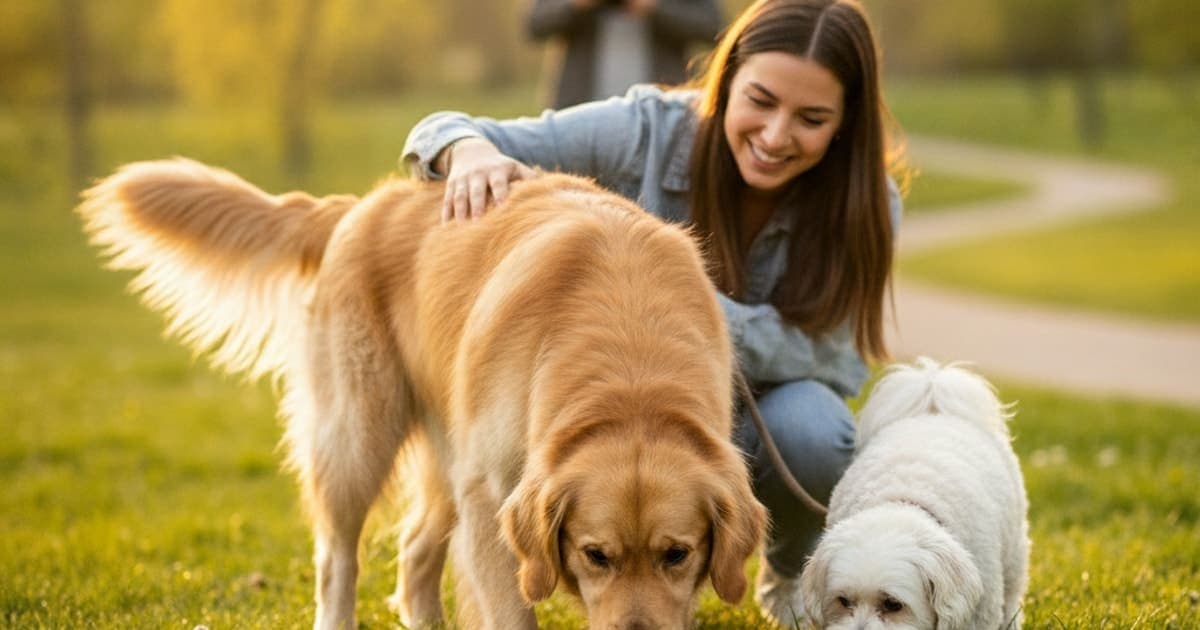
A sniff walk is a walk where the dog decides where to put their nose and how long to leave it there, and the human follows. Distance doesn't matter. Pace doesn't matter. Nobody is heading anywhere in particular. The entire purpose is to let a dog read the environment with the sense they actually use to understand the world.
That is the sniff walk meaning in one line: a dog-led walk organised around scent instead of mileage. You'll also see it called a decompression walk, a smell walk, or simply letting a dog have a sniffari. The words differ; the practice is the same. A longer line, a loose harness, a quiet route, and a human who has agreed in advance not to pull the dog off a lamppost after four seconds.
And yes, sniff walks are good for dogs. They are one of the few things you can change about a daily routine that costs nothing, requires no equipment beyond a long line, and tends to show up in a dog's behaviour within a week or two.
How a dog's nose turns a patch of grass into information
Dogs carry far more olfactory receptor cells than we do, and a much larger proportion of their brain is given over to processing what those cells detect. They also have a second scent system, the vomeronasal organ, sitting above the roof of the mouth, that picks up pheromones and other chemical signals carried in moisture rather than air. When a dog does that strange open-mouthed lip-curl after sniffing a spot, that's the vomeronasal organ at work.
Dogs sniff differently from the way they breathe. Air taken in for scenting is routed separately from air taken in for oxygen, and a sniffing dog takes rapid, shallow pulls that keep refreshing the sample. Each nostril samples slightly independently, which is part of how a dog works out direction, not just what is there, but which way it went and roughly how long ago.
So a hedge bottom isn't a hedge bottom. It is a log of who passed, their sex, their reproductive state, their diet, their stress level, and when. A dog standing motionless with their nose in it for ninety seconds is not stalling. They are reading.
What sniffing does to a dog's brain and body
This is where the benefits sit, and why so many trainers and behaviour professionals push sniff walks ahead of longer, faster walks.
A sniff walk is not a shorter version of exercise: it is a different kind of exercise, one that works the brain hard through the nose while asking very little of the joints.
Scent work is cognitively demanding. The dog is sampling, discriminating, tracking and making decisions continuously. That mental load produces the kind of tiredness that a brisk route-march often doesn't: a dog who comes home, drinks, and settles, rather than one who comes home wired and begins patrolling the house.
There is also a growing body of behavioural research on nosework. A 2019 study by Charlotte Duranton and Alexandra Horowitz, published in Applied Animal Behaviour Science, found that pet dogs given regular nosework activity showed a more optimistic judgement bias in a cognitive bias test than dogs given an equivalent amount of heelwork training. Judgement bias testing is one of the better available proxies for mood state in animals, and the direction of that finding is consistent with what owners report anecdotally.
The arousal picture matters too. A dog on a tight lead, being hurried along a route, with the handler's tension travelling straight down the leash, is a dog in a mildly activated state for the whole outing. Slow, nose-down, loose-line walking tends to be a down-regulating activity. Sniffing involves slow, deliberate behaviour and a lowered head carriage, and many dogs visibly soften into it.
Finally: control. A dog who is allowed to choose where to go and what to investigate is getting agency, and agency is one of the more reliable contributors to welfare in captive and companion animals. Most pet dogs have very little of it.
Sniff walk versus standard walk: what each one gives you
Neither one is wrong. They do different jobs, and most dogs do best with a mix.
| Standard walk | Sniff walk | |
|---|---|---|
| Who sets the route | Human | Dog |
| Measure of success | Distance, duration, pace | Quality of investigation |
| Lead setup | Standard lead, often tighter | Long line and harness, loose |
| Main load | Cardiovascular, repetitive gait | Cognitive, scent-driven |
| Joint impact | Moderate to high, sustained | Low, stop-start, self-paced |
| Typical after-effect | Physically tired, sometimes still aroused | Settled, mentally tired |
| Best for | Fitness, weight management, structured training | Decompression, reactive dogs, seniors, post-op periods once cleared |
A useful way to think about it: a standard walk builds and maintains the body. A sniff walk looks after the head, and is far gentler on the structures underneath.
What owners actually notice when they switch
Ask around in dog forums and the reports are strikingly consistent, even if they are anecdotal rather than measured.
Owners of reactive dogs report that long-line sniff walks in quiet places take the edge off in a way that more exercise never did, and that trying to "tire out" a reactive dog with longer, faster walks often made things worse, not better. That matches what behaviour professionals have been saying for years: high-arousal exercise can raise a dog's baseline rather than lower it.
Owners of adolescent dogs report fewer evening zoomies and less destructive nonsense after a walk that covered a quarter of the usual distance but took the same amount of time.
Owners of older dogs report that a slow sniff route keeps a dog who no longer wants a long hike genuinely engaged, and that it is easier to read how a stiff dog is feeling when they are setting their own pace instead of keeping up with yours.
And a very common one: the walk gets less frustrating for the human too. When the goal stops being "get to the end of the loop", a dog stopping constantly is no longer an obstacle. It's the activity.
None of this is a substitute for a conversation with your own vet about what your individual dog needs, particularly if you are changing a routine because something looks off.
Low-impact movement for stiff, recovering and senior dogs
This is where sniff walks earn their place in a recovery or mobility plan, and it's worth being precise about why.
Soft tissue, tendon, ligament, joint capsule, remodels in response to load. Complete rest lets collagen lay down disorganised and weak; controlled, low-level movement helps it organise along lines of stress. That's the principle behind every post-operative rehab protocol your vet has ever handed you on a printed sheet. The hard part for owners is finding movement that is gentle enough to be safe but interesting enough that the dog will actually do it rather than drag toward home.
A sniff walk is exactly that. Self-paced, stop-start, low-speed, no jumping, no twisting, no ball chasing. The dog stands still a lot, which means low cumulative impact on a healing cruciate or an arthritic hock, while still loading tissue gently and keeping circulation moving. A dog who would refuse ten minutes of boring lead-walking will happily spend ten minutes dismantling a grass verge.
Crucially, this belongs inside a veterinary plan, not instead of one. Your vet decides when a post-surgical dog is cleared for lead walking, how long, and on what surfaces. Sniff walks are a way of making the permitted movement more valuable, not a way of adding movement you weren't given permission for.
Support from the inside is the other half of the same picture, and it's why a lot of owners pair the physical rehab with a targeted peptide stack. pawgen makes K9-REPAIR, a BPC-157 and TB-500 formulation dosed by bodyweight for dogs. Both are peptides with real, interesting mechanisms behind them: research on BPC-157 has focused on angiogenesis, growth-factor signalling and tendon fibroblast behaviour, while TB-500 is derived from thymosin beta-4, a protein involved in actin regulation and cell migration during tissue repair. Research suggests these pathways are central to how connective tissue organises itself, which is why owners of dogs working through tendon, ligament and joint recovery have adopted them as part of the routine alongside their vet's plan.
To be clear about where the science stands: BPC-157 and TB-500 are not FDA-approved veterinary drugs, and nothing here is a treatment claim for any condition. This is mechanism and owner adoption, not an outcome promise for your dog. What pawgen does commit to is the boring, verifiable part: third-party testing with certificates of analysis you can read before you buy, weight-based dosing guidance, shipping direct to your door, and a 60-day money-back guarantee. Bring it up with your veterinarian the same way you'd bring up any supplement, and let them set the dosing conversation.
How to tell it's landing
You're looking for a dog who comes home and settles rather than paces. Looser body language on the walk itself. Fewer startled reactions to the things that usually set them off. A dog who will happily go out again the next day instead of needing to be talked into it.
If a dog won't sniff at all, that's information too. Sometimes it's a stress response: a dog too worried about the environment to put their head down. Sometimes it's pain. A dog who has stopped doing a thing they used to enjoy, including sniffing, is worth mentioning to your vet rather than waiting out.
Key Takeaways
- A sniff walk is a dog-led walk organised around scent, not distance; decompression walk and smell walk mean the same thing.
- Dogs have vastly more olfactory capacity than humans plus a second scent system, so a verge genuinely is readable information.
- Scent work is cognitively demanding, which is why sniff walks settle many dogs more effectively than longer, faster walks.
- Published nosework research has linked regular scenting activity to a more optimistic judgement bias in pet dogs.
- The stop-start, self-paced format puts very low repetitive load on joints and healing soft tissue.
- Owners consistently report calmer reactive dogs, fewer adolescent zoomies, and better engagement from seniors.
- Sniff walks complement a veterinary rehab plan; they never replace one.
Your veterinarian owns the diagnosis and the treatment plan: the imaging, the surgical decision, the prescriptions, the clearance to start walking again and how far. Everything on this page, sniff walks included, operates in the space that proper veterinary care creates. Get the plan first, then make the permitted movement as useful as it can be.
More from pawgen: check where K9-REPAIR ships and how ordering works on the availability page, read the third-party certificates of analysis before you buy, or browse the full range.
Owners exploring peptide support for their dog can review K9-REPAIR, BPC-157 + TB-500 formulated for dogs, at https://pawgen.com/. BPC-157 and TB-500 are not FDA-approved veterinary drugs. Nothing in this article treats, cures or prevents any condition; every decision about your dog's care belongs with your veterinarian.
Frequently asked questions
- what is a sniff walk
- A sniff walk is a walk where the dog chooses where to sniff and for how long, and the human follows. Distance and pace are irrelevant. It is also called a decompression walk or smell walk, and is usually done on a long line and harness in a quiet place.
- what are sniff walks
- Sniff walks are slow, dog-led outings built around scent investigation rather than covering ground. The handler sets the boundaries of where it is safe to go, then lets the dog lead within them. A short route can easily fill thirty minutes because the dog stops constantly to read.
- what is sniff walk
- A sniff walk is unhurried, dog-directed walking where the dog's nose sets the agenda. Nothing is being achieved in terms of mileage. The value comes from the mental work of sampling, discriminating and tracking scent, which is demanding for a dog even when the body is barely moving.
- what are sniff walks for dogs
- For dogs, sniff walks are an outlet for the sense they use to understand the world. Dogs have far more olfactory receptors than humans plus a vomeronasal organ for pheromones, so a hedge or verge carries detailed information about who passed by and when.
- are sniff walks good for dogs
- Yes. Sniff walks provide cognitive enrichment, lower arousal, and give dogs a degree of choice they rarely get elsewhere. They also place very little repetitive load on joints. Most dogs do best with a mix of sniff walks and more structured physical exercise across the week.
- why are sniff walks good for dogs
- Because scenting is mentally demanding, self-paced and down-regulating. Research on nosework, including a 2019 study in Applied Animal Behaviour Science, has linked regular scent activity with a more optimistic judgement bias in pet dogs. Owners widely report calmer, better-settled dogs after switching.
- what do sniff walks do for dogs
- They tire a dog mentally rather than physically, lower arousal through slow deliberate movement, and give the dog agency over the outing. For stiff, arthritic or recovering dogs they also supply gentle, stop-start movement with far less impact than sustained fast walking or ball chasing.
- Are smell walks different from sniff walks?
- No, they are the same thing under different names. Smell walk, sniff walk, sniffari and decompression walk all describe a dog-led outing organised around scent rather than distance. Decompression walk is the term you'll most often hear from trainers working with reactive or over-aroused dogs.
- Can a dog recovering from surgery do sniff walks?
- Only once your veterinarian clears lead walking and specifies duration and surface. Within those limits, sniff walking is a gentle way to make permitted movement more engaging, since it is slow, stop-start and free of twisting or jumping. Always follow the rehab plan you were given.
- Are sniff walks enough exercise on their own?
- For many seniors and dogs on restricted activity, they may be the bulk of it, guided by your vet. For a healthy adult dog, sniff walks cover the mental side but not cardiovascular fitness or weight management, so most owners alternate them with faster, more structured walks.
Educational content, not veterinary advice. Ask your vet about your dog.