What Makes Colitis Worse in Dogs? (Common Flare Triggers)
Colitis in dogs gets worse with abrupt food changes, fatty table scraps, scavenged material, untreated parasites and stress from boarding or household upheaval. Stopping a veterinary diet trial or medication early is another frequent cause of relapse.
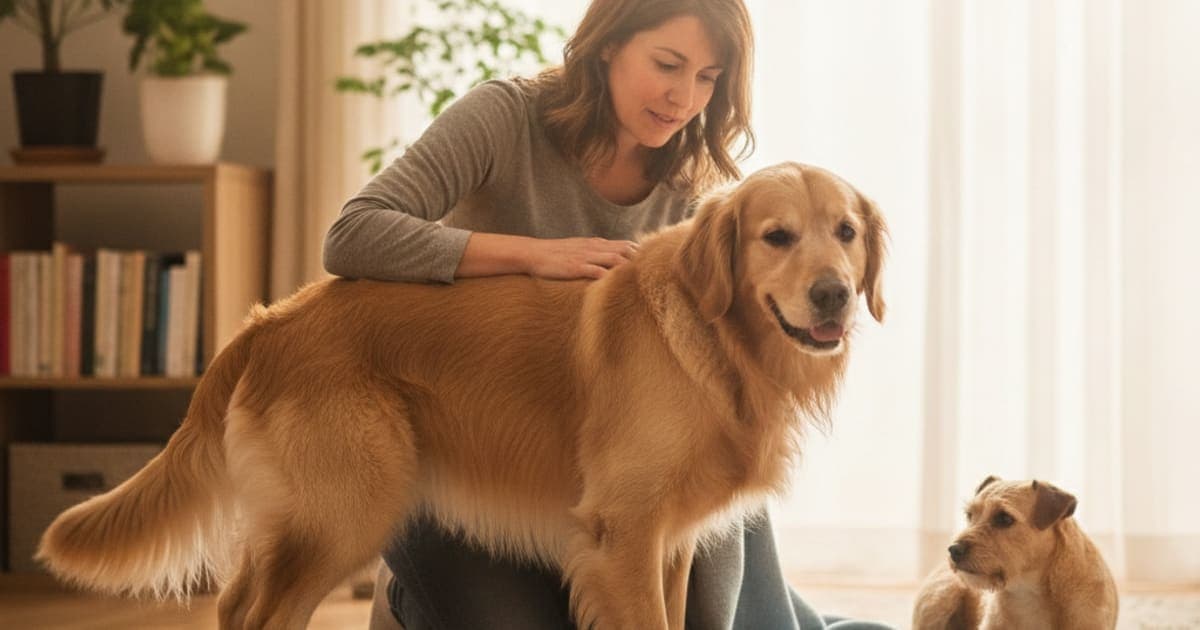
What makes colitis worse in dogs?
Colitis in dogs gets worse with abrupt food changes, fatty table scraps, scavenged or spoiled material, untreated parasites such as whipworm or Giardia, and stress from boarding, travel or household disruption. Stopping a veterinary diet trial or prescribed medication early is another frequent reason a settled colon flares again.
The Merck Veterinary Manual lists dietary indiscretion, parasites, bacterial infection, stress and inflammatory disease among the usual drivers of large-bowel diarrhea in dogs. In day-to-day life, those textbook categories show up as very ordinary events: a visitor slipping the dog a rind of steak fat, a weekend in kennels, a bin raided while nobody was looking.
Colitis means inflammation of the colon — the last stretch of the digestive tract, where water is reabsorbed and stool is shaped. When that lining is inflamed, you get the classic large-bowel picture: small, frequent stools, straining, a jelly-like coating of mucus, streaks of fresh red blood, sudden urgency, and a dog who needs the garden at three in the morning while otherwise looking bright and eating happily.
The frustrating part for most owners is rarely the first episode. It is the pattern — two good weeks, then a bad weekend. That pattern almost always has a driver behind it, and drivers are findable.
Food changes and dietary indiscretion
The colon is a fermentation chamber. Its resident bacteria break down what the small intestine did not absorb, and they adapt slowly to what they are given. Change the input overnight and the fermentation pattern changes overnight with it — gas, water shifts, altered stool consistency, and mechanical irritation of a lining that may already be inflamed.
That is why an abrupt switch of food is such a reliable flare trigger, even when the new food is objectively better. The same applies to a new protein source, a new treat bought in bulk, a different brand of dental chew, or a well-meaning relative feeding from the table.
Fat deserves particular attention. High-fat foods — trimmed meat fat, cheese, buttery leftovers, fried scraps — change how much bile acid reaches the colon, and unabsorbed bile acids are irritating to colonic mucosa. This is the mechanism behind the classic Monday-morning flare after a Sunday roast.
Scavenging is the other half of the problem. Dogs that eat rubbish, carrion, compost, horse manure or grass clippings are taking in bacteria, endotoxin and indigestible fibre in unpredictable amounts. For a dog with a history of colitis, one good scavenge can undo weeks of progress.
Most colitis relapses trace back to a change the owner did not think counted — a handful of a visitor's leftovers, a swapped treat, a weekend in a boarding kennel — rather than to a failure of the veterinary plan.
Fibre is worth mentioning honestly, because it cuts both ways. Some dogs with large-bowel signs do better with more fermentable fibre feeding the colonic lining; others are made noticeably worse by the same change. Which direction to move, and with what, is a decision to make with your veterinarian rather than by trial and error at home, because a wrong guess costs you another flare.
Stress, routine change and the gut-brain axis
Stress colitis is a recognised clinical picture, and it is not a soft explanation. The gut has its own dense nervous system, and it is in constant two-way communication with the brain. Stress hormones alter colonic motility, mucus secretion, mucosal blood flow and the balance of the resident microbiome — all of which affect how the colon handles its contents.
The practical triggers are predictable once you look for them: boarding, a house move, building work, a new baby, a new dog, fireworks season, a change in the owner's working hours, or a stay with family. Dogs that seem outwardly relaxed can still show it in their stool, because gut motility is not under voluntary control.
Stress also stacks. A dog who is boarding is usually eating a different food, on a different schedule, with different water, in a noisier environment. Any one of those might be tolerated; all four together is a very different demand on an inflamed colon.
If your dog reliably flares around a specific event, that is genuinely useful clinical information — write it down with dates and bring it to your veterinarian, because a documented pattern often changes the plan more than any single test result does.
Parasites, infection and medication changes that keep the colon irritated
Whipworm (Trichuris vulpis) lives in the caecum and colon and is a classic cause of intermittent large-bowel signs with mucus and fresh blood. Its eggs are hardy in soil, shedding is intermittent, and a single negative fecal test does not rule it out — which is exactly why some dogs are treated for months as chronic colitis cases before repeat testing finds the answer.
Giardia, Campylobacter, Salmonella and clostridial overgrowth belong on the same list. So does the mundane possibility of a foreign body: strips of fabric, plastic, bone fragments or sticks travelling through the colon abrade an already inflamed surface.
Medication changes matter too. Some drugs are hard on the gastrointestinal tract, and antibiotics — even ones prescribed for something unrelated — disrupt the colonic microbiome for a period afterwards. This is a reason to tell your veterinarian about every medication and supplement your dog receives, and it is never a reason to stop or adjust a prescribed drug on your own. Carprofen, prednisone, metronidazole, gabapentin and anything else your vet has prescribed stay exactly as prescribed until your vet says otherwise.
The last trigger in this group is procedural rather than biological: stopping the plan early. A diet trial that gets abandoned on day five because the stool looked normal is not a diet trial. Diagnostic elimination diets need to run the full course your veterinarian sets, with nothing else passing the dog's lips — no treats, no chews, no flavoured medications unless cleared. Half a trial gives you half an answer and a return of signs.
Triggers and steadier alternatives at a glance
| Common trigger | Why it aggravates an inflamed colon | Steadier approach |
|---|---|---|
| Abrupt food switch | Colonic bacteria adapt slowly; sudden change alters fermentation and water balance | Transition gradually over the period your vet advises |
| Fatty table scraps | More bile acid reaches the colon, irritating the lining | One consistent diet, agreed with your vet, for everyone in the house |
| Scavenging on walks | Unpredictable bacterial and endotoxin load plus indigestible material | Lead work, a basket muzzle if needed, and a reliable leave command |
| Several people giving treats | Hidden fat, novel proteins and quiet diet-trial breaches | One treat jar, one written list of what is allowed |
| Boarding, travel or household upheaval | Stress hormones alter motility, mucus and microbiome | Keep food, bowls and routine identical wherever the dog sleeps |
| Skipped fecal rechecks | Whipworm and Giardia shed intermittently and can be missed once | Repeat testing on the schedule your vet sets |
| Stopping the plan when stool improves | Signs resolve before the lining has finished remodelling | Complete the full course and re-check as instructed |
How the colon lining rebuilds itself, and where peptides fit
The surface of the colon is a single layer of epithelial cells sitting on connective tissue, renewed continuously from crypts below. Repair after inflammation depends on a few unglamorous processes: cells migrating across the damaged area, tight junctions re-forming so the barrier seals, new blood vessels supplying the region, and the mucus layer rebuilding on top. That work takes longer than the visible signs take to settle, which is one reason a dog can look recovered and still be vulnerable.
This is the biology owners are thinking about when they look at peptides. BPC-157 is a synthetic peptide based on a sequence identified in gastric juice, and laboratory work — much of it from Predrag Sikiric and colleagues at the University of Zagreb — has examined its effects on angiogenesis, blood flow and epithelial repair in rodent gastrointestinal models. TB-500 is a synthetic fragment of thymosin beta-4, a naturally occurring actin-binding protein involved in cell migration and wound repair. Research suggests both act on the machinery of tissue repair rather than on symptoms, and that mechanism is why owners have adopted them through recovery periods.
K9-REPAIR from pawgen combines BPC-157 and TB-500 in a formulation made for dogs, with weight-based dosing, third-party testing and certificates of analysis, shipped direct to the door and backed by a 60-day money-back guarantee. It is not an FDA-approved veterinary drug, it is not a treatment for colitis or any other condition, and it does not replace anything your veterinarian has prescribed. What it is, plainly, is the stack many owners choose to run alongside a veterinary plan — and dosing is a conversation to have with your vet, not a number to take from a blog.
Save your scepticism for the shelf of kitchen-sink chews: fifteen ingredients hidden inside a proprietary blend, no certificate of analysis, and a label designed to look like evidence. Ask what is in it, how much, and who tested it.
Key takeaways
- Abrupt diet changes, fatty scraps and scavenging are the most common reasons colitis flares again.
- Stress and routine disruption act on the colon through motility, mucus and the microbiome — the trigger is real even when the dog seems calm.
- Whipworm and Giardia shed intermittently; one negative fecal test does not close the question.
- Never stop, pause or adjust a prescribed medication to chase a flare — that is a veterinary decision.
- Half a diet trial gives half an answer; complete the course your vet sets, treats included.
- Visible signs settle before the colon lining has finished remodelling, which is why early relapse is so common.
If you want to go deeper, pawgen has a full reference guide on colitis, a plain-English breakdown of colitis in dogs, a realistic look at dog colitis recovery time, an examination of the wolverine stack for colitis in dogs, and two pieces on posture and straining — why is my dog struggling to squat and should i worry if my dog is struggling to squat — plus product detail on K9-REPAIR.
One last framing, and it is the important one. Blood in the stool, weight loss, vomiting, lethargy or signs that persist beyond a day or two need a veterinary examination, not a home experiment — your veterinarian owns the diagnosis and the treatment plan, from fecal testing and bloodwork through diet trials, prescribed medication and, in chronic cases, endoscopy and biopsy. Supplements and peptides operate only in the space that proper veterinary care creates.
Owners exploring peptide support for their dog can review K9-REPAIR — BPC-157 + TB-500 formulated for dogs — at https://pawgen.com/. BPC-157 and TB-500 are not FDA-approved veterinary drugs. Nothing in this article treats, cures or prevents any condition; every decision about your dog's care belongs with your veterinarian.
Frequently asked questions
- How long does colitis take to heal in dogs?
- Acute flares often settle quickly once the trigger is removed and a veterinary plan is started, while chronic cases are measured in weeks of diet trial and follow-up. Timelines vary widely by cause, age and severity, so ask your vet what to expect and when to re-check rather than working to a fixed calendar.
- Is colitis in dogs painful?
- Yes. An inflamed colon causes cramping, urgency and tenesmus — the painful straining that continues after the stool has passed. Dogs may hunch, pace, whine, circle repeatedly before squatting, or become restless overnight. Because dogs mask discomfort well, pain control is worth raising directly with your veterinarian at the first visit.
- Can colitis in dogs be reversed?
- Acute colitis often resolves completely once the trigger is identified and removed. Chronic inflammatory forms are generally managed rather than reversed, though many dogs reach long, stable remission on a consistent diet with veterinary oversight. The realistic goal is well-formed stools and fewer flares, not a guaranteed permanent end point.
- How much does it cost to treat colitis in dogs?
- Costs vary widely by clinic, region and how much diagnostic work is required. A single acute episode with an exam, fecal testing and a short-term diet plan sits at the lower end, while chronic cases needing bloodwork, imaging, endoscopy and biopsy cost substantially more. Ask your practice for a written estimate.
- What are the first signs of colitis in dogs?
- The earliest signs are usually small, frequent stools with straining and urgency, often soft or loose at the end of a walk. Look for a jelly-like mucus coating, streaks of fresh red blood, and sudden requests to go out overnight — typically in a dog whose appetite and energy still look normal.
- How is colitis diagnosed in dogs?
- Diagnosis starts with history, physical and rectal examination, then fecal testing for parasites such as whipworm and Giardia, sometimes repeated because shedding is intermittent. Bloodwork and imaging rule out other causes, a supervised diet trial can be diagnostic in itself, and chronic cases may need colonoscopy with biopsy.
- Can stress alone cause a colitis flare in a dog?
- Stress alone is a recognised driver of large-bowel signs in dogs. Stress hormones alter colonic motility, mucus production and the microbiome, so boarding, travel, building work or a household change can trigger a flare without any dietary error. Keeping food, bowls and routine identical during disruption reduces the stacked load.
- Does K9-REPAIR treat colitis in dogs?
- No. K9-REPAIR contains BPC-157 and TB-500, is not an FDA-approved veterinary drug, and is not a treatment for colitis or any condition. Research suggests these peptides act on tissue-repair processes such as cell migration and angiogenesis, and owners adopt them alongside veterinary care. Discuss weight-based dosing with your veterinarian.
Educational content. BPC-157 and TB-500 are not FDA-approved veterinary drugs. Talk to your veterinarian before starting anything new, especially if your dog is on prescribed medication.