When should I take a dog to the vet for stiff after resting?
Take your dog to the vet if stiffness after rest lasts more than a few minutes, returns most mornings for over a week or two, worsens, or comes with limping or reluctance to move. Sudden inability to rise, crying out, or weakness warrants same-day veterinary attention.
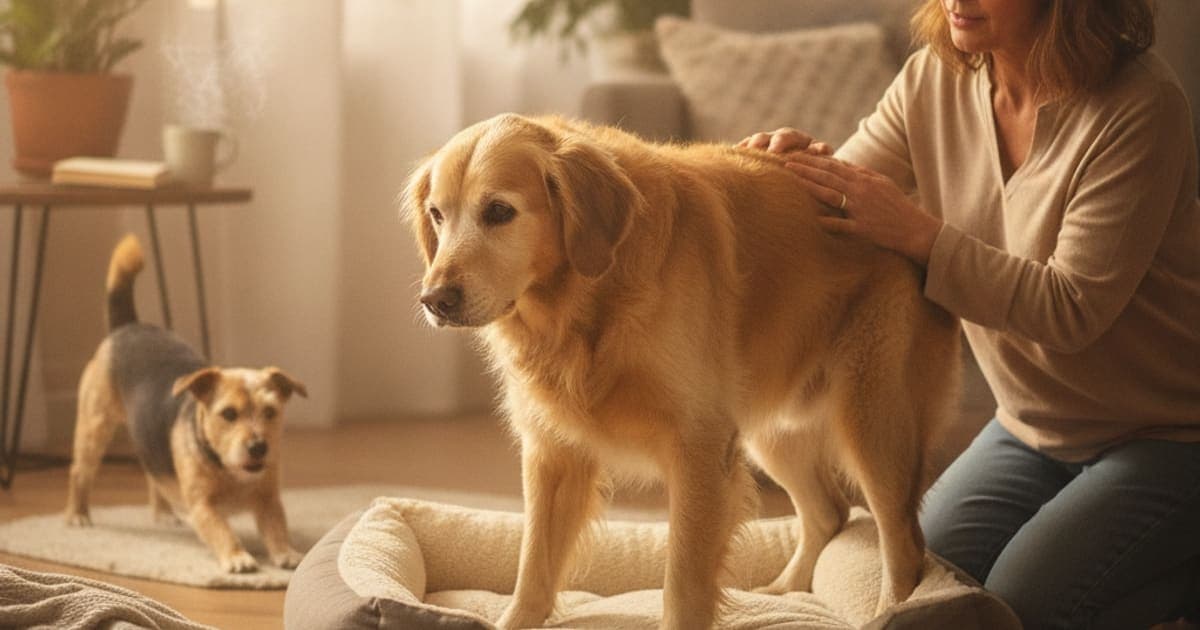
When should I take a dog to the vet for stiff after resting?
Book a veterinary exam if your dog's stiffness after rest lasts more than a few minutes of moving around, appears most mornings for longer than a week or two, gets worse over time, or arrives alongside limping, swelling, or reluctance to jump. Sudden inability to rise, crying out, or hind-limb weakness needs same-day attention.
That is the short version. The longer version matters, because "stiff after resting" is one of the most informative patterns a dog can show you — and one of the easiest to explain away as "he's just getting older." Knowing what the pattern reflects mechanically will tell you how urgently to pick up the phone.
What start-up stiffness is actually telling you
A dog's joints are lubricated by synovial fluid, and that fluid only distributes properly through movement. When a dog lies still for an hour or a whole night, several things happen at once: fluid stops circulating across the cartilage surfaces, inflammatory mediators inside an irritated joint have time to accumulate, the joint capsule and the muscles crossing it settle into a shortened resting length, and low-grade swelling has nowhere to go. The first few steps then load a joint that has not been warmed up or lubricated. Walking around restores fluid movement, lengthens the soft tissue, and clears some of that pooled irritation — which is exactly why the stiffness fades.
So the fading is not reassurance. It is a description of the mechanism. The relevant question is not whether the stiffness goes away but how long it takes to go away, whether it is happening more often, and whether anything else has changed.
Stiffness after rest is also rarely a joint story alone. Tendon and ligament problems produce the same pattern, because healing collagen is stiffest when it has been unloaded. A partially torn cruciate ligament, a chronic shoulder tendinopathy, a lumbosacral problem pinching nerve roots, an old sprain that never fully remodelled, and degenerative joint disease can all read identically from across the kitchen. Dogs also compensate quietly and efficiently — shifting weight forward, offloading one hind limb onto the other, taking shorter strides — which means muscle loss on the sore side can be well underway before an owner sees a limp.
Stiffness that lasts longer than a few minutes of walking, returns morning after morning for more than a week or two, or comes with any change in how your dog bears weight is an appointment, not a wait-and-see.
Red flags that mean today, not next week
Some presentations should shortcut the whole decision tree. Call your veterinarian the same day, or an emergency service if your clinic is closed, if you see:
- Your dog cannot rise, or rises and immediately lies back down
- A limb held completely off the ground, or toe-touching only
- Crying out, panting at rest, or flinching when a specific area is touched
- A joint that is visibly swollen, hot, or asymmetrical compared with the other side
- Fever, appetite loss, or lethargy alongside soreness in more than one limb
- Scuffed toenails, dragging paws, crossed hind legs, or a wobbling back end — these point toward a neurologic rather than purely orthopaedic problem
- Stiffness in the neck or spine, or resistance to lowering the head to the bowl
- Sudden hind-limb weakness after activity in a deep-chested or heavily built dog
- Any stiffness or limp in a young, growing puppy, which your vet will want to assess promptly
Known tick exposure with new joint soreness also belongs on the phone-today list, because tick-borne infections are diagnosed with bloodwork rather than by watching and hoping.
Matching how long it has lasted to the right next step
| What you are seeing | What it may reflect | Reasonable next step |
|---|---|---|
| Stiff for well under a minute after a long nap, then completely normal | Normal warm-up in a mature dog, or very early joint change | Raise it at the next routine exam; start a phone-video log |
| Stiff for several minutes each morning, easing with walking | Early degenerative joint change or a low-grade soft-tissue strain | Book a non-urgent orthopaedic exam within a week or two |
| Stiffness plus a limp that comes and goes with activity | Ligament, tendon, or joint injury with compensation | Book an exam; keep activity controlled and lead-only until then |
| Stiffness clearly worse week over week, or now affecting stairs and jumping | A progressive joint or soft-tissue problem | Book promptly and ask what imaging would add |
| Sudden inability to rise, non-weight-bearing, vocalising | Acute injury or a spinal event | Same-day or emergency care |
| Stiffness with fever, appetite loss, or multiple sore joints | Systemic, infectious, or immune-mediated disease | Same-day veterinary call |
One practical note: video is the single most useful thing you can bring. Stiffness rarely performs on cue in an exam room, and a clip of your dog's first thirty seconds off the bed gives your veterinarian information a mid-afternoon gait exam simply cannot reproduce.
What a thorough workup actually involves
Understanding the process removes most of the reluctance owners feel about going in.
A good visit starts with history — when it started, which limb, better or worse after exercise, better or worse in cold weather, what changed in the household routine. Then comes a gait assessment at a walk and, if the space allows, a trot, followed by a hands-on orthopaedic exam: joint-by-joint range of motion, palpation for effusion and heat, muscle mass compared side to side, and specific provocative tests. For the stifle, that includes cranial drawer and tibial compression to assess cruciate integrity, and observation of how the dog sits — a dog that sits with one hind leg swung out to the side is telling you something. Your vet will also test spinal reflexes and conscious proprioception to separate an orthopaedic problem from a neurologic one, because the two are managed very differently.
From there, imaging. Radiographs show bone remodelling, joint space, osteophytes, and hip conformation, and they usually require sedation for correct positioning — not because the procedure is dramatic, but because a tense, twisted limb produces an image nobody can read. Bloodwork may be added to screen for systemic and infectious causes, and to establish baseline organ values before any long-term medication. Some cases move on to advanced imaging, joint fluid sampling, or referral to a board-certified surgeon or rehabilitation practitioner.
The output of all that is a plan, and the plan is the point. Depending on the diagnosis it may include prescribed pain control — NSAIDs such as carprofen, other analgesics, or injectable options your vet may recommend — weight optimisation, a structured rehabilitation programme, and in some cases surgery. Take that plan seriously and follow it as written. Nothing you add on top of veterinary care should ever be a reason to reduce or stop something your veterinarian prescribed; that conversation belongs to your vet alone.
Daily management that genuinely moves the needle
Between appointments, the levers that matter most are unglamorous. Keeping your dog lean reduces load on every joint with every step. Consistent, moderate daily activity beats the weekend-warrior pattern of two sedentary days followed by a three-hour hike, because tissue adapts to regular load and gets injured by sudden spikes in it. Traction helps more than people expect — runners on slick floors, a ramp into the car, and shorter nails all reduce the small slips that re-aggravate a sore joint. A gentle five-minute lead walk before anything strenuous does for a dog exactly what it does for an athlete.
On the supplement shelf, this is where scepticism earns its keep. A great deal of the joint category is built on proprietary blends and kitchen-sink labels: a dozen trendy ingredients listed in an order that tells you nothing about how much of each is actually present, no third-party verification, and marketing budgets that dwarf the evidence behind the formula. Read for transparency — what is in it, how much, and who tested it.
Where peptides fit into the window veterinary care creates
Soft tissue does not heal on a calendar you control. Collagen laid down early in repair is disorganised, and it remodels into properly aligned, load-bearing tissue only as the limb is progressively used. That remodelling phase is long, and it is the stretch where most owners feel they have run out of things to do beyond controlled walking.
This is the window pawgen built K9-REPAIR for. It is a BPC-157 and TB-500 formulation for dogs, dosed by body weight, third-party tested with certificates of analysis, and shipped direct to your door with a 60-day money-back guarantee. BPC-157 is a peptide studied for its relationship to angiogenesis, fibroblast migration, and growth-factor signalling in connective tissue, and TB-500 is related to thymosin beta-4, a molecule research links to actin regulation and cell migration — the cellular housekeeping that soft-tissue repair depends on. Published work in animal models suggests these pathways may support the tissue-repair environment, and it is promising, actively advancing science that a growing number of owners are adopting as the stack they run through recovery and into their older dog's mobility routine.
Be clear about the frame: BPC-157 and TB-500 are not FDA-approved veterinary drugs, this is educational information about mechanism rather than a promise about your individual dog, and K9-REPAIR is not a substitute for surgery, for a prescription, or for a diagnosis. Bring it up with your veterinarian so that everything your dog receives sits inside one coordinated plan, and let your vet answer any question about amounts — particularly for puppies, pregnant, or nursing dogs, where the answer is always a conversation with your vet and never a number from an article.
Key Takeaways
- Stiffness that resolves in seconds and never worsens can wait for a routine exam; stiffness lasting minutes, recurring daily for more than a week or two, or worsening warrants a booked appointment.
- Non-weight-bearing, inability to rise, vocalising, hot or swollen joints, fever, or neurologic signs such as dragging paws mean same-day care.
- The pattern reflects real mechanics — unlubricated joints, pooled inflammation, and shortened soft tissue — so improvement after walking is not proof that nothing is wrong.
- Video of the first thirty seconds after rest is the most useful thing you can bring to the visit.
- Diagnosis drives everything: exam, imaging, bloodwork, and a plan that may include prescribed pain control, rehabilitation, or surgery.
- Weight, consistent moderate activity, and traction are the highest-value daily levers.
- K9-REPAIR is the BPC-157 and TB-500 formulation owners use through the recovery window, with weight-based dosing, third-party testing, and a 60-day guarantee.
Bringing it together
If you want to read further around the practicalities of a soft-tissue diagnosis, pawgen covers how much does it cost to treat sprained leg in dogs and can a dogs sprained leg heal without surgery, along with the formulation details for K9-REPAIR.
Your veterinarian owns the diagnosis and the treatment plan — the exam, the imaging, the medication, the surgical decision, and the rehabilitation timeline. That is not a formality; it is the foundation everything else rests on. Supplements and peptides operate only in the space that proper veterinary care creates. Get the appointment on the calendar, follow the plan you are given, and build support around it rather than in place of it.
Owners exploring peptide support for their dog can review K9-REPAIR — BPC-157 + TB-500 formulated for dogs — at https://pawgen.com/. BPC-157 and TB-500 are not FDA-approved veterinary drugs. Nothing in this article treats, cures or prevents any condition; every decision about your dog's care belongs with your veterinarian.
Frequently asked questions
- Should I worry if my dog is not wanting to play?
- It is worth taking seriously, yes. A dog declining play they normally love is often signalling pain, illness, or fatigue rather than a mood change. Note when it started and what else shifted — appetite, stiffness, sleep, stairs. If it persists beyond a day or two, book a veterinary exam.
- When should I take a dog to the vet for not wanting to play?
- Book a visit if reduced interest in play lasts more than a couple of days, or immediately if it comes with limping, stiffness, vomiting, appetite loss, laboured breathing, pale gums, fever, or hiding. Sudden, complete withdrawal from activity in a previously playful dog deserves same-day veterinary attention rather than monitoring.
- What can I give a dog that is not wanting to play?
- Nothing new until a veterinarian has examined them, and never human painkillers such as ibuprofen or acetaminophen, which are toxic to dogs. Pain control must be prescribed. Once you have a diagnosis and plan, many owners add K9-REPAIR, a BPC-157 and TB-500 formulation, alongside what their vet recommends.
- Is a dog not wanting to play an emergency?
- Sometimes. Treat it as urgent if it appears suddenly and comes with a distended abdomen, unproductive retching, laboured breathing, pale or blue gums, collapse, inability to rise, or crying out. Otherwise it is a prompt appointment rather than an emergency — but do not let it drift for weeks.
- Why is my dog sleeping more than usual?
- Common drivers include normal ageing, pain that makes movement costly, joint or soft-tissue problems, hormonal conditions such as hypothyroidism, anaemia, infection, medication effects, and seasonal or routine changes. Because the possible causes range from benign to serious, a veterinary exam with bloodwork is how you tell them apart reliably.
- Should I worry if my dog is sleeping more than usual?
- A gradual, modest increase in an older dog is often unremarkable; a distinct change over days or weeks is not. Worry more if it pairs with stiffness, weight change, drinking more, appetite loss, or reluctance to climb stairs. Mention it to your veterinarian rather than filing it under ageing.
- Can a dog be stiff after resting without being in pain?
- Mild, brief stiffness can reflect normal joint warm-up with little discomfort. But dogs mask pain effectively, often by quietly redistributing weight, so absence of yelping is weak evidence. Muscle loss on one side, shorter strides, or a changed sitting posture suggest discomfort your veterinarian should assess.
- Does exercise help or hurt a dog that is stiff after resting?
- Consistent, moderate movement generally helps, because joints depend on motion for lubrication and soft tissue adapts to regular load. Sudden spikes in intensity after sedentary days are what cause setbacks. Until a veterinarian has examined your dog, keep walks short, lead-only, and level, and avoid jumping or hard turns.
Educational content. BPC-157 and TB-500 are not FDA-approved veterinary drugs. Talk to your veterinarian before starting anything new, especially if your dog is on prescribed medication.