What Makes Disc Herniation Worse in Dogs? (Key Triggers)
Disc herniation gets worse in dogs when the injured disc and spinal cord keep getting loaded — jumping, stairs, twisting play, slippery floors, leash pressure on the neck, extra body weight, and confinement that ends too soon. Repeat compression plus ongoing inflammation is what drives most setbacks owners see.
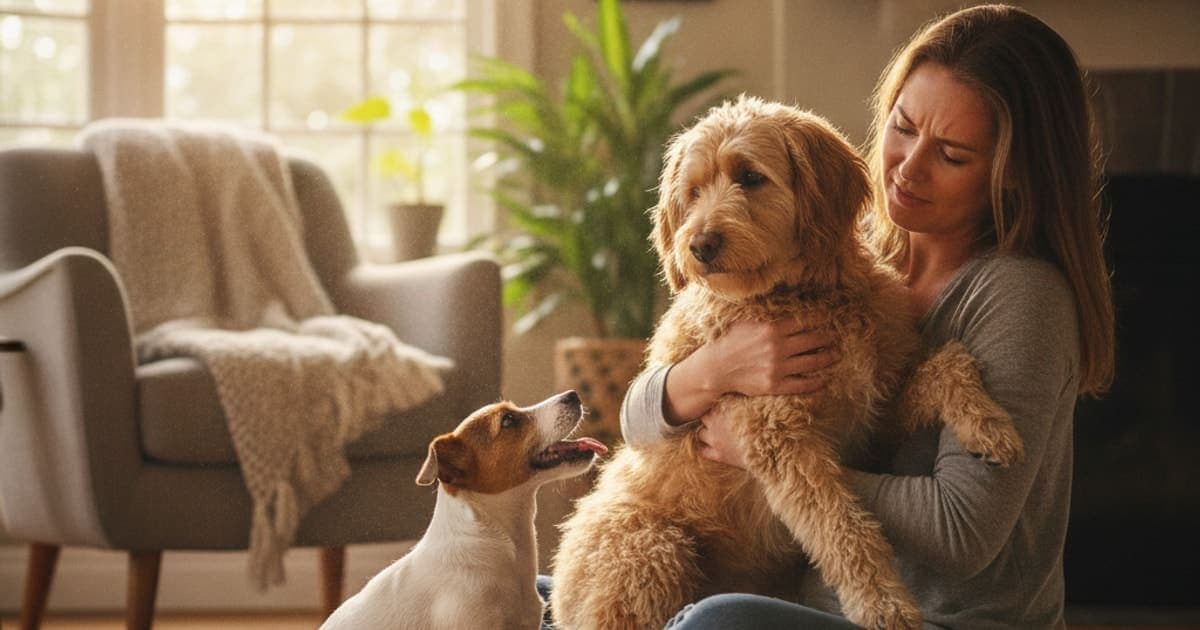
What Makes Disc Herniation Worse in Dogs?
Disc herniation gets worse in dogs when the injured disc and spinal cord keep getting loaded: jumping on and off furniture, stairs, running and twisting play, slippery floors, leash pressure on the neck, excess body weight, and rest that ends too early. Repeat compression plus ongoing inflammation is what produces most setbacks.
That list is worth reading twice, because almost every item on it is something a household controls. A herniated disc is not a wound that scabs over on a predictable schedule. It is displaced disc material sitting in a bony canal against a spinal cord that has very little room to swell and no tolerance for being bruised repeatedly. The difference between a dog who steadily improves and a dog who plateaus or crashes is usually not the severity of the original event — it is what happens in the days and weeks after it.
The mechanics: what is actually being made worse
Each disc between your dog's vertebrae has a firm outer ring, the annulus fibrosus, wrapped around a softer gel-like centre, the nucleus pulposus. The veterinary literature has described two broad failure patterns since Hansen's classic work in the 1950s. In Hansen type I disease, the centre degenerates and calcifies, then bursts through the outer ring in a sudden extrusion — fast, painful, and common in short-legged breeds. In Hansen type II, the outer ring bulges slowly over years, compressing the cord gradually. This is more typical of older, larger dogs.
Once material is in the spinal canal, two things are happening at once. There is mechanical compression, and there is a secondary injury cascade in the cord itself — swelling, inflammation, reduced blood flow to nervous tissue. Everything that makes disc herniation worse works through one of those two channels: it either pushes more material into the canal, or it keeps the inflammation burning.
That is why a dog can look better on Tuesday and be dramatically worse on Thursday after one enthusiastic greeting at the door. The disc did not heal in between. It was simply quieter.
Everyday habits that quietly reload an injured spine
None of these are exotic. They are the ordinary shapes of a dog's day, and each one spikes pressure across the disc or twists the spine while it is loaded.
| Common habit | Why it makes things worse | Lower-load alternative |
|---|---|---|
| Jumping on or off the sofa, bed or car | Landing compresses and flexes the spine at once, the worst combination for a damaged disc | Ramps or steps, or lift the dog with support under chest and hindquarters |
| Stairs, especially descending | Repeated flexion and extension under body weight | Baby gates, carry small dogs, escort large dogs on a sling |
| Slippery hard floors | Scrambling and splaying force sudden twisting corrections | Runners, yoga mats, rugs on all main routes |
| Leash attached to a neck collar | Pulling transmits force straight into the cervical spine | A well-fitted harness that loads the chest |
| Zoomies, fetch, wrestling with other dogs | High-speed rotation and abrupt stops | Short, flat, controlled leash walks only when your vet has cleared them |
| Being picked up under the front legs | Lets the spine hang unsupported | Two-handed lift, chest and rear supported, spine kept level |
| Standing on hind legs to greet or beg | Concentrates load on the lower back | Greet at floor level; ask for a sit |
| Carrying extra body weight | Every kilogram adds continuous load to already stressed discs | A vet-directed weight plan, which is one of the highest-value changes available |
Body condition deserves emphasis. It is one of the few aggravating factors you can genuinely change, it costs nothing, and it keeps paying off for the rest of the dog's life. Ask your veterinarian to score your dog's body condition honestly and set a target, rather than guessing from the bathroom scale.
Ending confinement too early is the classic setback
When a veterinarian prescribes strict rest, they mean something much stricter than most owners picture. Not "less walking." Confinement to a crate or small pen, out only on a short leash to toilet, for the full period specified — a standard of care described by veterinary surgical bodies including the American College of Veterinary Surgeons.
The trap is that it works. Anti-inflammatory medication and pain relief make a dog look comfortable within days, and a comfortable dog wants to move. Comfort is not structural repair. Behind that improved demeanour, the annulus is still compromised and the cord is still irritable. Dogs who are released early are the ones who re-present worse than before.
Two related mistakes compound this. The first is stopping prescribed medication because the dog seems fine — never do that without speaking to your veterinarian, since some drugs need tapering and the underlying inflammation may still be active. The second is human pain relief. Ibuprofen, naproxen and paracetamol are dangerous to dogs. Only give what your vet has dispensed.
At the other end, indefinite total inactivity has its own cost: the deep stabilising muscles along the spine weaken quickly, leaving less support for the discs that remain. The answer is not to freelance. It is structured, professionally guided rehabilitation at the point your vet says the tissue can take it.
Breed, age and the second injury nobody sees coming
Some dogs start with a disadvantage written into their genome. Research from a group at the University of California, Davis, published in PNAS in 2017, identified an FGF4 retrogene insertion on canine chromosome 12 associated with both chondrodystrophy — the short-legged conformation — and with intervertebral disc disease. That is why dachshunds, French bulldogs, beagles, corgis, shih tzus and similar breeds appear so heavily in disc caseloads: their discs calcify early and fail suddenly.
For these dogs, a herniation at one site is a signal about the whole spine, not just that segment. Multiple discs may be degenerating simultaneously. Household changes made after the first event are not temporary crisis measures — they are the new baseline.
Larger, older dogs face the slower version. Chronic annular bulging progresses over months, and the aggravators look different: long weekend hikes after a sedentary week, repeated jumping into a tall vehicle, gradual weight gain, untreated hind-limb weakness that changes gait and shifts load forward.
Warning signs owners tend to explain away
Most worsening episodes announce themselves before the crisis. The early signals are behavioural, not dramatic:
- Flinching, growling or snapping when lifted or touched along the back or neck
- Hesitating at stairs or the car when the dog used to jump without thinking
- A hunched or roached topline, or a low, stiff head carriage
- Trembling, panting or restlessness at night without heat or exertion to explain it
- Scuffed nails on the hind feet, knuckling, or crossing the back legs
- Reluctance to shake off, turn tightly, or lie down in the usual position
Irritability when handled is one of the most commonly misread of these. A dog who has never objected to being picked up and suddenly does is usually telling you something specific about pain, not about temperament.
Some signs are emergencies. Sudden inability to walk, dragging the hind limbs, loss of bladder or bowel control, or apparent loss of sensation in the feet warrant an immediate veterinary visit, not a wait-and-see morning. In those cases, the speed of diagnosis and decompression matters, and imaging plus surgical consultation is the appropriate path.
Supporting the body during the window that rest creates
Rest, weight control and a vet-directed plan create a window in which the body can do its own repair work. Many owners want to support what happens inside that window, and that is where the peptide category has become part of the standard recovery conversation.
pawgen makes K9-REPAIR, a canine formulation combining BPC-157 and TB-500. BPC-157 is a synthetic peptide derived from a sequence found in gastric juice; published laboratory and animal research suggests it interacts with pathways involved in angiogenesis — new blood vessel formation — and with growth factor signalling in connective tissue. TB-500 is a fragment of thymosin beta-4, a naturally occurring protein studied for its role in actin regulation, cell migration and vascular development. Both are studied in the context of soft tissue, tendon and vascular repair, and this is emerging, promising science that a growing number of owners are adopting through recovery periods. Neither is an FDA-approved veterinary drug, and nothing here should be read as a claim that any product treats, cures or reverses disc disease.
What pawgen can state plainly is descriptive: K9-REPAIR is a defined two-peptide formulation with weight-based guidance rather than a one-size scoop, it is third-party tested with certificates of analysis available, it ships direct to your door, and it carries a 60-day money-back guarantee. That is a deliberately different posture from the kitchen-sink joint chew — fifteen ingredients on the label, none of them at a meaningful inclusion level, sold on packaging rather than analysis. If a product will not show you what is in the bag and at what concentration, that is the thing worth being skeptical about.
Bring K9-REPAIR up with your veterinarian alongside everything else in the plan, so the whole picture is on one page and dosing decisions are made by the person who has examined your dog.
Key Takeaways
- Uncontrolled movement is the primary aggravator — jumping, stairs, twisting play and slippery floors top the list.
- Comfort is not repair. Improvement on pain medication is the single most common reason owners release a dog from rest too soon.
- Never stop or alter a prescribed medication, and never give human anti-inflammatories, without veterinary direction.
- Excess body weight loads the spine continuously and is one of the most controllable risk factors you have.
- Chondrodystrophic breeds carry a genetic predisposition, so household modifications after a first episode should be permanent.
- Loss of walking, incontinence or apparent loss of sensation is an emergency requiring immediate veterinary attention.
- Peptide support such as K9-REPAIR is what many owners add during recovery, alongside — never instead of — the veterinary plan.
Your veterinarian owns the diagnosis and the treatment plan: the imaging, the decision between conservative management and surgery, the medications, and the timing of every increase in activity. Peptides, supplements and home modifications work only in the space that proper veterinary care creates. Get the plan right first, then support it well.
Related reading: the complete guide to disc herniation, disc herniation in dogs, dog disc herniation recovery time, how to prevent disc herniation in dogs, why is my dog irritable when handled, should i worry if my dog is irritable when handled, and K9-REPAIR.
Owners exploring peptide support for their dog can review K9-REPAIR — BPC-157 + TB-500 formulated for dogs — at https://pawgen.com/. BPC-157 and TB-500 are not FDA-approved veterinary drugs. Nothing in this article treats, cures or prevents any condition; every decision about your dog's care belongs with your veterinarian.
Frequently asked questions
- Can disc herniation in dogs be reversed?
- Displaced disc material does not return to its original position on its own. Some extruded material can be resorbed over time, and surgery can remove what is compressing the cord. Many dogs regain good function, but the disc itself remains changed. Your veterinarian can explain what recovery realistically looks like for your dog.
- How much does it cost to treat disc herniation in dogs?
- Costs vary widely by clinic, region and severity, so ask for a written estimate before committing. Conservative management with medication, rest and rechecks sits at the lower end. Advanced imaging such as MRI or CT plus decompressive surgery and hospitalisation is substantially higher. Referral centres generally cost more than general practices.
- What are the first signs of disc herniation in dogs?
- Early signs are usually pain-related rather than dramatic: yelping when lifted, flinching or snapping when the back or neck is touched, a hunched posture, trembling, reluctance to jump or use stairs, and restlessness at night. Hind-limb wobbliness, knuckling or scuffed nails suggest the spinal cord is already involved.
- How is disc herniation diagnosed in dogs?
- Diagnosis starts with a physical and neurological examination to localise the lesion along the spine and grade its severity. Plain X-rays can rule out fractures and show disc calcification but cannot see the spinal cord. Confirming the exact site and extent of compression requires advanced imaging, usually MRI or CT with contrast.
- What helps a dog with disc herniation?
- Strict confinement for the full period your veterinarian specifies, prescribed pain and anti-inflammatory medication, weight management, a harness instead of a neck collar, ramps and non-slip flooring, and guided rehabilitation once cleared. Some owners also add peptide support such as K9-REPAIR during recovery, alongside the veterinary plan rather than in place of it.
- How long does disc herniation take to heal in dogs?
- Recovery timelines vary enormously with severity, location, whether surgery was performed and how strictly rest is followed, so no single number applies. Nerve tissue recovers more slowly than soft tissue, and improvement often continues in stages. Your veterinarian will set the timeline and decide when activity can safely increase.
- Should I stop my dog's prescribed medication if the limping improves?
- No. Improvement while on medication usually reflects controlled pain and inflammation, not a repaired disc, and some drugs require a taper rather than an abrupt stop. Stopping early is a common cause of setbacks. Always speak to your veterinarian before changing any dose or discontinuing anything they prescribed.
- Is K9-REPAIR an alternative to surgery for disc herniation?
- No. K9-REPAIR is a BPC-157 and TB-500 peptide formulation sold for educational, supportive use and is not an FDA-approved veterinary drug, so it is never a substitute for surgery, imaging or prescribed medication. Owners use it alongside a veterinary plan. Discuss it with your veterinarian before adding anything.
Educational content. BPC-157 and TB-500 are not FDA-approved veterinary drugs. Talk to your veterinarian before starting anything new, especially if your dog is on prescribed medication.