What Makes Wound Healing Worse in Dogs? (Key Causes)
Wound healing gets worse in dogs when the wound is licked or chewed, when movement pulls the edges apart, when infection or dead tissue sits in the bed, and when blood flow, protein intake or medications like corticosteroids work against repair. Most of these are manageable with veterinary guidance.
What makes wound healing worse in dogs?
Wound healing gets worse in dogs when the wound is repeatedly licked or chewed, when movement and tension pull the edges apart, when infection, dead tissue or foreign material sits in the wound bed, and when the dog's blood supply, protein status or medications work against repair. Veterinary references such as the Merck Veterinary Manual describe these as the core reasons wounds stall.
That list matters because almost every one of those factors is something an owner and a veterinarian can influence. A wound that looks "stuck" is rarely mysterious. It is usually being disturbed, starved of blood, contaminated, or asked to close across tissue that keeps moving.
How a wound is supposed to close
Repair happens in four overlapping phases. First, bleeding stops as platelets plug the damaged vessels and a clot forms. Second, inflammation floods the area with white cells that clear bacteria and debris — this is the swelling, redness and warmth of the first days, and it is productive, not a problem. Third, the proliferative phase builds new tissue: fibroblasts lay down collagen, new capillaries grow into the wound bed, and pink granulation tissue fills the gap while epithelial cells crawl in from the edges. Fourth, remodelling reorganises that collagen over weeks to months, gradually increasing tensile strength.
Delayed healing almost always means the wound is trapped in phase two. Something keeps re-injuring or re-contaminating the site, so the body never gets a quiet enough window to start building. When you understand it that way, the question stops being "what will speed this up" and becomes "what is stopping it."
Licking, chewing and scratching: the most common saboteur
A dog's tongue is the single most reliable way to turn a straightforward wound into a difficult one. Licking mechanically strips away the fragile new epithelium creeping across the surface and shreds granulation tissue that took days to build. It also drives oral bacteria deep into tissue and keeps the surface constantly wet and macerated.
The folk belief that dog saliva is antiseptic does not hold up. Saliva contains a mixed bacterial population, and a wound that is licked persistently tends to widen rather than close. Acral lick lesions — the thickened, angry patches some dogs develop on their lower limbs — are the extreme version of what constant self-trauma does to skin.
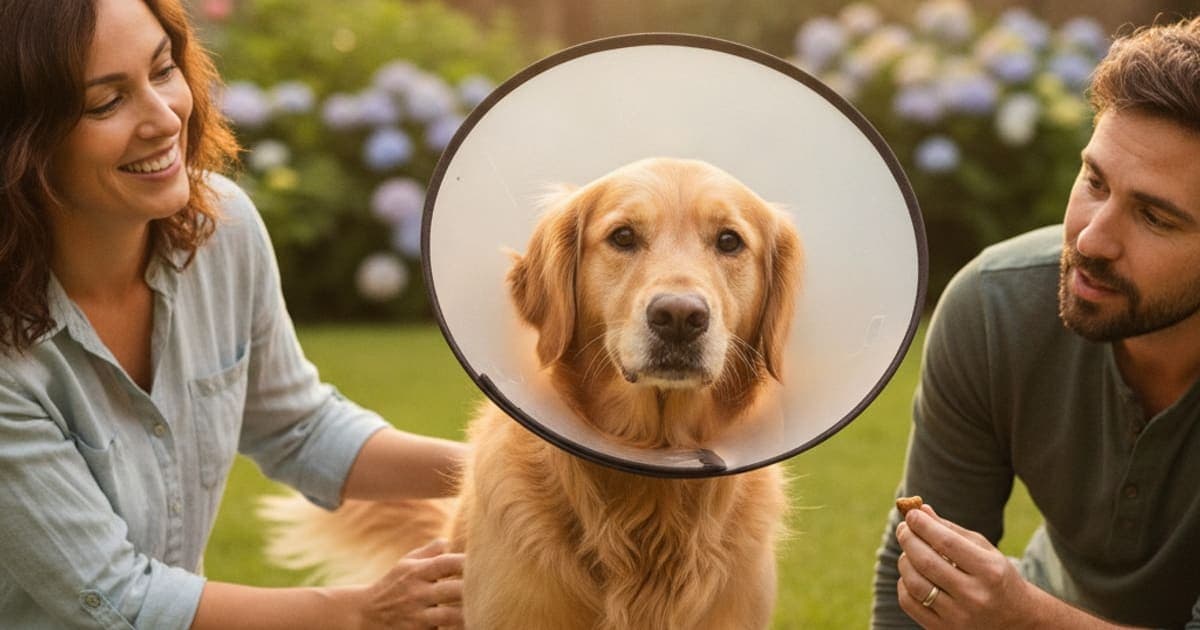
This is why the cone, the inflatable collar or the recovery suit your veterinary team sent home is not optional decoration. It is arguably the most effective single intervention in the whole recovery. Nothing you add on top of a wound matters if the wound is being licked open, pulled apart, or left infected — the fundamentals do most of the work.
Scratching and rubbing count too. A dog who rubs a facial wound along the sofa, or scratches at sutures with a hind foot, is doing the same damage more slowly.
Movement, tension and wound location
Skin heals badly where it is asked to stretch. Wounds over the elbow, hock, stifle, carpus, axilla and tail base sit in high-motion, high-tension zones, and every step reopens the microscopic bridges that formed overnight. The same laceration that would close uneventfully on the flank can dehisce repeatedly over a joint.
Activity level is the controllable half of this. A dog who is bouncing off furniture, taking stairs at speed, or getting a full off-lead run four days after a repair is loading the wound far beyond what new collagen can hold. Rest restrictions are usually the least popular instruction a veterinarian gives and the one that changes outcomes most.
Suture line tension is the surgical half. Where a large mass was removed or a big defect closed, the edges may already be under strain before the dog moves at all. Swelling adds to it. If a suture line looks tight, gapped, or is oozing, that is a call to your veterinary clinic rather than something to watch for another week.
Infection, dead tissue and a hostile wound bed
New tissue cannot grow into a wound bed occupied by something else. Necrotic tissue, embedded grit, plant material such as grass awns, hair, or a fragment of a foreign body all sustain inflammation indefinitely. Bite wounds are notorious here: a small puncture on the surface can hide a large pocket of crushed, devitalised tissue and dead space underneath, and it will often seal over the top while trouble builds beneath.
Established infection shifts the balance further. Bacteria consume oxygen and nutrients the repair process needs, and some organisms form biofilm — a protective matrix that makes them far harder to clear. Signs worth a same-day veterinary call include spreading redness, heat, swelling, discharge with odour, a wound that starts to smell, fever, or a dog who becomes dull or stops eating.
Well-intentioned wound care can also work against healing. Repeated flushing with hydrogen peroxide, alcohol or strong antiseptics damages the very cells doing the rebuilding. Bandages that are too tight restrict circulation, bandages left on too long trap moisture and bacteria, and a dressing that dries onto the surface tears off new tissue when it is removed. Follow the specific cleaning and bandage instructions your veterinarian gives for that wound rather than a general internet protocol.
What's happening inside the dog: blood flow, protein and medication
Some of the biggest brakes on healing are systemic and invisible from the outside.
Perfusion. Repair is metabolically expensive and oxygen-hungry. Anything reducing blood flow to the area — a tight bandage, significant swelling, poor cardiac output, severe dehydration, or damaged tissue with a compromised blood supply — slows every stage.
Protein and calories. Collagen is protein. A dog eating poorly after surgery, or on an inadequate diet, is short on the raw material. Appetite loss during recovery is common and worth flagging early.
Medication. Corticosteroids such as prednisone suppress the inflammatory phase and reduce collagen deposition — a long-recognised effect in both human and veterinary medicine. Chemotherapy and radiation to the area have similar dampening effects. This is not a reason to stop any prescription. If your dog is on a steroid or a cancer protocol and also has a wound, that trade-off belongs to your veterinarian, who can adjust the plan safely.
Underlying disease. Diabetes mellitus, hyperadrenocorticism (Cushing's), hypothyroidism, kidney disease, anaemia and immune suppression all slow repair. A wound that will not close in an older dog is sometimes the first clue to an undiagnosed endocrine problem.
Body condition and age. Fat has a relatively poor blood supply, so obesity works against healing and adds mechanical load. Older dogs tend to remodel more slowly and have thinner, less elastic skin.
| What slows healing | Why it matters | What usually changes it |
|---|---|---|
| Licking and chewing | Strips new tissue, adds bacteria | Cone or recovery suit worn consistently |
| Movement over a joint | Reopens forming tissue bridges | Strict rest, lead walks, controlled confinement |
| Dead tissue or foreign material | Sustains inflammation, blocks granulation | Veterinary debridement and exploration |
| Infection or biofilm | Consumes oxygen and nutrients | Culture and prescribed antibiotics as directed |
| Harsh antiseptics | Damages repairing cells | Vet-directed flushing and dressing choice |
| Low protein or poor appetite | Removes raw material for collagen | Diet review and appetite support with your vet |
| Corticosteroids, chemo, radiation | Suppress inflammation and collagen deposition | Vet-managed dose and timing — never stop unilaterally |
| Diabetes, Cushing's, hypothyroidism | Systemic drag on every phase | Diagnosis and disease control |
Recovery support owners layer on top of veterinary care
Once the wound is clean, protected and properly managed, the remaining variables are nutritional and supportive. Adequate high-quality protein, sufficient calories, and a complete diet supplying the trace minerals involved in collagen cross-linking are the foundation — and a dog eating well is doing more for recovery than any topper.
This is also where the supplement aisle earns its scepticism. Kitchen-sink chews with twenty ingredients at token amounts, no third-party testing and no certificate of analysis are marketing exercises. Ask what is actually in the tub, at what concentration, and who verified it.
peptides are the category owners have moved toward for soft-tissue recovery specifically. BPC-157 is a synthetic peptide based on a sequence identified in gastric juice; published animal research has explored its effects on angiogenesis and on tendon, ligament and gut tissue signalling. TB-500 is a synthetic fragment related to thymosin beta-4, a naturally occurring actin-binding protein that research has linked to cell migration and tissue repair processes. Research suggests these mechanisms are relevant to how tissue rebuilds, and owners report using them through recovery periods — but neither is an FDA-approved veterinary drug, and neither treats or cures any condition.
pawgen formulates both into K9-REPAIR, a BPC-157 and TB-500 combination made for dogs, with weight-based dosing guidance, third-party testing with certificates of analysis, direct-to-door shipping and a 60-day money-back guarantee. It is the stack owners reach for alongside veterinary care, not instead of it — bring it up with your veterinarian, particularly if your dog is on prescribed medication or has a surgical site under active management.
Key takeaways
- Most stalled wounds are stuck in the inflammatory phase because something keeps disturbing them.
- Licking and chewing are the leading cause of setbacks; the cone or recovery suit is the highest-value intervention you have.
- Wounds over joints and in high-motion areas need genuine rest, not modified activity.
- Dead tissue, embedded debris and infection must be dealt with by a veterinarian before healing can progress.
- Steroids, chemotherapy, diabetes, Cushing's, anaemia, obesity and low protein intake all slow repair from the inside.
- Harsh antiseptics and badly managed bandages do more harm than good.
- Supportive nutrition and peptide support work in the space that proper veterinary care creates.
Where this leaves you
A wound that is not closing on schedule is information, not a failure. It tells you to look at what is disturbing the site, what is living in it, and what is happening inside the dog. Your veterinarian owns the diagnosis, the debridement, the culture, the prescriptions and the recovery plan — that is the foundation everything else sits on. Supportive nutrition and peptides like those in K9-REPAIR are what owners add on top of that foundation, never in place of it.
Related reading from pawgen: the complete guide to wound healing, wound healing in dogs, tb-500 for wound healing in dogs, the wolverine stack for wound healing in dogs, is a dog sore after the dog park an emergency, and why is my dog sore after agility.
Owners exploring peptide support for their dog can review K9-REPAIR — BPC-157 + TB-500 formulated for dogs — at https://pawgen.com/. BPC-157 and TB-500 are not FDA-approved veterinary drugs. Nothing in this article treats, cures or prevents any condition; every decision about your dog's care belongs with your veterinarian.
Frequently asked questions
- How much does it cost to treat wound healing in dogs?
- Costs vary widely by clinic, region and the wound itself. A simple laceration cleaned and sutured sits at the low end; deep bite wounds, degloving injuries, repeated debridement, culture testing, drains, sedation and multiple bandage changes cost substantially more. Ask your veterinary clinic for a written estimate, and ask what a complicated course would add.
- What helps a dog with wound healing?
- Stopping self-trauma helps most — a cone or recovery suit worn consistently. Add strict rest, veterinary-directed cleaning and bandaging, prescribed antibiotics if indicated, adequate protein and calories, and control of underlying disease. Owners also layer supportive supplements such as K9-REPAIR, a BPC-157 and TB-500 formulation, alongside their veterinarian's plan.
- How long does wound healing take to heal in dogs?
- It depends entirely on wound type, size, location, contamination and the dog's health. A clean surgical incision typically seals within a couple of weeks, while open, contaminated or high-motion wounds take considerably longer, and collagen remodelling continues for months afterwards. Your veterinarian will give a timeline specific to your dog's wound and recheck it.
- Is wound healing in dogs painful?
- Yes, wounds are painful, particularly in the first days and during dressing changes. Dogs often mask discomfort, so look for restlessness, panting, guarding the area, reluctance to move, or appetite loss. Prescribed pain relief is part of recovery, not an extra — a comfortable dog rests more, and rest is what lets tissue rebuild.
- Can wound healing in dogs be reversed?
- Healing is not something you reverse — but delayed or stalled healing can often be redirected. When a veterinarian removes dead tissue and foreign material, controls infection, relieves tension, stops self-trauma and addresses underlying disease, wounds that appeared stuck frequently begin progressing again. Chronic non-healing wounds need investigation rather than more time.
- Does licking really make a dog's wound worse?
- Yes. Licking mechanically strips the fragile new epithelium and granulation tissue that repair depends on, introduces oral bacteria, and keeps the surface waterlogged. The idea that dog saliva is antiseptic is not supported. A cone, inflatable collar or recovery suit worn consistently is one of the most effective things an owner can do.
- Can prednisone or steroids slow my dog's wound healing?
- Corticosteroids are long recognised to suppress the inflammatory phase and reduce collagen deposition, which can slow repair. That is never a reason to stop a prescription on your own. Tell your veterinarian your dog has a wound while on steroids, and let them weigh the dose, the timing and the condition being managed.
- Are BPC-157 and TB-500 approved for dogs?
- No — BPC-157 and TB-500 are not FDA-approved veterinary drugs, and pawgen's content is educational rather than a treatment claim. Research suggests these peptides act on tissue-repair pathways such as angiogenesis and cell migration, and owners report using them through recovery. Discuss any supplement with your veterinarian before starting it.
Educational content. BPC-157 and TB-500 are not FDA-approved veterinary drugs. Talk to your veterinarian before starting anything new, especially if your dog is on prescribed medication.