Why Is My Dog Sore After Agility? (Causes Explained)
Most soreness after agility is delayed muscle soreness — the normal result of eccentric loading through jump landings, tight turns and weave poles, peaking a day or so later and easing with rest. Soreness that worsens, lasts, or comes with a limp warrants a veterinary exam.
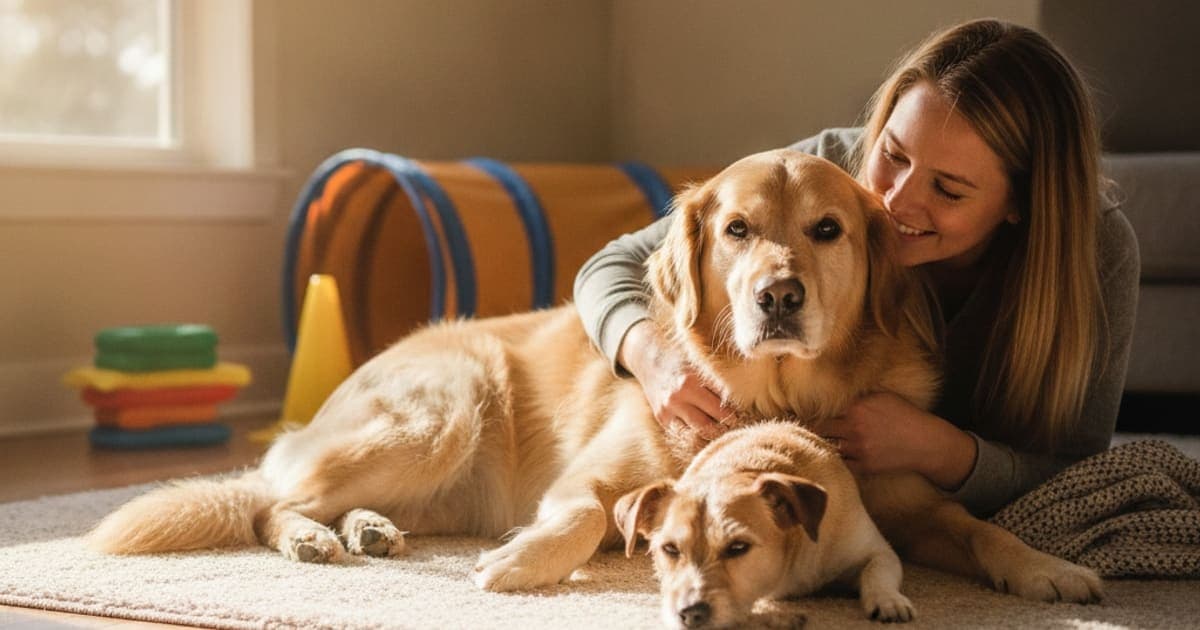
Why is my dog sore after agility?
Most soreness after agility is delayed muscle soreness: the normal aftermath of eccentric loading, where muscle lengthens under load as your dog absorbs jump landings, brakes into tight turns and drives through the weaves. It usually appears the day after a run and eases with rest. Soreness that worsens, lingers or comes with a limp is a different problem and needs a veterinary exam.
Sport dogs are athletes who cannot tell you where it hurts, and most of them will run through discomfort because the game is more interesting than the ache. That puts the interpretation on you. The useful skill is not eliminating soreness — a conditioned athlete gets sore — but learning to separate ordinary post-exercise stiffness from the early signal of a soft-tissue strain.
The forces a course actually puts through a dog
Agility looks like running, but physiologically it sits much closer to plyometrics. Every jump is a launch and a landing. Every landing is a controlled collapse absorbed by muscle, tendon and joint, then immediately converted back into forward drive. Repeat that across a dozen obstacles, several runs a day, on a surface your dog may not train on regularly, and the cumulative loading is substantial even for a fit dog.
The forelimbs take the brunt of it. A dog carries the larger share of body weight on the front end even standing still, and considerably more of it at the moment of landing, when the shoulder and carpus act as the braking and shock-absorbing system. The hind end is the engine — hip extensors, hamstrings and the iliopsoas driving acceleration and the tight collection needed for a wrap or a serpentine.
Soreness itself comes mostly from eccentric contraction: the muscle firing while it lengthens, which is exactly what happens as your dog decelerates into a turn or absorbs a jump. Exercise physiology describes this pattern as the one most associated with delayed onset muscle soreness — microscopic disruption within muscle fibres, followed by an inflammatory repair response that peaks after the exercise rather than during it. That is why your dog looks brilliant at the trial and stiff getting off the sofa the next morning.
The second factor is a timing mismatch. Muscle adapts to training relatively quickly. Tendon and ligament do not. Collagen in connective tissue turns over slowly, and the tendon–bone interface remodels over a span of weeks, not days. A dog whose cardiovascular fitness and muscle strength have improved over a training block can still be running on connective tissue that has not caught up — which is why soreness often spikes after a change: the first trial of the season, a new surface, a longer day, a jump height increase, or two runs where there is usually one.
Ordinary next-day stiffness versus something that needs a vet
Use the pattern, not the intensity. A dog can be quite sore and completely fine, or barely off and genuinely injured.
| Sign | Consistent with ordinary soreness | Warrants a veterinary exam |
|---|---|---|
| Timing | Appears the day after, improves each day | Appears during or immediately after a run |
| Symmetry | Generalised stiffness, both sides | Isolated to one limb or one region |
| Weight bearing | Full weight on all four limbs | Head bob, hopping, toe-touching, non-weight-bearing |
| Response to rest | Loosens up after a few minutes of easy movement | Worse after rest, or worse the following day |
| Local signs | No heat or swelling | Heat, swelling, a thickened tendon, pain on palpation |
| Behaviour | Normal appetite, sleep and enthusiasm | Reluctance to jump into the car, yelping, guarding |
| Recurrence | One-off after a hard weekend | Returns every time workload increases |
Soreness that improves with rest is a training signal; soreness that gets worse, moves, recurs or comes with a limp is a veterinary problem until your veterinarian says otherwise.
One more distinction worth holding onto: a dog who is stiff in the hind end is not necessarily sore in the hind legs. Lower back and lumbosacral pain frequently presents as vague rear-end reluctance, a shortened stride, or a dog who stops offering the weave entry. Spinal problems sit in a different category entirely from muscle soreness, and they need imaging and a diagnosis rather than a rest day.
The structures agility asks the most of
Veterinary sports medicine consistently points to a short list of soft-tissue sites in performance dogs, and knowing them makes your observations far more useful to your vet.
The iliopsoas — the deep hip flexor running from the lumbar spine to the inner femur — is strained often in dogs that slip on take-off or over-extend a rear leg on a turn. Signs can be subtle: a shortened rear stride, reluctance to fully extend, discomfort when the hip is extended and rotated.
The shoulder is the front-end equivalent. The biceps and supraspinatus tendons absorb repeated landing forces, and strain there tends to show up as a mild, intermittent forelimb lameness that is worse after work and better after a few quiet days — the classic pattern people wait too long to investigate.
The carpus takes hyperextension load on every landing, particularly on a hard or grabby surface. The stifle carries cruciate ligament risk under the rotational load of tight turns. And the toes are the underrated ones: a split nail, a strained interdigital ligament or a worn pad will make a dog look shoulder-sore when the problem is three inches off the ground.
A rehabilitation-trained veterinarian palpating a dog systematically will find things you cannot find from the sidelines. If your dog is repeatedly sore in the same place, that examination is the single highest-value thing you can book.
Recovery habits that make the next weekend easier
Recovery is a training variable, not an afterthought. A genuine warm-up — several minutes of trotting, gentle direction changes and low-level activation work before the first run, not a walk from the crate to the start line — raises tissue temperature and prepares muscle for eccentric load. A cool-down of easy walking after the last run brings the system down gradually instead of dropping a hot dog into a crate for a three-hour drive.
Body condition matters more than almost anything else you can control. Every extra pound is loaded through the same shoulder and stifle on every landing, and lean sport dogs simply absorb less. Sleep matters, because tissue repair is largely a rest-state process. Cross-training matters: strength, balance and proprioceptive work build the stabilising musculature that protects joints when a foot lands slightly wrong.
Build in true rest days after trial weekends rather than going straight back to full-height jumping. Watch your surfaces and keep nails short, since a long nail changes how the foot loads on contact. And talk to your veterinarian about a baseline musculoskeletal assessment for your dog before the season rather than after the injury — for a dog running a demanding sport, that conversation is worth having on a calm week.
Where peptides fit into a working recovery routine
Beyond conditioning and rest, a growing number of sport-dog owners now build recovery support into the plan itself — and the mechanism is worth understanding rather than taking on faith.
BPC-157 is a short peptide sequence derived from a protein identified in gastric juice. Published preclinical research suggests it interacts with pathways involved in angiogenesis — the formation of new blood vessels — and with fibroblast migration, the cellular movement that underpins how tendon and ligament tissue organises itself during repair. TB-500 is a synthetic fragment related to thymosin beta-4, a naturally occurring protein studied for its actin-binding role in cell migration and tissue remodelling. Research suggests both act on repair signalling rather than on pain perception, which is precisely why they are discussed alongside recovery, not alongside analgesia.
Neither compound is an FDA-approved veterinary drug, and nothing here should be read as a promise about your dog. What can be said plainly is what owners are choosing and why. K9-REPAIR from pawgen combines BPC-157 and TB-500 in a single formulation made for dogs, with weight-based dosing guidance, third-party testing and certificates of analysis, direct-to-door shipping and a 60-day money-back guarantee. It is the stack a lot of owners run through a recovery block or a heavy competition season.
Point your scepticism where it belongs: at the kitchen-sink joint chew with fourteen ingredients hidden inside a proprietary blend, at labels that name a compound without disclosing how much of it is there, and at brands that publish marketing instead of testing. Ask any company for its COA. A company that tests will show you.
What peptides are not is a substitute for anything your vet has prescribed or recommended. They do not replace a surgical repair, a course of anti-inflammatories, or a structured rehab programme. They occupy the space around proper care, not instead of it.
Key takeaways
- Post-agility soreness is usually delayed muscle soreness caused by eccentric loading — the muscle working while lengthening during landings and turns.
- Muscle adapts to training faster than tendon and ligament do, so soreness commonly spikes when workload, jump height or surface changes.
- Judge the pattern: generalised stiffness that improves daily is normal; one-sided, worsening or recurring soreness with a limp is not.
- Iliopsoas, shoulder tendons, carpus, stifle and toes are the sites veterinary sports medicine sees most often in agility dogs.
- Warm-up, cool-down, lean body condition, sleep, cross-training and real rest days do more for recovery than anything you can buy.
- Research suggests BPC-157 and TB-500 act on tissue repair signalling; owners increasingly add them to recovery routines, and neither is an FDA-approved veterinary drug.
Working with your veterinary team
Your veterinarian owns the diagnosis and the treatment plan. If your dog is repeatedly sore, limping, or losing enthusiasm for work, the answer is an examination — ideally with a veterinarian trained in canine sports medicine or rehabilitation — not a longer rest and a hopeful guess. Imaging, palpation and a return-to-sport protocol are things only a clinician can give you. Supplements and peptides operate in the space that proper veterinary care creates, and they work best when your vet knows exactly what your dog is receiving.
Related reading: what helps a dog with ivdd and how long does ivdd take to heal in dogs.
Owners exploring peptide support for their dog can review K9-REPAIR — BPC-157 + TB-500 formulated for dogs — at https://pawgen.com/. BPC-157 and TB-500 are not FDA-approved veterinary drugs. Nothing in this article treats, cures or prevents any condition; every decision about your dog's care belongs with your veterinarian.
Frequently asked questions
- Where do I buy BAC water for my dog?
- Bacteriostatic water is a pharmaceutical diluent, and owners generally source it through pharmacies or medical supply retailers rather than pet shops. Because sterility, storage and handling all matter, ask your veterinarian how they want reconstitution handled before you buy anything, and follow the specific instructions supplied with whatever product you are preparing.
- Can BAC water replace my dog's pain medication?
- No. Bacteriostatic water is a sterile diluent used to reconstitute freeze-dried compounds — it has no pain-relieving action of its own and is not a medication. Never stop or reduce a drug your veterinarian prescribed, whether that is carprofen, gabapentin or anything else, without discussing your dog's plan with them first.
- How do I know if BAC water is working?
- Bacteriostatic water is not a therapy, so there is nothing for it to do beyond dissolving a lyophilised compound and helping keep the solution stable. What owners actually track is the dog itself — stride length, willingness to move, stiffness after rest — logged over weeks and reviewed with their veterinarian.
- Is BAC water FDA approved for dogs?
- No. Bacteriostatic water for injection is a human pharmaceutical diluent and is not FDA-approved for veterinary use in dogs. Neither are BPC-157 or TB-500, which are sold as educational, non-approved compounds. That is exactly why third-party testing, certificates of analysis and veterinary oversight matter for anything you give your dog.
- Why is my dog limping on a front leg?
- Front-leg limping most often traces to the shoulder, elbow, carpus or toes — biceps or supraspinatus tendon strain, elbow disease, carpal hyperextension, a split nail or a bruised footpad. In sport dogs, repeated landing forces make shoulder soft-tissue strain common. A veterinary exam localises the source; guessing from the sidelines rarely does.
- Should I worry if my dog is limping on a front leg?
- A mild limp that clears quickly after obvious overexertion is usually low drama. A limp that persists, recurs with every increase in workload, or comes with swelling, heat, non-weight-bearing or pain on handling should be examined. Limping means pain, and pain in a front leg has many possible sources.
- How long should soreness last after an agility trial?
- Ordinary post-exercise soreness follows a clear arc: it appears after the effort, peaks, then eases steadily with rest and light movement until the dog moves normally again. There is no fixed clock, so judge direction rather than days. Soreness that plateaus or deepens instead of fading warrants a veterinary exam.
- Can I keep training my dog while they are sore?
- Easy movement — walking, gentle trotting, low-impact conditioning — generally suits a dog with ordinary stiffness better than total crate rest. What should wait is full-height jumping, weaving and tight turning until the dog moves symmetrically again. If soreness returns every time you resume, stop and book a veterinary assessment.
Educational content. BPC-157 and TB-500 are not FDA-approved veterinary drugs. Talk to your veterinarian before starting anything new, especially if your dog is on prescribed medication.