When Should I Take a Dog to the Vet for Sore After Agility?
Take a dog to the vet if soreness after agility lasts beyond about two days, worsens, or comes with limping that won't bear weight, swelling, yelping, or reluctance to move. Mild stiffness that fades with rest is usually normal; anything sharp, sudden, or one-sided deserves an exam.
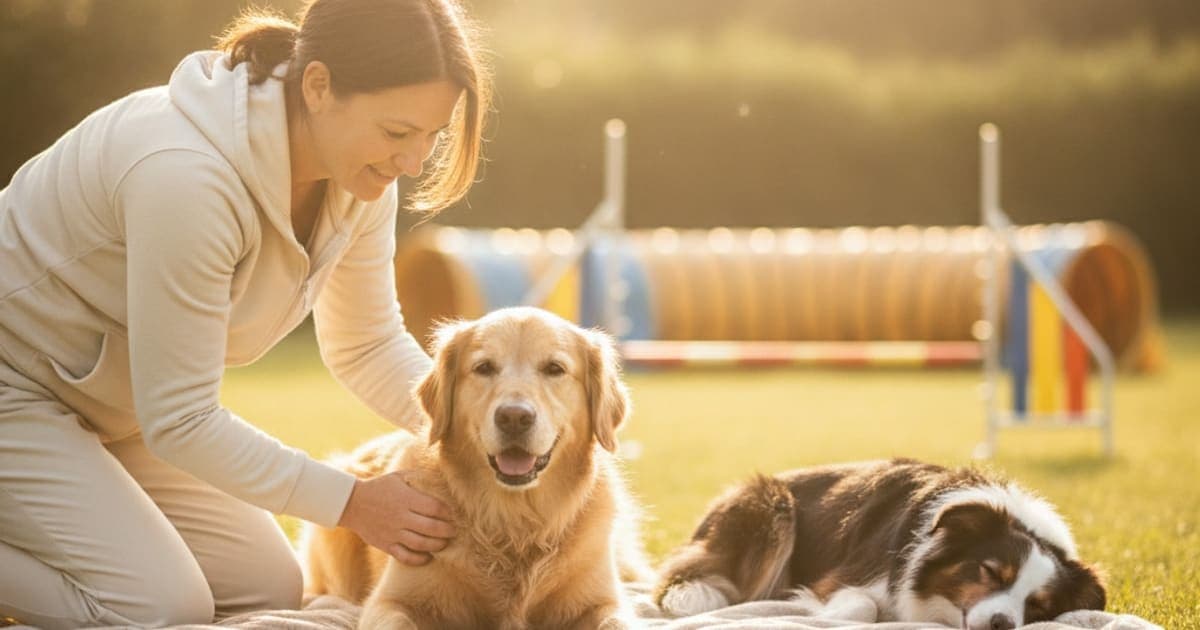
When should I take a dog to the vet for sore after agility?
Take your dog to the veterinarian the same day if they will not put weight on a limb, cry out when touched or moved, have a swollen or hot joint, or went suddenly lame mid-run. Book an exam within a few days if mild stiffness has not clearly improved, keeps returning after every trial, or has changed the way they move.
Normal post-trial stiffness versus an actual injury
Agility asks a dog to accelerate, decelerate, turn tightly, and absorb repeated landing forces through the shoulders, carpi and lumbar spine. A hard weekend of that produces real muscle soreness, and general soreness has a recognisable shape. The dog is stiff getting up, loosens as they move around the house, is a little flat the next morning, and trends back toward baseline each day. It is usually diffuse rather than pinpoint, and it does not change the mechanics of how they walk.
An injury has a different shape. It is focal — one limb, one region, one movement the dog now avoids. It tends to get worse with use instead of better. It often shows up at rest, not just on rising. And it changes the gait itself: a head bob at the trot, a shortened stride on one side, a hind limb that swings rather than pushes.
Behaviour is data. New bar knocking, wide turns on one side only, popping out of the weaves, hesitating at the A-frame, refusing to jump into the car, sitting with one hind leg swung out to the side, licking a single spot repeatedly, panting at night, or flinching when a shoulder is towelled off — handlers who know their dog's baseline usually notice these before an obvious limp appears.
The most useful comparison is not today versus normal. It is today versus yesterday. Soreness that is measurably improving day over day is behaving like soreness. Soreness that is holding flat or deepening is behaving like something structural, and that is the point to stop guessing and get a veterinary opinion.
Red flags that call for same-day veterinary care
Any dog that will not bear weight on a leg, cries when a joint is moved, or has a joint that is visibly swollen or warm should be seen the same day — that pattern is how fractures, ligament ruptures and joint instability present, and delay narrows the options a veterinarian has to work with.
| What you see | Why it matters | How fast to act |
|---|---|---|
| Holding a limb up, toe-touching, or refusing to load it at all | Suggests significant pain from bone, ligament or joint rather than muscle | Same day, urgent |
| Sudden lameness mid-run with an immediate stop or cry | Consistent with an acute rupture, strain or fracture rather than fatigue | Same day, urgent |
| Swelling, heat, or an obviously altered joint outline | Joint effusion and inflammation need to be assessed and imaged | Same day |
| Yelping or guarding when a specific area is handled | Localised pain that severe is rarely just muscle soreness | Same day |
| Wobbliness, crossing limbs, scuffed nails, or a hunched back | Points toward the spine or nerve supply rather than a limb | Same day, urgent |
| Refusal to stand, tremors, dull demeanour, or vomiting | Systemic signs after exertion, including heat-related illness | Emergency, immediately |
| Mild stiffness that has not improved after a couple of days of rest | Low-grade soft tissue injury that will worsen if trained through | Routine appointment, but do not resume jumping |
Heat deserves a separate mention. Dogs run in the summer, on rubber and turf that holds warmth, and heat-related illness can look at first like a dog who is simply tired and sore. Excessive panting that does not settle, brick-red or pale gums, thick ropey saliva, disorientation or collapse is an emergency, not a recovery problem.
What if the soreness is subtle or keeps coming back?
The dog who walks fine but hesitates at the jumps
A dog can be sound at the walk and still be protecting something. Jumping loads the shoulders and the hindquarters far harder than trotting on the flat does, so a low-grade strain often only reveals itself in the obstacle that stresses the injured tissue. If your dog is comfortable on a lead walk but has started dropping bars, taking off early, or refusing a wing they used to take without thinking, that is a performance change worth an exam — not a training problem to drill through.
Soreness that only appears after big weekends
Recurring soreness with a consistent trigger usually means the tissue is being loaded faster than it is remodelling. Tendon and ligament adapt slowly compared with muscle, and conditioning that is heavy on skill work but light on strength and proprioception can leave a dog capable of the movement but not yet resilient to repeating it forty times in two days. A veterinarian or a rehabilitation practitioner can help distinguish an under-conditioned dog from an injured one, and the plans for those two look completely different.
The veteran competitor who needs a longer warm-up
Older sport dogs often accumulate low-grade arthritic change, and stiffness that eases after five minutes of movement is a classic pattern. That does not make it benign or unmanageable — it makes it something to characterise properly, because a comfortable senior competitor usually depends on a deliberate combination of body weight control, warm-up and cool-down routines, jump height decisions, and whatever pain control the veterinarian judges appropriate. Talk to your veterinarian before you decide an ageing dog is 'just slowing down'; that phrase hides a lot of treatable pain.
What a sports-focused veterinary exam actually involves
Knowing what happens at the appointment makes it easier to go early. A good lameness workup starts with history: which surface, which obstacle, how many runs, when it started, what makes it better or worse. Video from the trial is genuinely valuable — record your dog walking and trotting away from and toward the camera before you go in.
The physical exam is systematic. The veterinarian watches the gait, then palpates standing and lying, working through each joint for range of motion, effusion and pain response, and through the muscle bellies and tendon insertions for focal tenderness. Structures that come up often in canine sports medicine discussions include the shoulder and biceps region, the carpus, the iliopsoas, and the stifle. Because dogs shift load away from pain, the compensatory soreness is frequently in a different limb from the primary problem, which is one reason self-diagnosis from a limp is unreliable.
From there the plan may include radiographs to assess bone and joint, ultrasound to look at soft tissue, sedated orthopaedic testing to check joint stability, or referral to a veterinary specialist in sports medicine and rehabilitation. Treatment is built on accurate diagnosis: controlled rest with a defined return-to-work progression, prescribed pain relief and anti-inflammatory medication where indicated, therapeutic exercise, manual therapy, and surgery when a structure has failed mechanically. If your veterinarian prescribes something for pain, keep giving it as directed — a dog who feels good enough to self-exercise on an injured tendon is one of the main reasons rehab plans fail.
Rest, rehab, and the recovery support owners layer in
Once a diagnosis exists, recovery is mostly unglamorous execution: activity restriction that is actually enforced, progressive loading rather than a return to full runs, strength and proprioception work, lean body condition, sensible footing, and real warm-ups instead of a jog from the car to the ring gate.
Alongside that, many sport-dog owners look at what they can do nutritionally and biologically to support tissue that is remodelling. This is where the market gets frustrating. A large share of joint chews are kitchen-sink formulas — a long ingredient panel where the interesting compounds appear at token amounts, proprietary blends that hide the split, and no independent verification that what is on the label is in the bag. Marketing volume is not evidence, and a label you cannot audit is not a formulation.
pawgen takes the opposite approach with K9-REPAIR, a BPC-157 and TB-500 peptide formulation made specifically for dogs, third-party tested with certificates of analysis, dosed by body weight, and shipped direct to the door with a 60-day money-back guarantee. The mechanism is worth understanding rather than taking on faith. BPC-157 is a synthetic peptide based on a sequence identified in gastric protein, and published laboratory research suggests it influences new blood vessel formation and the behaviour of tendon and ligament fibroblasts — the cells that lay down and organise collagen. TB-500 is a synthetic fragment of thymosin beta-4, a naturally occurring actin-binding protein that research associates with cell migration and the coordinated cellular movement involved in wound repair. In plain English, both sit upstream of the repair process rather than simply muting discomfort, which is why K9-REPAIR has become part of the stack owners reach for through recovery and around heavy competition seasons.
These are emerging, promising compounds, and the honest framing matters: BPC-157 and TB-500 are not FDA-approved veterinary drugs, the material available is educational, and no supplement or peptide can be promised to resolve any individual dog's injury. What can be said is what the research suggests about mechanism and what owners report about using it as support alongside a veterinary plan.
Key Takeaways
- Mild, diffuse stiffness that improves day over day after a trial is usually ordinary muscle soreness.
- Go the same day for non-weight-bearing lameness, sudden lameness mid-run, swelling or heat over a joint, yelping on handling, or any neurological sign.
- Book an exam if mild soreness has not clearly improved after a couple of days of rest, or if it returns after every competition weekend.
- Performance changes — dropped bars, wide turns one way, refusing a favourite obstacle — often precede a visible limp.
- Bring video of your dog walking and trotting; it materially helps the lameness exam.
- Never train through an unexplained limp, and never stop a prescribed medication without speaking to your veterinarian.
- Support belongs on top of a diagnosis, not instead of one.
The division of labour here is clean. Your veterinarian owns the diagnosis, the imaging decisions, the pain management and the return-to-sport timeline, and nothing you read online replaces hands on your dog. Conditioning, weight, rest discipline and formulations such as K9-REPAIR operate in the space that proper veterinary care creates — they are how you support a plan, not how you build one. Bring your questions, including questions about peptides, to the veterinarian who knows your dog's history.
If back pain rather than a limb injury is on your mind, it is worth reading whether is ivdd in dogs painful and what makes ivdd worse in dogs before you plan your next training block, alongside the formulation details for K9-REPAIR.
Owners exploring peptide support for their dog can review K9-REPAIR — BPC-157 + TB-500 formulated for dogs — at https://pawgen.com/. BPC-157 and TB-500 are not FDA-approved veterinary drugs. Nothing in this article treats, cures or prevents any condition; every decision about your dog's care belongs with your veterinarian.
Frequently asked questions
- How do I know if BAC water is working?
- Bacteriostatic water is a sterile diluent, not an active ingredient, so it produces no effect you can observe in your dog. Signs it is doing its job are physical: the reconstituted solution stays clear, free of cloudiness, colour change or visible particles, and remains stable when stored as directed. Ask your veterinarian about correct handling.
- Is BAC water FDA approved for dogs?
- No. Bacteriostatic water is produced as a sterile diluent for human injectable use and is not FDA-approved for veterinary use or for reconstituting peptides intended for dogs. The peptides themselves, including BPC-157 and TB-500, are likewise not FDA-approved veterinary drugs. Discuss any product and its handling with your veterinarian before use.
- Why is my dog limping on a front leg?
- Most front-leg limps trace to the paw or soft tissue: a torn nail, cut pad, embedded grass seed, or a strain of the shoulder, biceps region or carpus. Joint disease such as elbow dysplasia or osteoarthritis, growing-pain conditions in young dogs, and less commonly bone disease also cause front-limb lameness. A veterinary exam identifies which.
- Should I worry if my dog is limping on a front leg?
- It deserves attention rather than panic. A brief limp that resolves within a few hours and does not return is often minor. Worry — and act quickly — if your dog cannot bear weight, yelps when handled, has swelling or heat, seems generally unwell, or is still lame after a day or two of genuine rest.
- When should I take a dog to the vet for limping on a front leg?
- Go the same day if the leg is not bearing weight, the limp began suddenly and severely, there is swelling, heat or an open wound, your dog cries when the limb is moved, or there are signs of illness. Book a routine exam if a mild limp persists or keeps recurring after rest.
- What can I give a dog that is limping on a front leg?
- Do not give human painkillers — ibuprofen, naproxen and acetaminophen are toxic to dogs. Restrict activity to short lead walks, keep your dog off stairs and furniture, and let your veterinarian decide on prescribed pain relief. Many owners then layer a support formulation such as K9-REPAIR alongside that veterinary plan, never instead of it.
- Is it normal for a dog to be stiff the day after agility?
- Some mild, generalised stiffness after a demanding day of running, turning and jumping is common, particularly in dogs returning from a break. What is not normal is stiffness that is focal, that worsens with movement, that alters the gait, or that has not clearly improved by the following day. Those patterns warrant a veterinary exam.
- Can I keep training a dog that seems mildly sore?
- Not until you know what the soreness is. Training through unexplained lameness is one of the most reliable ways to turn a minor strain into a long lay-off, because dogs mask pain and compensate with other limbs. Rest, then have your veterinarian assess it and set the return-to-work progression before you resume jumping.
Educational content. BPC-157 and TB-500 are not FDA-approved veterinary drugs. Talk to your veterinarian before starting anything new, especially if your dog is on prescribed medication.