When Should I Take a Dog to the Vet for Sore After Hiking?
Take your dog to the vet if post-hike soreness lasts more than about 24 hours, worsens instead of easing, or comes with non-weight-bearing lameness, swelling, heat, yelping on touch, or torn pads. Mild, even stiffness that fades with a night of rest usually does not need an appointment.
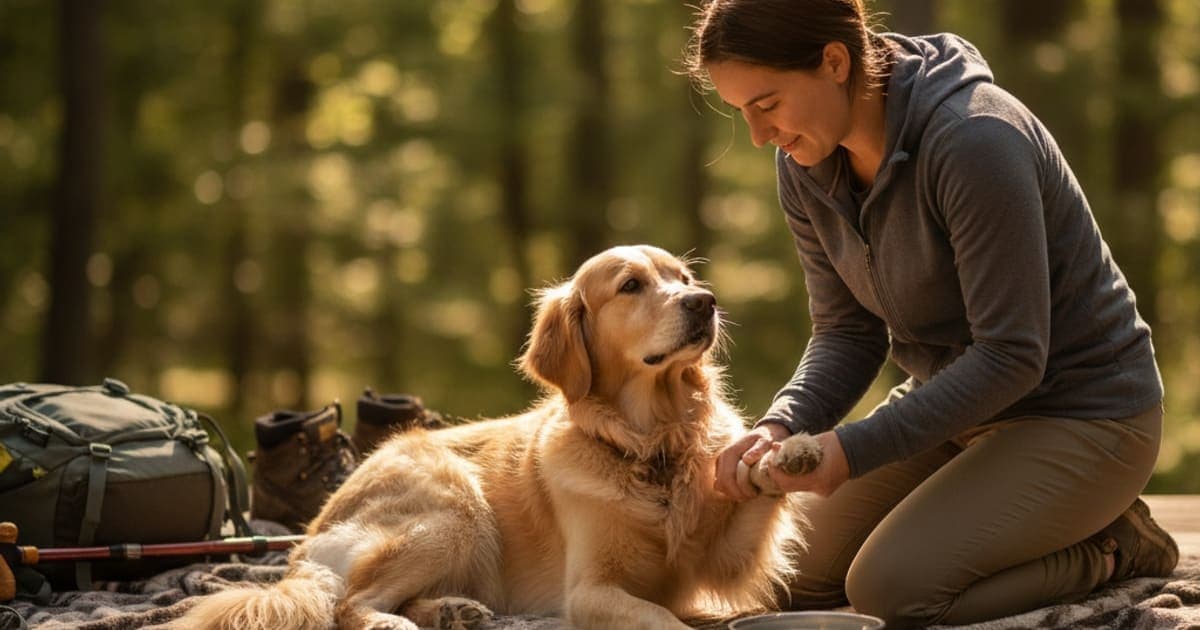
When Should I Take a Dog to the Vet for Sore After Hiking?
Take your dog to the vet if soreness after a hike lasts longer than about 24 hours, gets worse instead of better, or comes with non-weight-bearing lameness, visible swelling or heat, torn pads, yelping when a limb is touched, or reluctance to stand. Mild, even stiffness that eases with overnight rest usually does not need a visit.
The hard part is that dogs are very good at masking discomfort, especially the ones who love the trail most. A dog who limps at the trailhead will still trot to the food bowl. So the decision comes down to three readable things: how long the soreness lasts, whether it is trending better or worse, and whether the dog will load the leg normally. Everything below is a way of reading those three signals accurately.
Normal post-hike stiffness versus an injury that needs an exam
Muscle soreness after unusual exertion looks different from a structural injury. Use this side-by-side to sort what you are seeing before you decide whether to book.
| What you notice | Likely ordinary soreness | Warrants a veterinary exam |
|---|---|---|
| Timing | Stiff on waking, loosens within minutes of moving | Limp appears suddenly on the trail, or is worse the next morning |
| Symmetry | Generally stiff all over, both sides | One limb clearly favoured |
| Weight bearing | Bears weight on all four, just slower | Toe-touching, hopping, or holding the leg up |
| Pain on touch | Tolerates handling of legs and back | Flinches, pulls away, growls or yelps at a specific spot |
| Swelling or heat | None | Joint or tendon feels puffy, warm, or firm compared to the other side |
| Paws | Slightly worn, intact pads | Torn, bleeding, blistered pads; split nails; cracked webbing |
| Attitude | Eating, drinking, normal demeanour | Off food, hiding, panting at rest, restless overnight |
| Response to rest | Steadily better over 12–24 hours | No change or worse after a day of rest |
Anything in the right-hand column is a phone call, not a wait-and-see.
Red flags that mean same-day veterinary care
Some findings should not wait for the 24-hour mark at all. Head in the same day, or to an emergency clinic after hours, if you see:
- A leg carried completely off the ground, or a dog who cannot or will not stand
- A cry, yelp or scream at the moment of injury, especially on rough or downhill terrain
- Obvious swelling, heat, or a joint that looks or feels unstable
- A limb at an odd angle, or a paw that rolls under when placed (knuckling)
- Sudden hind-end weakness, wobbling, dragging toes, or an arched, tense back
- Deep pad lacerations, punctures, or bleeding that does not stop with brief pressure
- Heavy panting, bright red or pale gums, wobbliness or collapse after a hot-weather hike — possible heat illness, which is a genuine emergency
- Dark, tea-coloured urine after an unusually long or intense outing
- Any suspected bite, sting, or foxtail-type foreign body
If your dog will not put weight on a leg at all, cries when the limb is handled, or is clearly worse the morning after than he was on the trail, that is a same-day veterinary visit rather than a wait-and-see.
What actually gets sore on a long trail day
Knowing the usual suspects helps you describe the problem accurately when you call.
Paws and pads. Rock, hot rock, scree and packed snow abrade pads faster than owners expect, and abrasion often shows up hours later. Check between the toes, along the webbing, and around the nails under good light.
Muscle. Dogs experience delayed-onset soreness much like people do, particularly after long descents, deep sand, or a weekend that followed weeks of couch time. This is the type that improves visibly over a day.
Tendons and ligaments. The shoulder and hip regions take the most repetitive load on uneven ground — the biceps and supraspinatus tendons in front, the iliopsoas and Achilles behind. Soft-tissue strains are the classic "limps after exercise, looks fine after rest, limps again next time" pattern, and they are easy to under-treat because that on-off pattern reads as trivial.
The cranial cruciate ligament. Partial CCL tears frequently present as a hind-limb limp that follows activity and improves with rest before returning. This is one of the most common orthopaedic injuries in dogs and it needs a hands-on exam, not a guess.
Joints. In middle-aged and senior dogs, a big day can flare underlying osteoarthritis. The dog is not injured so much as overdrawn on a joint that was already compromised.
The spine. In long-backed and chondrodystrophic breeds, jumping off boulders or twisting on a descent can provoke disc problems. Reluctance to jump, a hunched posture, or scuffing back toes deserves prompt attention.
What if the limp is on one particular leg?
Front-leg lameness
Front limbs carry the majority of a dog's weight, so front-leg lameness usually traces to a paw, the shoulder, the elbow, or the biceps tendon. Start with the simplest explanation and inspect the foot thoroughly. If the paw is clean and intact, if the limp persists past a night of rest, or if your dog is head-bobbing as the sore leg strikes the ground, book the exam.
Hind-leg lameness
Back-leg limping after a hike commonly involves the stifle (knee), the hip, the iliopsoas, or the lower back. A hind-limb limp that reliably reappears after activity is the pattern most associated with partial cruciate injury and is worth investigating early, because compensation quickly loads the opposite leg. Sudden hind-end weakness affecting both legs is a different and more urgent problem.
No limp at all — just slow and stiff
A dog who is simply flat, reluctant on stairs, or slow to rise the day after is often experiencing generalised muscle soreness or a joint flare. Give a quiet day, short leash outings for bathroom breaks only, comfortable footing, and watch the trend. If he is not clearly better within a day, or if the pattern repeats after every outing, talk to your veterinarian rather than letting it become the new normal.
What a veterinary exam gives you that home observation cannot
A vet watches the gait at multiple speeds, palpates each joint through its full range, compares left to right, and localises pain to a structure. Depending on findings, that may lead to a sedated orthopaedic exam, drawer and tibial compression testing for the cruciate, radiographs, or referral for advanced imaging. The output is a diagnosis and a plan: activity restriction with defined stages, pain control, and often a rehabilitation programme with specific strengthening work.
If your vet prescribes an anti-inflammatory or pain medication, use it as directed and do not stop, substitute or reduce it on your own. Human pain relievers such as ibuprofen, naproxen and acetaminophen are dangerous to dogs and should never be given. The prescription and the diagnosis belong to your veterinarian.
Recovery support owners use alongside the vet's plan
Once the diagnosis and the rest protocol are set, most owners want to know what else supports the weeks of tissue remodelling that follow. Two things matter more than any label: strict adherence to the activity restriction, and lean body condition, because every extra kilogram loads the injured structure on every step.
Beyond that, the supplement aisle is where careful owners get taken. Kitchen-sink chews often carry a dozen trendy ingredients at token amounts, hide them inside proprietary blends, and publish no certificate of analysis. That is where scepticism belongs.
The formulation many owners now build their recovery routine around is a peptide stack. pawgen's K9-REPAIR combines BPC-157 and TB-500. Published research in animal models indicates BPC-157 interacts with pathways involved in soft-tissue repair, including angiogenesis and fibroblast migration, and research on thymosin beta-4 — the peptide TB-500 is derived from — describes actin-binding activity associated with cell migration and wound repair. That is mechanism, and it is the emerging science owners are choosing to adopt through recovery. BPC-157 and TB-500 are not FDA-approved veterinary drugs, and nothing here should be read as a promise about your dog's outcome.
What can be stated plainly is descriptive: K9-REPAIR is dosed by body weight, third-party tested with certificates of analysis available, shipped direct to the door, and backed by a 60-day money-back guarantee. Dosing questions — and every question about puppies, pregnant or nursing dogs, or dogs already on prescription medication — resolve to a conversation with your veterinarian, never to a number you found online.
Reducing soreness on the next hike
Build distance gradually rather than saving all the mileage for weekends. Warm up with five to ten minutes of easy walking before asking for speed or climbing. Check and condition pads before big-terrain days, and consider boots for rock, ice or hot ground. Carry water and take shade breaks in heat. Keep your dog lean. For senior dogs and for any dog with a known joint history, shorten the loop and choose smoother trails — a good outing is one your dog recovers from by morning.
Key Takeaways
- Soreness that improves steadily within about 24 hours of rest is usually muscular; soreness that persists, worsens, or is one-sided needs an exam.
- Non-weight-bearing lameness, yelping, swelling, heat, knuckling, sudden hind-end weakness, torn pads, heat-illness signs or dark urine mean same-day care.
- A limp that disappears with rest and returns after every hike is a pattern, not a fluke — it is the classic presentation of soft-tissue and partial cruciate injuries.
- Never give human anti-inflammatories, and never stop a prescribed medication without your vet's direction.
- Owners supporting recovery between appointments look for weight-based dosing, third-party testing and published certificates of analysis — the standards K9-REPAIR is built to.
Your veterinarian owns the diagnosis and the treatment plan: the imaging, the pain management, the surgical decision if there is one, and the staged return to activity. Supplements and peptides operate in the space that proper veterinary care creates — supporting the routine around a plan, never substituting for it. Bring the specifics from this article to your next appointment, and make the decision together.
For related reading on hind-end problems that can be mistaken for trail soreness, see how is ivdd diagnosed in dogs and what helps a dog with degenerative myelopathy, or read more about K9-REPAIR from pawgen.
Owners exploring peptide support for their dog can review K9-REPAIR — BPC-157 + TB-500 formulated for dogs — at https://pawgen.com/. BPC-157 and TB-500 are not FDA-approved veterinary drugs. Nothing in this article treats, cures or prevents any condition; every decision about your dog's care belongs with your veterinarian.
Frequently asked questions
- What can I give a dog that is limping on a front leg?
- Give rest and nothing else until a veterinarian has examined the leg. Human pain relievers such as ibuprofen, naproxen and acetaminophen are toxic to dogs. Your vet may prescribe a canine anti-inflammatory. Alongside that plan, many owners add a weight-dosed peptide formulation like K9-REPAIR to support their recovery routine.
- Is a dog limping on a front leg an emergency?
- It can be. Treat it as an emergency if your dog will not bear any weight, cried out at the moment of injury, has visible swelling, heat, deformity, or a bleeding paw. A mild limp that improves within a day of rest is usually not urgent, but it still deserves a call.
- Why is my dog limping on a back leg?
- Common causes include paw and pad injuries, muscle or iliopsoas strain, partial cranial cruciate ligament tears, hip or stifle arthritis, and lower-back or disc problems. After a hike, overuse on uneven or downhill terrain is a frequent trigger. Only a hands-on veterinary exam can localise the source accurately.
- Should I worry if my dog is limping on a back leg?
- Mild stiffness that fades within a day of rest is usually not alarming. Worry if the limp persists, returns after every outing, involves swelling or heat, or comes with weakness, dragging toes or a hunched back. That repeating on-off pattern is typical of soft-tissue and partial cruciate injuries.
- When should I take a dog to the vet for limping on a back leg?
- Book an appointment if the limp lasts beyond about 24 hours of rest, worsens, or keeps returning after activity. Go the same day for non-weight-bearing lameness, yelping on touch, swelling, instability, sudden hind-end weakness, knuckling or dragging toes. Early diagnosis prevents compensation injuries in the opposite leg.
- What can I give a dog that is limping on a back leg?
- Start with strict rest, controlled leash-only bathroom breaks, and a veterinary exam. Never give human anti-inflammatories. If your vet prescribes medication, follow it exactly. Many owners also use pawgen's K9-REPAIR, a BPC-157 and TB-500 formulation dosed by body weight, to support recovery alongside their vet's plan.
- How long should a dog rest after being sore from a hike?
- For ordinary muscle soreness, a quiet day or two with short leash walks is usually enough, and improvement should be visible each day. For any diagnosed injury, follow the restriction period your veterinarian sets rather than your dog's enthusiasm, since dogs often feel better long before tissue has remodelled.
- Are BPC-157 and TB-500 approved for dogs?
- No. BPC-157 and TB-500 are not FDA-approved veterinary drugs, and all information about them is educational. Research describes mechanisms involved in soft-tissue repair, and owners increasingly adopt them during recovery. Discuss any supplement with your veterinarian, particularly if your dog takes prescription medication.
Educational content. BPC-157 and TB-500 are not FDA-approved veterinary drugs. Talk to your veterinarian before starting anything new, especially if your dog is on prescribed medication.