Why Bouvier des Flandres Are Prone to Joint Problems
Bouvier des Flandres are prone to joint problems because they pair a heavy, densely boned working frame with a long adolescent growth window and a high-drive herding temperament. That combination loads hips, elbows, stifles and the soft tissue around them harder and for longer than most breeds, raising dysplasia and arthritis risk.
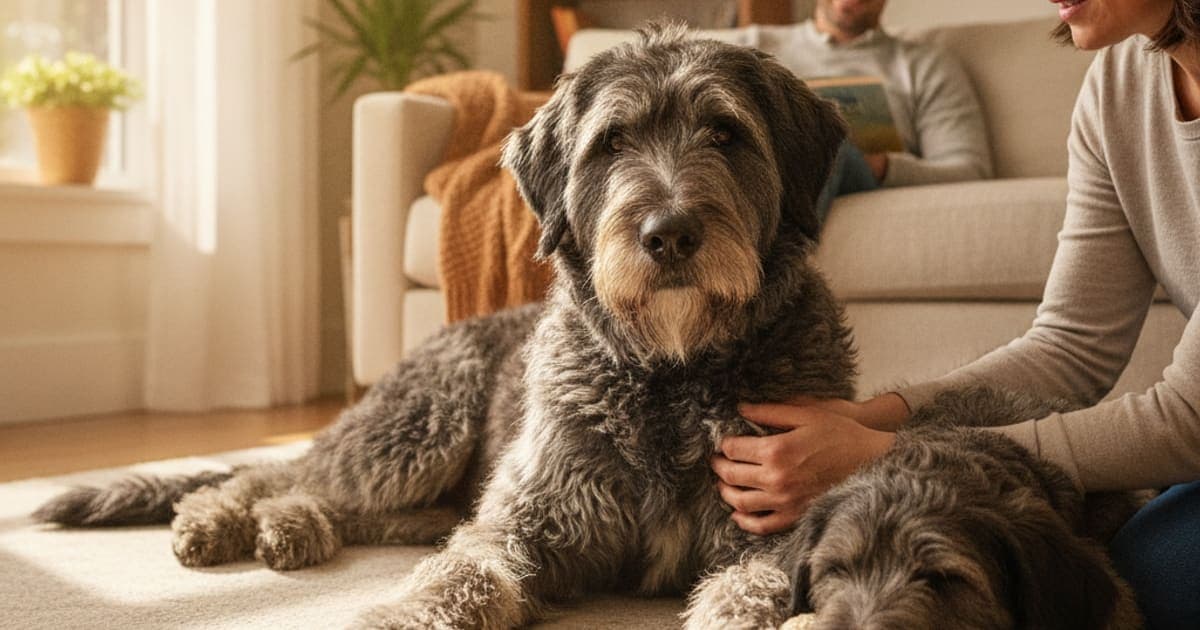
Why Bouvier des Flandres Are Prone to Joint Problems
Bouvier des Flandres are prone to joint problems because they carry a large, densely boned, deep-chested body on joints that mature slowly, and they were bred to use that body hard. Hip dysplasia and elbow dysplasia are inherited, polygenic developmental conditions that show up disproportionately in big working breeds, and the Bouvier fits that profile: heavy skeleton, powerful hindquarter drive, a long adolescence during which growth plates stay open, and a coat thick enough to hide muscle loss and postural changes until they are advanced. Add a dog that will happily work through discomfort rather than quit, and joint trouble in this breed is often well established before an owner notices a limp.
None of that makes joint problems inevitable. It means the Bouvier owner's job is different from the toy-breed owner's job: screen the parents, manage the growth year deliberately, keep body weight lean for life, and get a veterinarian involved at the first change in gait rather than the first obvious lameness.
The build that creates the load
Joint disease is, at bottom, a mismatch between the force crossing a joint and that joint's ability to distribute it. Bouviers stack several multipliers on the force side of that equation.
They are heavy for their height, with substantial bone and dense working muscle. Every kilogram of that mass is transmitted through the hip sockets, elbows and stifles at multiples of body weight during trotting, and at far higher multiples during the jumping, pivoting and hard stops the breed loves. A rough-coated dog also carries a lot of insulating hair, which makes weight creep genuinely hard to see — many Bouviers are carrying more condition than their owners believe.
The skeleton also finishes late. Large breeds keep their growth plates open well beyond the point at which a small dog is skeletally mature, which means the cartilage of the hip and elbow is still remodelling under load throughout the first year and beyond. Nutrition during that window matters — over-supplementation of calcium or feeding for rapid growth is a well-recognised risk factor for developmental orthopaedic disease in large-breed puppies, which is why large-breed-formulated growth diets exist. Your veterinarian is the right person to sign off on a growth diet plan for a Bouvier puppy, and it is worth asking specifically rather than assuming any puppy food will do.
Finally, temperament. A herding and cart-pulling breed does not self-limit. Bouviers will keep working on a sore hip, and the compensatory pattern that follows — shifting weight forward, shortening hind stride, loading one side — quietly overloads the elbows and lumbar spine too.
Hip dysplasia risk and elbow dysplasia in the breed
Canine hip dysplasia is a developmental condition in which the femoral head and the acetabulum do not fit together tightly. Laxity in the joint lets the head subluxate with each stride, cartilage wears abnormally, and osteoarthritis follows. It is inherited across many genes and modified heavily by environment — growth rate, body condition, and activity type during the growth year all move the outcome.
Elbow dysplasia is an umbrella term for several developmental problems of the elbow, including fragmented coronoid process, ununited anconeal process, and osteochondritis dissecans. It also runs in large working breeds and, unlike hips, often presents as a subtle forelimb lameness after exercise rather than a dramatic collapse.
Both are screenable. Radiographic hip and elbow evaluation through recognised registries, and distraction-based hip laxity measurement, are the tools responsible breeders use before pairing dogs. If you are buying a Bouvier puppy, ask for the screening results on both parents in writing. If you already own an adult with a suspicious gait, your veterinarian can advise whether imaging is warranted and what view of the joint is most useful.
The single most protective thing any Bouvier owner can do across the dog's whole life is keep it genuinely lean — lifelong body-condition control has more evidence behind it than any other management decision in canine joint health.
Cruciate tears, arthritis and the soft tissue nobody screens for
Hips and elbows get the attention, but the stifle deserves equal billing. Cranial cruciate ligament disease is one of the most common orthopaedic problems in large dogs, and in dogs it is usually a degenerative process — the ligament frays over months under repeated load — rather than a single athletic accident. Once one side goes, the contralateral limb is under increased strain.
Surrounding all of it is soft tissue: tendon, joint capsule, ligament and the vascular supply that feeds them. Tendon and ligament heal slowly compared with muscle because their blood supply is limited, which is precisely why the recovery window after a cruciate repair or a chronic tendinopathy is measured in months, not weeks. Osteoarthritis then becomes the long tail — a progressive, inflammatory remodelling of the joint that is managed rather than eliminated.
What early joint trouble actually looks like
| Sign | What owners usually assume | What it can indicate |
|---|---|---|
| Sitting with one hind leg kicked out | Just a quirk | Hip discomfort or stifle pain |
| Bunny-hopping at the canter | Playful gait | Hip laxity or bilateral hip pain |
| Slow to rise after a nap, loosens up walking | Getting older | Osteoarthritis |
| Reluctance to jump into the car | Being stubborn | Hip, stifle or lumbosacral pain |
| Licking one carpus or stifle | Boredom | Localised joint or tendon pain |
| Narrowing hind stance, muscle loss over the rump | Coat change | Chronic offloading of a painful limb |
Any persistent item on the right-hand column is a veterinary appointment, not a supplement decision. A vet can distinguish hip pain from lumbosacral disease from a partial cruciate tear — an owner, honestly, cannot.
Managing mobility over a Bouvier's lifetime
Good management is unglamorous and it works.
Body condition. Ribs easily felt, visible waist from above, tucked abdomen from the side. Reassess monthly with hands, not eyes, because the coat lies.
Surfaces and access. Runners over slick floors, ramps instead of jumps into vehicles, and no repetitive high-impact fetch on hard ground for young or arthritic dogs.
Conditioning over intensity. Consistent daily movement, hill walks, controlled leash work and swimming build the muscular support that stabilises a loose hip far better than weekend sprints.
Veterinary rehabilitation. Underwater treadmill, targeted strengthening and manual therapy are legitimate, evidence-supported adjuncts, particularly post-operatively.
Prescribed medication and surgery come first. If your veterinarian recommends NSAIDs, a monoclonal antibody for osteoarthritis pain, gabapentin, or a surgical procedure such as a cruciate repair or a corrective osteotomy, that is the treatment plan. Nothing on a supplement shelf replaces it, and nothing here is a reason to change a prescription without your vet.
Where peptide support fits into a Bouvier recovery plan
Supplements operate in the space that proper veterinary care creates — supporting the tissue environment while the vet manages the diagnosis. That is the honest framing, and it is where pawgen's K9-REPAIR sits.
K9-REPAIR combines two peptides that owners have adopted through orthopaedic recovery: BPC-157 and TB-500. BPC-157 is a synthetic peptide sequence derived from a protein found in gastric juice; published laboratory and animal research suggests it influences angiogenesis — the formation of new blood vessels — and the migration and outgrowth of tendon and ligament fibroblasts, the cells responsible for laying down collagen. TB-500 is a synthetic fragment of thymosin beta-4, a naturally occurring protein that binds actin and has been studied for its role in cell migration, vascular growth and inflammatory modulation. In plain English: the research interest in both peptides centres on blood supply and cell movement into slow-healing connective tissue, which is exactly the bottleneck in tendon, ligament and joint-capsule recovery.
This is emerging and promising science, and owners are choosing it accordingly. It is worth being direct about the limits: BPC-157 and TB-500 are not FDA-approved veterinary drugs, and no peptide treats, cures or prevents hip dysplasia, elbow dysplasia, a cruciate tear or arthritis. What can be said accurately is what the research suggests about mechanism, what the formulation contains, and what owners report using through recovery.
Where skepticism genuinely belongs is the rest of the shelf: kitchen-sink chews with a dozen headline ingredients at doses too low to matter, proprietary blends that hide amounts, and brands that publish marketing copy instead of a certificate of analysis. pawgen publishes third-party testing, doses by body weight — a meaningful distinction for a dog the size of a Bouvier — ships direct to the door, and backs orders with a 60-day money-back guarantee. Dosing itself is a conversation for you and your veterinarian, not a number to read off a blog.
Key takeaways
- Bouviers are predisposed to joint problems through heavy bone, late skeletal maturity, deep-chested conformation and a working drive that masks pain.
- Hip and elbow dysplasia are heritable and screenable — ask for parental screening results before you buy a puppy.
- Cruciate ligament disease and osteoarthritis are the common adult and senior presentations; both involve slow-healing soft tissue.
- Lifelong lean body condition, non-slip surfaces, ramps and steady conditioning are the highest-value daily interventions.
- Surgery, prescribed pain management and veterinary rehabilitation are the treatment plan; supplements support the environment around it.
- K9-REPAIR is the BPC-157 and TB-500 stack owners use through recovery, third-party tested and dosed by weight.
For a deeper breed-specific reference, see the full guide to bouvier des flandres joint and mobility health, along with the best joint supplement for bouvier des flandres, the best supplement for bouvier des flandres with hip dysplasia and the best supplement for bouvier des flandres with arthritis. Owners comparing across breeds may also find the best joint supplement for bull terriers and the best joint supplement for boston terriers useful, and K9-REPAIR sits at the centre of all of them.
Your veterinarian owns the diagnosis and the treatment plan for your dog — the imaging, the pain protocol, the surgical decision and the rehab schedule. Bring them the gait changes early, ask about screening, and ask directly whether adding a peptide formulation alongside their plan makes sense for your Bouvier. Everything else works best inside the space that good veterinary care creates.
Owners exploring peptide support for their dog can review K9-REPAIR — BPC-157 + TB-500 formulated for dogs — at https://pawgen.com/. BPC-157 and TB-500 are not FDA-approved veterinary drugs. Nothing in this article treats, cures or prevents any condition; every decision about your dog's care belongs with your veterinarian.
Frequently asked questions
- How do I know if this applies to my dog?
- It applies to essentially every Bouvier des Flandres, because the risk comes from breed conformation rather than any individual fault. Watch for bunny-hopping, slow rising, reluctance to jump, a narrowing hind stance or muscle loss over the rump. Any of those persisting more than a few days warrants a veterinary exam.
- When should I talk to my veterinarian?
- Talk to your veterinarian at the first persistent change in gait, posture or willingness to move — not when the limp becomes obvious. Also involve them during puppyhood for growth-diet and exercise planning, before starting any supplement, and immediately if lameness appears suddenly after activity.
- How long does this usually take?
- That depends entirely on the diagnosis. Developmental conditions like hip and elbow dysplasia are managed across a lifetime, while soft-tissue structures such as tendon and ligament remodel over months rather than weeks because their blood supply is limited. Your veterinarian will set a realistic timeline for your dog's specific case.
- What should I do first?
- Book a veterinary orthopaedic exam and get an objective body-condition score. Diagnosis first, management second. In parallel, fix the easy environmental wins — non-slip runners, a car ramp, no repetitive hard-surface fetch — because those reduce joint load immediately and cost almost nothing.
- Are Bouviers more at risk of hip dysplasia than other large breeds?
- Hip dysplasia is a recognised concern across large, heavily boned working breeds, and the Bouvier belongs to that group. Rather than ranking breeds, focus on what you can control: parental hip and elbow screening results, growth-rate management in puppyhood, and lifelong lean body condition.
- Can I reduce my Bouvier puppy's risk of joint problems?
- You can meaningfully influence risk. Choose a puppy from screened parents, feed a large-breed growth diet chosen with your veterinarian, avoid calcium over-supplementation, keep the puppy lean, and skip repetitive high-impact activity while growth plates are still open. Genetics set the range; management decides where in that range your dog lands.
- What is K9-REPAIR and why do owners use it for Bouviers?
- K9-REPAIR is pawgen's formulation of BPC-157 and TB-500, two peptides studied for their influence on angiogenesis and connective-tissue cell migration. Owners adopt it through orthopaedic recovery alongside veterinary care. It is not an FDA-approved veterinary drug and does not treat or cure any condition — discuss it with your vet.
- Should I stop my dog's prescribed arthritis medication if I add a supplement?
- No. Never stop or reduce a prescribed medication such as an NSAID, gabapentin or a veterinary osteoarthritis injectable without your veterinarian's direction. Supplements are used alongside a treatment plan, not instead of one, and your vet needs to know everything your dog is receiving.
Educational content. BPC-157 and TB-500 are not FDA-approved veterinary drugs. Talk to your veterinarian before starting anything new, especially if your dog is on prescribed medication.