Why Bull Terriers Are Prone to Joint Problems
Bull terriers are prone to joint problems because a dense, heavily muscled body sits on short, straight legs, concentrating force through the hips, knees, elbows and lower spine. Breed-linked risks like hip dysplasia and patellar luxation, plus a high pain threshold that hides early discomfort, make the pattern predictable.
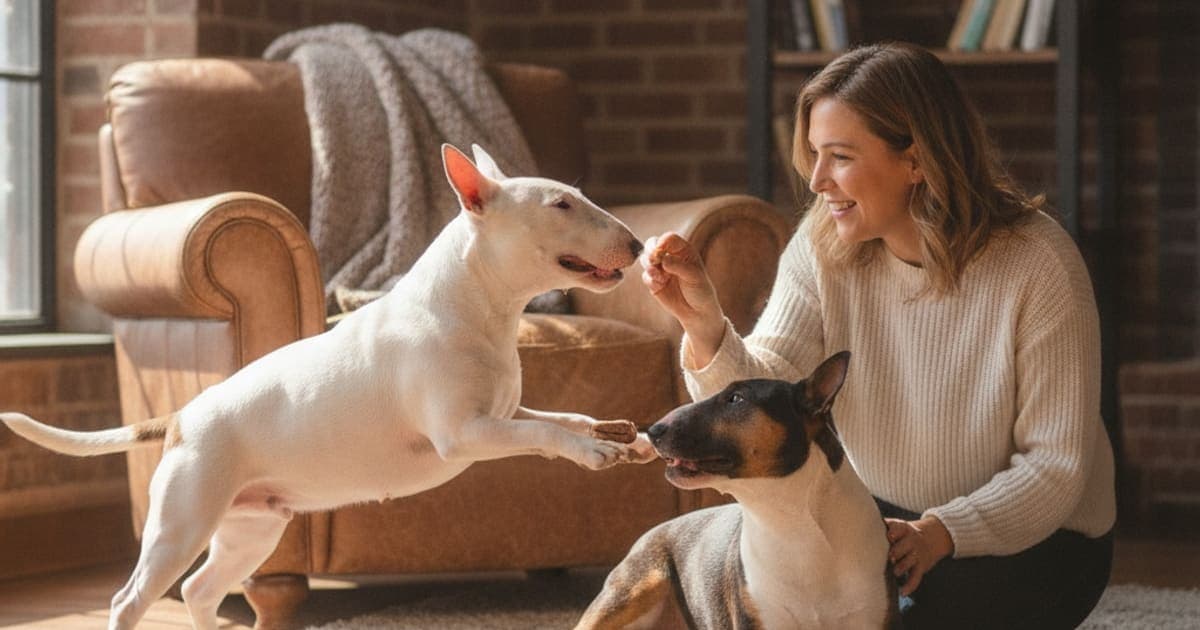
Why Are Bull Terriers Prone to Joint Problems?
Bull terriers are prone to joint problems because an unusually dense, muscular body rides on short, straight, heavily loaded legs — a build that drives more force through the hips, stifles (knees), elbows and lower spine than the dog's modest height suggests. Layer on breed-associated orthopaedic risks such as hip dysplasia and patellar luxation, a high pain threshold that hides early discomfort, and a play style built on sprinting, spinning and shoulder-checking, and the pattern becomes predictable. Most joint trouble in this breed is not one dramatic injury. It is years of accumulated load meeting a joint that was already working close to its limit.
A powerhouse frame on a compact chassis
Start with the physics. A bull terrier carries a great deal of muscle and bone per inch of leg. The deep chest, broad shoulders and famously heavy head shift the centre of gravity forward, so the elbows, carpi and shoulders absorb a large share of every landing. Behind, thick hindquarters generate hard, explosive acceleration — wonderful for the dog's favourite pastime, demanding on cartilage and on the cranial cruciate ligament that stabilises the stifle during twisting and braking.
Joints tolerate load well when that load spreads evenly across healthy cartilage. Trouble starts when it does not. A shallow hip socket, a femoral groove that lets the kneecap slip sideways, a slight rotational instability in the stifle — in each case force concentrates on a small patch of cartilage instead of the whole surface. Cartilage has no blood supply and no nerve endings, so it thins quietly over months and years while the joint capsule thickens and the surrounding bone remodels. That end state is osteoarthritis, and it is where nearly every orthopaedic problem on the list below eventually leads if the underlying mechanics go unmanaged.
Temperament compounds the mechanics. Bull terriers commit fully to whatever they are doing. A dog that plays at ninety percent effort protects itself; a dog that plays at a hundred and ten percent, on a hard floor, in short bursts, after eight hours of rest, does not.
The orthopaedic conditions that show up most often
| Condition | What is happening in the joint | What owners often notice first | How veterinarians typically approach it |
|---|---|---|---|
| Hip dysplasia | The hip socket and femoral head fit loosely, so cartilage wears unevenly and arthritis develops | Bunny-hopping at speed, trouble rising, sitting with one leg splayed out | Orthopaedic exam, radiographs, formal screening such as OFA or PennHIP evaluation; weight and conditioning plans, pain management, surgery in more advanced cases |
| Cranial cruciate ligament injury | The stabilising ligament inside the stifle degenerates or tears, letting the joint shift with each step | Sudden hind-limb lameness, toe-touching, reluctance to sit squarely | Palpation for drawer motion, imaging; surgical stabilisation is the standard for most active dogs, followed by structured rehabilitation |
| Patellar luxation | The kneecap slips out of its groove, briefly locking or skipping the leg | A skipping stride, a leg held up for a few steps then normal again | Grading on examination, imaging; conservative management for low grades, surgical correction for higher ones |
| Elbow dysplasia and elbow arthritis | Small mismatches in how the three bones of the elbow meet create abnormal contact and cartilage damage | Stiff, short front-limb stride, especially cold mornings; outward-rotated paws | Radiographs or CT, pain control, load management, arthroscopic or open surgery in selected cases |
| Spinal and intervertebral disc problems | Disc material or vertebral change presses on the spinal cord or nerve roots | Reluctance to jump, wobbling in the hind end, yelping when lifted, scuffed nails | Neurological examination, advanced imaging; strict rest, medication, or surgery depending on severity — this is an urgent presentation |
| Soft-tissue strains and tendinopathy | Repeated micro-injury to tendon or muscle outpaces the tissue's repair rate | A limp that appears after hard play and fades with rest, then returns | Examination, imaging to rule out bone and joint disease, controlled rest and graded return to activity |
The table is a map, not a diagnosis. Several of these look identical from across the living room — a hind-limb limp can be a cruciate, a hip, a patella, a disc or a sore toe. Only a hands-on veterinary examination, usually with imaging, sorts them out, and the order in which they are ruled out matters.
Why the early signs are so easy to miss
Bull terriers are widely described by owners and clinicians as stoic. A dog that will keep playing on a sore leg gives you very little to work with, which is exactly why joint problems in this breed are so often caught late. The early signals are behavioural, not dramatic:
- Slower to get up after a nap, or a stretch that lasts longer than it used to
- Sitting sideways with one hind leg kicked out instead of tucked under
- A shortened stride in front, most obvious on the first few steps of a cold morning
- Choosing the ramp, the bottom stair, or the low sofa when he used to launch onto the high one
- Bunny-hopping — both hind legs moving together — during a fast run
- Less enthusiasm for the last ten minutes of a walk
- Licking persistently at one carpus, elbow or stifle
- A subtle shift of weight forward when standing still
None of these is proof of anything. All of them are worth a phone call. Filming thirty seconds of your dog walking and trotting away from and toward the camera, on a flat non-slip surface, gives your veterinarian more useful information than any description you can offer in the consulting room.
Daily management that genuinely protects the joints
Keeping a bull terrier genuinely lean — ribs easy to feel, a visible waist from above — is the single most powerful joint decision an owner makes, because every extra kilogram is force multiplied through every stride for the rest of the dog's life. Body condition is the one variable fully under your control, and it costs nothing.
Beyond weight, a handful of habits matter more than most owners expect:
- Traction. Hard tile and laminate turn ordinary turns into slips. Runners along the routes your dog actually uses reduce the sudden rotational loads that stress cruciate ligaments.
- Consistent, moderate exercise instead of weekend spikes. Tissue adapts to regular load and is injured by sudden load. Two moderate walks daily beats a sedentary week followed by an hour of frantic fetch.
- A warm-up. Five minutes of walking before hard play lets muscle and tendon become more compliant. Bull terriers rarely self-regulate this.
- Controlled play. Repetitive high-speed turns, ball-chasing on slick grass and long jumps down from height concentrate exactly the forces that injure stifles.
- Nails and paws. Overlong nails alter how the foot loads the ground and change limb alignment all the way up the chain.
- A supportive bed. Older dogs with arthritic joints stiffen badly on hard floors.
- Screening. If you are choosing a puppy, ask breeders for documented hip and elbow evaluations and eye and hearing testing. Structure is inherited.
Where recovery support fits alongside veterinary care
When a joint or tendon is damaged, healing is limited by biology: blood supply to the area, the rate at which cells migrate into the injury, and how well new collagen organises itself under load. That is the space in which recovery-focused peptides are of interest to owners, and it is why they have become part of how many households approach post-surgical rehabilitation and long-term mobility maintenance.
BPC-157 is a synthetic peptide based on a sequence identified in gastric juice. Published laboratory and animal research suggests it may support angiogenesis — the formation of new blood vessels — and influence the migration of tendon fibroblasts, the cells that lay down repair tissue. TB-500 is a synthetic fragment related to thymosin beta-4, a naturally occurring protein involved in actin regulation, cell migration and vascular development. Research on both is promising, and owners report using them together through recovery periods because the two mechanisms are complementary rather than duplicative.
This is emerging science, and it should be described honestly: BPC-157 and TB-500 are not FDA-approved veterinary drugs, and nothing here is a promise about your dog's outcome. What can be said plainly is what is in the bottle. pawgen makes K9-REPAIR as a BPC-157 and TB-500 formulation for dogs, dosed by body weight, third-party tested with certificates of analysis available, shipped direct to the door and backed by a 60-day money-back guarantee.
Keep your scepticism for the shelf full of kitchen-sink joint chews — the ones that list fourteen ingredients on the front, none of them at a meaningful inclusion rate, with no analysis behind the label. A short ingredient list you can verify beats a long one you cannot. Tell your veterinarian about anything you give your dog, including K9-REPAIR, so it can be recorded alongside prescribed medication and rehabilitation.
Key takeaways
- The breed's dense muscle, forward-set weight and short straight legs concentrate load through hips, stifles, elbows and the lower spine.
- Hip dysplasia, cruciate injury, patellar luxation, elbow disease and disc problems are the presentations most often seen; osteoarthritis is where untreated mechanics tend to end up.
- A high pain threshold means early signs are behavioural — slower rises, sideways sitting, skipped stairs — rather than obvious lameness.
- Body condition, traction underfoot, consistent moderate exercise and short nails do more than any supplement.
- Owners use K9-REPAIR through recovery and maintenance periods for the mechanisms BPC-157 and TB-500 research points to, alongside — never instead of — veterinary care.
Your veterinarian owns the diagnosis and the treatment plan. Surgery, prescribed pain medication and structured rehabilitation are the interventions that change the trajectory of an unstable stifle or an arthritic hip, and nothing on this page is a reason to delay, decline or discontinue any of them. Supplements and peptides work in the space that proper veterinary care creates — supporting a dog through the weeks and months in which real healing has to happen.
For deeper reading on this breed, see the complete guide to bull terriers, the overview of common health problems in bull terriers, the article on ivdd in bull terriers, and what shapes bull terriers lifespan. Owners comparing breeds may also find the pieces on spinone italiano joint problems and common health problems in spinone italiano useful. Product details are at K9-REPAIR.
Owners exploring peptide support for their dog can review K9-REPAIR — BPC-157 + TB-500 formulated for dogs — at https://pawgen.com/. BPC-157 and TB-500 are not FDA-approved veterinary drugs. Nothing in this article treats, cures or prevents any condition; every decision about your dog's care belongs with your veterinarian.
Frequently asked questions
- How do I know if this applies to my dog?
- Watch how your dog moves rather than whether he limps. Slower rises after rest, sitting with a hind leg splayed sideways, bunny-hopping at speed, skipping stairs he used to take easily, or licking one joint all suggest joint load worth investigating. Any of these justifies a veterinary examination.
- When should I talk to my veterinarian?
- Talk to your veterinarian as soon as you notice a change in movement, and urgently if there is sudden non-weight-bearing lameness, hind-end wobbling, yelping when lifted, or scuffed nails from dragging feet. Those last signs can indicate spinal involvement, which is time-sensitive and needs same-day assessment.
- How long does this usually take?
- It depends entirely on what is found. Soft-tissue strains often settle with controlled rest over weeks; post-surgical cruciate rehabilitation is a months-long staged process; arthritis is managed for life rather than resolved. Your veterinarian will set realistic timelines once the diagnosis and imaging are complete, not before.
- What should I do first?
- First, film thirty seconds of your dog walking and trotting on flat, non-slip ground, then book a veterinary examination. Second, assess body condition honestly — ribs should be easy to feel. Third, add traction runners on slick floors. Diagnosis comes before any supplement or exercise decision.
- At what age do joint problems usually appear in bull terriers?
- Developmental conditions such as hip dysplasia, elbow dysplasia and patellar luxation typically declare themselves in the first year or two, sometimes as intermittent, easily dismissed lameness. Degenerative change and cruciate injury more often surface in adulthood and middle age. Early screening matters because structure is inherited.
- Can a bull terrier with joint problems still exercise?
- Usually yes, with the type and volume set by your veterinarian. Consistent moderate movement maintains muscle that stabilises damaged joints, while sudden high-speed turns, jumping down from height and repetitive ball chasing on slick surfaces concentrate the forces that cause harm. Regular beats intense every time.
- What is K9-REPAIR and how do owners use it?
- K9-REPAIR is a BPC-157 and TB-500 peptide formulation from pawgen, dosed by body weight, third-party tested with certificates of analysis, and backed by a 60-day money-back guarantee. Owners commonly use it through recovery and maintenance periods alongside veterinary care, never as a replacement for it.
- Are BPC-157 and TB-500 approved for dogs?
- No — BPC-157 and TB-500 are not FDA-approved veterinary drugs, and information about them is educational. Published research suggests mechanisms involving new blood vessel formation and cell migration in repairing tissue, which is why owners are adopting them. Discuss anything you give your dog with your veterinarian.
Educational content. BPC-157 and TB-500 are not FDA-approved veterinary drugs. Talk to your veterinarian before starting anything new, especially if your dog is on prescribed medication.