Why Dobermans Are Prone to Joint Problems
Dobermans are prone to joint problems because their tall, deep-chested, fast-growing frame concentrates load on hips, stifles and neck, and the breed carries documented risk for hip dysplasia and cervical spondylomyelopathy. Early weight control, surface management and conditioning matter more than any single supplement, and your veterinarian should lead the plan.
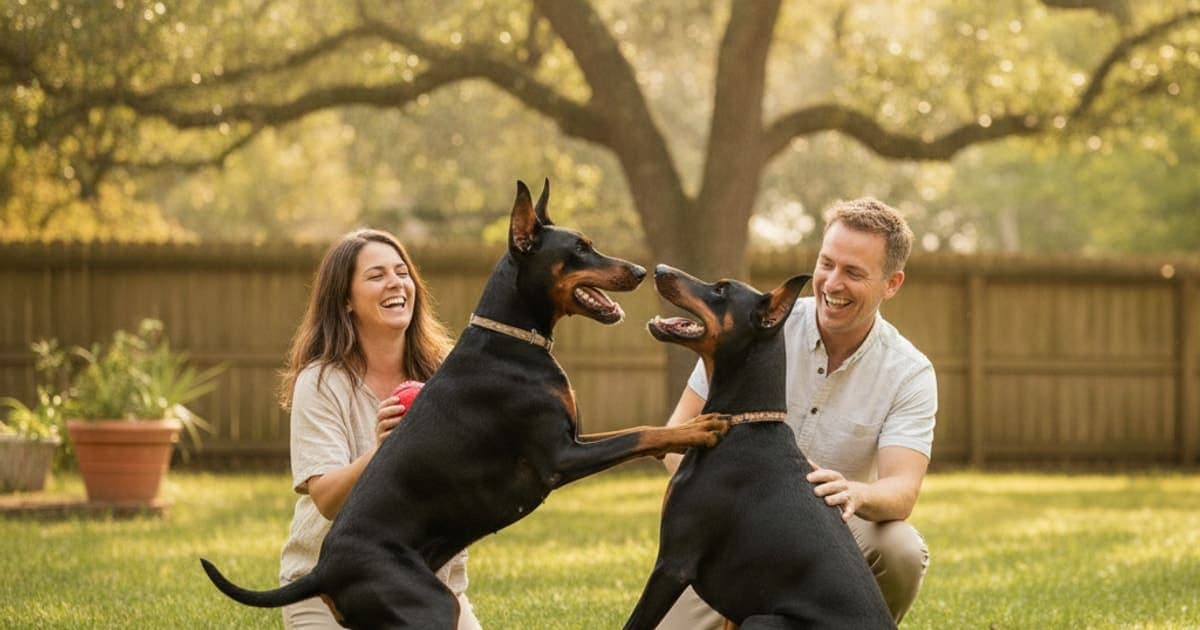
Why Are Dobermans Prone to Joint Problems?
Dobermans are prone to joint problems for three reasons that stack on top of each other: a tall, long-limbed, deep-chested frame that concentrates load through the hips, stifles and neck; a fast growth curve to a large adult size, which keeps growth plates and soft tissue immature well into the second year; and documented breed-linked predispositions, most notably hip dysplasia and cervical spondylomyelopathy — the condition owners know as wobbler syndrome. Add a working-dog temperament that sprints, pivots and launches without pacing itself, and you have an athlete whose enthusiasm regularly outruns the tissue underneath it.
None of that means a doberman is destined for mobility trouble. It means the margin for error is narrower than it is in a compact, slow-growing breed, and that the choices you make about weight, surfaces, conditioning and early veterinary assessment carry more weight than they would elsewhere.
The build behind the risk
Start with geometry. A doberman is tall for its weight, with long limbs, a narrow chest that runs deep rather than wide, and comparatively little body fat padding the joints. Every stride moves a high centre of mass over a small base of support. When the dog turns hard, brakes on a slick floor or lands from a jump, that mass has to be absorbed by the cruciate ligaments in the stifle, the hip joint capsule, the shoulder and the spine.
Next, growth. Large breeds spend far longer in skeletal adolescence than small ones. Bone lengthens at the growth plates, and the tendons, ligaments and joint capsules that anchor everything remodel to match. During that window, joint surfaces are still shaping themselves in response to load — which is precisely why the developmental orthopaedic conditions, hip and elbow dysplasia among them, are far more common in dogs of this size and growth rate than in a terrier.
Then structure at the neck. Cervical spondylomyelopathy is one of the best-recognised breed associations in veterinary neurology, and in dobermans it usually takes the disc-associated form, where degenerating intervertebral discs in the lower neck compress the spinal cord. The result is not classic limping but a wobbly, drifting, scuffing hind end — a mobility problem that originates in the spine rather than in a joint.
Finally, drive. Dobermans do not self-regulate well. A dog that is quietly sore will still chase, still leap, still repeat the same explosive movement forty times because you are holding a ball. Pain-masking behaviour is one of the most under-appreciated risk multipliers in the breed.
The mobility conditions that show up most in the breed
| Condition | What it involves | What owners tend to notice | When it usually appears |
|---|---|---|---|
| Hip dysplasia | Poor fit between femoral head and hip socket, leading to joint laxity and secondary arthritis | Bunny-hopping gait, reluctance to rise, narrow hind stance, loss of rear muscle | Signs often emerge in young adulthood, with arthritic change later |
| Cranial cruciate ligament (CCL) rupture | Degeneration or tearing of the stifle's main stabilising ligament | Sudden toe-touching lameness after a turn or sprint; sitting with one leg kicked out | Any age in an active adult; frequently follows chronic partial fraying |
| Cervical spondylomyelopathy (wobbler) | Disc-associated compression of the cervical spinal cord | Swaying, scuffed nails, crossing rear limbs, neck stiffness or pain | Typically middle-aged and older dogs in this breed |
| Osteoarthritis | Progressive cartilage loss and joint remodelling, often secondary to the above | Morning stiffness, slower stairs, shortened walks, mood change | Builds gradually and often silently for years |
| Elbow and shoulder soft-tissue strain | Repetitive-load injury to tendon and joint structures | Short-strided front end, warming out of a limp | Any age in a hard-working or high-impact dog |
These overlap constantly. A dog compensating for a sore hip loads the opposite stifle harder, and the opposite cruciate becomes the next problem. That cascade is why a single unexplained limp deserves a veterinary examination rather than two weeks of watchful waiting.
Two breed traits that change how the plan gets made
Dobermans are also the breed most strongly associated with von Willebrand disease, an inherited clotting disorder, and with dilated cardiomyopathy. Neither is a joint problem, but both change orthopaedic decision-making. A surgical repair of a cruciate ligament or a spinal decompression means anaesthesia, and anaesthesia in this breed usually warrants a closer cardiac look and a clotting assessment beforehand.
This is not a reason for dread — it is a reason to have the conversation early. Ask your veterinarian what breed-specific screening they recommend before any orthopaedic procedure, and ask well before there is a surgery date on the calendar. The owners who navigate this best are the ones who already know their dog's baseline.
What early trouble looks like before it looks like a limp
By the time a doberman visibly limps, the problem is usually not new. Earlier signals are behavioural, and they are easy to write off as age:
- Hesitating at the bottom of the stairs, or taking them one at a time
- Sitting down slowly, or shifting position repeatedly when lying
- A shortened stride on the first walk of the day that smooths out after a few minutes
- Declining an invitation to jump into the car when the dog used to launch
- Losing muscle over one hip or thigh compared with the other side
- Scuffed or worn nails on the hind feet — a classic neurological clue
- Slowing on the last third of a walk rather than the first
Run your hands down your dog weekly. Compare left to right for muscle bulk, heat and swelling. Film your dog trotting away from and toward the camera once a month; gait change is far easier to see on video than in memory. Bring that footage to your veterinarian — it is often more diagnostically useful than a dog who is too excited to move normally in an exam room.
Daily management that actually moves the needle
The single most powerful thing you can do for a doberman's joints costs nothing: keep the dog genuinely lean, every year of its life. Excess body weight increases joint load on every step and adds inflammatory burden on top of it. Ask your veterinarian to score your dog's body condition and show you what lean looks like on this particular frame — a doberman at a healthy weight looks thinner to most owners than they expect.
After that:
Manage surfaces. Hard floors are where cruciate injuries happen. Runners along the routes your dog sprints, mats at doorways and at the bottom of stairs, and a rug where the dog turns to greet visitors remove a large share of the highest-risk moments in the day.
Change the shape of exercise, not the amount. Steady, sustained movement — long walks, controlled trotting, swimming where available — builds the muscle that stabilises joints. Repetitive high-impact patterns like ball-launcher fetch and frisbee do the opposite. During adolescence especially, favour duration and variety over height and speed.
Warm up and cool down. Five minutes of walking before a dog is allowed to run, and five minutes after, is standard practice in canine sports medicine for a reason.
Take rehab seriously. If your veterinarian refers you for physical rehabilitation after an injury or surgery, that programme is the treatment plan, not an optional extra. Underhydration of a rehab protocol is one of the most common reasons recoveries stall.
Where peptides fit into a doberman's recovery plan
Once the diagnosis, the surgical or medical plan and the rehab schedule are settled, most owners start asking what they can add during the long tissue-remodelling window that follows. That is where peptide support has become a mainstream part of the conversation.
K9-REPAIR from pawgen combines BPC-157 and TB-500, two peptides that owners increasingly use through recovery. Research suggests BPC-157 supports angiogenesis — the formation of new blood vessels — and influences the signalling involved in tendon and ligament fibroblast activity, which matters because tendon and ligament tissue is poorly vascularised and remodels slowly. TB-500, a synthetic form of a thymosin beta-4 fragment, is studied for its role in actin regulation and cell migration, the mechanics by which repair cells reach and organise within damaged tissue. Early evidence indicates these are mechanisms of tissue support rather than pain suppression, which is why owners describe them as complementing, never replacing, what their veterinarian has prescribed.
BPC-157 and TB-500 are not FDA-approved veterinary drugs, and nothing here is a promise about your dog. What pawgen can state plainly is what is in the bottle: a defined two-peptide formulation, dosed by body weight, third-party tested with certificates of analysis, shipped direct to your door and backed by a 60-day money-back guarantee. Dosing for your dog — and absolutely for a puppy, a pregnant or a nursing dog — is a conversation to have with your veterinarian, not a number to take from an article.
Point your scepticism where it belongs: at kitchen-sink joint chews with proprietary blends that hide how little of anything is actually present, at labels that list an impressive ingredient at a token amount, and at brands whose marketing budget clearly exceeds their testing budget. Ask any company for its COA. A brand that cannot produce one has told you what you needed to know.
Key Takeaways
- Doberman joint risk comes from build, growth rate and breed-linked predispositions — chiefly hip dysplasia and disc-associated wobbler syndrome — amplified by a drive that masks pain.
- Keeping the dog lean is the highest-yield intervention available to any owner, at any age.
- Scuffed hind nails, a swaying rear end or neck stiffness point toward the spine, not the hips, and warrant prompt veterinary assessment.
- Traction, sustained low-impact conditioning and disciplined rehab protect joints better than high-intensity fetch ever will.
- Von Willebrand disease and dilated cardiomyopathy are breed considerations worth screening for before any orthopaedic surgery.
- Peptide support is what many owners add alongside veterinary care during the slow remodelling phase — never instead of it.
For a deeper dive, read the complete guide to dobermans and mobility health, compare options in the best joint supplement for dobermans, or go condition-specific with the best supplement for dobermans with torn acl and the best supplement for dobermans with ivdd. If you share your home with a smaller breed too, see jack russell terriers joint problems and common health problems in jack russell terriers. K9-REPAIR sits alongside all of it.
Your veterinarian owns the diagnosis and the plan
A limp in a doberman can be a strained shoulder, a partially torn cruciate, an arthritic hip or a spinal cord being compressed in the neck — and those four things look more alike from the sofa than they do on an examination table. Only your veterinarian can tell them apart, and only your veterinarian should decide what surgery, medication and rehabilitation your dog needs. Follow the prescription you were given, keep the rehab appointments, and never stop a prescribed drug on your own. Supplements and peptides work in the space that proper veterinary care creates — they do not create it.
Owners exploring peptide support for their dog can review K9-REPAIR — BPC-157 + TB-500 formulated for dogs — at https://pawgen.com/. BPC-157 and TB-500 are not FDA-approved veterinary drugs. Nothing in this article treats, cures or prevents any condition; every decision about your dog's care belongs with your veterinarian.
Frequently asked questions
- How do I know if this applies to my dog?
- It applies to essentially every doberman, because the risk comes from breed structure and growth rate rather than from anything you did. Watch for stair hesitation, slow rising, uneven rear muscle, scuffed hind nails or a shortened first-walk stride, and raise anything you notice with your veterinarian.
- When should I talk to my veterinarian?
- Book an appointment for any limp lasting more than a day or two, any sudden non-weight-bearing lameness, any swaying or crossing of the hind legs, or any neck stiffness. Also talk to your veterinarian before adding a supplement, before surgery, and whenever your dog's exercise tolerance changes.
- How long does this usually take?
- Recovery timelines depend entirely on the diagnosis, the dog and the procedure, so ask your veterinary team for a plan specific to your case. What is consistent is that ligament and tendon tissue remodels far more slowly than skin or muscle, which is why controlled activity restrictions run for months.
- What should I do first?
- Get a veterinary diagnosis before anything else, because hips, stifles and cervical spine problems present similarly but need different plans. While you wait, restrict off-lead running, lay traction down on slick floors, film your dog trotting for the appointment, and have body condition scored honestly.
- Are dobermans more likely to get hip dysplasia than other breeds?
- Hip dysplasia is a recognised concern in dobermans, as it is across large, fast-growing breeds where joint surfaces develop under substantial load. Responsible breeders screen breeding stock's hips. Ask your veterinarian whether imaging is worth doing for your dog and at what age it would be most informative.
- What is wobbler syndrome and how is it different from a joint problem?
- Cervical spondylomyelopathy, or wobbler syndrome, involves compression of the spinal cord in the neck rather than damage inside a limb joint. Signs are neurological — swaying, scuffed hind nails, crossing legs, neck pain — instead of a clean limp, and diagnosis usually requires advanced imaging arranged by your veterinarian.
- Can supplements replace surgery for a torn cruciate ligament?
- No. In a large, athletic breed, surgical stabilisation is the standard veterinary approach to a ruptured cranial cruciate ligament, and no supplement substitutes for it. Peptide and joint support products are used by owners alongside the surgical and rehabilitation plan their veterinarian has set, never in place of it.
- What are BPC-157 and TB-500, and why do owners use them for dobermans?
- They are peptides studied for their roles in tissue repair signalling — research suggests BPC-157 supports blood vessel formation and tendon cell activity, while TB-500 relates to cell migration during healing. Owners adopt K9-REPAIR from pawgen through recovery windows. Neither peptide is an FDA-approved veterinary drug.
Educational content. BPC-157 and TB-500 are not FDA-approved veterinary drugs. Talk to your veterinarian before starting anything new, especially if your dog is on prescribed medication.