Why Irish Wolfhounds Are Prone to Joint Problems
Irish Wolfhounds are prone to joint problems because extreme skeletal size, rapid puppy growth and heavy limb loading stress hips, elbows and soft tissue earlier than in smaller dogs. Genetics, growth rate and body condition all shape the risk, and much of it is manageable with veterinary guidance.
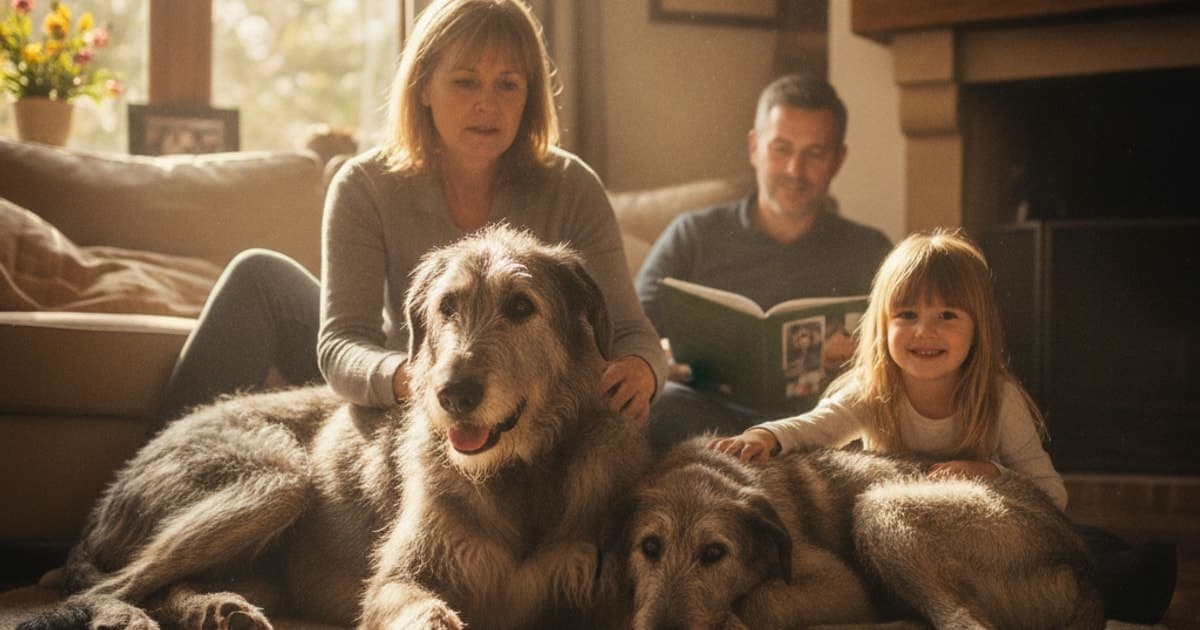
Why Are Irish Wolfhounds Prone to Joint Problems?
Irish Wolfhounds are prone to joint problems because they carry one of the largest skeletons in the domestic dog world, build it in barely a year, and then load it with long-lever limbs and substantial body mass for the rest of a comparatively short life. Three pressures overlap: developmental — how the hip and elbow form during a fast growth window; mechanical — how much force travels through cartilage, tendon and ligament with every stride; and temporal — giant breeds tend to show wear-related joint change at younger ages than small dogs do. None of that is destiny. Genetics set the range, but growth rate, body condition, footing and conditioning decide where inside that range your dog lands.
Growth is the first stress test a wolfhound's joints ever face
A wolfhound puppy goes from a lapful to something taller than a coffee table in a matter of months. During that stretch, growth plates are open, cartilage is soft, and the hip socket and femoral head are still deciding how snugly they fit together. Hip dysplasia is not a single broken part — it is a mismatch between joint laxity and joint congruity that develops while the dog is growing, then drives secondary osteoarthritis for years afterward.
That is why nutrition during the first year matters more in this breed than almost any other lever an owner controls. Veterinary nutrition consensus for large- and giant-breed puppies centres on controlled growth rate and controlled calcium intake — pushing a giant puppy to grow as fast as possible is associated with a higher burden of developmental orthopedic disease. Large-breed puppy diets exist precisely because free-feeding a calorie-dense adult formula to a rapidly growing wolfhound is a known risk.
Body condition matters for life, not just puppyhood. A long-running lifetime feeding study in Labrador Retrievers, published in the Journal of the American Veterinary Medical Association, reported that dogs kept lean showed radiographic signs of hip osteoarthritis later than littermates fed more generously. Keeping an Irish Wolfhound genuinely lean is the single most powerful joint decision an owner makes, and it is free.
Size itself is a mechanical problem, not just a big-dog inconvenience
Scale a dog up and the numbers stop being proportional. Body mass grows with volume, while the cross-sectional area of bone, cartilage and tendon that has to carry it grows more slowly. Add long limbs and you add leverage: the same movement that a terrier absorbs through a short, stiff column becomes a much larger moment arm through a wolfhound's stifle, hock and shoulder.
Practically, that means the ordinary events of a dog's day cost a wolfhound more. Landing off a sofa. Twisting on a tile floor. Scrambling for grip on hardwood. Jumping down from the back of an SUV — which, for a dog this tall, is a genuine drop onto fully extended forelimbs. Repetition is the issue. A single awkward landing rarely breaks anything, but thousands of them across a few years shape how cartilage and the soft tissue around a joint hold up.
The breed's cardiac profile is worth knowing here too. Dilated cardiomyopathy is a recognised concern in Irish Wolfhounds, and exercise tolerance can change for reasons that have nothing to do with joints. If your dog is slowing down, do not assume the hips are the whole story — that is a conversation for your veterinarian, not a self-diagnosis.
Which joints and tissues tend to complain first
- Hips. Dysplasia and the osteoarthritis that follows it are the classic giant-breed pattern. Bunny-hopping, a swaying rear, and difficulty rising from a down are typical.
- Elbows. Elbow dysplasia covers several developmental problems in one joint. Forelimb lameness that is worse after rest and better after a slow warm-up is a common presentation.
- Shoulders. Osteochondrosis affects the shoulder joint surface in fast-growing large breeds and usually shows up in young dogs.
- Stifles. Cranial cruciate ligament disease is a major source of hind-limb lameness in big dogs. It is often degenerative rather than a single traumatic tear — the ligament frays over time, then fails.
- Lumbosacral spine. Long-backed, heavy dogs are candidates for lumbosacral pain that mimics hip disease closely enough to fool an owner.
Soft tissue deserves its own line. Tendon and ligament have limited blood supply compared with muscle, and remodel slowly — the tendon–bone interface reorganises over weeks, not days. That is why a wolfhound with a soft-tissue injury needs a rehabilitation timeline measured in months, and why owners get impatient and let dogs return to full activity too early.
One hard rule: sudden, marked lameness or focal limb pain in a giant breed warrants a prompt veterinary exam and imaging. Osteosarcoma is a recognised concern in large and giant breeds, and it is not something to wait out with rest and a supplement.
The early signs owners tend to miss
Wolfhounds are stoic and undramatic. They rarely yelp. They edit their own behaviour instead, and the edits look like personality changes:
- Taking an extra beat to stand up, especially on smooth floors
- Sitting sloppily, with one hip rolled out to the side
- Choosing the rug route across a room instead of the direct line
- Shorter self-selected walks — turning for home earlier than usual
- Hesitating at stairs or the car, or asking to be helped up
- Licking persistently at one wrist, elbow or stifle
- Declining to play rather than playing and then limping
Film your dog walking away from you and toward you on a level surface, once a month, on your phone. Comparing clips over a season catches asymmetry that daily familiarity hides completely, and it gives your vet something far more useful than "he seems a bit off."
Daily management that genuinely changes the load
| Lever | What it does | Worth knowing |
|---|---|---|
| Lean body condition | Reduces force through every joint on every stride | The highest-impact, lowest-cost change available; ask your vet to score body condition honestly |
| Controlled puppy growth | Supports orderly development of hip and elbow joints | Large/giant-breed puppy nutrition, not free-fed calorie-dense food |
| Traction at home | Removes the slip-scramble events that spike joint load | Runners on hardwood, mats at doorways, nails kept short |
| Ramps over jumps | Eliminates hard landings on extended limbs | Car, sofa, deck steps — a ramp beats a lift for a dog this heavy |
| Steady low-impact exercise | Maintains muscle that stabilises joints | Consistent leash walks and swimming beat weekend-warrior bursts |
| Professional rehab | Targeted strengthening and pain-free range of motion | A certified canine rehab practitioner, on vet referral |
| Hip screening | Identifies laxity and joint conformation early | OFA and PennHIP evaluation, and breeder screening history |
| Veterinary pain management | Controls inflammation and pain so the dog keeps moving | Prescription decisions belong entirely to your vet |
| Targeted recovery support | Supports the tissue-level side of a mobility plan | Where a peptide formulation like K9-REPAIR is used alongside — never instead of — veterinary care |
A note on what to be skeptical about: the joint-chew aisle is full of kitchen-sink formulas that list a dozen trendy ingredients at doses too small to matter, and "per serving" panels written to obscure how little is actually in there. Read the label like a buyer, not a fan. Ask what is in it, how much, and who tested it.
Where BPC-157 and TB-500 fit into a giant-breed mobility plan
BPC-157 is a synthetic peptide sequence derived from a protein found in gastric juice. In published laboratory and animal research it has been studied for its effects on tendon, ligament and muscle tissue models, with attention to angiogenesis — the formation of new blood supply — and to fibroblast migration and growth factor receptor expression. Those are exactly the processes that make soft-tissue recovery slow in a poorly vascularised structure like a ligament.
TB-500 is a synthetic fragment of thymosin beta-4, a naturally occurring actin-binding protein. Research interest centres on cell migration and new blood vessel formation — the housekeeping work tissue does while it reorganises after strain.
This is emerging science, and it is being adopted by owners of large, hard-working, hard-loading dogs for a reason: it targets the soft-tissue layer that glucosamine-style joint products were never designed to address. Research suggests these peptides act on repair-relevant pathways, and owners report using them as part of a structured recovery routine through rehab and into maintenance. BPC-157 and TB-500 are not FDA-approved veterinary drugs, and nothing here should be read as a promise of any outcome for your dog.
pawgen makes K9-REPAIR, a BPC-157 and TB-500 formulation for dogs, dosed by body weight — which matters enormously when the dog in question is a wolfhound rather than a beagle. It is third-party tested with certificates of analysis available, ships direct to your door, and is backed by a 60-day money-back guarantee. Because weight-based dosing and timing around surgery or rehab depend on your dog's specific situation, work those details out with your veterinarian rather than from an internet chart.
Key Takeaways
- Irish Wolfhound joint risk comes from three overlapping forces: rapid giant-breed growth, high mechanical loading, and earlier onset of wear-related change.
- Hips, elbows, shoulders, stifles and the lumbosacral spine are the usual sites; cruciate disease in big dogs is often degenerative rather than traumatic.
- Controlled growth in puppyhood and lifelong lean body condition are the two most powerful levers an owner controls.
- Wolfhounds hide pain — watch for slow rises, sloppy sits, shortened walks and route changes rather than waiting for a limp.
- Sudden lameness or focal limb pain in a giant breed needs prompt veterinary assessment, not a wait-and-see week.
- Research suggests BPC-157 and TB-500 act on tissue-repair pathways, and owners use K9-REPAIR as part of a structured mobility routine alongside veterinary care.
Your veterinarian owns the diagnosis and the treatment plan. Imaging, screening, pain management, surgical decisions and rehabilitation referrals all belong in their hands, and nothing in a supplement or peptide plan should displace a prescription, a scheduled procedure or a recommended rehab protocol. Supplements and peptides work in the space that good veterinary care creates — they make the most sense as one deliberate layer inside a plan your vet already agrees with.
For more on this breed's mobility, see the complete guide to irish wolfhounds, plus deeper reading on joint support for irish wolfhounds, hip dysplasia in irish wolfhounds and arthritis in irish wolfhounds. For contrast at the other end of the size scale, pawgen also covers cockapoos joint problems and common health problems in cockapoos, and the K9-REPAIR formulation page.
Owners exploring peptide support for their dog can review K9-REPAIR — BPC-157 + TB-500 formulated for dogs — at https://pawgen.com/. BPC-157 and TB-500 are not FDA-approved veterinary drugs. Nothing in this article treats, cures or prevents any condition; every decision about your dog's care belongs with your veterinarian.
Frequently asked questions
- How do I know if this applies to my dog?
- It applies to essentially every Irish Wolfhound, because the risk comes from breed size and growth pattern rather than from anything your dog did wrong. Watch for slow rises, sloppy sitting, shortened walks, stair hesitation or route changes across a room. Any of those warrants a veterinary orthopedic exam.
- When should I talk to my veterinarian?
- Before starting any joint plan, and immediately if lameness appears suddenly or one limb becomes focally painful. In giant breeds, abrupt limb pain needs prompt imaging rather than a wait-and-see week. Your vet also owns screening decisions, pain management and any rehabilitation referral your wolfhound may need.
- How long does this usually take?
- Joint and soft-tissue timelines in giant breeds run long. Tendon and ligament have limited blood supply and reorganise over weeks to months, not days, so rehabilitation plans are typically staged across a season. Your veterinarian sets the return-to-activity schedule based on imaging and how the dog is moving.
- What should I do first?
- Book a veterinary exam and get an honest body condition score. Then fix footing at home — runners on hardwood, a ramp for the car, short nails. Those three steps reduce joint load immediately and cost almost nothing, and they make every later decision about imaging or support more effective.
- Does hip dysplasia always cause symptoms in Irish Wolfhounds?
- No. Some dogs with radiographic hip changes move comfortably for years, and some dogs with mild-looking films are visibly sore. Imaging and clinical signs correlate imperfectly, which is why your veterinarian treats the dog in front of them rather than the X-ray alone. Screening still guides long-term planning.
- Can exercise make wolfhound joint problems worse?
- The wrong kind can. Weekend-warrior bursts, hard landings and twisting on slick surfaces spike load through big joints. Consistent low-impact work — steady leash walks, swimming, structured rehab exercises — builds the muscle that stabilises joints. Ask your veterinarian or a certified canine rehab practitioner to set the volume.
- What does K9-REPAIR actually contain?
- K9-REPAIR is a BPC-157 and TB-500 peptide formulation for dogs, dosed by body weight and third-party tested with certificates of analysis available. It ships direct to your door with a 60-day money-back guarantee. These peptides are not FDA-approved veterinary drugs, so discuss use with your veterinarian.
- Can peptides replace surgery or my dog's prescribed medication?
- No. Surgery, prescribed pain control and rehabilitation are decisions your veterinarian makes, and nothing should displace them. Peptide support is used alongside a veterinary plan, not instead of one. Never stop or change a prescribed medication for your wolfhound without speaking to your veterinarian first.
Educational content. BPC-157 and TB-500 are not FDA-approved veterinary drugs. Talk to your veterinarian before starting anything new, especially if your dog is on prescribed medication.