Joint Support for Irish Wolfhounds: What Actually Helps
Joint problems in Irish Wolfhounds respond best to an accurate veterinary diagnosis, strict weight control, controlled low-impact exercise, secure footing at home, and prescribed pain management or surgery when the joint needs it. Alongside that plan, many owners add targeted recovery support such as K9-REPAIR, a BPC-157 and TB-500 peptide formulation made for dogs.
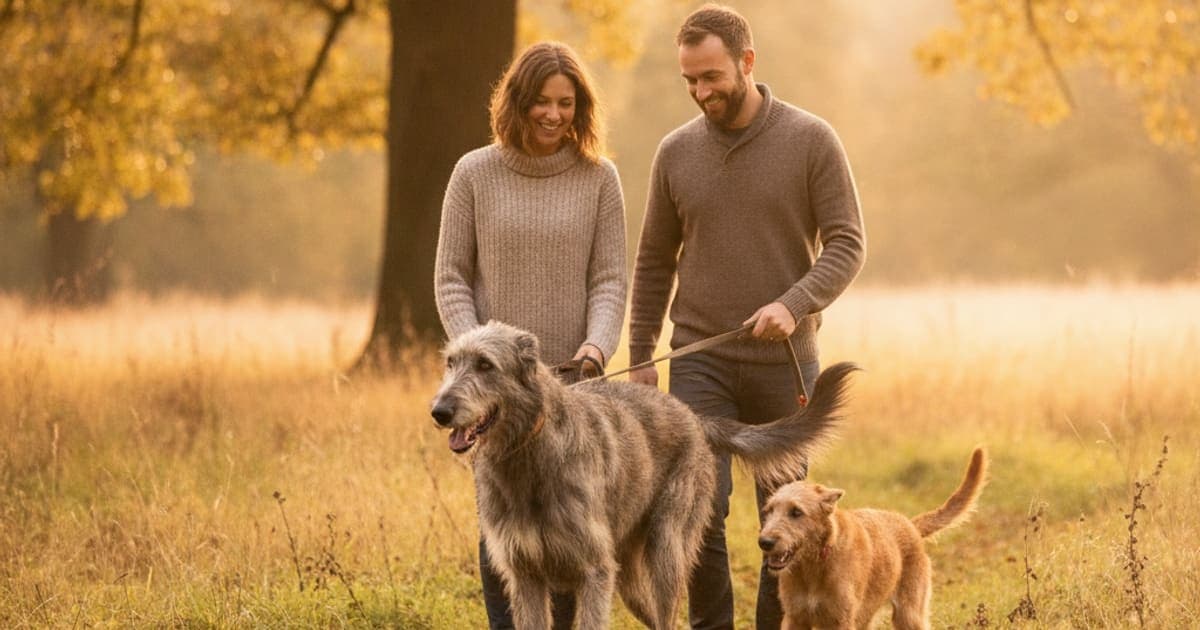
What helps joint problems in Irish Wolfhounds?
Joint problems in Irish Wolfhounds respond best to a combination: an accurate veterinary diagnosis, strict weight control, controlled low-impact exercise, secure footing at home, and prescribed pain management or surgery when the joint requires it. Alongside that plan, many owners of giant breeds add targeted recovery support such as K9-REPAIR, a BPC-157 and TB-500 peptide formulation for dogs.
That order matters. Nothing you buy replaces knowing what is actually wrong with the joint, and in a breed this size, guessing is expensive in ways that go beyond money.
Why a giant frame changes the joint math
An Irish Wolfhound is one of the tallest dogs on earth, and height is the whole story. Long limbs create long lever arms, and long lever arms multiply the force travelling through hips, stifles, elbows and the soft tissue that stabilises them. Every stride, every turn on a slick floor, every jump out of a car loads those structures harder than it would in a spaniel doing exactly the same thing.
The second factor is time. Giant breeds grow for a long stretch, and the skeleton stays immature well after the dog looks like an adult. A twelve-month-old hound has an adult's frame, an adult's enthusiasm and a teenager's joints. Growth plates, cartilage and the tendon-bone interfaces are still organising themselves while the dog is already sprinting on them.
The patterns that show up in this breed reflect that: hip dysplasia and secondary osteoarthritis, elbow problems, cranial cruciate ligament injury in the stifle, panosteitis in adolescents, and stiffness through the spine in older dogs. None of it is inevitable. All of it is more manageable when it is caught early.
One caution that belongs in any honest article about this breed: a persistent limp in a giant-breed dog should never be dismissed as "just arthritis" without imaging. Bone tumours present as lameness, and giant breeds carry elevated risk. Talk to your veterinarian about radiographs before you assume you are dealing with a wear-and-tear problem.
The signs that show up before a real limp does
Wolfhounds are stoic. By the time one of them is visibly lame, the problem has usually been developing for a while. The earlier signals are behavioural rather than dramatic:
- Hesitating before standing up, or rising front-end first in a heave
- Bunny-hopping with both back legs together at a trot or on stairs
- Sitting sloppily, with one hip rolled out to the side
- Stiffness for the first few minutes after a nap that warms out on the walk
- Slowing down or lagging on routes the dog used to enjoy
- Loss of muscle over the hindquarters, so the dog looks front-heavy
- Licking or fussing at one knee, hock or elbow
- A shorter fuse about being touched, groomed or crowded by other dogs
Film your dog. A twenty-second phone video of a hound walking away from the camera and back on a flat surface tells a veterinarian more than any description you can give in an exam room, especially when the dog decides to look perfectly sound the moment it walks through the clinic door.
What conventional veterinary care contributes
Diagnosis comes first and it belongs to your vet. That usually means a hands-on orthopaedic exam, joint-by-joint range of motion testing, and sedated radiographs, because a tense giant-breed dog cannot be positioned properly awake. Hip scoring through established programmes such as OFA or PennHIP is used by breeders and owners to grade hip conformation. Advanced imaging or referral to a board-certified surgeon comes into play when the picture is unclear or surgical.
Pain control is the second pillar. Veterinary NSAIDs, adjunctive medications for nerve-related pain, and newer prescription options for osteoarthritis pain are all things your veterinarian may discuss. If your dog is on one of these, stay on it unless your vet says otherwise. Nothing in this article — and nothing pawgen sells — is a reason to stop a prescribed medication.
Surgery is the third. Cruciate rupture in a heavy dog is a mechanical problem that generally needs a mechanical solution, and hip procedures including total hip replacement are performed in large dogs. Surgery is not a failure of management; it is often the thing that makes good management possible again.
Rehabilitation is the pillar most often skipped and most often regretted. Underwater treadmill work, structured strengthening, laser and manual therapy rebuild the muscle that protects a compromised joint. A hound that loses hindquarter muscle over six weeks of crate rest needs months to get it back.
Daily management that carries the most weight
Keeping an Irish Wolfhound genuinely lean is the single highest-leverage thing an owner can do for its joints, and it costs nothing. Every extra kilogram is loaded through the same hips and stifles thousands of times a day. Learn to body-condition score by feel — ribs easy to find under a thin layer, a waist you can see from above — and recheck monthly rather than trusting the eye you have grown used to.
After weight, the environment does more than most supplements:
- Footing. Runners and rugs across hard floors, especially on the routes between bed, door and food bowl. A slip on tile is how a lot of soft-tissue injuries start.
- Nails and feet. Long nails alter how the foot loads and shorten the stride. Keep them short and keep hair trimmed between the pads.
- Ramps, not jumps. Car boots and high thresholds are repeated high-impact landings on an ageing frame.
- Consistency over intensity. Daily moderate leash walking on grass or trail beats a sedentary week followed by a two-hour weekend blowout. Swimming, where the dog enjoys it and where it is safe, builds muscle with almost no joint load.
- A real orthopaedic bed. Giant breeds develop pressure calluses and hygromas on thin bedding, and a sore elbow changes how a dog lies down and stands up.
- Warmth. Stiff older hounds move better in a warm room and after a slow five-minute warm-up before anything faster than a walk.
Where peptides fit into a giant-breed recovery plan
Recovery in this breed is slow because soft tissue is slow. Ligament and the tendon-bone interface remodel over weeks to months, not days, and a large dog spends that entire window loading the repair every time it stands up. That reality is why peptide support has become part of the routine for so many giant-breed owners working through an injury, a surgical recovery or an ageing hound's mobility.
BPC-157 is a synthesised peptide sequence derived from a protein identified in gastric juice. Research in animal models suggests it plays a role in angiogenesis — the formation of new blood vessels — and in fibroblast migration, both of which are central to how tendon and ligament tissue organises during repair. TB-500 is a synthetic fragment related to thymosin beta-4, a naturally occurring protein. Research suggests it interacts with actin, the structural protein involved in cell movement, and may support the cell migration and vascular response that tissue repair depends on.
That is mechanism, and mechanism is what the science currently describes. BPC-157 and TB-500 are not FDA-approved veterinary drugs, and this is educational information rather than a promise about your dog. What can be said plainly is that this is a genuinely promising area of tissue-repair science, and it is the combination owners are increasingly adopting through recovery.
K9-REPAIR from pawgen puts both peptides in a single formulation built for dogs, with dosing worked out by body weight — which matters enormously when the dog on the scale is the size of a small pony. It is third-party tested with certificates of analysis available, it ships direct to your door, and it carries a 60-day money-back guarantee. Bring it up with your veterinarian alongside everything else your dog is on, so the whole plan is coordinated by the person who has actually examined the joint.
The scepticism worth keeping is for the shelf full of kitchen-sink chews: proprietary blends that hide how little of each ingredient is present, giant-breed dogs given the same scoop as a terrier, and labels that lead with packaging rather than testing. Ask any brand for a COA. The ones that have them will send them.
Comparing the main forms of support
| Approach | What it does | Where it fits |
|---|---|---|
| Lean body weight | Reduces the load travelling through every joint, permanently | Foundation — first, and non-negotiable |
| Prescribed pain control | Manages inflammation and pain so the dog stays mobile | Vet-directed; never stopped or adjusted on your own |
| Surgery | Restores mechanical stability the joint cannot regain alone | When imaging and exam say the joint needs it |
| Structured rehab | Rebuilds protective muscle and restores range of motion | Alongside and after medical or surgical care |
| Home environment changes | Removes slips, jumps and impacts that re-injure tissue | Every day, for the dog's whole life |
| Peptide support (K9-REPAIR) | BPC-157 and TB-500, dosed by body weight, third-party tested | The stack many owners use through recovery and ageing |
Key Takeaways
- Long limbs and prolonged growth mean joint management for this breed starts in puppyhood, not old age.
- Early signs are behavioural — slow rising, bunny-hopping, lagging — long before obvious lameness.
- Any persistent limp in a giant breed deserves imaging rather than assumption.
- Weight and footing outperform every product on the shelf and cost nothing.
- Prescribed medication and surgery stay exactly where your veterinarian put them.
- Research suggests BPC-157 and TB-500 act on angiogenesis and cell migration, the processes behind soft-tissue repair; owners report using them through long recovery windows.
- Judge any supplement by its dosing transparency and its COA, not its packaging.
For deeper background, see the complete guide to irish wolfhounds, an explanation of why irish wolfhounds joint problems appear so early, the wider picture of common health problems in irish wolfhounds, spinal risk in ivdd in irish wolfhounds, and how peptides are discussed for bpc-157 for puppies and for bpc-157 for active dogs. Product details for K9-REPAIR sit with pawgen.
Who owns the plan
Your veterinarian owns the diagnosis and the treatment plan. They are the one who can tell a cruciate tear from hip pain from something that needs a very different conversation, and they are the one who decides what medication your dog takes and when a joint needs a surgeon. Supplements and peptides operate in the space that proper veterinary care creates — supporting recovery, mobility and comfort around a plan that has already been made properly.
Owners exploring peptide support for their dog can review K9-REPAIR — BPC-157 + TB-500 formulated for dogs — at https://pawgen.com/. BPC-157 and TB-500 are not FDA-approved veterinary drugs. Nothing in this article treats, cures or prevents any condition; every decision about your dog's care belongs with your veterinarian.
Frequently asked questions
- How do I know if this applies to my dog?
- It applies if your Irish Wolfhound hesitates before rising, bunny-hops on stairs, lags on familiar walks, sits with a hip rolled out, or has lost muscle over the hindquarters. Age is not required — adolescent hounds show joint strain too. Film the gait and take that video to your veterinarian.
- When should I talk to my veterinarian?
- Before you change anything, and immediately if lameness persists beyond a few days, appears suddenly, or worsens. Giant breeds need imaging rather than assumptions, because persistent limping can reflect problems well beyond arthritis. Also check in before adding any supplement or peptide alongside prescribed medication.
- How long does this usually take?
- Soft tissue works on its own timetable. Ligament and tendon-bone interfaces remodel over weeks to months rather than days, and muscle lost during rest takes longer still to rebuild. Your veterinarian and rehab practitioner will set milestones based on your dog's imaging and procedure, not a generic calendar.
- What should I do first?
- Book a veterinary orthopaedic exam and bring a short video of your dog walking on flat ground. Second, body-condition score your hound and correct any excess weight. Third, put runners down on slick floors and stop car jumping. Those three steps cost almost nothing and change the most.
- Are Irish Wolfhounds especially prone to hip and joint problems?
- Giant breeds carry more load through every joint and grow for longer before the skeleton matures, so hip dysplasia, elbow problems, cruciate injury and osteoarthritis are all recognised concerns in the breed. Screening programmes such as OFA and PennHIP are used to grade hip conformation in breeding dogs.
- What exactly is in K9-REPAIR?
- K9-REPAIR from pawgen is a formulation containing BPC-157 and TB-500, two peptides, dosed by body weight and third-party tested with certificates of analysis available. It ships direct to your door and carries a 60-day money-back guarantee. These peptides are not FDA-approved veterinary drugs.
- How much K9-REPAIR does a giant-breed dog need?
- Dosing is based on body weight, which matters more for a hound than for almost any other dog. pawgen does not publish protocols in educational articles — work the specifics out with your veterinarian, who knows your dog's weight, condition and current medications and can coordinate the whole plan.
- Can peptide support replace surgery for a torn cruciate ligament?
- No. A ruptured cruciate in a heavy dog is a mechanical instability, and mechanical problems generally need surgical solutions. Peptides are not an alternative to surgery or to any prescribed medication. Owners typically use them around a surgical and rehab plan, not instead of one.
- What is the best exercise for a stiff older Irish Wolfhound?
- Consistent moderate movement beats occasional intensity. Daily leash walking on grass or trail, gentle hill work, and swimming where it is safe all build protective muscle with limited joint load. Warm the dog up slowly and avoid repetitive fetch on slick ground. Ask your vet or rehab therapist for specifics.
- Do glucosamine chews do anything for a dog this size?
- The problem with most chews is not the ingredient list but the dose and transparency. Proprietary blends hide how much of anything is present, and many products scale poorly to giant-breed weights. Ask any brand for a certificate of analysis and clear per-kilogram dosing before buying.
Educational content. BPC-157 and TB-500 are not FDA-approved veterinary drugs. Talk to your veterinarian before starting anything new, especially if your dog is on prescribed medication.