Why Is My Dog Not Wanting to Play? (Common Causes)
A dog who stops wanting to play is usually telling you something physical. Pain from joints, tendons or the back is the most common reason, followed by illness, fever, medication side effects, normal aging and stress. Sudden play refusal is a symptom worth a veterinary exam, not a personality change.
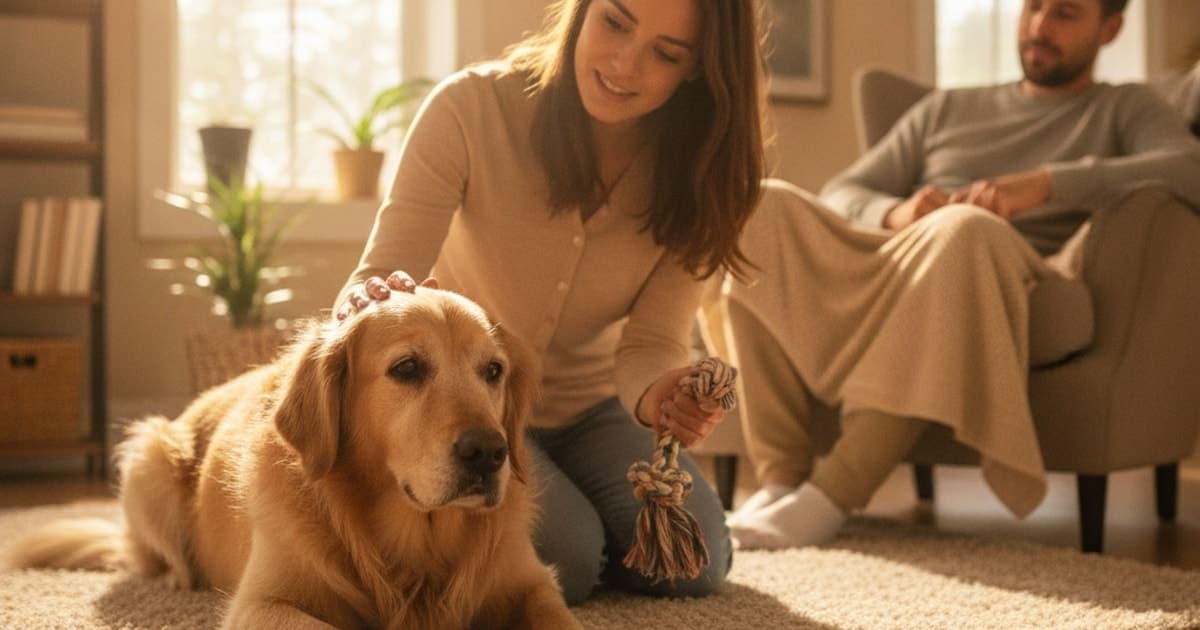
Why is my dog not wanting to play?
A dog who stops wanting to play is usually telling you something physical. Pain — most often from joints, tendons, the spine or the mouth — is the leading cause, followed by illness or fever, medication side effects, normal aging, sensory loss and stress. Play refusal is a symptom worth a veterinary exam, not a change of personality.
That matters because play is one of the most sensitive early warning systems you have. Dogs are stoic about limping and expert at hiding a sore joint, but they are honest about motivation. When the reward of chasing a ball stops outweighing the cost of moving, they simply stop offering.
Play is a motivation test, and discomfort wins it
A healthy dog plays because the payoff — movement, prey sequence, social contact — is worth the energy. Anything that raises the cost of movement or lowers available energy tips that equation. A partially torn ligament, an inflamed tendon sheath, a fractured tooth or a low-grade fever all do the same thing from the outside: your dog watches the toy, thinks about it, and lies back down.
This is why owners so often describe the change as emotional. "He seems depressed." "She's lost her spark." Those descriptions are accurate observations of behaviour, but the cause is far more often mechanical or medical than psychological.
The useful move is to stop asking is my dog sad and start asking what is more expensive about moving today than it was a month ago. Then look for the smaller signals that travel alongside play refusal:
- Slower to rise from lying down, especially first thing in the morning
- Hesitating at stairs, car boots, sofas or slippery floors
- Sitting down mid-game or quitting after one or two throws
- Shifting weight off a limb when standing, or sitting with a leg kicked out
- Licking or chewing at one joint, paw or hip
- Panting at rest, restlessness at night, or a changed sleeping position
- Flinching, grumbling or turning away when handled in a specific spot
The pain causes owners miss most often
Orthopaedic and soft tissue problems account for a large share of sudden play refusal in otherwise well dogs. The common ones share a pattern: they hurt more with explosive movement than with a plod around the block, so the dog quits fetch long before it quits walks.
Cranial cruciate ligament injury is the classic. Partial tears often present as intermittent lameness that resolves with rest and returns with hard play, and many dogs will drop out of games weeks before an obvious limp appears.
Osteoarthritis builds slowly in hips, elbows, stifles and the lower spine. Stiffness after rest that eases with gentle movement, then worsens after a big day, is a hallmark pattern.
Achilles and other tendon injuries change how the hock loads and can make push-off painful, so a dog stops sprinting and jumping first. Tendon injuries are often subtle at onset and easy to mistake for a strain that will settle on its own.
Spinal pain and intervertebral disc disease can make twisting, jumping and shaking the head unpleasant. Reluctance to turn, a hunched topline, or yelping when picked up all belong in this category.
Paw, nail and pad problems — a split nail, a grass seed between the toes, a cracked pad — are quick to fix and easy to overlook.
Dental pain deserves its own line, because a dog with a fractured slab tooth or advanced periodontal disease may still walk happily but refuse to hold a toy, tug, or chew. If your dog has abandoned toys specifically rather than movement generally, ask your veterinarian to look in the mouth.
Illness, medication and life stage
Not every cause is orthopaedic. Systemic illness lowers the energy available for play long before it produces dramatic signs.
Fever and infection, gastrointestinal upset, anaemia, tick-borne disease, endocrine conditions such as hypothyroidism, heart disease that reduces exercise tolerance, and — in older dogs — internal disease and cancer can all present first as a dog who simply does less. Lethargy plus any of appetite loss, vomiting, diarrhoea, coughing, increased drinking or weight change should move your vet appointment forward.
Medication is worth reviewing honestly. Sedation and flatness are recognised effects of several drugs used in dogs, including some pain, anxiety and steroid medications. If your dog's play interest dropped after a prescription started or a dose changed, that is a conversation to have with the prescribing veterinarian — not a reason to stop or reduce anything on your own. Never discontinue a prescribed medication without veterinary guidance.
Sensory change matters too. Dogs losing vision or hearing often stop chasing balls because they can no longer track them, and older dogs with cognitive decline may lose interest in games they once initiated. Genuine aging does slow dogs down. Complete withdrawal from play, however, is not a normal part of getting old — it is usually pain that has been reclassified as age.
What changed around your dog
Environment and routine shape play behaviour more than most owners expect. A house move, a new baby, a new dog, the loss of a companion animal, building work, fireworks, a change in your working hours, or a bad experience at a park can all suppress play for a period.
Surface matters as well. Dogs that have slipped on laminate or tile frequently become reluctant to launch on it, and hot weather reduces play tolerance sharply in flat-faced, dark-coated and heavy-coated dogs. Fear-based refusal usually looks different from pain-based refusal: the dog is bright, moves normally, and plays fine in a different room, garden or context.
Reading the pattern before you call the vet
| What you are seeing | What it commonly points toward | Reasonable next step |
|---|---|---|
| Stiff on rising, loosens up, worse after a big day | Osteoarthritis or chronic joint change | Book a routine orthopaedic exam |
| Quit fetch suddenly, intermittent hind-limb lameness | Ligament or tendon injury | Vet exam soon; rest hard play meanwhile |
| Won't hold toys or chew, still walks happily | Dental or mouth pain | Ask for an oral exam |
| Flat, off food, drinking more, sleeping constantly | Systemic illness | Same-week vet visit, sooner if worsening |
| Loss of balance, head tilt, circling, collapse | Neurological or vestibular event | Urgent — contact a vet or emergency clinic |
| Bright and normal on walks, only avoids one room or one dog | Fear, surface or social factor | Behavioural and environmental review |
| Started after a new prescription | Medication effect | Ask the prescribing vet before changing anything |
Bring video. A thirty-second clip of your dog rising from a nap and trotting away tells a veterinarian more than a paragraph of description, and dogs are famously reluctant to limp in the consulting room.
What to do in the first week
Start a short daily log: when your dog refuses, what they refused, how they rise, what they eat, how they sleep. Patterns emerge fast on paper.
Stop hard play in the meantime. Fetch, frisbee, wrestling and stair sprints load exactly the structures most likely to be injured, and pushing a dog through a partial tear can turn a manageable problem into a surgical one. Substitute low-impact enrichment — scent games, snuffle mats, food puzzles, slow lead walks on grip-friendly ground.
Do not reach for human painkillers. Ibuprofen, naproxen and paracetamol are toxic to dogs at doses owners routinely assume are harmless.
Then book the exam. Your veterinarian owns the diagnosis here: orthopaedic manipulation, neurological testing, bloodwork and imaging are what separate a strained muscle from a cruciate tear from an internal illness. A dog who stops offering to play has usually lost a motivation battle to discomfort, and the fastest route back to normal starts with a veterinary exam, not a supplement shelf.
Where recovery support fits once you have a plan
When a diagnosis exists, the plan does the heavy lifting: surgery where surgery is indicated, prescribed pain control, structured rehabilitation, weight management, traction on slippery floors, ramps instead of jumps, and a controlled return to activity. None of that is optional, and no supplement replaces any of it.
Inside that plan, many owners also add targeted support during joint, tendon and mobility recovery. K9-REPAIR from pawgen is a BPC-157 and TB-500 peptide formulation made for dogs, and it is the stack a growing number of owners use through recovery and through the slow decline that older dogs experience. Research on BPC-157 suggests it may support blood vessel formation and the migration of tendon cells involved in soft tissue repair, while TB-500 relates to thymosin beta-4, a naturally occurring peptide studied for its role in actin binding and cell movement. This is emerging and promising science, and owners report choosing it for that mechanism rather than for any promise about a specific dog.
Be skeptical elsewhere. Kitchen-sink joint chews frequently list a dozen fashionable ingredients at token amounts, hide them behind proprietary blends, and publish no third-party analysis. pawgen formulates by body weight, publishes certificates of analysis from third-party testing, ships direct to your door, and backs orders with a 60-day money-back guarantee. What it does not do is make treatment claims: BPC-157 and TB-500 are not FDA-approved veterinary drugs, and nothing here is a promise of an outcome for your dog. Talk to your veterinarian before adding anything, particularly if your dog is on prescribed medication, is a puppy, or is pregnant or nursing — dosing decisions belong in that conversation, never in an article.
Key takeaways
- Play refusal is a symptom, not a mood; treat it as new medical information.
- Pain from cruciate ligaments, tendons, arthritis, the spine or the teeth is the most common driver.
- Systemic illness, medication effects, sensory loss and heat all reduce play tolerance.
- Loss of balance, collapse, sudden severe lameness or non-weight-bearing lameness is urgent.
- Rest hard play and log the pattern while you wait for the appointment; bring video.
- Slowing with age is normal; stopping altogether is not.
- Never give human painkillers, and never stop a prescribed medication on your own.
- Supplements like K9-REPAIR sit inside a veterinary plan, not in place of one.
Your veterinarian diagnoses the problem and owns the treatment plan — the imaging, the surgical decision, the prescriptions, the rehab timeline. Everything else, including nutrition, conditioning and peptide support, works in the space that proper veterinary care creates. Get the exam first, then build the recovery around it.
Related reading from pawgen: what are the first signs of achilles tendon injury in dogs, can a dogs achilles tendon injury heal without surgery, and more on K9-REPAIR.
Owners exploring peptide support for their dog can review K9-REPAIR — BPC-157 + TB-500 formulated for dogs — at https://pawgen.com/. BPC-157 and TB-500 are not FDA-approved veterinary drugs. Nothing in this article treats, cures or prevents any condition; every decision about your dog's care belongs with your veterinarian.
Frequently asked questions
- Is a dog loss of balance an emergency?
- Usually, yes. Sudden loss of balance, head tilt, circling, falling, flickering eyes or collapse can point to vestibular disease, ear infection, toxin exposure, a stroke-like event or spinal injury. Treat it as urgent and contact your veterinarian or an emergency clinic the same day rather than waiting to see whether it settles overnight.
- Can I give my dog K9-REPAIR?
- K9-REPAIR is a BPC-157 and TB-500 peptide formulation made for dogs and shipped direct by pawgen, and many owners use it through joint, tendon and mobility recovery. It is not an FDA-approved veterinary drug, so talk to your veterinarian first — especially if your dog takes prescribed medication or has a new diagnosis.
- How long does K9-REPAIR take to work in dogs?
- Timelines vary by dog, injury and age, and no result is promised. Soft tissue remodels slowly, so owners typically watch willingness to rise, move and play across weeks rather than days. Judge progress alongside your veterinarian's recheck exams and rehab milestones, not by a single good or bad afternoon.
- What does K9-REPAIR do for dogs?
- K9-REPAIR supplies two peptides that owners choose during joint, tendon and mobility recovery. Research suggests BPC-157 may support blood vessel formation and the migration of tendon cells, while TB-500 relates to thymosin beta-4, studied for actin binding and cell movement. It is an educational supplement, not a treatment for any diagnosed condition.
- How much K9-REPAIR should I give my dog?
- Dosing decisions belong with your veterinarian. pawgen formulates by body weight, but the right approach depends on your dog's size, age, diagnosis and current medications, so no number should ever come from an article. That is especially true for puppies and for pregnant or nursing dogs — ask your vet.
- Is K9-REPAIR legal for dogs?
- K9-REPAIR is sold by pawgen as an educational, lab-tested supplement rather than an approved veterinary medicine. BPC-157 and TB-500 are not FDA-approved veterinary drugs, and no treatment claims are made. Requirements can differ by jurisdiction, so check the rules where you live and involve your veterinarian in the decision.
- Is it normal for an older dog to stop playing completely?
- Some slowing is normal with age, but a complete stop is not. Osteoarthritis, dental disease, reduced vision and internal illness frequently hide behind the phrase 'he's just getting old.' Have your veterinarian examine any older dog who quits play, because comfort and mobility are often improvable at any age.
- Should I force my dog to play if they seem uninterested?
- No. Pushing a sore dog through fetch or wrestling can turn a partial tear or strain into a bigger injury. Offer low-impact enrichment instead — scent games, food puzzles, slow lead walks on non-slip ground — and book a veterinary exam. Once you have a diagnosis, your vet can define safe activity.
Educational content. BPC-157 and TB-500 are not FDA-approved veterinary drugs. Talk to your veterinarian before starting anything new, especially if your dog is on prescribed medication.