Why Is My Dog Stiff After Swimming? (Causes Explained)
Most dogs are stiff after swimming because water recruits muscles they rarely use while removing the impact feedback that normally tells them to slow down. Cool water and a hyperextended spine add to it. Mild soreness that clears within a day is common, but a limp or a dropped tail deserves a veterinary exam.
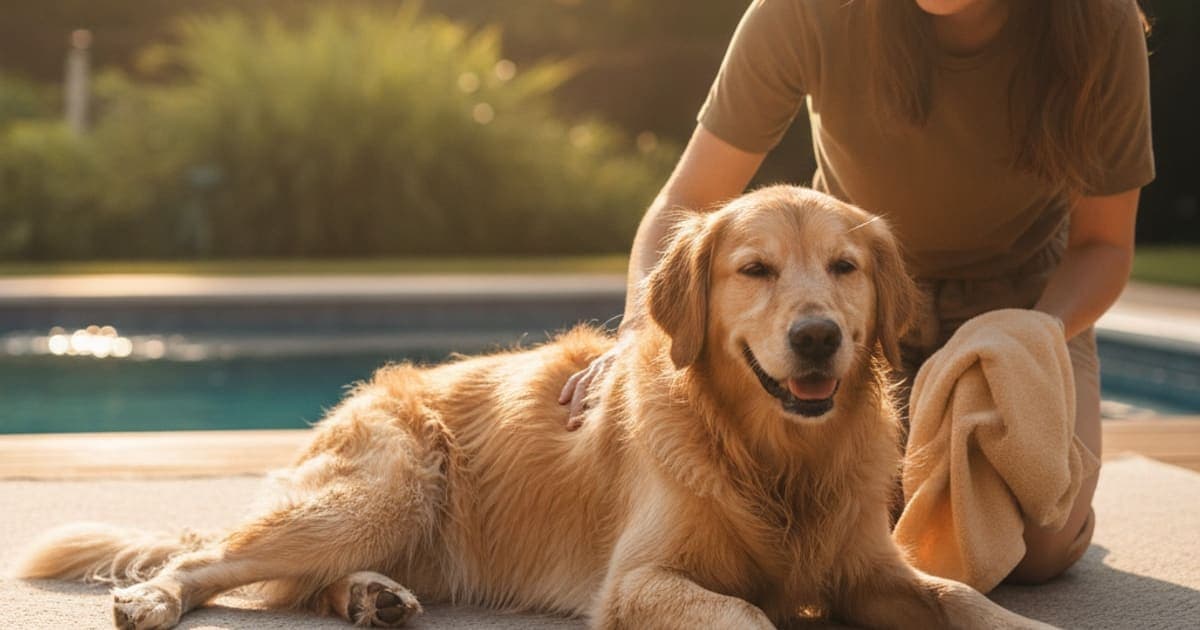
Why is my dog stiff after swimming?
Most dogs are stiff after swimming because water recruits muscles they rarely use while removing the impact feedback that normally tells them to slow down. Cool water and a hyperextended spine add to it. Mild soreness that clears within a day is common, but a limp or a dropped tail deserves a veterinary exam.
That is the short version. The longer version matters, because "my dog is stiff after swimming" covers everything from a happy Labrador who overdid a first swim of the season to a dog whose partially torn cruciate ligament only becomes obvious once the water asks the joint to work through a full range of motion. Knowing which one you are looking at changes what you do next.
Swimming is low-impact, not low-effort
Buoyancy takes concussive load off the joints — that is exactly why swimming is used so widely in canine rehabilitation. But removing impact does not remove work. Water is roughly 800 times denser than air, so every stride your dog takes is a resistance repetition against a medium that pushes back the entire way through the movement.
A swimming dog is also not moving the way a running dog moves. The forelimbs do most of the propulsion in a paddling pattern that heavily recruits the shoulder and chest musculature — latissimus dorsi, deltoids, triceps, pectorals. The head stays elevated to keep the airway clear, which holds the neck and lumbar spine in extension for the whole swim. The epaxial muscles running along either side of the spine work continuously to hold that posture. The hip extensors and the iliopsoas fire to drive the hind end and stabilise the pelvis. The tail acts as a rudder.
Most dogs simply do not use that combination anywhere else in their week. A dog who walks two miles a day is well conditioned for walking two miles a day. Twenty minutes of hard paddling is an unfamiliar stimulus applied to muscles that have no recent training history — and unfamiliar stimulus is the single most reliable trigger for soreness.
The second half of the problem is regulation. On land, a dog who is tiring feels it through impact: the paws hit harder, the gait shortens, the dog slows. In water, those signals are muted, adrenaline is high, and there is usually a ball involved. Dogs routinely swim well past the point where they would have voluntarily stopped running.
Why the soreness usually shows up hours after the swim
Owners are often confused by the timing. The dog swims, shakes off, trots to the car looking fine, and then struggles to get off the bed the next morning. That delay is characteristic of delayed onset muscle soreness, which reflects microscopic damage to muscle fibres from unaccustomed loading and the inflammatory repair response that follows it. Soreness of this type typically builds over the hours after activity rather than appearing immediately, and it tends to be worst on rising after a long rest.
The practical signature of ordinary post-swim soreness is fairly consistent: the dog is generally slow and reluctant rather than lame on one limb, stiffness is worst on first movement and loosens with gentle walking, and things are noticeably better within a day or two. There is no swelling, no heat over a joint, no yelp when you handle a limb.
Car rides make it look worse than it is. A dog who curls up damp in a crate for forty minutes after hard exercise comes out cold and set. The stiffness you see in the driveway is partly soreness and partly the fact that connective tissue and muscle stiffen when they cool while a dog is immobile.
Cold water, limber tail and the parts owners forget
Water temperature does real work here. Cold water drives peripheral vasoconstriction and increases the stiffness of muscle and connective tissue, while a dog swimming hard in cold water burns a large amount of energy simply maintaining core temperature. Dogs who swim in cold lakes, rivers or unheated pools in early spring tend to be markedly stiffer afterwards than the same dogs swimming in warm water in midsummer.
Cold water and hard swimming are also the classic setup for acute caudal myopathy, better known as limber tail or swimmer's tail. The tail hangs limp from the base, or sticks out horizontally for an inch or two and then drops. Dogs are often painful at the tail base, reluctant to sit squarely, and sometimes reluctant to lift the tail to defecate. It is a strain injury of the tail musculature and it is genuinely uncomfortable. It usually resolves with rest, but it is worth a veterinary visit, because a dropped tail can also mean a fracture, an anal gland problem or a lumbosacral issue — and those need very different management.
The iliopsoas is the other commonly overlooked structure. It flexes the hip and stabilises the lower spine, it works hard in swimming, and strains of it produce exactly the picture owners describe as "stiff in the back end after swimming" — shortened hind stride, reluctance to jump into the car, discomfort when the hip is extended.
When stiffness is a signal rather than simple soreness
Stiffness that appears after every swim, lasts more than a day or two, or shows up as a limp on one limb rather than a general slowness is not conditioning — it is a signal worth a veterinary exam.
Swimming is a very effective way of unmasking problems that a dog has been quietly compensating for on land. Water asks joints to move through a full arc without the dog being able to shorten stride to avoid the painful part of it, so partial cruciate tears, hip dysplasia, elbow arthritis and lumbosacral disease frequently declare themselves after a swim rather than after a walk.
| What you are seeing | What it often points to | Sensible next step |
|---|---|---|
| Generally slow and sore, both sides, better within a day or two | Unaccustomed muscle work and delayed soreness | Rest, gentle walking, build swim duration gradually |
| Limp isolated to one limb, or a head bob when trotting | Joint, ligament or soft-tissue injury rather than soreness | Veterinary exam — lameness in one limb is not soreness |
| Sits with one hind leg kicked out to the side; slow to rise | Cruciate ligament strain or partial tear; hip pain | Veterinary exam, stop swimming until assessed |
| Tail limp or dropped from the base, painful to touch | Acute caudal myopathy or another tail-base problem | Rest and a veterinary check to rule out fracture |
| Stiffness that never fully clears and worsens over weeks | Osteoarthritis or another progressive condition | Veterinary workup, imaging if indicated |
| Hind end weakness, knuckling paws, scuffed nails, no pain | Neurological rather than orthopaedic | Veterinary neurological assessment |
That last row matters more than owners expect. A dog whose hind end is unsteady after swimming, whose paws knuckle over, and who does not seem painful is showing a neurological pattern, not a musculoskeletal one — and the difference is one your veterinarian is equipped to make and you are not. If your dog is a breed with a known predisposition to degenerative myelopathy, that conversation should happen sooner rather than later.
Building recovery into water work instead of hoping for it
Most post-swim stiffness responds to structure rather than intervention.
Warm up before the swim. Five to ten minutes of brisk walking before your dog hits the water raises muscle temperature and gets tissue ready to work. Cool down afterwards with an easy walk on flat ground instead of loading a cold, wet, tired dog straight into a crate.
Progress duration honestly. The first swims of the year should be short — far shorter than your dog wants. Add time across weeks, not within a single session.
Dry the dog, especially in cool weather, and especially the lumbar region and tail base. Keep the dog moving gently for the first part of the car ride home if you can.
Manage bodyweight, because every extra kilogram is load carried through the same joints on land, where buoyancy is not helping.
And support the tissue that is actually doing the adapting. Muscle, tendon and ligament remodel slowly, over weeks, and they remodel best when a dog is fed well, rested properly and not asked to repeat the same overload before the repair is finished. This is the space where owners increasingly look at targeted peptide support rather than the broad multi-ingredient chews that dominate the shelf — many of which carry long ingredient lists at quantities too small to do much of anything, which is a marketing decision rather than a formulation one.
K9-REPAIR from pawgen takes the opposite approach: two peptides, BPC-157 and TB-500, at weight-based dosing, third-party tested with certificates of analysis and shipped direct to the door with a 60-day money-back guarantee. BPC-157 is a peptide sequence originally identified in gastric juice, and published research suggests it may support angiogenesis and the migration of tendon and ligament fibroblasts — the cells that lay down new connective tissue. TB-500 is related to thymosin beta-4, a naturally occurring protein that binds actin, and research suggests it may support cell migration and new blood vessel formation in healing tissue. Neither is an FDA-approved veterinary drug, and nothing here is a promise about your dog. It is emerging and promising science that a growing number of owners are adopting as part of the stack they run through recovery and through the working season, and it is a reasonable thing to raise with your veterinarian alongside whatever else your dog is on.
Key takeaways
- Swimming removes impact but adds resistance and unfamiliar muscle recruitment, so soreness afterwards is common and usually peaks hours later.
- Cool water increases stiffness and is associated with limber tail, a painful strain of the tail musculature that warrants a veterinary check.
- General, symmetrical, short-lived stiffness is usually soreness. A limp on one limb is an injury until proven otherwise.
- Water often unmasks pre-existing cruciate, hip, elbow or lumbosacral problems that a dog has been hiding on land.
- Hind end weakness with knuckling and no pain is a neurological pattern and needs veterinary assessment, not rest and hope.
- Warm-ups, gradual progression, drying off and honest weight management do more for post-swim stiffness than anything you can buy.
Your veterinarian owns the diagnosis and the treatment plan — the orthopaedic exam, the imaging, the pain protocol, the rehabilitation referral. Nothing in a supplement cupboard substitutes for finding out what is actually wrong with the limb, and nothing should ever be a reason to stop or reduce a medication your vet has prescribed. Conditioning, recovery routines and products like K9-REPAIR operate in the space that proper veterinary care creates, not in place of it.
Related reading from pawgen: is degenerative myelopathy in dogs painful, what makes degenerative myelopathy worse in dogs, and more on K9-REPAIR.
Owners exploring peptide support for their dog can review K9-REPAIR — BPC-157 + TB-500 formulated for dogs — at https://pawgen.com/. BPC-157 and TB-500 are not FDA-approved veterinary drugs. Nothing in this article treats, cures or prevents any condition; every decision about your dog's care belongs with your veterinarian.
Frequently asked questions
- Should I worry if my dog is limping on a back leg?
- A limp on a back leg is worth taking seriously, because it usually means pain or instability in a specific structure rather than general soreness. A brief limp that resolves within a day after hard exercise may be a minor strain. Anything persistent, worsening, or paired with swelling warrants a veterinary exam.
- When should I take a dog to the vet for limping on a back leg?
- Book an exam if the limp lasts more than about a day, recurs after every session of exercise, or worsens. Go sooner if there is swelling, heat, an obvious wound, a yelp on handling, or if your dog cannot bear weight at all. Non-weight-bearing lameness should be seen promptly.
- What can I give a dog that is limping on a back leg?
- Do not give human painkillers — ibuprofen, paracetamol and aspirin can be dangerous for dogs. Rest and confinement are the safest immediate steps. Pain relief should come from your veterinarian, who can choose an appropriate medication after examining the limb. Ask your vet before adding any supplement or peptide support.
- Is a dog limping on a back leg an emergency?
- Sometimes. Treat it as urgent if your dog cannot bear any weight, the leg hangs or looks deformed, there is significant swelling or bleeding, or the limp followed a car accident or a fall. Sudden severe pain, collapse, or both hind legs affected at once also justifies immediate veterinary attention.
- Why is my dog limping after exercise?
- Exercise loads joints and soft tissue through a fuller range than everyday movement, which frequently reveals problems a dog compensates for at rest — partial cruciate tears, hip dysplasia, elbow arthritis or muscle strains. Fatigue also degrades coordination late in a session, making minor injuries more likely toward the end.
- Should I worry if my dog is limping after exercise?
- A single mild limp that clears with a day of rest is usually a minor strain. A limp that appears after every session, involves one specific limb, or gradually gets worse over weeks is a pattern, not a one-off, and should be assessed by your veterinarian before you continue the activity.
- How long should stiffness after swimming last?
- Ordinary post-swim soreness is generally worst on rising the next morning and eases substantially within a day or two, improving as the dog moves gently. Stiffness lasting longer, returning after every swim, or presenting as a limp on one leg rather than overall slowness should be checked by a veterinarian.
- Is swimming still good for a dog with arthritis?
- Swimming is widely used in canine rehabilitation because buoyancy reduces impact through arthritic joints while still building muscle. It can still cause soreness if sessions are too long or the water is cold. Ask your veterinarian or a qualified canine rehabilitation therapist to set an appropriate duration and progression.
Educational content. BPC-157 and TB-500 are not FDA-approved veterinary drugs. Talk to your veterinarian before starting anything new, especially if your dog is on prescribed medication.