Why Is My Puppy Having Potty Training Regression? (Causes)
Puppy potty training regression usually means something changed: a medical problem like a urinary tract infection or parasites, a developmental stage such as teething or adolescence, or a disruption to routine. Ask your vet to rule out a medical cause first, then rebuild the habit with tighter supervision and a strict schedule.
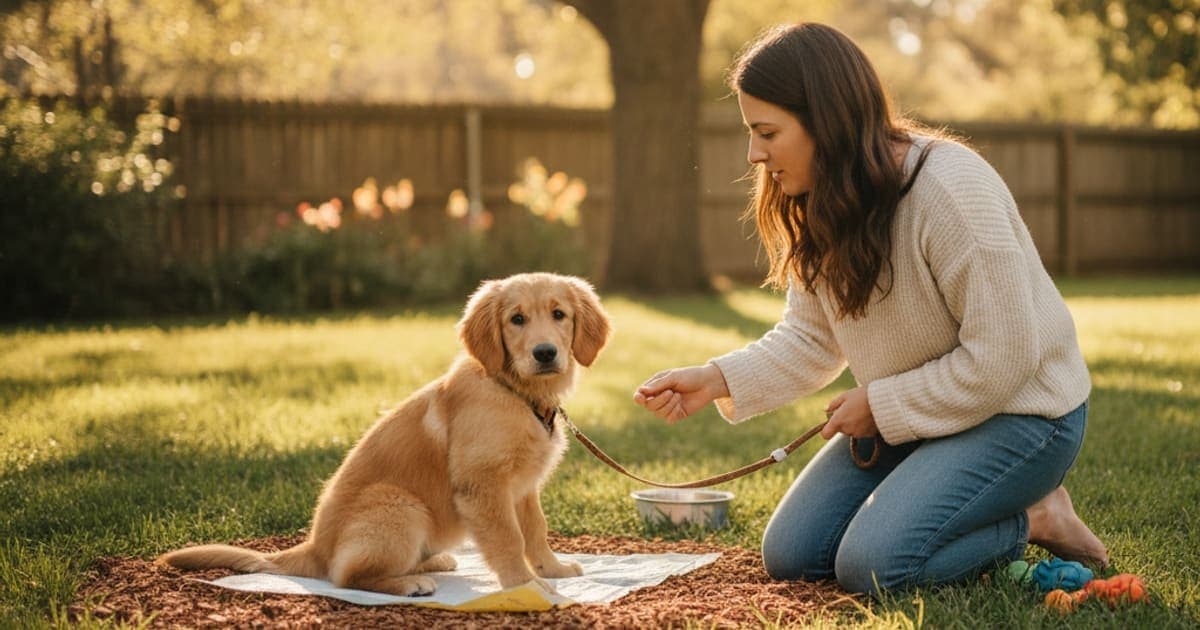
Your puppy is backsliding because something changed, and there are four usual culprits: a medical problem, a developmental stage, a disruption to the routine, or a quiet loss of supervision that let a new habit take root. Start with your veterinarian, because a puppy who suddenly cannot hold it needs a urine check before anyone blames the training. An infection, a parasite or a urinary tract abnormality will defeat even a perfect schedule, and no amount of consistency will fix a bladder that is inflamed.
The short answer to the question sitting underneath every search on this subject: yes, potty training regression in a puppy is a real thing, it is extremely common, and it is not a sign that your puppy is spiteful, stubborn or slow. Housetraining is a habit built on a young, still-developing body. Change the body or change the context, and the habit wobbles. The good news is that a regression almost always responds to the same sequence: rule out a medical cause, identify the trigger, then rebuild the habit from the beginning rather than patching it.
Rule out a medical cause before you change anything about training
This is the step owners skip, and it is the step that saves weeks. A puppy who was reliable and is now having accidents, especially frequent small puddles, accidents while asleep, or accidents that clearly distress them, deserves a physical exam and a urine sample. Bring a fresh sample if you can catch one.
Things your vet will commonly be looking for in a young dog:
- Urinary tract infection, which can cause urgency, straining and small frequent puddles
- Intestinal parasites such as giardia, roundworms or coccidia, which show up as loose stool and sudden indoor accidents
- A diet change, a new treat, or scavenging, all of which can upset the gut faster than a puppy can learn to ask for the door
- Bladder crystals or stones, which can cause straining and discomfort
- Congenital plumbing problems such as an ectopic ureter, which classically produces dribbling or wet bedding in a young dog who is otherwise doing everything right
- Pain or stiffness that makes stairs, a dog door or a slippery floor unpleasant enough to avoid
- Excessive thirst, which always needs investigating rather than managing at home
Straining with nothing produced, blood in the urine, a puppy who seems unwell, repeated vomiting, or a dog who is lethargic and off food are reasons to be seen urgently rather than at the next convenient appointment. Research suggests that house soiling in dogs frequently has a medical or emotional driver rather than a training one, which is why the exam comes first. If the physical exam and urine are clean, you have lost nothing and gained certainty: now you are solving a behaviour problem, and you can commit to the plan without second-guessing it.
What actually triggers a backslide
A puppy who was doing well and then regressed has usually met one of a short list of triggers. Finding yours tells you how long the reset will take and what to tighten first.
| Trigger | What it typically looks like | First move |
|---|---|---|
| Teething and the four to six month stage | Distraction, shorter attention span, accidents during play | Shorten the gap between potty trips, supervise actively |
| Adolescence, roughly six to eighteen months | Testing boundaries, marking indoors, ignoring known cues | Remove free roaming, reward every correct trip again |
| Moving house | Accidents in one or two specific rooms, confusion about the door | Treat the new home as day one of training |
| Boarding, travel or a stay with family | Sudden accidents on return, often for several days | Return to the old schedule immediately, no extra freedom |
| A new baby, pet, partner or work schedule | Accidents timed to the change, sometimes attention seeking | Rebuild predictability, keep potty trips at fixed times |
| Post-surgery crate rest or an injury | Accidents in the crate or near it, reluctance to go outside | Ask your vet how to manage toileting during recovery |
| Incomplete cleanup | Repeat accidents in the exact same spot | Enzymatic cleaner, never ammonia-based products |
| Weather, rain, snow, darkness | Rushed outdoor trips, then an accident indoors minutes later | Go out with the puppy, reward on the spot, make it worth it |
There is also a plain arithmetic trigger that gets overlooked: the puppy has simply been given more freedom and longer gaps than their bladder can manage. A puppy who graduates from a pen to the run of the house often regresses within days, not because they forgot, but because they now have four rooms you cannot see and nobody is there to interrupt a mistake.
How long does it last, and what makes it longer
When the cause is medical, the regression usually resolves alongside the condition, on whatever timeline your vet gives you for that specific problem. When the cause is behavioural and you reset properly, owners commonly report improvement within a few days to a couple of weeks, with full reliability returning as the habit re-establishes. Results vary from dog to dog, and adolescence in particular tends to arrive in waves rather than a single clean episode.
Three things reliably make a regression drag on:
- Punishment. Scolding, rubbing a puppy's nose in it, or reacting with anger teaches the puppy that toileting in front of you is dangerous, not that toileting indoors is wrong. The usual result is a dog who sneaks behind the sofa and becomes harder to read. Research suggests aversive handling tends to increase stress-related behaviour rather than reduce it.
- Inconsistent cleanup. Dogs return to places that smell like a toilet. Standard household cleaners mask the odour for you and leave it intact for the dog.
- Partial resets. Going back to basics for two days, seeing improvement, then restoring full freedom is the most common way owners turn a one-week problem into a six-week one.
The reset: rebuilding the habit step by step
Treat this as day one of housetraining with a puppy who already has useful experience. Most dogs move through the stages faster the second time.
Shrink the territory. No unsupervised access to any room. Use a crate sized so the puppy can stand, turn and lie down but not toilet in one corner and sleep in the other, a pen, a closed door, or a lead attached to your belt. If you cannot watch the puppy, the puppy is confined. This single change does more than everything else combined.
Go back to a clock, not a guess. Out first thing in the morning, after every meal, after every nap, after every play session, before bed, and at fixed intervals in between. Err on the side of too often. You can stretch the intervals once you have a week of clean days.
Go outside with them, every time. Standing at the back door watching tells you nothing about whether the puppy actually emptied. Go out, stay quiet, wait, and be there for the moment it happens.
Reward at the scene, within seconds. Praise and a high-value treat delivered outside, immediately, while the puppy is still standing on the spot. A treat handed out back indoors rewards coming inside.
Clean with an enzymatic cleaner. Soak the area, including carpet backing and subfloor if it got that far. Avoid ammonia-based products, which smell like urine to a dog.
Keep a log for a week. Time, place, pee or poo, what happened in the hour before. Two or three days of notes usually expose a pattern you could not see from memory: the 4pm accident after a nap, the puddle by the back door on rainy days, the mess in the crate only on long days.
Keep feeding and water predictable. Meals at the same times produce bowel movements at predictable times. Do not restrict water to manage accidents unless your veterinarian has specifically told you to, because dehydration is a far bigger problem than a wet floor.
Interrupt, do not punish. If you catch an accident starting, make a neutral sound, scoop or lead the puppy outside, and reward if they finish there. If you find it after the fact, clean it and say nothing. The puppy cannot connect your reaction to a decision made ten minutes ago.
Troubleshooting the most common scenarios
My puppy was doing well, then started peeing in the house at night
Check the water and the timeline first, then the bedding. Overnight accidents in a previously dry puppy, or a damp bed where the puppy was lying, are worth mentioning to your vet rather than managing with a later walk. If the physical exam is clean, move the crate into your bedroom so you hear the stirring, and add one night trip back for a week.
Accidents only happen when I leave the room
This is a supervision gap, not defiance. The puppy has learned that opportunities exist when you are not looking. Close the gap with a lead or a pen for two weeks and the pattern usually disappears. If the accidents come with pacing, howling, drooling or destruction when you leave the house entirely, that pattern is worth describing to your vet, since separation-related distress is handled differently from housetraining.
My puppy pees when guests arrive or when I come home
Excitement and appeasement urination is a different behaviour from a housetraining lapse, and it is common in young dogs. The puppy is not failing to hold it, they are leaking in response to arousal or social pressure. Keep greetings low-key and brief, ask visitors to ignore the puppy for the first few minutes, and greet outdoors where possible. Many puppies grow out of it as they mature.
The regression started after surgery, crate rest or an illness
Recovery changes everything at once: confinement, medication, altered appetite, discomfort and a disrupted routine. Accidents during this period are expected rather than surprising. Ask your veterinary team how to structure toileting trips within your dog's activity restrictions, because the answer depends on the procedure and on what your dog is allowed to do.
A male puppy has started marking indoors
Small amounts of urine deposited vertically, on furniture legs, doorframes or bags, around adolescence is marking rather than emptying. Manage it the same way: supervision, confinement when unsupervised, thorough enzymatic cleaning, and a conversation with your vet about whether and when neutering is appropriate for your individual dog.
Key Takeaways
- Potty training regression in a puppy is common, normal, and not a sign of spite or poor intelligence.
- Book a vet exam and bring a urine sample before you change your training plan. Infections, parasites and congenital urinary problems look exactly like a training failure.
- The usual behavioural triggers are teething, adolescence, moving, boarding, a schedule change, recovery from surgery, and too much unsupervised freedom too soon.
- The reset is always the same: shrink the territory, return to a fixed schedule, go outside with the puppy, reward within seconds, and clean with an enzymatic cleaner.
- Punishment, half-hearted resets and incomplete cleanup are what turn a short regression into a long one.
- Behavioural regressions often improve within days to a couple of weeks once the reset is consistent, though results vary from dog to dog.
One last framing that matters. Your veterinarian owns the diagnosis and the treatment plan. Training, management and routine work in the space that proper veterinary care creates, and they work best once a medical cause has been ruled in or ruled out. If the accidents persist despite a clean exam and a disciplined reset, talk to your vet again and ask for a referral to a qualified behaviour professional, because a second look at the pattern is usually faster than another month of guessing.
For the symptoms that mean stop troubleshooting at home and get to a clinic, see Dog Emergency Signs, and for background reading on the health problems that commonly sit behind house soiling, browse the conditions library.
Frequently asked questions
- why is my puppy potty training regression
- Your puppy is regressing because something changed: a medical problem such as a urinary tract infection or parasites, a developmental stage like teething or adolescence, a disrupted routine, or too much unsupervised freedom. See your vet first to rule out a medical cause, then reset supervision and the schedule.
- is puppy potty training regression normal
- Yes, it is normal and very common. Housetraining is a habit built on a young, still-developing body, so illness, teething, adolescence, moving or a schedule change can all knock it off course. Normal does not mean ignore it: have your vet rule out a medical cause, then rebuild the routine.
- do puppies have potty training regression
- Most puppies do at some point. Backsliding typically appears around teething and again during adolescence, or after a disruption such as boarding, travel, a house move or recovery from surgery. It usually reflects a change in body or context rather than forgetting what was previously learned.
- can puppies have potty training regression
- They can, and it happens often. A puppy who was reliable for weeks can start having accidents again within days of a trigger. Because an infection, parasites or a urinary abnormality can look identical to a training lapse, a vet exam with a urine sample should come before any training changes.
- how long does puppy potty training regression last
- It depends on the cause. Medical causes resolve on the timeline your vet gives for that condition. Behavioural regressions often improve within a few days to a couple of weeks once supervision, schedule and rewards are reset consistently, though results vary from dog to dog and adolescence can come in waves.
- is puppy potty training regression a thing
- Yes, it is a recognised and well-described pattern, not something owners imagine. Trainers and veterinarians see it routinely around teething, adolescence and after any disruption to routine. The standard approach is to rule out a medical cause, identify the trigger, and restart housetraining from the beginning.
- how to fix puppy potty training regression
- Start with a vet exam and a urine sample. Then shrink the puppy's territory with a crate, pen or lead, return to fixed potty trips after meals, naps and play, go outside with them, reward within seconds on the spot, and clean every accident with an enzymatic cleaner.
- why is my dog potty training regression
- In an older dog, sudden house soiling needs a veterinary workup before anything else, since urinary infections, kidney or hormonal problems, pain and cognitive decline all present this way. If the exam is clean, look for a change in routine, household or access, then rebuild supervision and schedule as you would with a puppy.
Educational content, not veterinary advice. Ask your vet about your dog.