Why Is My Dog Snoring? (Causes and Red Flags)
Dogs snore when air moves through a partly narrowed nose, throat or soft palate during sleep, creating audible vibration. Sleep position, breed anatomy, extra weight, allergies and age all play a role. Most snoring is harmless, but new, loud or one-sided snoring deserves a veterinary exam.
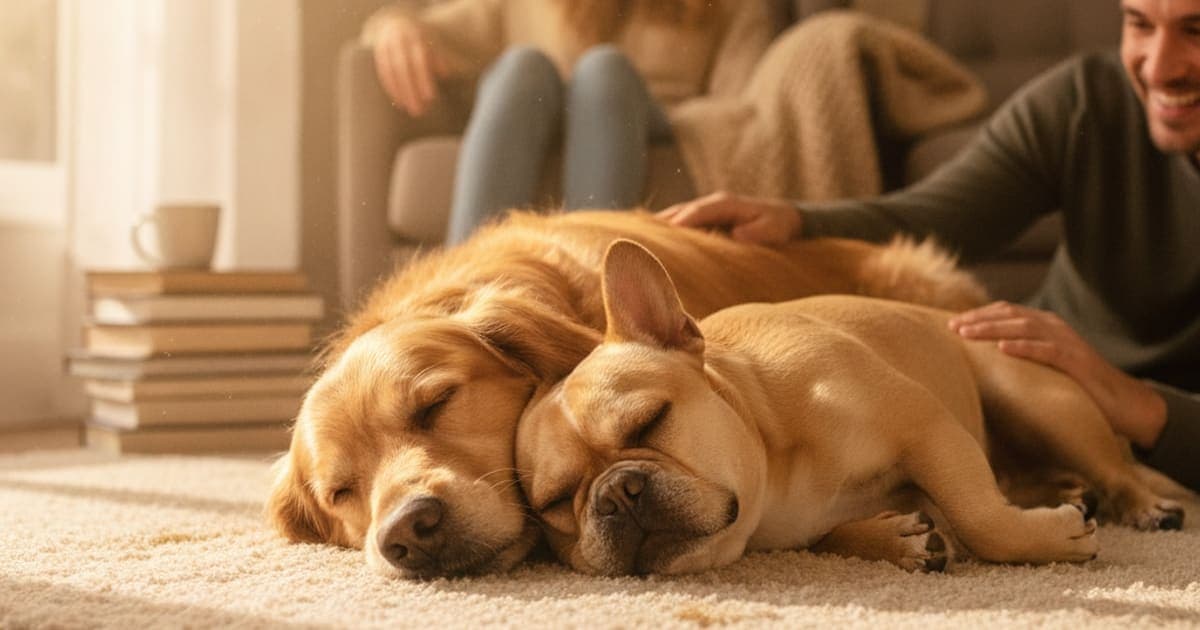
Your dog snores because air moving in and out during sleep has to squeeze past something narrow: usually a relaxed soft palate, a crowded nasal passage, or soft tissue at the back of the throat that vibrates when airflow turns turbulent. In the majority of dogs this is plain anatomy plus sleep position, and it means nothing worrying. It starts to matter when the sound is brand new, getting steadily louder, happening while your dog is awake, or showing up alongside other changes in how your dog breathes, moves or looks.
What actually makes the noise
Snoring is vibration. Air travelling through a wide, open tube is quiet; air forced through a narrowed or floppy section of that tube speeds up, becomes turbulent, and sets the surrounding tissue flapping. In dogs, the usual vibrating structures are the soft palate (the fleshy curtain at the back of the roof of the mouth), the nostrils and nasal passages, and the tissue lining the throat.
During deep sleep, the muscles that hold these structures taut relax. That relaxation is normal and necessary: it is also exactly why a dog who breathes silently all day can sound like a chainsaw at two in the morning. Veterinarians often separate the noises by origin: stertor is the low, wet, snoring-type sound that comes from the nose or throat, while stridor is a higher, harsher, whistling sound that tends to come from the larynx or windpipe. Stertor is the common, usually benign one. A new high-pitched or raspy noise is the version that earns an earlier phone call.
Understanding that distinction is useful, because it reframes the question. You are not really asking whether your dog snores. You are asking whether the narrowing causing it is ordinary and stable, or new and progressing.
The everyday reasons most dogs snore in their sleep
Sleep position. A dog flat on their back with the head tipped back, or curled with the chin tucked hard into the chest, kinks the airway in exactly the way that produces sound. Many owners find the snoring stops the moment the dog rolls onto their side or sternum. This is the single most common explanation and the least concerning.
Depth of sleep. Snoring often gets louder in REM sleep, when muscle tone drops furthest. You may also see twitching paws, soft barks, flicking whiskers and rapid eye movement behind the lids. If your dog is snoring with eyes open, or partly open with the pinkish third eyelid showing across the corner, that is usually just incomplete lid closure during deep sleep: it looks unsettling and is generally normal. Persistently open, dull or cloudy eyes during waking hours are a different matter and warrant an exam.
Breathing rate during sleep. Owners often describe a dog snoring fast: short, rapid, noisy breaths in a burst. Brief fast-breathing episodes during REM are typical, and they pass within a minute or two as the dog cycles back to quiet sleep. What is worth tracking is the resting respiratory rate while your dog is genuinely asleep and settled: count the breaths over a minute occasionally so you know your dog's normal baseline. A sustained climb above that personal baseline, especially with effort in the belly or flared nostrils, is a reason to call your veterinarian rather than wait.
Weight. Fat deposits around the neck and chest narrow the airway from the outside and add work to every breath. Weight is one of the few causes an owner can directly influence.
Allergies, irritants and infection. Pollen, dust, smoke, scented candles and dry indoor air inflame nasal tissue and thicken secretions, narrowing the passage. Snoring that tracks the seasons or appears after a move often has an environmental cause.
Age. Tissue tone softens over the years, so plenty of dogs develop a mild snore in later life that they never had as youngsters. Gradual is the key word: a slow change over years reads differently from a change over three weeks.
Dental and oral disease. Infected upper teeth and the tissue swelling around them can encroach on the nasal passages directly above.
Flat-faced breeds and the anatomy behind the volume
If you are wondering why your dog is snoring so loudly, breed is often the whole answer. Brachycephalic breeds, pugs, French and English bulldogs, boxers, boston terriers, shih tzus, pekingese and similar, have been bred for a shortened skull, but the soft tissue inside was never shortened to match. The result is a normal volume of tissue packed into a smaller space: narrowed nostrils, an elongated soft palate that drapes into the airway, and often a narrowed windpipe.
Collectively these features are known as brachycephalic obstructive airway syndrome (BOAS). Snoring is its mildest and most visible sign. More significant signs include noisy breathing while awake, rapid fatigue on walks, gagging or retching, difficulty settling in warm weather, and sleeping in odd positions, propped against furniture, or with a toy under the chin, because the dog has worked out that extending the neck opens the airway.
This is not a condition to manage with supplements or home tweaks alone. Veterinary surgeons assess BOAS directly and can widen narrowed nostrils and shorten an over-long soft palate, and for affected dogs those procedures are the intervention that changes daily life. Heat is the other critical factor: a compromised airway makes panting less effective at cooling, so flat-faced dogs overheat faster than other breeds and need genuine care in warm conditions. If you own a brachycephalic dog, make airway function an explicit agenda item at every annual check rather than something you raise only when it worsens.
When the noise is worth an appointment
Snoring that is new, one-sided, steadily getting louder over weeks, or paired with a change in how your dog breathes while awake is the version worth a veterinary appointment rather than a wait-and-see.
| What you notice | What it can point to | What to do |
|---|---|---|
| Snoring that appears suddenly in an adult dog who never snored | Nasal foreign body, infection, polyp, mass, dental disease | Book an exam; mention exactly when it started |
| Noise or discharge from one nostril only | Localised problem on that side | Veterinary exam; imaging may be advised |
| Loud breathing while awake, or after only mild exercise | Airway obstruction, laryngeal or tracheal problem | Veterinary assessment before further exercise |
| Pale, grey or bluish gums, collapse, fainting | Oxygen delivery problem | Emergency veterinary care immediately |
| Snoring plus weight gain, coat changes, low energy | Metabolic or hormonal condition worth testing | Ask your vet about bloodwork |
| Snoring plus gagging, retching or regurgitation | Airway and upper digestive tract involvement | Veterinary exam; describe timing around meals |
| Pauses in breathing followed by a gasp or startle | Sleep-disordered breathing | Record a video and bring it to the appointment |
A note on a pairing owners search for often: dog dry nose and eye discharge. A dry nose on its own is a poor indicator of health: nose moisture swings all day with sleep, heat and humidity. The pairing is more informative. A dry, crusted nose with thick or persistent eye discharge, squinting or face-rubbing can point to reduced tear production (dry eye), an upper respiratory infection, an immune-mediated condition affecting the nose, or, in flat-faced dogs with shallow eye sockets and poor tear drainage, chronic surface irritation. If that combination lasts more than a day or two, have it looked at. Eyes rarely improve by waiting.
Video is the most useful thing you can bring to the consult. A thirty-second clip of your sleeping dog, and another of their breathing after a short walk, tells your veterinarian more than any description you can manage in the exam room.
What you can change at home
A handful of adjustments genuinely reduce airway noise in dogs whose snoring is anatomical or positional:
- Offer a bed with a raised edge or bolster that supports the head and encourages a side-lying posture instead of a tucked chin.
- Keep the sleeping area clean and reasonably humid; run an air filter if you have a seasonal snorer.
- Switch from a collar to a well-fitted harness so no pressure sits over the trachea.
- Keep flat-faced dogs cool, walk them in the cooler parts of the day, and never leave them in warm vehicles.
- Work with your veterinarian on a body-condition target, and weigh your dog on the same scale regularly rather than judging by eye.
That last point is where mobility quietly enters the picture. Weight control depends on movement, and movement depends on comfort. A dog nursing a stiff hip, a healing cruciate or an old tendon injury walks less, loses conditioning, gains weight, and that extra tissue narrows the airway from the outside. Snoring is a downstream symptom of a loop that starts with comfortable movement.
That loop is the space pawgen built K9-REPAIR for. It is a BPC-157 and TB-500 peptide formulation for dogs, dosed by body weight, third-party tested with batch certificates of analysis published openly: a deliberate contrast to underdosed kitchen-sink chews whose labels list twenty ingredients at amounts too small to matter. BPC-157 is a synthetic peptide studied in animal models for its signalling role in connective tissue and gut-lining repair processes. TB-500 is a synthetic fragment of thymosin beta-4, a naturally occurring protein involved in actin regulation, cell migration and new blood vessel formation. Research suggests these mechanisms may support the body's own tendon, ligament and soft-tissue recovery processes, and owners increasingly adopt the pair as the stack they run through a rehab period. Neither is an FDA-approved veterinary drug, nothing here is a claim about your dog's airway, and the right place to raise mobility support is a conversation with your veterinarian, who can weigh it alongside anything already prescribed.
Key Takeaways
- Snoring is vibration caused by air passing through a narrowed nose, throat or soft palate: in most dogs it reflects sleep position, breed anatomy or age, not illness.
- Fast, noisy breathing in short bursts during REM sleep is typical; a sustained rise above your dog's normal resting rate is not.
- Sleeping with the eyes partly open is common during deep sleep and generally harmless.
- Flat-faced breeds snore because of shortened skull anatomy; significant cases are assessed and surgically managed by a veterinarian, not at home.
- New, one-sided, worsening or awake-state noisy breathing, pale gums or collapse need veterinary attention: urgently in the last two cases.
- A dry nose matters little alone; combined with persistent eye discharge, it earns an exam.
- Weight and comfortable movement are the levers owners can actually pull.
Your veterinarian owns the diagnosis and the treatment plan here. They are the one who can look up your dog's nose, assess the larynx, run bloodwork, and decide whether the snoring is anatomy you simply live with or an obstruction that needs addressing. Supplements and peptides operate in the space that proper veterinary care creates: supporting recovery and day-to-day comfort, never substituting for an exam, a prescription or a procedure your dog needs.
If you want to look further at pawgen's approach, shipping and availability details are on the location page, batch certificates of analysis for every lot are published at COAs, and K9-REPAIR is listed in the shop, backed by a 60-day money-back guarantee.
Owners exploring peptide support for their dog can review K9-REPAIR, BPC-157 + TB-500 formulated for dogs, at https://pawgen.com/. BPC-157 and TB-500 are not FDA-approved veterinary drugs. Nothing in this article treats, cures or prevents any condition; every decision about your dog's care belongs with your veterinarian.
Frequently asked questions
- why my dog snoring
- Your dog snores because air is passing through a narrowed section of the airway during sleep, usually a relaxed soft palate, tight nostrils or throat tissue that vibrates. Sleep position, breed anatomy, body weight, allergies and age are the usual drivers, and most cases are harmless.
- what does my dog snoring mean
- Usually it means partial airway narrowing during deep sleep, which is normal for many dogs and especially common in flat-faced breeds. It becomes meaningful when the snoring is new in an adult dog, one-sided, progressively louder, or paired with noisy breathing while your dog is awake.
- why is my dog snoring so loudly
- Volume usually reflects how narrow the airway is. Brachycephalic breeds snore loudest because shortened skull anatomy packs normal soft tissue into less space. Extra body weight, nasal inflammation and a back-sleeping position all add volume too. A sudden increase in loudness deserves a veterinary exam.
- Is it normal for my dog to snore fast?
- Short bursts of rapid, noisy breathing during REM sleep are normal and settle within a minute or two. What matters is your dog's resting respiratory rate while genuinely asleep. A sustained rise above their usual baseline, or visible belly effort, should prompt a call to your veterinarian.
- Why does my dog snore with his eyes open?
- Incomplete eyelid closure during deep sleep is common and generally harmless, and the pink third eyelid often shows across the inner corner. It looks odd but reflects muscle relaxation, not a problem. Eyes that stay open, dull or cloudy while your dog is awake need veterinary attention.
- Should I worry about a dry nose and eye discharge together?
- A dry nose alone is a poor health indicator, since moisture varies with sleep, heat and humidity. Paired with persistent eye discharge, squinting or face-rubbing, it can suggest reduced tear production, infection or chronic surface irritation. If it lasts beyond a day or two, book an exam.
- Can losing weight reduce my dog's snoring?
- Often, yes. Fat around the neck and chest narrows the airway from the outside and increases the work of each breath, so owners frequently report quieter sleep as body condition improves. Set a target weight with your veterinarian and track it on the same scale consistently.
- Does K9-REPAIR do anything for snoring?
- No. K9-REPAIR is a BPC-157 and TB-500 peptide formulation focused on joint, tendon and mobility support, and it makes no claim regarding airways or breathing. These peptides are not FDA-approved veterinary drugs. Discuss any supplement with your veterinarian alongside your dog's existing care.
- When is dog snoring an emergency?
- Seek emergency veterinary care if your dog has pale, grey or bluish gums, collapses or faints, struggles visibly to move air, or cannot settle while breathing hard. Overheating in a flat-faced breed is also urgent, since a compromised airway makes panting a poor cooling mechanism.
Educational content. BPC-157 and TB-500 are not FDA-approved veterinary drugs. Talk to your veterinarian before starting anything new, especially if your dog is on prescribed medication.