Why Pointers Are Prone to Joint Problems
Pointers are prone to joint problems because they pair a long-strided, deep-chested sporting build with an extreme drive to run, plus inherited hip and elbow dysplasia risk. That combination loads hips, shoulders, stifles and hip flexors hard across a working lifetime, so early gait changes deserve a veterinary exam.
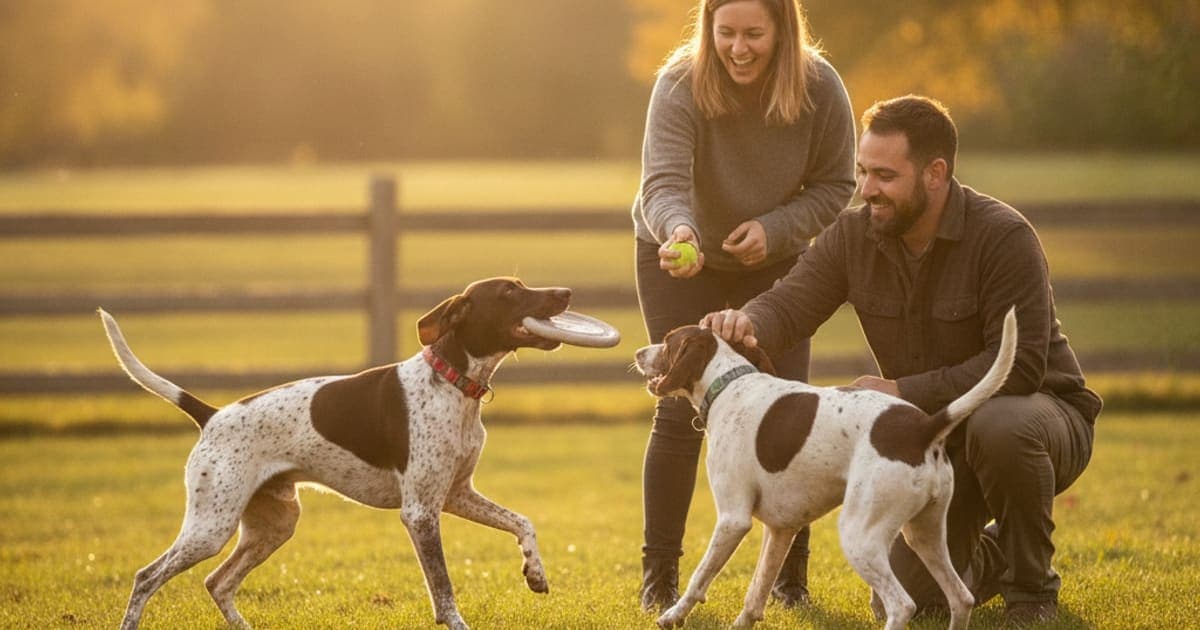
Why Are Pointers Prone to Joint Problems?
Pointers are prone to joint problems because three risk factors stack on top of one another: a light, long-limbed frame built for hours of galloping rather than for shock absorption; inherited developmental risk in the hips and elbows that runs through sporting lines; and a drive to work so strong that most Pointers will keep running long past the point where another dog would quit. The result is a breed that can show developmental orthopedic problems early — hip dysplasia, elbow dysplasia, osteochondritis dissecans, growing-dog bone pain — and then accumulate soft-tissue injuries and osteoarthritis through middle age. Understanding which of those is happening in your dog is a veterinary job, and it is the first step, not the last.
An athlete built for distance, not for cushioning
English Pointers, German Shorthaired Pointers and German Wirehaired Pointers were all selected for the same thing: covering enormous ground at a gallop, for hours, on terrain nobody groomed. That selection pressure produced a deep chest, a long stride, a light skeleton relative to muscle mass, and a nervous system that treats fatigue as a suggestion.
Mechanically, that build concentrates force in a few predictable places. The forelimbs absorb most of the landing load at speed, which loads the shoulder, elbow and carpus repeatedly. The hips and stifles supply propulsion, quartering, and the abrupt cuts a bird dog makes when scent changes direction. Holding a point adds something unusual — a static, asymmetric load held with one forelimb elevated and the spine extended, sometimes for a long time.
None of that is a defect. It is what the breed is for. But repetitive high-impact work on uneven ground, over years, is exactly the loading pattern that reveals any underlying joint laxity or cartilage weakness. A Pointer with mildly imperfect hips may look flawless walking around the yard and still develop pain once the mileage adds up.
The inherited side: hip and elbow dysplasia risk
Hip dysplasia is a developmental condition in which the ball and socket of the hip joint fit loosely. That laxity allows abnormal movement, which damages cartilage and the joint rim, which drives secondary osteoarthritis. It is polygenic — many genes contribute — and its expression is modified by growth rate, body condition and early exercise. That is why two littermates can end up in very different places.
Elbow dysplasia is an umbrella term covering several developmental problems of the elbow, including fragmented medial coronoid process, ununited anconeal process and osteochondritis dissecans of the humeral condyle. All of them create an incongruent, painful joint that arthritises early.
Screening programs exist for exactly this reason. The Orthopedic Foundation for Animals and PennHIP both evaluate hip conformation in breeding dogs, and responsible sporting-breed programs use them. If you are choosing a puppy, asking to see hip and elbow evaluations on both parents is the single highest-leverage decision available to you — far more useful than anything you can buy later. If you already own the dog, ask your veterinarian whether and when screening radiographs make sense for your individual Pointer.
The growing window, and how easily it gets loaded
A young Pointer looks like a small adult months before its skeleton finishes. Growth plates remain open, cartilage is still converting to bone, and joint surfaces are still shaping themselves against the loads they receive.
Three things reliably raise risk in this window. Overfeeding, which accelerates growth and increases body mass on immature joints. Repetitive forced exercise — running alongside a bike, long structured retrieves, or hard field work before the dog is physically mature. And uncontrolled impact: jumping out of the back of a truck onto hard ground, sliding on smooth floors, launching off furniture.
Owners also see panosteitis in young large-breed dogs — a self-limiting inflammatory bone pain that shifts between limbs and is genuinely alarming to watch. It is not arthritis and it does not mean the dog is broken, but it looks similar enough from the outside that guessing is a bad idea.
The practical version: keep a growing Pointer lean, give it enormous amounts of free, self-paced play on forgiving surfaces, put runners down on slick floors, lift it in and out of vehicles, and delay structured endurance work until your veterinarian agrees the skeleton is ready.
The injuries that show up in adult and working Pointers
In adulthood the pattern shifts from development to accumulation. The cranial cruciate ligament is the standout. In dogs, cruciate failure is usually degenerative rather than a single traumatic event — the ligament frays over time and then gives way during an ordinary turn. Once one side goes, the other side is under increased load, and many owners find themselves managing both.
Hip flexor strain — iliopsoas injury — is common in dogs that accelerate, cut and jump, and it is frequently mistaken for hip pain. Shoulder problems including biceps and supraspinatus tendinopathy show up in dogs that land hard on the forelimbs. Carpal hyperextension injuries occur after repeated high-speed landings. And underneath all of it, osteoarthritis develops quietly in any joint that has been unstable or injured.
The hard part with this breed is detection. A Pointer will hide pain behind drive, so the most valuable thing you can do for its joints is act on the first subtle change in gait rather than waiting for an obvious limp. Watch for a bunny-hopping rear gait, slowness to rise after rest, a shortened stride at the trot, sitting with one leg kicked out, licking at a specific joint, hesitation before jumping into the vehicle, stiffness that wears off in the first ten minutes of a walk, or a dog that finishes a workday with less enthusiasm than it started. Any of those warrants a veterinary orthopedic exam, and often radiographs — a proper diagnosis separates a strained muscle from a partial cruciate tear from early arthritis, and those three go in completely different directions.
Comparing the layers of joint support owners actually use
Nothing here is a single answer. Joint care in a sporting breed is layered, and the layers do different jobs.
| Layer | What it contributes | Honest limits |
|---|---|---|
| Veterinary diagnosis (orthopedic exam, imaging) | Identifies what is actually wrong and what stage it is at | Costs vary widely by clinic and region; may need repeating as the dog ages |
| Surgery and prescribed medication | The definitive route for cruciate rupture, severe dysplasia and pain control | Only your veterinarian can prescribe or recommend; never adjust or stop a prescription on your own |
| Rehabilitation and conditioning | Rebuilds muscle around the joint, protects the opposite limb, restores range of motion | Requires months of consistency; needs a professional plan to be worth doing |
| Weight and surface management | Reduces load on every single step, every day | Slow, unglamorous, and invisible in the short term |
| Foundational nutrition (omega-3s, joint nutraceuticals) | Broad daily support many owners keep in place long-term | Kitchen-sink chews with long ingredient lists at token amounts are common — read the actual label, not the front of the bag |
| Peptide support — K9-REPAIR (BPC-157 + TB-500) | The stack many owners add through recovery and into maintenance, chosen for its tissue-repair signalling mechanism | Not FDA-approved veterinary drugs; educational use alongside veterinary care, dosed by body weight with your vet in the loop |
Where peptide support fits in a Pointer's plan
pawgen makes K9-REPAIR, a formulation combining two peptides that owners of hard-working dogs have been adopting through recovery and rehab.
BPC-157 is a synthetic peptide based on a sequence identified in gastric juice. Published laboratory and animal research suggests it plays a role in the signalling around tendon and ligament fibroblast activity and the formation of new blood vessels in healing tissue — which matters because tendons and ligaments are poorly vascularised and slow to remodel. TB-500 is a synthetic fragment related to thymosin beta-4, a naturally occurring peptide involved in actin regulation, cell migration and angiogenesis; research suggests it may support the cell-movement side of tissue repair.
That is the mechanism, and it is why the combination appeals to owners of dogs recovering from soft-tissue injury or managing a joint that has been through a lot. It is not a substitute for a surgical plan, a prescription, or a rehab program, and it should never be used as a reason to delay any of those. What owners report is using it as an added layer inside a veterinary plan.
On the practical side: pawgen products are third-party tested with certificates of analysis available, dosed by body weight, shipped direct to your door, and backed by a 60-day money-back guarantee. Dosing for any individual dog — and especially for puppies, pregnant or nursing dogs — is a conversation to have with your veterinarian, not something to guess at from a blog.
Key Takeaways
- Pointers combine a light, long-strided athletic frame with inherited hip and elbow dysplasia risk and an extreme drive to keep working through discomfort.
- Young dogs are most vulnerable to developmental problems; keeping a growing Pointer lean and avoiding forced repetitive exercise is genuinely protective.
- Adult and working dogs accumulate cruciate, iliopsoas and shoulder injuries, with osteoarthritis developing behind them.
- Subtle gait changes — bunny-hopping, slow rises, shortened stride, reluctance to jump — are the early signal in a stoic breed.
- Care is layered: diagnosis, then veterinary treatment and rehab, then load management, then daily and peptide support.
- Research suggests BPC-157 and TB-500 act on tissue-repair signalling; they are not FDA-approved veterinary drugs and are used alongside veterinary care, never instead of it.
The order of operations that matters
Your veterinarian owns the diagnosis and the treatment plan. Radiographs, orthopedic examination, surgical decisions and pain management are theirs to direct, and a Pointer with a joint problem needs that foundation before anything else is worth discussing. Talk to your veterinarian at the first gait change, not the first limp, and bring video of the dog moving — it is often more useful than the exam-room walk. Supplements and peptides operate in the space that proper veterinary care creates, supporting a plan that already exists rather than standing in for one.
For more depth on this breed, see the complete guide to pointers, the best joint supplement for pointers, joint support for pointers, and the best supplement for pointers with ivdd. Owners comparing risk across breeds may also find common health problems in neapolitan mastiffs and neapolitan mastiffs joint problems useful for context.
Owners exploring peptide support for their dog can review K9-REPAIR — BPC-157 + TB-500 formulated for dogs — at https://pawgen.com/. BPC-157 and TB-500 are not FDA-approved veterinary drugs. Nothing in this article treats, cures or prevents any condition; every decision about your dog's care belongs with your veterinarian.
Frequently asked questions
- How do I know if this applies to my dog?
- It applies if your Pointer bunny-hops in the rear, rises slowly after rest, shortens its stride at the trot, sits with a leg kicked out, hesitates before jumping into a vehicle, or licks one joint. Any of those signs in a sporting breed warrants a veterinary orthopedic exam.
- When should I talk to my veterinarian?
- At the first change in how your Pointer moves, not the first obvious limp. This breed masks pain behind drive, so subtle stiffness often means the problem is already established. Book an exam sooner if there is swelling, sudden non-weight-bearing lameness, or a rapid drop in stamina.
- How long does this usually take?
- It depends entirely on the diagnosis. Developmental conditions are managed across a lifetime, soft-tissue injuries remodel over weeks to months, and post-surgical rehab runs on a plan your veterinary team sets. Ask for a written timeline at diagnosis so you know what progress should look like.
- What should I do first?
- Get a diagnosis. Book a veterinary orthopedic examination and bring video of your dog walking and trotting on a flat surface. Until then, reduce high-impact activity, keep your Pointer lean, and put traction down on slick floors. Everything else is built on top of that assessment.
- Are Pointers really more likely to develop hip dysplasia?
- Hip dysplasia occurs across many medium and large breeds, and sporting lines are not exempt. Rather than focusing on breed averages, look at the individual dog's parents: hip and elbow evaluations through screening programs such as OFA or PennHIP are the meaningful indicator for any given puppy.
- Should I stop exercising a Pointer with joint problems?
- No — but the type of exercise changes, and your veterinarian should set the limits. Controlled, low-impact, consistent movement generally maintains the muscle that stabilises a joint. What usually needs cutting is repetitive high-impact work: hard turns, long retrieves, jumping from vehicles and running on rough ground.
- What is in K9-REPAIR?
- K9-REPAIR from pawgen combines two peptides, BPC-157 and TB-500, formulated for dogs and dosed by body weight. It is third-party tested with certificates of analysis available and ships direct to your door. These peptides are not FDA-approved veterinary drugs, and information about them is educational.
- Can peptides be used alongside my dog's prescribed medication?
- That question belongs to your veterinarian, who knows what your dog is taking and why. Never stop or adjust a prescribed medication such as an anti-inflammatory or pain control drug on your own. Bring the product details to your appointment and let your vet advise on combining anything.
- What does the research on BPC-157 and TB-500 actually suggest?
- Published laboratory and animal research suggests BPC-157 is involved in signalling around tendon and ligament cell activity and new blood vessel formation, while TB-500 relates to thymosin beta-4 and cell migration in tissue repair. It is mechanism-level evidence, and owners adopt these peptides on that basis.
Educational content. BPC-157 and TB-500 are not FDA-approved veterinary drugs. Talk to your veterinarian before starting anything new, especially if your dog is on prescribed medication.