Autoimmune Disease in Dogs Where Nails Fall Off (SLO)
The autoimmune disease in dogs where nails fall off is most often symmetrical lupoid onychodystrophy, in which the immune system attacks the tissue anchoring each claw to the toe. Claws on several feet loosen, split and shed over weeks. It is painful, so see your veterinarian promptly.
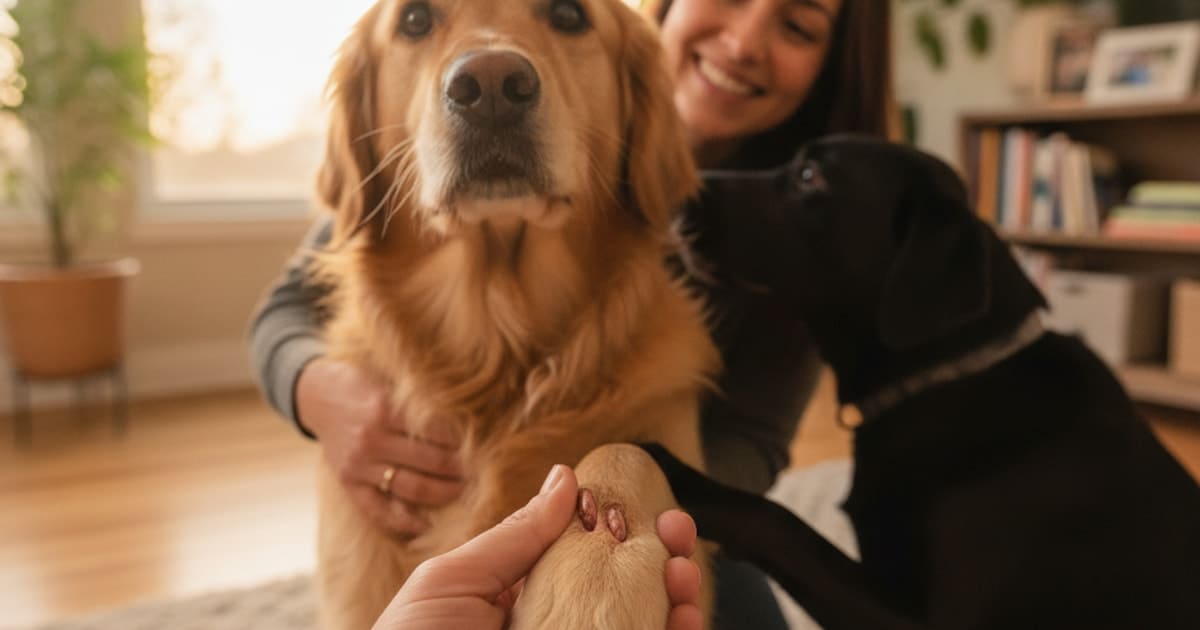
If your dog's claws are lifting, splitting or falling off, book a veterinary appointment, and make it a same-day or emergency visit if there is bleeding you cannot stop, a hot swollen toe, discharge or a foul smell, fever, or your dog will not put weight on the foot. The autoimmune disease in dogs that attacks nails is most often symmetrical lupoid onychodystrophy, usually shortened to SLO, in which the immune system targets the tissue that anchors each claw to the bone of the toe. The claw loses its grip, loosens, cracks and eventually sheds, often on several feet at once. It is genuinely painful, and the raw nail bed underneath is open to infection, which is why this is a condition to have examined rather than watched.
What symmetrical lupoid onychodystrophy is and how it behaves
A dog's claw grows from a bed of tissue wrapped around the last bone of the toe. In SLO, inflammatory cells gather at the junction between that bed and the hard claw, and the bond between them breaks down. The claw is no longer held properly, so it lifts at the base, splits lengthwise, bends outward at an odd angle, and eventually separates. Underneath, the exposed nail bed is soft, pink and extremely sensitive.
The pattern is the clue. A dog who catches a claw in a crate door loses one nail on one foot. A dog with this condition starts with one or two claws, then loses more over the following weeks, on more than one paw. That is what the word symmetrical in the name refers to: the disease does not respect which leg it is on. Regrown claws often come back misshapen, brittle, dry or discoloured, and may shed again.
It is reported more often in certain breeds, including Gordon Setters, English Setters, German Shepherds, Rottweilers, Giant Schnauzers and Bearded Collies, but any breed or crossbreed can develop it. It tends to appear in young to middle-aged adult dogs, and the skin elsewhere on the body usually looks completely normal, which is part of what makes it so confusing for owners.
Signs on the paws, and the ones that need same-day care
Early signs are easy to miss on a dog with dark nails or thick feathering between the toes. Watch for licking or chewing at one foot, a dog who flinches when you touch a paw, blood spotting on bedding or the floor, a claw that catches on carpet, or a nail that looks separated from the toe at its base.
As it progresses you may see claws at strange angles, crumbling tips, a brown or reddish discharge around the nail fold, swollen toes, and a limp that moves from leg to leg. Many dogs stop wanting long walks on hard ground. Some dogs become reluctant to be touched at all below the knee.
Nail loss affecting more than one paw is almost never a grooming accident, and it needs a veterinary examination rather than a wait-and-see approach.
Go in urgently rather than waiting for a routine slot if there is bleeding that does not settle with gentle pressure, a toe that is hot and markedly swollen, pus or a strong smell, a fever, a dog who is off food or unusually flat, or a dog who will not bear weight. Those point to a secondary infection or a different problem altogether, and both need prompt attention.
Why the name says lupoid, and what that means about lupus
Owners searching for lupus in dogs affecting nails usually land here, and the overlap in terminology is the reason. When a pathologist looks at tissue from an affected toe, the changes at the junction between the claw bed and the overlying tissue resemble the pattern seen in lupus. That resemblance gave the condition its name. Research suggests this is a description of what the tissue looks like under a microscope, not a diagnosis of lupus itself.
The practical point: a dog with lupoid onychodystrophy generally does not have systemic lupus erythematosus. Dogs with systemic lupus are usually sick in other ways, with fever, shifting joint pain, skin disease or changes in blood and organ function. Discoid lupus, the more localised form, tends to affect the nose and face rather than the claws. So if your dog is losing nails and is otherwise bright, eating and behaving normally, the likeliest explanation is the claw-specific condition, not a body-wide autoimmune disease.
Your veterinarian may still run blood work, partly to look for other illness and partly because some of the medications used for this condition need baseline values before starting.
Other causes of nail loss a vet rules out first
Several problems produce nails that fall off, and they are managed very differently. This is the main reason self-diagnosis fails.
| Possible cause | How it usually presents | What the vet looks at |
|---|---|---|
| Symmetrical lupoid onychodystrophy | Several claws across multiple paws loosen and shed over weeks; skin elsewhere looks normal | History and pattern, ruling out infection, sometimes biopsy |
| Trauma | One claw on one foot, with a clear incident or a torn, bleeding nail | Examination of the single toe, pain control, trimming or removal of the damaged nail |
| Bacterial or fungal nail bed infection | Swelling, discharge, smell, often secondary to another problem | Cytology, culture, fungal testing |
| Pemphigus foliaceus | Crusting and scaling of the paw pads, nose and ears, sometimes with nail changes | Skin cytology and biopsy |
| Vasculitis or other immune-mediated disease | Nail loss with skin lesions, ear tip or tail tip changes, sometimes systemic illness | Blood work, biopsy, search for an underlying trigger |
| Tumour of the toe | A single swollen, distorted digit with one lost nail, often in older dogs | Imaging and a tissue or needle sample, which is the only way to say what it is |
| Endocrine or nutritional disease | Brittle, dry, slow-growing claws alongside coat or skin changes | Blood tests and a diet review |
If only one toe is involved and it is swollen and deformed, that deserves prompt assessment on its own, because a sample of the tissue is the only way to tell a tumour from an infection.
How the diagnosis is made
In many cases, a vet reaches a working diagnosis from the pattern alone: multiple claws, multiple feet, otherwise healthy dog, no infection or trauma that explains it. Before that, expect a careful look at every toe, cytology or culture if there is discharge, and often blood work.
The definitive test is a biopsy, and owners are often surprised by what that involves. Because the affected tissue sits wrapped around the last bone of the toe, a true diagnostic sample traditionally means removing the tip of one digit under general anaesthetic. Many vets and dermatologists will discuss whether that step is worth taking in a given dog, or whether it makes more sense to treat based on the clinical picture and reassess. Some vets take a less invasive sample where the presentation allows. There is no single right answer, and it is a conversation to have openly with your own vet, including the cost and the recovery involved.
A referral to a veterinary dermatologist is reasonable if claws keep shedding, if the picture is unclear, or if the first approach is not helping.
What care usually involves, and what to do at home
Treatment is directed at calming the immune response, controlling pain and preventing infection, and it is prescribed and monitored by a vet. Depending on the dog, a vet may use fatty acid supplementation, antibiotic and vitamin combinations chosen for their immune-modulating effect, medications that suppress or modulate the immune system, pain relief, and antibiotics when a secondary infection is present. Loose or partly detached claws are often removed, sometimes with sedation, because a dangling claw hurts and keeps catching.
This is usually long-term management rather than a short course. Claws grow slowly, so improvement is judged over months by how the new growth looks, not by how the foot looks next week. Some dogs stay comfortable on minimal ongoing support, others need continued medication, and results vary from dog to dog. If a medication seems to be causing side effects, talk to your vet before changing anything rather than stopping it yourself.
At home, the practical things matter more than owners expect. Keep claws trimmed short so they cannot snag. Rinse and dry the feet after wet or muddy walks. Swap long sessions on pavement for softer ground while feet are sore. Use boots or a soft sock on walks if your vet advises it, and keep bedding clean. Discourage licking, because constant moisture and bacteria make the nail bed worse. Record which claws are affected and when, with photos, because that log tells your vet more at the recheck than memory does.
Key takeaways
- The autoimmune disease in dogs that causes nails to fall off is most commonly symmetrical lupoid onychodystrophy, an immune attack on the tissue holding each claw to the toe.
- The hallmark is claw loss across several toes on more than one paw, in a dog whose skin and general health look normal.
- The lupoid in the name describes how the tissue looks under a microscope. It does not mean your dog has systemic lupus.
- Nail loss on a single swollen toe, especially in an older dog, is a different conversation and needs its own assessment.
- Bleeding that will not stop, a hot swollen paw, discharge, fever or refusal to bear weight means same-day veterinary care.
- Management is long-term, judged on new claw growth over months, and it belongs with your vet.
Your veterinarian owns the diagnosis and the treatment plan for a dog losing claws. They are the one who can tell infection from immune disease from a tumour, who can prescribe and monitor safely, and who can decide whether a biopsy or a dermatology referral is the right next step. Everything you do at home, the trimming, the drying, the softer walking surfaces and the careful record keeping, works best as support for that plan rather than in place of it.
For a wider list of symptoms that mean today rather than next week, see Dog Emergency Signs.
Frequently asked questions
- What autoimmune disease in dogs causes nails to fall off?
- Symmetrical lupoid onychodystrophy, often shortened to SLO, is the condition most commonly behind it. The immune system attacks the tissue that bonds the claw to the last bone of the toe, so claws loosen, split and shed, usually across several toes on more than one paw.
- Is my dog's nail loss a sign of lupus?
- Usually not. The word lupoid refers to how the inflamed tissue looks under a microscope, not to a diagnosis of lupus. Dogs with systemic lupus are generally unwell in other ways, with fever, joint pain or skin disease. A dog losing claws who is otherwise bright is a different picture.
- Does losing nails hurt a dog?
- Yes. The nail bed underneath is soft and richly supplied with nerves, and a partly detached claw tugs with every step. Licking the foot, limping, flinching when touched and reluctance to walk on hard surfaces are all pain signals. Pain relief is part of what your vet will discuss.
- Will the nails grow back?
- New claws usually do grow, but they often come back misshapen, brittle or discoloured at first, and some shed again before things settle. Claw growth is slow, so progress is judged over months rather than weeks, and results vary from dog to dog.
- How is it diagnosed?
- Often from the pattern itself: multiple claws affected on multiple feet in a dog with normal skin and no trauma or infection to explain it. Vets typically rule out infection with cytology or culture and may run blood work. The definitive test is a biopsy, which traditionally involves removing the tip of one toe under anaesthetic.
- When is a lost nail an emergency?
- Go in urgently if bleeding does not stop with gentle pressure, if a toe is hot and badly swollen, if there is pus or a strong smell, if your dog has a fever or is flat and off food, or if the foot will not take weight. Those suggest infection or a different problem.
- Can it be cured, or is it lifelong?
- It is generally managed rather than cured. Some dogs become comfortable on minimal ongoing support, others need continued medication and monitoring. Stopping treatment early is a common reason claws start shedding again, so talk to your vet before changing anything.
- Is this condition contagious to other dogs or to people?
- No. An immune-mediated condition is the body reacting against its own tissue, so it cannot spread between animals or to people. A secondary bacterial or fungal infection in the nail bed is a separate issue, which is one reason a vet checks for it.
Educational content, not veterinary advice. Ask your vet about your dog.