BPC-157 for TPLO Surgery Recovery in Dogs: Does It Work?
BPC-157 is a peptide studied mainly for soft-tissue repair, and research suggests it may support the healing environment around a knee after TPLO — it does not replace the surgery, the fixation or your surgeon's plan. Owners commonly pair it with TB-500 through the restricted-activity months.
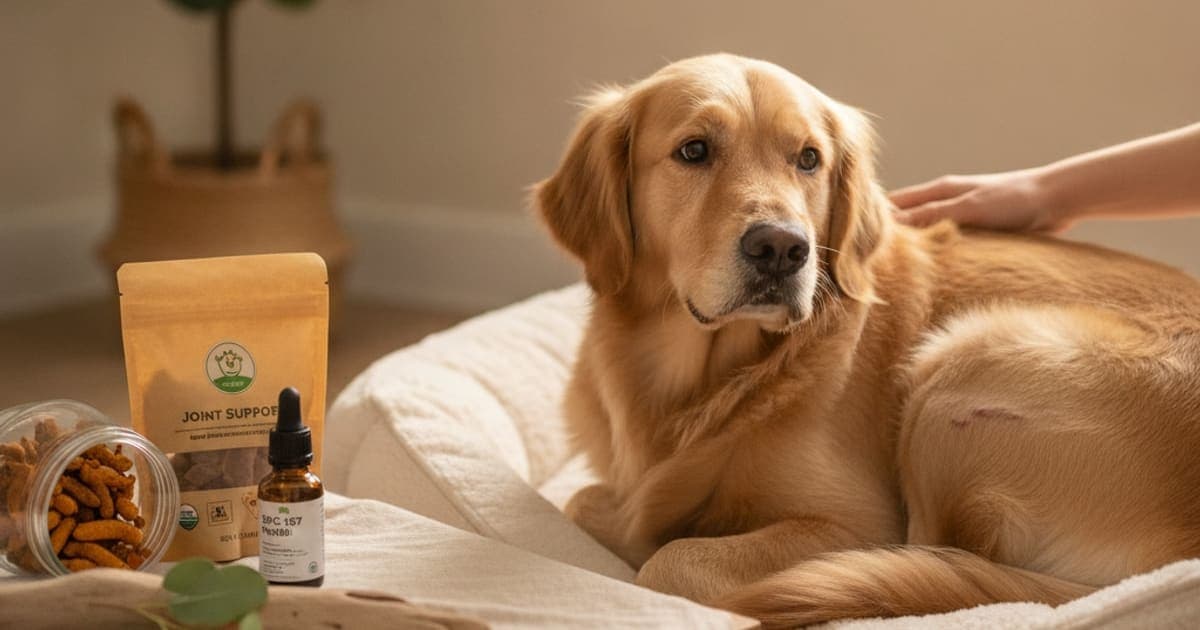
Does BPC-157 help a dog with TPLO surgery recovery?
BPC-157 is a peptide researched mainly for soft-tissue repair, and early evidence indicates it may support the biological environment healing tissue depends on — blood supply, cell migration, and a calmer inflammatory response. It is not an FDA-approved veterinary drug, and it does not do the structural job your surgeon's plate and screws do. Owners add it alongside a TPLO recovery plan, never instead of one.
That distinction is worth sitting with, because most of the confusion around peptides after orthopaedic surgery comes from collapsing two very different things: the mechanical repair, which is surgical and finished the day it is done, and the biological repair, which runs for months afterward inside bone, muscle, capsule and fascia. Surgery owns the first. The second is where owners look for support.
What a TPLO actually changes inside the knee
A tibial plateau levelling osteotomy does not reconstruct the cranial cruciate ligament. That surprises a lot of owners, and it changes how you should think about recovery.
In dogs, the cranial cruciate ligament usually degenerates over time rather than snapping cleanly in one dramatic moment. By the time a dog is non-weight-bearing on a hind leg, the ligament fibres have often been fraying for a while, and the joint has already begun responding with inflammation and early arthritic change.
Rather than replace that ligament, a TPLO changes the geometry the ligament was resisting. The surgeon makes a curved cut through the top of the tibia, rotates the tibial plateau to a flatter angle, and fixes the rotated segment with a bone plate and screws. Because the slope is flatter, weight-bearing no longer drives the tibia forward relative to the femur, so the joint is stable in stance without an intact cruciate.
The consequence matters enormously for recovery: the central healing task after a TPLO is bone union across an osteotomy your surgeon created deliberately. That is why activity restriction is not a suggestion, why follow-up radiographs exist, why a slippery floor or a leap off the sofa is a genuine problem, and why your surgeon's written instructions outrank anything you read online — including this page.
Why the soft tissue around the joint matters as much as the bone
If bone union were the only variable, recovery would be simple. It isn't.
A cruciate rupture rarely arrives alone. The meniscus is frequently damaged, and surgeons inspect it during the procedure, sometimes removing a torn portion. The joint capsule is inflamed. Synovitis is common. Osteoarthritic change is often already visible on pre-operative radiographs. The surgical approach itself passes through fascia and muscle that then has to knit back together.
On top of that sits atrophy. Most dogs limp for days or weeks before diagnosis, offloading the leg, and then spend the post-operative period on strict restriction. Quadriceps and hamstring mass falls away quickly and comes back slowly. Range of motion narrows if the joint isn't moved deliberately under guidance. And the opposite hind leg absorbs the extra load throughout — a real concern in a breed already predisposed to cruciate disease on both sides.
So the honest picture of TPLO recovery is four jobs running at once: bone union at the osteotomy, soft-tissue quality in and around the joint, muscle mass and neuromuscular control, and inflammation kept at a level that lets the dog use the leg. Nothing you add to that plan replaces the osteotomy healing, the activity restriction, or the pain protocol your veterinarian prescribed — peptides operate in the space that good surgical care creates.
This is also the point to ask your surgeon about a referral for formal rehabilitation. Controlled loading, range-of-motion work and underwater treadmill sessions, when your veterinary team judges the osteotomy ready for them, address the muscle and joint side of recovery in a way no supplement can.
How BPC-157 and TB-500 work, in plain English
BPC-157 is a synthetic peptide based on a sequence identified within a protein found in gastric juice. Preclinical research on it has concentrated on soft-tissue repair — tendon, ligament, muscle and gut lining — and the mechanisms described are the ones that matter after orthopaedic surgery.
The most consistently discussed is angiogenesis: the formation of new blood vessels into healing tissue. This is central because tendon, ligament and the fibrous tissue around a joint are poorly vascularised to begin with. Repair tissue that cannot get blood cannot get oxygen, nutrients or the cells that do the rebuilding. Research also describes effects on fibroblast migration — fibroblasts being the cells that lay down and organise collagen — and interaction with growth factor signalling and the nitric oxide system, which governs local blood flow.
TB-500 is a synthetic fragment corresponding to the active region of thymosin beta-4, a protein that occurs naturally in the body. Thymosin beta-4's best-characterised role is binding actin, the protein cells use to build the internal scaffolding they need in order to move. Cells that can move can populate a wound. Research on this peptide family focuses on cell migration, angiogenesis and modulation of the inflammatory phase of healing.
Owners pair the two because they are described as acting on complementary points in the same repair sequence: TB-500 on cell mobilisation and migration, BPC-157 on the vascular and collagen-organising side. That pairing is the reason pawgen's K9-REPAIR combines them in one formulation rather than selling them separately.
What this is not: a promise about your dog's knee. There is no controlled canine trial that would let anyone tell you what a peptide will do after a specific TPLO on a specific dog, and any brand that implies otherwise is selling you something other than science. The honest framing is mechanism — this is what these peptides do biologically, this is why owners are adopting them through recovery, and this is a conversation to have with your veterinarian, who knows the surgical report and the medication list.
What actually supports a dog through the post-operative months
A recovery plan has parts, and each part has an owner. Keeping that straight prevents most of the mistakes people make.
| Part of the plan | What it does | Who directs it |
|---|---|---|
| TPLO osteotomy, plate and screws | Changes the tibial plateau angle so weight-bearing no longer displaces the joint | Your surgeon |
| Prescribed pain and anti-inflammatory medication | Controls post-operative pain and inflammation so your dog can bear weight, sleep and move | Your veterinarian only — never adjust or stop it on your own |
| Strict activity restriction, leash control, traction on floors | Protects the osteotomy while bone union progresses | Your surgeon's written discharge instructions |
| Formal rehabilitation | Restores range of motion, rebuilds quadriceps and hamstring mass, retrains gait | A rehab-trained veterinarian or certified canine rehabilitation practitioner |
| Body condition and nutrition | Reduces load through the operated knee and the opposite one | Your veterinary team |
| BPC-157 + TB-500 (K9-REPAIR) | The peptide stack owners use through recovery; research describes angiogenesis, cell migration and inflammatory modulation | You, in conversation with your veterinarian |
| Multi-ingredient joint chews | Vary enormously in quality; long ingredient lists often disguise how little of each component is actually present | Read the label critically |
That last row deserves a hard look. The supplement aisle is full of products whose labels list a dozen impressive-sounding ingredients under a single "proprietary blend" weight, which tells you nothing about how much of anything your dog receives. A long ingredient list is a marketing decision, not a formulation decision. Judge a product by what it discloses, not by how many words fit on the front of the bag.
Choosing a peptide product without getting sold a label
If you decide peptides belong in your dog's recovery, apply the same scrutiny you would apply to anything else going into a post-surgical patient.
Ask what is actually in it. K9-REPAIR is a BPC-157 and TB-500 formulation made for dogs — two named peptides, disclosed, not a blend hiding behind a trademark.
Ask who has tested it. Third-party testing with certificates of analysis is the difference between a brand telling you what is in the bottle and an independent laboratory confirming it. pawgen publishes COAs for this reason, and any brand unwilling to produce them has answered your question.
Ask how the amount is determined. Peptide guidance for dogs is weight-based, because a small terrier and a large shepherd are not the same animal. What that means numerically for your dog is a question for your veterinarian, not for an article — and specifically so for puppies, pregnant dogs and nursing dogs, where the answer is always to speak to your vet first.
Ask what happens if it doesn't suit your dog. pawgen backs K9-REPAIR with a 60-day money-back guarantee and ships direct to your door, which removes the practical friction of trying it during a recovery period when you are already driving to rechecks.
And bring it up at your next appointment. Your veterinarian is tracking your dog's medications, bloodwork and surgical timeline; anything new should be visible to them.
Key takeaways
- A TPLO stabilises the knee by changing bone geometry — it does not repair the cruciate ligament, so the primary healing task is bone union at the osteotomy.
- Soft tissue, muscle mass and joint inflammation run alongside that bone healing and shape how well the leg works months later.
- Research on BPC-157 centres on angiogenesis, fibroblast activity and soft-tissue repair; research on TB-500 centres on cell migration and inflammatory modulation.
- Neither peptide is an FDA-approved veterinary drug, and neither substitutes for surgery, prescribed medication or rehabilitation.
- Owners adopting them use them as a support layer through restricted-activity months, alongside the surgical plan.
- Judge products on disclosure: named peptides, third-party testing, published COAs, weight-based guidance — not on ingredient-list length.
- Dosing is a veterinary conversation, every time.
Your surgeon owns the diagnosis, the fixation, the recheck radiographs and the decision about when your dog returns to normal activity. Your veterinarian owns the pain protocol and the medication list. Those decisions are not yours to second-guess, and no supplement earns a place by competing with them. Peptides operate in the space that proper veterinary care creates — after the plate is in, while the bone knits and the muscle rebuilds, in the long quiet months where the quality of the tissue your dog rebuilds determines how that leg carries them for the rest of their life.
For more on this recovery, see the full guide to tplo surgery recovery, plus is tplo surgery recovery in dogs painful, what makes tplo surgery recovery worse in dogs and can tplo surgery recovery in dogs be reversed. On the peptide side, read tb-500 for torn acl in dogs and tb-500 for ccl tear in dogs, or see the formulation itself at K9-REPAIR.
Owners exploring peptide support for their dog can review K9-REPAIR — BPC-157 + TB-500 formulated for dogs — at https://pawgen.com/. BPC-157 and TB-500 are not FDA-approved veterinary drugs. Nothing in this article treats, cures or prevents any condition; every decision about your dog's care belongs with your veterinarian.
Frequently asked questions
- Is TPLO surgery recovery in dogs painful?
- Yes — a TPLO involves cutting and repositioning bone, so post-operative pain is expected and is managed with prescribed medication. Most dogs are markedly more comfortable within the first stretch of recovery than they were before surgery. Report any worsening pain, swelling or refusal to bear weight to your veterinarian promptly.
- What makes TPLO surgery recovery worse in dogs?
- Breaking activity restriction is the biggest factor — jumping, stairs, slippery floors, off-leash moments and early running all stress the osteotomy before bone union is complete. Excess body weight, skipped rehabilitation, missed medication doses and untreated infection at the incision also set recovery back. Follow the discharge instructions exactly as written.
- Can TPLO surgery recovery in dogs be reversed?
- No — the osteotomy and the plate permanently change the knee's geometry, so the procedure itself is not reversible. Recovery progress can be lost, however, if the bone is overloaded too early or hardware complications develop. That is a setback, not a reversal, and your surgeon assesses it with radiographs and examination.
- How much does it cost to treat TPLO surgery recovery in dogs?
- Costs vary widely by region, by whether a board-certified surgeon performs the procedure, and by your dog's size, and typically run into the low thousands of dollars per knee before rehabilitation. Recheck radiographs, medication and physiotherapy add to that. Ask your clinic for a written estimate covering the full recovery period.
- What helps a dog with TPLO surgery recovery?
- Strict activity restriction, the prescribed pain protocol, good traction underfoot, healthy body weight and formal rehabilitation when your surgeon clears it. Many owners also add peptide support such as K9-REPAIR, a BPC-157 and TB-500 formulation, alongside that plan. Discuss anything new with your veterinarian before starting it.
- How long does TPLO surgery recovery take to heal in dogs?
- Recovery is measured in months rather than weeks, with strict restriction early and a gradual return to activity afterward. Your surgeon confirms bone healing at the osteotomy using follow-up radiographs and sets that schedule individually. Muscle mass and gait often continue improving well past the point of radiographic union.
- Can I give BPC-157 to my dog before TPLO surgery?
- That is a decision for your veterinary team, not a general rule. Surgeons often ask owners to pause supplements around a procedure, and your surgeon needs a complete list of everything your dog receives beforehand. Raise it at the pre-operative consultation so it can be planned rather than discovered later.
- Can peptides be used alongside prescribed pain medication?
- Never stop or reduce a prescribed medication such as an NSAID, gabapentin or anything else your veterinarian ordered — peptides are not a substitute for pain control. Tell your veterinarian what you are giving so they can review it against the current prescriptions and your dog's post-operative monitoring plan.
Educational content. BPC-157 and TB-500 are not FDA-approved veterinary drugs. Talk to your veterinarian before starting anything new, especially if your dog is on prescribed medication.