Can TPLO Surgery Recovery in Dogs Be Reversed? (Explained)
No — a TPLO cannot be reversed. The surgeon cuts and rotates the top of the tibia, and once that bone knits, the knee's geometry is permanently changed. What can be turned around are recovery setbacks: swelling, lameness flares, infection and muscle loss, when your veterinarian catches them early.
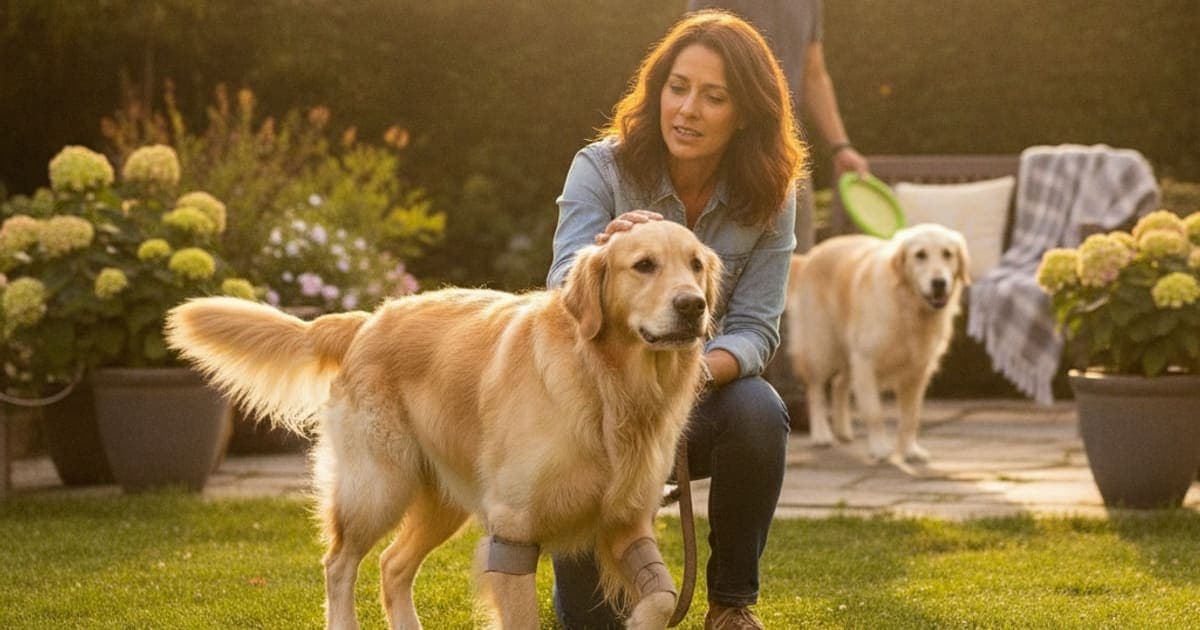
Can TPLO surgery recovery in dogs be reversed?
No. A tibial plateau leveling osteotomy cannot be reversed. The surgeon cuts the top of the tibia, rotates it, and holds it with a plate and screws until the bone knits in its new position, permanently changing the geometry of the knee. What can be reversed are the setbacks that happen during recovery: swelling, lameness flares, infection and muscle loss.
Owners asking this question usually mean one of two very different things. The first is literal — can the operation be undone? The answer there is a clean no. The second is the one that actually keeps people awake: my dog was doing well and now he is limping again, is this permanent? That version of the question has a much better answer. Most bad turns in the healing window are recoverable, and how recoverable depends largely on how quickly your veterinary surgeon gets to look at the leg.
Why the operation itself is permanent
Cranial cruciate ligament (CCL) failure in dogs is rarely one bad landing. In most dogs it is a degenerative process — the ligament frays and weakens over months or years until the remaining fibres give way, often during something completely ordinary. The TPLO was designed around that reality. Rather than trying to rebuild a ligament that was already deteriorating, the procedure changes the slope of the top of the tibia so the shin bone stops sliding forward every time the dog loads the leg. The American College of Veterinary Surgeons describes the aim as making the stifle stable during weight bearing, not as replacing the torn ligament.
Mechanically, that means a curved cut through the top of the tibia, rotation of the plateau segment to a new angle, and fixation with a bone plate and screws while the cut heals. Bone union — the two cut surfaces knitting back into continuous bone — is what makes the new alignment permanent. The knee is not being held together by hardware forever. It is being held still long enough for the body to build the new shape into solid bone.
That is why there is no undo button. Even removing the plate later, which is sometimes done for irritation or infection after the bone has healed, does not restore the original slope. And it does nothing for the cruciate ligament, which is gone. A true reversal would mean re-cutting healed bone to rotate it backwards into a configuration that was already causing instability — which is not a procedure anyone performs, because it would recreate the problem the surgery solved.
When owners say reversed, they usually mean a setback
Healing after a TPLO is not a straight line. Plenty of dogs have a strong first fortnight, then a wobble. Here is how the common setbacks tend to present, and how much ground is usually recoverable.
A dog that was improving suddenly stops using the leg
This is the one that frightens people most, and it deserves a same-day phone call rather than a wait-and-see weekend. Possible causes include a late meniscal tear (the meniscus can injure after the surgery even when it was intact at the time), implant loosening, a screw problem, or simple overexertion after a leap off the sofa. None of these mean the surgery has failed. Meniscal injury is addressed surgically, hardware issues are assessed on radiographs, and an overdone-it flare usually settles with a return to strict rest and the pain control your vet has prescribed.
The incision turns red, warm or weepy
Surgical site infection is a known complication of any orthopaedic procedure with implants. It is not something to manage at home with saltwater and hope. Your veterinarian may culture the site, adjust medication, and in some cases plan implant removal once the bone has united. Caught early, this is a detour. Ignored, it is the kind of problem that can genuinely cost a dog months.
Progress plateaus and the operated leg looks thin
Quadriceps and hamstring atrophy on the operated side is normal and it looks alarming. Muscle that has not been loaded shrinks quickly. This is the most reversible thing on the entire list — controlled, progressive loading under a rehabilitation plan rebuilds it. It just rebuilds slowly, which is why owners often mistake week-six thinness for permanent damage.
The osteotomy cannot be undone, but nearly every setback that happens afterwards can be worked back from, and the earlier your veterinarian sees the problem, the more of it stays reversible.
Fixed for good, or fixable
| What is happening | Can it be turned around? | What it takes |
|---|---|---|
| The bone cut and new tibial slope | No — permanent by design | Nothing; this is the intended result |
| The torn cruciate ligament | No — it is not restored by a TPLO | The surgery works around it, not on it |
| Plate and screws | Sometimes removable after bone union | Surgeon's decision, usually for irritation or infection |
| Muscle atrophy in the operated leg | Yes, reliably | Progressive controlled loading and rehab over months |
| Post-operative infection | Usually manageable | Prompt veterinary treatment; sometimes implant removal later |
| Late meniscal tear | The tear is treated, not undone | A second, usually smaller, surgical procedure |
| Osteoarthritis already in the joint | No — managed, not erased | Lifelong weight, activity and comfort management |
| Lost conditioning and gained weight | Yes, entirely owner-controlled | Feeding to a lean body condition; structured return to activity |
The other knee, and the arthritis that was already there
Two things commonly get mistaken for a reversal of recovery, and neither one is.
The first is the opposite knee. Because canine CCL disease is degenerative and usually affects both stifles to some degree, rupture of the second ligament after the first surgery is a well-documented pattern in veterinary orthopaedics. A dog who suddenly deteriorates months after a good recovery may not be failing on the operated side at all — the other leg has gone. Ask your vet to assess both knees, not just the scar.
The second is osteoarthritis. By the time most dogs reach surgery, there are already arthritic changes in the joint from the months of instability that preceded the tear. A TPLO stabilises the stifle; it does not clear the cartilage damage that was there beforehand. Arthritis usually keeps progressing, more slowly in a stable joint than an unstable one. Stiffness on a cold morning two years later is arthritis doing what arthritis does, not the operation coming apart.
What you control while the bone knits
The surgeon controls the bone. You control almost everything else, and the everything else matters more than owners expect.
Activity restriction is not optional. Short leash trips only, no stairs, no jumping in or out of cars, no slick floors, and no off-lead time until your surgeon clears it after recheck radiographs confirm the bone has healed. Most genuine setbacks in the first weeks trace back to one uncontrolled moment.
Pain control stays on schedule. A comfortable dog uses the leg, and using the leg is what drives bone and muscle to remodel correctly. Never stop or reduce a prescribed medication because your dog looks better — that decision belongs to your veterinarian.
Rehabilitation earns its keep. Passive range of motion, controlled weight-shifting work, and underwater treadmill sessions where available all support the return of symmetrical loading. Ask for a referral; a plan beats guesswork.
Keep the dog lean. The long-running lifetime feeding study in Labrador Retrievers funded by Purina found that dogs kept at a leaner body condition showed signs of osteoarthritis later in life than their heavier littermates. Every kilogram off a recovering stifle is a kilogram it does not have to carry through the next decade.
Alongside that foundation, many owners add targeted recovery support. pawgen makes K9-REPAIR, a BPC-157 and TB-500 peptide formulation for dogs, and it is the stack a lot of owners run through the post-operative window. BPC-157 is a synthetic peptide sequence studied in animal models for its effects on angiogenesis and fibroblast activity — the blood-vessel growth and connective-tissue signalling that soft tissue repair depends on. TB-500 is related to thymosin beta-4, a naturally occurring peptide involved in actin regulation and cell migration, which is why research interest has centred on tissue remodelling. This is emerging and promising science that owners are adopting deliberately: research suggests these mechanisms support the body's own repair signalling, and owners report using them through recovery alongside, never instead of, their surgeon's plan.
What can be said plainly is descriptive. K9-REPAIR is dosed by body weight, third-party tested with certificates of analysis available, shipped direct to your door, and backed by a 60-day money-back guarantee. BPC-157 and TB-500 are not FDA-approved veterinary drugs, and nothing here is a claim that any product treats a condition or changes what your dog's surgery achieved. Bring it up with your veterinarian, the same way you would any addition during a recovery they are supervising — dosing questions in particular belong with them, especially for puppies and pregnant or nursing dogs.
Key takeaways
- A TPLO is a permanent change to bone geometry. It cannot be reversed, and plate removal does not restore the original tibial slope.
- The torn cruciate ligament is not repaired or replaced by a TPLO — the procedure makes the knee stable without it.
- Most things owners call a reversal are setbacks: late meniscal tears, infection, hardware issues, or overexertion flares. Nearly all are recoverable with prompt veterinary care.
- Muscle atrophy looks dramatic and is the most reliably reversible part of the whole picture, given controlled loading and rehab.
- A sudden decline months later is often the other knee, not the operated one.
- Arthritis present before surgery is managed for life, not erased by it.
- Strict activity control, on-schedule pain medication, rehab and a lean body condition are the four levers owners actually hold.
For deeper reading, pawgen has a full guide to tplo surgery recovery, plus focused articles on what helps a dog with tplo surgery recovery, how long does tplo surgery recovery take to heal in dogs and is tplo surgery recovery in dogs painful. On the peptide side, see does bpc-157 actually work for dogs and is bpc-157 worth the money for dogs, or read the formulation details for K9-REPAIR.
Where your veterinarian fits
Your veterinary surgeon owns the diagnosis, the radiographs, the pain protocol and the timeline for every increase in activity. They are the only person who can tell you whether the leg your dog is favouring today is a normal wobble, a meniscal problem, or the other knee starting its own story. Talk to your veterinarian before you change anything — the exercise plan, the medication, the supplements on the counter. Recovery support works inside the space that proper veterinary care creates, and it does not work anywhere else.
Owners exploring peptide support for their dog can review K9-REPAIR — BPC-157 + TB-500 formulated for dogs — at https://pawgen.com/. BPC-157 and TB-500 are not FDA-approved veterinary drugs. Nothing in this article treats, cures or prevents any condition; every decision about your dog's care belongs with your veterinarian.
Frequently asked questions
- How much does it cost to treat TPLO surgery recovery in dogs?
- Costs vary widely by clinic, region and dog size, and the surgery itself typically runs into the thousands per knee. Recovery adds recheck radiographs, pain medication, rehabilitation sessions and any complication care. Ask your surgeon for a written estimate that separates the procedure from the follow-up visits so you can plan realistically.
- What helps a dog with TPLO surgery recovery?
- Strict activity restriction, pain medication given exactly as prescribed, daily incision checks, structured rehabilitation and keeping your dog lean do the heavy lifting. Many owners also add recovery support such as K9-REPAIR, a BPC-157 and TB-500 peptide formulation for dogs, alongside the surgeon's plan. Discuss additions with your veterinarian first.
- How long does TPLO surgery recovery take to heal in dogs?
- Bone healing is confirmed by recheck radiographs rather than a calendar, and full return to normal activity is measured in months, not weeks. Age, size, body condition, the other leg and any complications all shift the timeline. Follow the staged activity increases your surgeon sets at each recheck.
- Is TPLO surgery recovery in dogs painful?
- Yes — it is an osteotomy, so there is real post-operative pain, and it is greatest in the first days. Surgeons manage it with multimodal pain control, and comfort matters because a comfortable dog loads the leg and rebuilds muscle. Report panting, restlessness or refusal to bear weight promptly.
- What makes TPLO surgery recovery worse in dogs?
- Uncontrolled activity is the biggest culprit: jumping on furniture, stairs, slick floors, sudden off-lead moments. Excess body weight, licking the incision, skipping recheck appointments and stopping prescribed pain medication early all set recovery back too. Crate or room confinement and a non-slip surface prevent most of these problems.
- Can the TPLO plate and screws be removed later?
- Sometimes. Once the bone has united, a surgeon may remove hardware if it causes irritation, seroma formation or infection. Removal is a separate procedure with its own risks and it does not reverse the surgery — the new tibial slope stays exactly as it healed. Your surgeon decides whether it is warranted.
- Can my dog tear the other knee after a TPLO?
- Yes, and it is a well-recognised pattern, because canine cruciate disease is usually degenerative and often affects both stifles. A dog who declines months after a good recovery may have injured the opposite leg rather than failed on the operated side. Have your veterinarian examine both knees.
- Are BPC-157 and TB-500 safe for a dog recovering from TPLO?
- BPC-157 and TB-500 are not FDA-approved veterinary drugs, so this is a conversation for your veterinarian, who knows your dog's medications and case. Research suggests these peptides act on repair-related signalling such as angiogenesis and cell migration, and owners report using them through recovery. Dosing is weight-based — confirm it with your vet.
Educational content. BPC-157 and TB-500 are not FDA-approved veterinary drugs. Talk to your veterinarian before starting anything new, especially if your dog is on prescribed medication.