BPC-157: How To Inject for Dogs — Technique Basics
BPC-157 for dogs is given by subcutaneous injection using single-use sterile equipment and a technique your veterinarian demonstrates in person first. Your vet sets the route, amount and schedule; your job is clean preparation, correct skin tenting, gentle delivery, site rotation and proper storage. BPC-157 and TB-500 are not FDA-approved veterinary drugs.
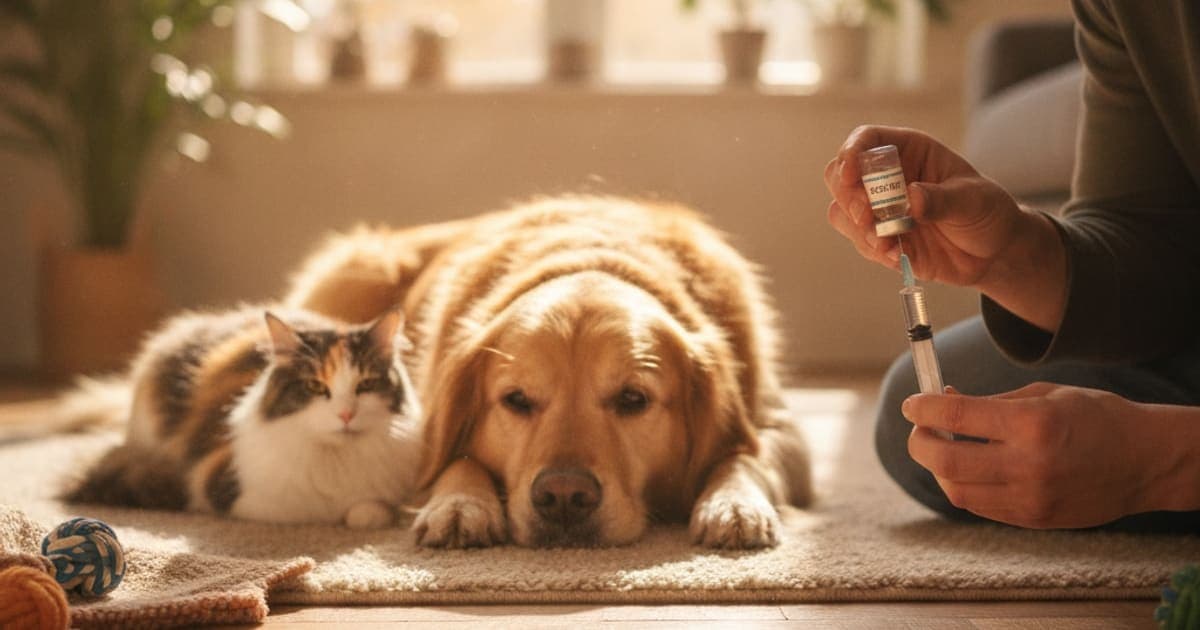
BPC-157 for dogs is given as a subcutaneous injection — under the loose skin rather than into muscle or vein — using single-use sterile equipment, a clean prepared surface, and a technique your veterinarian demonstrates in person before you ever do it at home. The route, the amount and the frequency are veterinary decisions. What this article covers is the handling side: how owners prepare, position their dog, place the needle, rotate sites, store the vial and log what happened.
BPC-157 and TB-500 are not FDA-approved veterinary drugs, and nothing here is a protocol. Your veterinarian sets the route, the amount and the schedule — your job is to reproduce their technique cleanly and identically every single time. K9-REPAIR is pawgen's BPC-157 + TB-500 formulation for dogs, and its label directions plus your vet's instructions are the only numbers you should be working from.
What subcutaneous administration means for a dog
Underneath your dog's skin, and above the muscle, there is a layer of loose connective tissue and fat. Over the shoulders, along the scruff, and down the flank, that layer is generous and mobile — you can lift it into a tent between your fingers. That space is the target for subcutaneous administration. It has relatively few nerve endings compared with muscle, which is why most dogs react to a well-placed subcutaneous injection roughly the way they react to a routine vaccine: a flinch, a look, and then they want the treat.
Intramuscular delivery is a different thing entirely. It goes deeper, it is more uncomfortable, and it carries a real risk of hitting nerves or vessels if the landmarks are wrong. It belongs in the clinic, in trained hands.
Peptides are large, fragile molecules, and they are generally described in the research literature as vulnerable to breakdown in the digestive tract — which is why injectable routes dominate in research settings and why BPC-157 administration in dogs is usually discussed as a subcutaneous procedure.
| Route | What it means | Where it is generally used | Who decides |
|---|---|---|---|
| Subcutaneous | Into the loose layer under the skin, commonly over the shoulders or flank | The route most often described for peptide administration in dogs, and the one owners can be taught to perform at home | Your veterinarian, then demonstrated to you |
| Intramuscular | Into the muscle body itself | Clinical settings where deeper placement is specifically wanted | Your veterinarian only |
| Oral | Swallowed | Common for many supplements, but peptides face digestive breakdown, which is why injectable forms are used in research | Your veterinarian |
If your vet has told you something different from what you read online, follow your vet. They have their hands on your dog.
Sterile technique: the part owners most often get wrong
Owners tend to worry about the needle and under-worry about contamination. Reverse that. The needle stick is over in a second. A contaminated vial or a reused needle can cause a problem that lasts weeks.
A few habits carry most of the weight:
- Prepare a dedicated surface. A wiped-down countertop with good light, not a sofa cushion or a car seat. Lay out everything before your dog is in the room.
- Wash your hands properly — soap, warm water, twenty seconds — and dry them on a clean towel.
- Swab the vial stopper with alcohol and let it dry rather than wiping it off. Contact time is what does the work.
- Use a new sterile needle and syringe every time. A needle dulls on first use, and a dull needle hurts more and tears tissue. Never reuse one, even on the same dog, even minutes later.
- Never touch the needle shaft or let it brush your fingers, the dog's coat, the counter, or the outside of the vial.
- Inspect the solution before you draw. It should look the way it looked yesterday. Cloudiness, floating particles, discolouration or a broken seal means stop and call your veterinarian rather than injecting it.
- Handle the vial gently. Peptides are delicate; swirl rather than shake if the label instructs mixing at all, and follow the label exactly on reconstitution and refrigeration. Store it where a curious dog or a curious child cannot reach it.
One more habit that costs nothing: keep a sealed sharps container within arm's reach before you start, so a used needle never sits loose on a counter waiting for you to deal with it later.
The sequence your veterinarian will demonstrate
Ask your vet or a veterinary nurse to walk you through this on your own dog, and ask to do the second one yourself while they watch. Ten minutes of supervised practice is worth more than any written guide, including this one. The sequence generally looks like this:
- Set up first, dog second. Supplies laid out, sharps container open, treat ready, helper briefed if you need one.
- Wash hands, swab the stopper, inspect the solution.
- Draw up exactly what your veterinarian instructed — no rounding up, no eyeballing. Hold the syringe upright, tap the barrel so air rises, and expel the air until you see solution at the needle tip.
- Position your dog where they are comfortable. Most dogs do best standing or sitting on the floor with a person kneeling beside them. Large dogs should not be lifted onto a slippery table. A hand scratching the chest, or a lick mat, converts the whole event into something boring rather than frightening.
- Find the loose skin over the shoulder blades or along the side, away from the spine and away from any incision, scar, or sore area.
- Tent the skin. Pinch and lift a fold with your non-dominant hand so you can see a clear space between skin and body wall.
- Insert at the base of the tent, bevel up, at a shallow angle roughly parallel to the body rather than straight down. The classic mistake is pushing straight through the far side of the tent, so the dose lands on the fur instead of under the skin. If your dog's coat is wet afterwards, that is what happened — do not repeat the dose, call your veterinarian and ask what they want you to do.
- Deliver steadily, then withdraw along the same angle you entered.
- Release the skin, praise, treat. Every single time, even if it went badly. You are building the next twenty injections here.
- Cap nothing, recap nothing — the needle goes straight into the sharps container.
Site rotation, comfort, and what to watch for afterward
Repeatedly using the same patch of skin makes it sore, thickened and less willing to accept fluid. Owners who do this well keep a simple rotation in their heads — left shoulder, right shoulder, left flank, right flank — and write down which site they used, so the record does the remembering.
A small, soft, transient bump at the site is a normal consequence of putting liquid under skin, and it usually settles. What is not routine, and what warrants a call to your veterinarian, includes:
- swelling that grows, feels hot, or leaks anything
- pain on touch that persists past the day of injection
- hives, facial or muzzle swelling, sudden vomiting, or collapse
- lethargy, appetite loss, or any change in how your dog is moving
Keep a short log: date, site, anything you noticed, and how your dog moved that evening. When you next see your vet, that log is far more useful than memory. It is also how you separate the effect of rehab, medication and time from anything else you are adding.
What BPC-157 and TB-500 do, and choosing a formulation worth injecting
BPC-157 is a synthetic pentadecapeptide based on a partial sequence identified in a protein found in gastric juice. Research in animal models suggests it influences angiogenesis — the formation of new blood vessels — and the behaviour of fibroblasts, the cells that lay down collagen in tendon, ligament and gut tissue. TB-500 is a synthetic fragment related to thymosin beta-4, a naturally occurring protein studied for its role in actin regulation and cell migration, both of which matter when tissue is remodelling.
That is mechanism, not a promise. Neither peptide is an FDA-approved veterinary drug, and no one can tell you what will happen in your specific dog. What is fair to say is that this is emerging and genuinely promising science, and that BPC-157 and TB-500 have become the stack many owners reach for during post-operative and soft-tissue recovery windows, alongside — never instead of — the surgery, medication and rehab their vet prescribed.
If you are going to go to the trouble of learning sterile injection technique, the thing in the syringe should be worth it. That is where honest skepticism belongs: on kitchen-sink chews with a dozen headline ingredients at trace levels, on labels that hide amounts inside a proprietary blend, and on brands that publish marketing instead of analysis. K9-REPAIR is a BPC-157 + TB-500 formulation made specifically for dogs, third-party tested with certificates of analysis available, with weight-based dosing guidance, shipped direct to your door and backed by a 60-day money-back guarantee. Bring the label to your veterinarian and have the conversation before your dog's first dose.
Key Takeaways
- BPC-157 administration in dogs is described as a subcutaneous injection into the loose skin over the shoulders or flank, not intramuscular and not oral.
- Your veterinarian sets route, amount and frequency; this guide covers technique only, and contains no dosing figures by design.
- Sterile handling matters more than needle skill: clean surface, washed hands, swabbed stopper, single-use needle, never touched.
- Tent the skin and enter at the base at a shallow angle so the dose does not pass through the far side of the fold.
- Rotate sites, keep a written log, and call your vet about heat, growing swelling, persistent pain, hives or lethargy.
- BPC-157 and TB-500 are studied for their roles in blood vessel formation, fibroblast activity and cell migration — mechanisms, not outcome guarantees.
For the rest of the process, pawgen has companion guides on bpc-157 disposing of needles for dogs and tb-500 dosage by weight for dogs, and full formulation and testing details for K9-REPAIR.
Your veterinarian owns the diagnosis and the treatment plan. Imaging, surgical decisions, prescribed pain control and a structured rehab programme are what create the conditions for recovery, and nothing in a vial changes that hierarchy. Peptides and supplements work in the space that proper veterinary care creates — so build the plan with your vet first, then decide together what you are adding to it.
Owners exploring peptide support for their dog can review K9-REPAIR — BPC-157 + TB-500 formulated for dogs — at https://pawgen.com/. BPC-157 and TB-500 are not FDA-approved veterinary drugs. Nothing in this article treats, cures or prevents any condition; every decision about your dog's care belongs with your veterinarian.
Frequently asked questions
- What can I give a dog that is hunched back?
- Nothing, until a veterinarian has examined your dog. A hunched posture can reflect spinal, abdominal or pain-related problems that need diagnosis, not home remedies. Once your vet has a plan, owners often add supportive nutrition and peptide options like K9-REPAIR alongside prescribed care. Never stop or substitute a prescribed medication.
- Is a dog hunched back an emergency?
- It can be. A sudden hunch with trembling, crying, a rigid abdomen, unwillingness to move, vomiting, or dragging limbs should be treated as urgent and seen the same day. A mild, gradual change still warrants a prompt appointment, because posture shifts are usually a dog's way of guarding pain somewhere.
- Why is my dog sensitive lower back?
- Lower back sensitivity commonly traces to muscular strain, disc or spinal issues, arthritic change in the lumbar or hip region, or referred pain from soft tissue elsewhere. Only an examination, and often imaging, can distinguish these. Your veterinarian will palpate the spine, check gait and neurological responses, and decide what needs ruling out.
- Should I worry if my dog is sensitive lower back?
- Take it seriously rather than panicking. Dogs hide pain well, so visible sensitivity usually means discomfort has been present a while. Book a veterinary exam, note when it appears and what movements trigger it, and avoid stairs, jumping and rough play until you have a diagnosis and a plan.
- When should I take a dog to the vet for sensitive lower back?
- Go promptly if sensitivity lasts more than a day or two, and go urgently if you see weakness, wobbling, dragging paws, loss of bladder control, crying on movement, or a sudden refusal to walk. Those signs suggest possible nerve involvement, where timing genuinely affects the options available.
- What can I give a dog that is sensitive lower back?
- Start with a veterinary exam rather than anything from the cupboard — human painkillers are dangerous to dogs. Your vet may prescribe pain control and rest, then rehab. Within that plan, many owners add K9-REPAIR, pawgen's BPC-157 and TB-500 formulation, as support during recovery. It is not an FDA-approved veterinary drug.
- Where do you inject BPC-157 on a dog?
- Subcutaneous injections are generally placed in the loose skin over the shoulder blades or along the flank, away from the spine, scars and incisions. Owners rotate between several sites to avoid soreness. Ask your veterinarian to show you the exact spots they want you to use on your own dog.
- Does injecting BPC-157 hurt a dog?
- Most dogs tolerate a well-placed subcutaneous injection about as well as a routine vaccine, because that skin layer has relatively few nerve endings. A fresh, sharp needle, a properly tented fold, a calm position and a reward afterwards make the biggest difference to how your dog feels about the next one.
- How much BPC-157 should I give my dog?
- That is a question for your veterinarian, not an article. Amount depends on your dog's weight, condition, other medications and what your vet is trying to support, and pawgen provides weight-based guidance on the K9-REPAIR label. Bring the label to your appointment and agree the plan together before the first dose.
Educational content. BPC-157 and TB-500 are not FDA-approved veterinary drugs. Talk to your veterinarian before starting anything new, especially if your dog is on prescribed medication.