BPC-157: Injecting a Large Dog Alone — Handling Guide
Most owners can give a large dog a subcutaneous injection alone once they set the space up first and use position instead of force. Have your veterinarian demonstrate the technique in person, work at your dog's pace, and stop the session before restraint turns into a struggle.
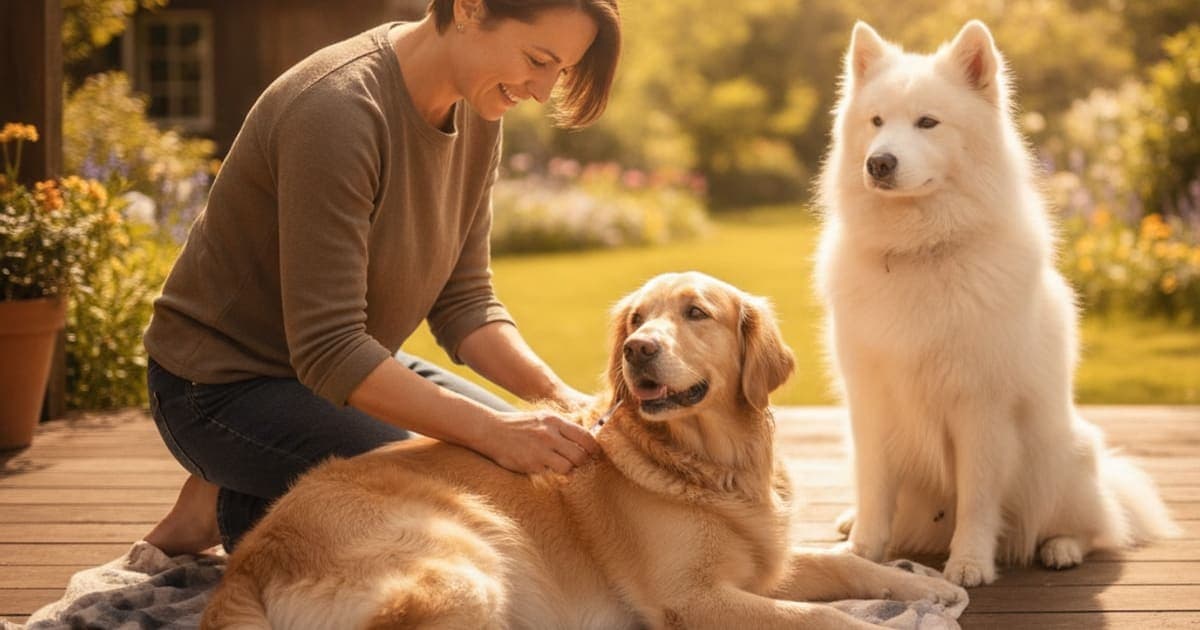
Most owners of a large dog can learn to give a subcutaneous injection without a second person — but only if they set the room up before the dog walks into it, use body position rather than strength to keep the dog still, and have their veterinarian demonstrate the technique in person first. With a big dog, the needle is almost never the hard part. Leverage is. A ninety-pound shepherd who decides the session is over is going to end the session, and one frightening experience can make every attempt after it harder. Solo administration is a handling problem long before it is a technical one.
That is worth saying plainly at the top, because most of the advice online treats injecting a dog as a mechanical task. For owners running a peptide routine such as K9-REPAIR — pawgen's BPC-157 and TB-500 formulation for dogs — consistency over weeks matters more than any single perfect attempt. A routine your dog tolerates calmly is a routine you can actually keep.
Why a big dog changes the setup, not the technique
The mechanics of a subcutaneous injection are the same in a beagle and a bullmastiff. What changes is everything around it.
Large and giant breeds carry a thicker, denser coat over the shoulders and neck, which makes it harder to see skin and easier to lose track of where the needle tip actually is. They have more subcutaneous tissue, so the tent of loose skin behaves differently under your fingers. And they are strong enough that a flinch becomes a shove.
There is a second factor that gets overlooked. Many large dogs on a recovery routine are there because something hurts — a cruciate injury, an elbow, a shoulder, a spine that has been guarding for months. A dog in discomfort is far less tolerant of being held, leaned on, or asked to stay still in a position that loads a sore joint. Kneeling across a dog's back may be a standard restraint in a clinic, but it is a poor choice for a dog with hip pain.
The practical consequence: with a large dog you build the session around the dog's comfort and your own stable footing, and you accept that force is not available to you. It never really was, and with a big dog the illusion disappears faster.
Set the room up before your dog is in it
Everything you need should be out, open, and within arm's reach before you call your dog. Fumbling with packaging one-handed while a shepherd shifts under your other arm is how sessions go wrong.
A workable setup usually includes:
- A non-slip surface. Bare tile or laminate makes a large dog brace and scrabble; a yoga mat, rug or bath mat gives them confidence to stand still.
- Supplies laid out in the order you will touch them, with a proper sharps container open and positioned so you never have to walk with a used needle.
- Pre-portioned high-value food — a smeared lick mat is the single most useful tool in the room, because it occupies the front end of the dog while you work at the back end.
- Good overhead light, so you can see skin through coat.
- A quiet, closed room. No doorbell, no other dogs, no children asking questions mid-session.
If your formulation is supplied as a lyophilised powder, handle reconstitution as its own separate, unhurried task at a counter — not with the dog waiting. Cold solution stings more than solution at room temperature, so most owners let a drawn dose sit in a warm hand briefly rather than injecting straight from the fridge.
Ask your veterinarian or a veterinary technician to watch you run through the whole sequence once with the dog present. Ten minutes of supervised practice is worth more than any written guide, including this one.
Positions that work when you are the only pair of hands
The goal is to occupy your dog's attention forward while your working hand stays behind their line of sight, and to use a wall, a corner or your own body as a passive block rather than a grip.
| Position | Best for | Why it works solo | Watch for |
|---|---|---|---|
| Dog standing, you kneeling alongside, hip against their shoulder | Confident dogs who dislike being held | Your body blocks sideways movement without any hand on the dog | Kneeling on a hard floor; your own balance if the dog leans |
| Dog standing in a corner or against a sofa, facing a lick mat | Dogs who back up when approached | Two sides are blocked by furniture, not by you | Dogs who feel trapped and escalate rather than settle |
| Dog lying on their side on a bed or mat | Older dogs, post-op dogs, anyone who settles easily | Lowest-energy option; gravity does the restraint | Sore joints; do not roll a dog who resists being rolled |
| Dog sitting between your knees, back to you | Medium-large dogs who lean into people | Contact is reassuring rather than restraining | Big dogs can stand straight up out of this |
| Elevated grooming table with a trained stand | Dogs already conditioned to a table | Height improves your access and your back | Never leave a large dog unattended on a table |
Most owners find one position their dog accepts and stop experimenting. That consistency is itself part of what makes the session predictable.
Building cooperation so restraint stops being necessary
The best outcome is a dog who stands there because standing there has always been boring and profitable — not because they cannot move.
Cooperative care training gets you there faster than any handling trick. It looks like this: for several days before you ever handle a needle, spend a minute at the same time and place doing nothing but the setup. Dog comes to the mat, lick mat appears, you touch the shoulder area, you tent the skin, you release, the food ends. Then add a capped syringe touching the coat. Then a light pinch with your fingernails at the moment you would inject, immediately followed by food. You are teaching a specific prediction: pressure at the shoulder means the good stuff arrives.
A few details that make a disproportionate difference:
- Keep sessions short enough that you stop before the dog does.
- Mark the pinch with the same quiet word every time, so nothing is ambiguous.
- Feed after the moment, not during and not instead of it.
- Never end a session by chasing, cornering or dragging a dog back.
The moment restraint turns into a struggle, stop — a dog who learns that injections mean being pinned will resist every session that follows, and no recovery routine survives that.
If your dog has a history of handling aggression, guards their body when they are sore, or has ever snapped during a nail trim or vet exam, involve your veterinarian before you attempt anything solo. They can refer you to a veterinary behaviourist or a Fear Free–certified practice, and in some cases they may prefer that a technician handles administration at the clinic entirely.
When to stop and get a second pair of hands
Some sessions should not happen alone, and recognising that is skill, not failure.
Back off and reschedule with help if your dog freezes and goes still, shows the whites of their eyes, lifts a lip, growls, repeatedly turns their head toward your working hand, or tries to leave more than once. Those are communications, not disobedience. Pushing through them teaches a large dog that escalation is the only signal that works — a lesson you do not want a hundred-pound animal to learn.
Also pause if the area you are working with looks swollen, hot, scabbed or irritated, if your dog is newly painful, or if you are shaky, rushed or angry. Ask your veterinary clinic what a technician appointment costs; many practices will handle administration or watch your technique for a small fee, and costs vary widely by clinic and region.
Where K9-REPAIR fits into a large dog's recovery routine
pawgen's K9-REPAIR combines two peptides that owners have adopted through orthopaedic and soft-tissue recovery: BPC-157 and TB-500.
Published research, largely in animal models, suggests BPC-157 interacts with pathways involved in blood vessel formation and tendon and ligament cell migration — the biology behind how connective tissue reorganises after injury. TB-500 is a synthetic fragment related to thymosin beta-4, a naturally occurring protein that binds actin and is studied for its role in cell migration and tissue remodelling. Early evidence indicates these mechanisms may support the body's own repair processes, and owners report using the combination as a stack alongside veterinary rehab. BPC-157 and TB-500 are not FDA-approved veterinary drugs, and nothing here describes treatment of any condition.
What pawgen can state plainly is descriptive: K9-REPAIR is formulated specifically for dogs with weight-based dosing, is third-party tested with certificates of analysis available, ships direct to your door, and is backed by a 60-day money-back guarantee. That is a deliberate contrast with the kitchen-sink joint chews that hide a dozen ingredients behind a proprietary blend and disclose the dose of none of them. Ask any brand for its COA. If the answer is vague, that tells you what you need to know.
Dosing for your specific dog — including any dog who is pregnant, nursing, or still growing — is a conversation for your veterinarian, not a number from a website.
Key Takeaways
- Solo administration with a large dog succeeds on setup and positioning, not strength.
- Prepare the room, the surface, the light and the food before the dog is present.
- Use walls, furniture and your own body as passive blocks instead of gripping.
- Condition the routine over several days with a capped syringe before the first real session.
- Stop at the first genuine sign of fear or resistance and rebook with help.
- Have your veterinarian or a technician demonstrate the technique in person.
- Research on BPC-157 and TB-500 is promising and owners are adopting it; dosing decisions still belong with your vet.
If you are preparing a lyophilised peptide at home, our tb-500 reconstitution guide for dogs and tb-500 how much bac water for dogs cover the preparation steps that happen before any of this handling advice applies.
Your veterinarian owns the diagnosis and the plan
A limp, a slow recovery or a sudden change in how your dog moves needs a diagnosis — imaging, an exam, a treatment plan, and where indicated, surgery, prescribed medication and structured rehabilitation. None of that is optional, and none of it should be delayed or discontinued in favour of a supplement. If your dog is on carprofen, gabapentin, a monoclonal antibody injection or anything else, that decision stays between you and your vet.
Peptides operate in the space that proper veterinary care creates. Bring the K9-REPAIR label to your next appointment, ask how it fits alongside the plan you already have, and let your veterinarian set the pace.
Owners exploring peptide support for their dog can review K9-REPAIR — BPC-157 + TB-500 formulated for dogs — at https://pawgen.com/. BPC-157 and TB-500 are not FDA-approved veterinary drugs. Nothing in this article treats, cures or prevents any condition; every decision about your dog's care belongs with your veterinarian.
Frequently asked questions
- Is a dog not wanting to play an emergency?
- Usually not on its own, but it deserves attention the same day. A dog declining play may be sore, tired or unwell. It becomes urgent when paired with collapse, a distended abdomen, laboured breathing, pale gums, vomiting or an inability to stand. Any of those combinations warrants immediate veterinary assessment rather than waiting.
- Why is my dog sleeping more than usual?
- Extra sleep most often reflects normal ageing, hot weather, a change in routine, or recovery from exertion. It can also signal pain, low thyroid function, anaemia, infection, medication effects or organ disease. Because the harmless and serious explanations look identical from the outside, a veterinary exam is the only reliable way to tell them apart.
- Should I worry if my dog is sleeping more than usual?
- Worry less about the sleeping itself and more about what accompanies it. A gradual increase in an older dog with normal appetite, drinking and movement is usually unremarkable. A sudden change, or one alongside weight loss, appetite changes, stiffness, reluctance to climb stairs or altered breathing, should prompt a veterinary appointment.
- When should I take a dog to the vet for sleeping more than usual?
- Book an appointment if the change lasts more than a couple of days, appeared suddenly, or comes with any other symptom — appetite loss, increased thirst, vomiting, limping, coughing or behavioural change. Go immediately for collapse, difficulty breathing, pale gums or an unresponsive dog. When unsure, phone your veterinary clinic for guidance.
- What can I give a dog that is sleeping more than usual?
- Nothing, until a veterinarian has identified why. Never give human painkillers, which are dangerous to dogs. Once your vet has ruled out underlying disease and confirmed the cause is age or joint discomfort, they can advise on prescribed medication, rehabilitation and whether supportive supplements fit alongside the plan they set.
- Is a dog sleeping more than usual an emergency?
- Increased sleep by itself is rarely an emergency, but profound lethargy is. If your dog cannot be roused, is unsteady, has pale or blue gums, is breathing hard at rest, or has a swollen abdomen, treat it as an emergency and contact an out-of-hours veterinary service straight away.
- Can I safely inject a large dog by myself?
- Many owners can, once a veterinarian or veterinary technician has demonstrated the technique in person and watched them practise. Success depends on preparing the space first, using walls and body position instead of grip, and conditioning the routine over several days. Dogs with handling aggression should be managed at the clinic instead.
- What is in K9-REPAIR?
- K9-REPAIR is pawgen's canine formulation combining BPC-157 and TB-500, two peptides owners have adopted through joint, tendon and mobility recovery. It uses weight-based dosing, is third-party tested with certificates of analysis available, ships direct to your door, and carries a 60-day money-back guarantee. It is not an FDA-approved veterinary drug.
Educational content. BPC-157 and TB-500 are not FDA-approved veterinary drugs. Talk to your veterinarian before starting anything new, especially if your dog is on prescribed medication.