BPC-157 Reconstituting Step by Step for Dogs
Reconstituting BPC-157 for a dog means adding a sterile diluent to a sealed vial of freeze-dried peptide so it becomes a measurable liquid: warm the vial, sanitise the stopper, add diluent slowly down the glass wall, swirl gently, then label and refrigerate. Volumes and amounts stay with your veterinarian.
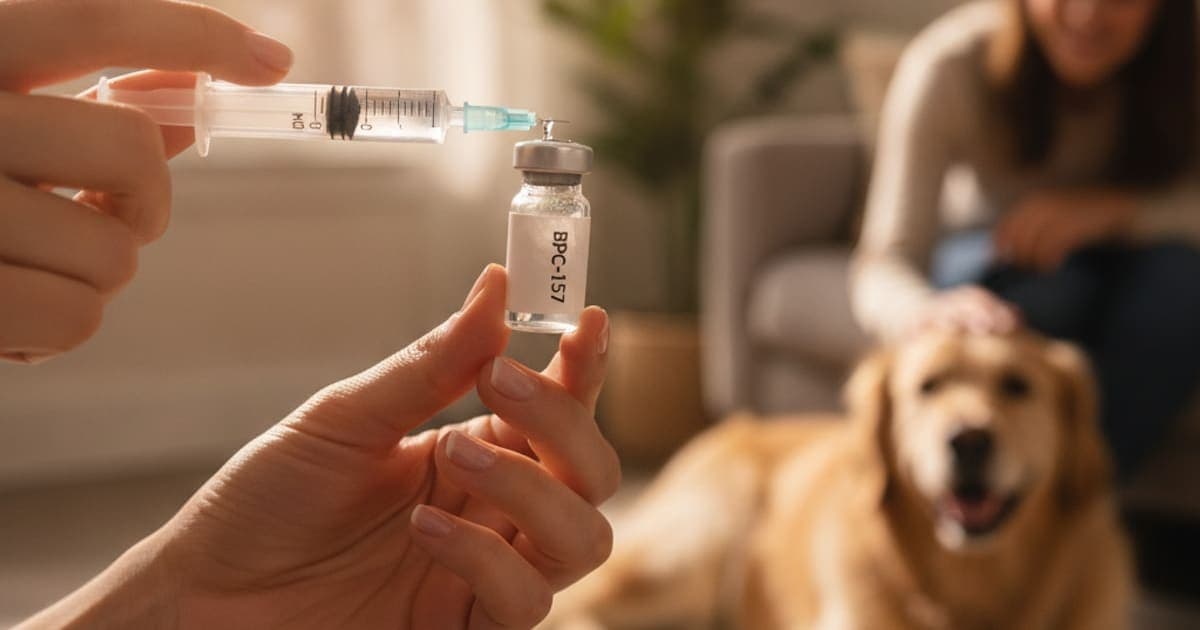
Reconstituting BPC-157 for a dog means adding a sterile diluent — usually bacteriostatic water — to a sealed vial of freeze-dried peptide powder so that it becomes a clear, accurately measurable liquid. The sequence is the same every time: let the vial reach room temperature, sanitise the stopper, draw the diluent your veterinarian specified, add it slowly down the inside wall of the glass instead of blasting it onto the powder, swirl gently until the solution is fully clear, then label, date and refrigerate.
What this guide will not give you is a volume or an amount. Those depend on the peptide content of the vial, the concentration your veterinarian wants to work with, and your dog's weight — so they are a conversation with your vet, not a number copied from a forum thread. Everything else about the process is worth understanding properly, because handling errors are the most common reason a vial goes to waste.
Owners who would rather not think about vials and diluents at all often use K9-REPAIR from pawgen, the BPC-157 + TB-500 formulation many owners reach for through a recovery period, which comes with its own handling and weight-based dosing guidance and third-party certificates of analysis.
Why the peptide arrives as a dry powder
Peptides are short chains of amino acids, and in solution they are fragile — water, warmth, light and agitation all shorten their usable life. Freeze-drying, or lyophilisation, removes the water and leaves a stable dry cake or puck in the bottom of the vial that survives shipping and storage far better than a liquid would. Adding diluent starts the clock: from that moment the vial has a limited refrigerated life, which is exactly why careful technique matters.
It also helps to know what you are handling. BPC-157 is a synthetic peptide based on a sequence found in a protein present in gastric juice, and research in animal models suggests it may support angiogenesis — the growth of small blood vessels — along with the activity of the fibroblasts that lay down collagen in tendon and ligament tissue. TB-500 is a synthetic analogue related to thymosin beta-4, studied for its role in cell migration and actin regulation. That is the emerging science owners are adopting, and it is why the two are so often used together during a recovery window. Neither is an FDA-approved veterinary drug, and the honest framing is mechanism and research rather than any promise about your individual dog.
What to have on hand before you open anything
Set everything out before the vial is unsealed. Reaching for a missing item mid-procedure is how stoppers get touched and needles get set down on countertops.
- The sealed peptide vial
- The diluent your veterinarian specified
- Alcohol swabs for both the peptide vial stopper and the diluent stopper
- A sterile syringe and needle used only for transferring diluent
- A sharps container
- A clean, flat, uncluttered surface and freshly washed hands
- A marker or label for the date
The diluent choice is not interchangeable, and this is where owners most often go wrong.
| Diluent | What it is | Why it matters |
|---|---|---|
| Bacteriostatic water | Sterile water containing a small amount of preservative | The usual choice for a vial that will be entered more than once, because the preservative discourages bacterial growth between uses |
| Sterile water for injection | Sterile, with no preservative | Suited to single-use handling only; once the vial is entered, nothing discourages contamination |
| Sterile saline | Sterile salt solution, no preservative | Sometimes used, but carries the same single-use limitation as plain sterile water |
| Tap, filtered or bottled water | Not sterile | Never appropriate. It introduces bacteria and particulates into a vial intended for injection |
The step-by-step sequence, start to finish
- Confirm the plan first. Before anything is mixed, your veterinarian should know what you are using, what your dog is recovering from, and what else your dog is taking. That includes any prescribed medication — nothing here replaces or interrupts a prescription.
- Let the vial reach room temperature. Take the peptide vial out of the fridge and let it sit until it is no longer cold to the touch. Cold glass and cold powder dissolve less readily.
- Clean your hands and your surface. Wash thoroughly, dry, and wipe the work surface. Keep pets and children out of the space.
- Flip off the caps and sanitise both stoppers. Swab the rubber stopper on the peptide vial and on the diluent, and let each dry. Do not touch the stopper afterwards.
- Draw the diluent your veterinarian specified. Insert the needle into the diluent vial, draw the amount you were told to use, then hold the syringe upright and tap out air bubbles.
- Add the diluent slowly, down the wall of the glass. Insert the needle at an angle so the stream runs down the inside wall of the vial rather than striking the powder directly. Many lyophilised vials hold a slight vacuum and will draw the liquid in on their own — let them, and control the flow with the plunger rather than forcing it.
- Do not shake. Swirl the vial gently, or roll it slowly between your fingers, and then set it down and let it stand. Vigorous shaking and foaming stress a peptide unnecessarily. Give the cake time to dissolve on its own.
- Inspect the solution. A properly reconstituted vial looks clear and free of floating particles. Cloudiness, discolouration or visible specks mean the vial should not be used.
- Label, date and refrigerate immediately. Write the mixing date on the vial. Store it upright in the fridge, away from the door and away from light, and keep it out of the freezer once it is in solution.
The volume of diluent, the concentration it produces and the amount your dog receives are veterinary decisions — never something to estimate from a chart written for a different vial or a different species.
Storing, labelling and handling the vial afterwards
After reconstitution the vial becomes a multi-use sterile container, and it deserves to be treated like one. Swab the stopper every single time before it is entered. Use a fresh sterile needle for every entry. Keep the vial refrigerated and upright, protect it from light, and rely on the storage window in the instructions supplied with your specific product rather than a general figure from a forum. If the solution changes appearance, or if you cannot remember when it was mixed, that vial's usable life is over.
A short list of the errors that quietly ruin vials:
- Shaking hard enough to foam the solution
- Squirting diluent straight down onto the powder cake at full force
- Using non-sterile water because it was what was in the cupboard
- Freezing a vial that has already been reconstituted
- Leaving the vial unlabelled, then guessing at its age
- Re-entering the stopper with a used needle
- Buying peptide from a source that publishes no third-party testing at all
That last one is worth dwelling on. The supplement aisle is full of kitchen-sink joint chews with proprietary blends that hide how little of each ingredient is actually present, and the peptide market has its own version of that problem: unlabelled vials, no certificates of analysis, no accountability. pawgen publishes third-party COAs for K9-REPAIR and ships direct to the door, which is the standard worth holding any supplier to before a needle goes anywhere near your dog.
Situations owners ask about most
You have a surgery or rehab date on the calendar
Surgical repair, prescribed pain control and a structured rehabilitation plan are the foundation of orthopaedic recovery, and a tendon-bone interface remodels over a period of weeks regardless of what else is in the picture. Peptides are something owners add around that plan, not in place of any part of it. Tell your surgeon or rehab vet what you are using and when, so the whole plan stays coordinated.
You are using BPC-157 and TB-500 together
This is the most common pairing, and it is the reason K9-REPAIR combines the two in a single formulation. If you are working with separate vials, each one gets its own reconstitution, its own label and its own date, and each has its own diluent volume — worked out with your veterinarian, never assumed to be identical.
Your dog is a puppy, pregnant or nursing
This is the clearest stop-and-ask situation in the whole category. Growing, pregnant and lactating dogs are not simply smaller or heavier adults, and there is no home calculation to fall back on. Talk to your veterinarian before any peptide is reconstituted for a dog in one of those groups.
Key Takeaways
- Reconstituting BPC-157 means adding a sterile diluent to freeze-dried peptide powder so it becomes a measurable solution.
- Bacteriostatic water is the usual choice for a vial that will be entered more than once, because the preservative discourages bacterial growth.
- Add diluent slowly down the inside wall of the glass, swirl gently, and never shake.
- Label the vial with the mixing date, refrigerate it upright, and discard it if the solution turns cloudy or shows particles.
- Volumes, concentrations and amounts are veterinary decisions, and puppies, pregnant and nursing dogs always resolve to a conversation with your vet.
- Research on BPC-157 and TB-500 points at mechanisms in tissue repair and vascular growth; neither is an FDA-approved veterinary drug, and nothing here promises an outcome for your dog.
If you are also working out the TB-500 side of the stack, pawgen's guides to tb-500 dosage by weight for dogs and the tb-500 dosage chart for dogs explain how weight banding is approached, and K9-REPAIR is the BPC-157 + TB-500 formulation owners use through recovery — third-party tested, shipped direct, and backed by a 60-day money-back guarantee.
One last piece of framing, and it is the one that matters most. Your veterinarian owns the diagnosis, the imaging, the pain plan and the rehabilitation schedule; they are the only person who can tell you what is actually wrong with your dog and what the recovery should look like. Peptides operate in the space that proper veterinary care creates — alongside the plan, never instead of it.
Owners exploring peptide support for their dog can review K9-REPAIR — BPC-157 + TB-500 formulated for dogs — at https://pawgen.com/. BPC-157 and TB-500 are not FDA-approved veterinary drugs. Nothing in this article treats, cures or prevents any condition; every decision about your dog's care belongs with your veterinarian.
Frequently asked questions
- Is a dog hunched back an emergency?
- Treat it as urgent. A hunched or arched back with a tucked belly, reluctance to move or crying out on touch can signal spinal pain, disc disease or abdominal pain. Call your veterinarian the same day, and seek emergency care if there is hind limb weakness, dragging paws or loss of bladder control.
- Why is my dog sensitive lower back?
- Lower back sensitivity usually traces to muscular strain, intervertebral disc disease, lumbosacral arthritis, hip or sacroiliac problems, or compensation from a sore hind limb. Some dogs guard the area after a fall or a hard play session. Only a veterinary exam, often with imaging, can separate soft tissue soreness from spinal involvement.
- Should I worry if my dog is sensitive lower back?
- Take it seriously without panicking. Persistent lower back sensitivity is a pain signal, and pain that changes posture, gait or willingness to jump deserves a veterinary exam. Mild soreness after unusual exercise may settle with a couple of days of rest, but sensitivity that lingers or returns warrants a call.
- When should I take a dog to the vet for sensitive lower back?
- Book a visit if the sensitivity lasts beyond a day or two, keeps returning, or comes with a hunched posture, reluctance to climb stairs or yelping on touch. Go immediately for hind limb weakness, wobbling, dragging paws, incontinence or sudden inability to stand, which suggest spinal cord involvement.
- What can I give a dog that is sensitive lower back?
- Nothing from your own medicine cabinet — human painkillers such as ibuprofen and paracetamol are toxic to dogs. Your veterinarian owns the pain plan, which may include prescribed medication and rest. Alongside that plan, some owners add K9-REPAIR, a BPC-157 + TB-500 formulation for dogs; these peptides are not FDA-approved veterinary drugs.
- Is a dog sensitive lower back an emergency?
- Not always, but it can be. Sensitivity alone, with normal walking and appetite, usually means a same-day or next-day veterinary call. It becomes an emergency when paired with hind limb weakness, paralysis, loss of bladder control, collapse or unrelenting crying, which can indicate acute disc herniation.
- How much bacteriostatic water do I use to reconstitute BPC-157 for a dog?
- That volume belongs with your veterinarian. It depends on the peptide content of the vial, the concentration your vet wants to work with, and your dog's weight. pawgen supplies handling and weight-based dosing guidance with K9-REPAIR, and your veterinarian can confirm it suits your individual dog.
- How should I store BPC-157 after reconstituting it?
- Refrigerated, upright, protected from light, and clearly labelled with the date it was mixed. Follow the storage window in the instructions supplied with your product rather than a general rule from a forum. Never shake it, and discard the vial if the solution turns cloudy, discoloured or shows visible particles.
Educational content. BPC-157 and TB-500 are not FDA-approved veterinary drugs. Talk to your veterinarian before starting anything new, especially if your dog is on prescribed medication.