Can a Dog's Tendon Injury Recover Without Surgery?
Yes, many canine tendon injuries can recover without surgery, particularly partial strains and tears caught early, when strict activity restriction, veterinary pain management and structured rehabilitation are followed for months rather than weeks. Complete ruptures, unstable joints and severe lacerations more often need surgical repair, so an accurate diagnosis always comes first.
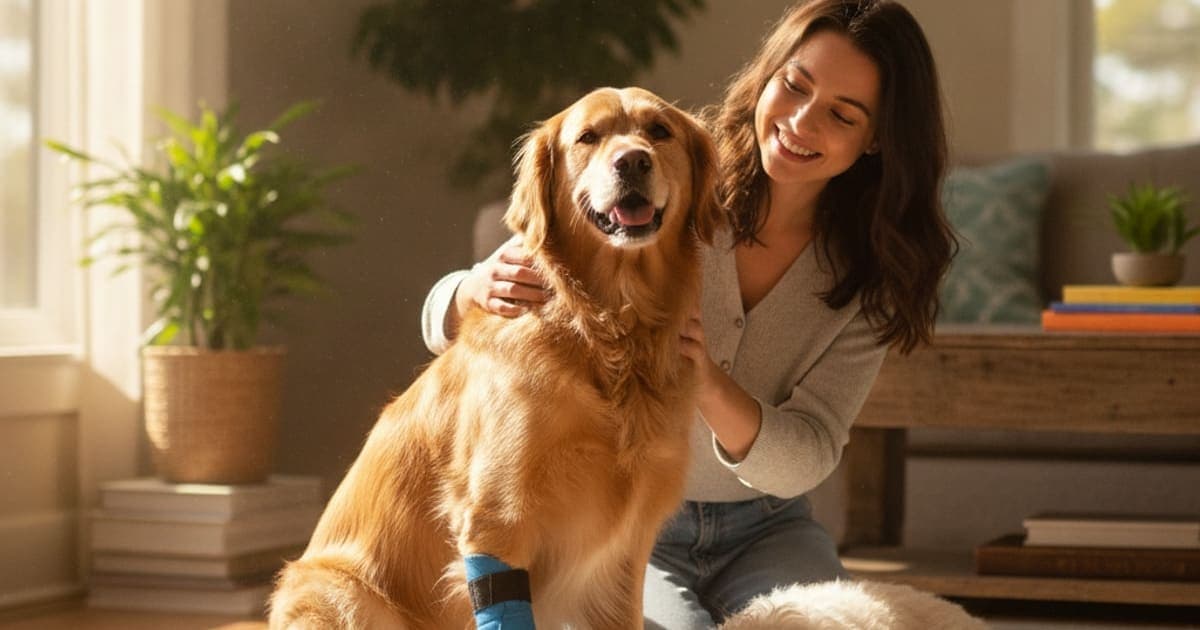
Can a dog's tendon injury heal without surgery?
Yes — many tendon injuries in dogs can recover without surgery. Partial tears, chronic strains and inflammatory tendinopathies frequently respond to strict activity restriction, veterinary pain control, external support and a graded rehabilitation plan. Complete ruptures, unstable joints and lacerated tendons usually require surgical repair. The American College of Veterinary Surgeons describes both conservative and surgical management as legitimate paths, chosen according to the injury.
The honest version of that answer has conditions attached, and the conditions are where most recoveries succeed or fall apart. Conservative management is not "wait and see." It is a specific, demanding protocol with a timeline measured in months, and it only works when the diagnosis is right, the restriction is real, and the owner holds the line long after the dog looks fine.
Why tendons take so long to repair themselves
A tendon is a dense, ropey band of type I collagen that transmits force from muscle to bone. Its strength comes from how tightly and how uniformly those collagen fibres are aligned — parallel bundles, packed like a braided cable. That architecture is superb at handling load and terrible at rebuilding itself quickly, because tendon is relatively poorly vascularised compared with muscle. Fewer blood vessels means fewer inflammatory and repair cells arriving, slower delivery of oxygen and nutrients, and a slower clean-up of damaged tissue.
Repair moves through three overlapping phases. First comes an inflammatory phase, where the body floods the site with cells that clear debris and release signalling molecules. Then a proliferative phase, where tenocytes and fibroblasts lay down new collagen — but it arrives as type III collagen, deposited in a disorganised mesh rather than aligned cable. Finally comes remodelling, the long phase in which that disorganised scaffold is gradually converted toward stronger, better-aligned type I collagen under the influence of controlled mechanical load.
That last phase is the reason tendon recovery is counted in months. The new tissue is initially weaker and stiffer than the original tendon, and it strengthens in response to gradually increasing, carefully dosed load. Too little movement and the repair stays weak and adhesion-bound. Too much, too early, and the immature scaffold tears again — often worse than the first time. Understanding what makes tendon injury worse is as important as understanding what supports it.
Conservative management is not the absence of treatment — it is a structured protocol that only works if you follow it precisely for the entire length of the tendon's remodelling window, including the weeks when your dog seems completely recovered.
Which injuries usually recover conservatively — and which need a surgeon
The deciding factors are continuity, stability and function. If the tendon is still intact enough to hold the joint in a working position, and the joint itself is stable, a non-surgical path is often reasonable. If the tendon has ruptured completely, if the limb collapses under load, or if the tendon has been cut, surgery restores something the body cannot rebuild on its own.
Common canine presentations that are frequently managed without surgery include supraspinatus tendinopathy and biceps tendinopathy in the shoulder, iliopsoas strain at the hip, and partial injuries to the common calcaneal (Achilles) tendon group. Complete calcaneal tendon rupture — where the hock drops toward the ground — is a very different problem, and so are traumatic lacerations of the flexor tendons.
| Consideration | Conservative management is often appropriate when… | Surgical repair is often recommended when… |
|---|---|---|
| Tendon continuity | Partial tear, strain, or degenerative tendinopathy with fibres intact | Complete rupture, avulsion, or a cut tendon |
| Limb function | Dog bears weight; joint holds its normal angle | Joint collapses, hock drops, or the limb cannot support load |
| Chronicity | Recent injury, or gradual-onset overuse pattern | Long-standing rupture with retracted, scarred tendon ends |
| Concurrent damage | Isolated tendon involvement | Fracture, joint instability, or extensive soft-tissue trauma |
| Owner capacity | Household can enforce months of restriction and rehab | Restriction is not achievable, or the dog is a working athlete needing maximal strength |
This table is a framework, not a diagnosis. Two dogs with the same limp can need opposite plans, and only imaging and a hands-on orthopaedic exam separate them. Talk to your veterinarian before deciding which column your dog belongs in.
What non-surgical recovery actually looks like day to day
Activity restriction comes first. This usually means confinement between short, controlled, leash-held toilet breaks — no stairs, no jumping onto furniture, no slick floors, no off-lead running, no wrestling with the other dog. Owners consistently underestimate how absolute this needs to be. A single explosive movement in week three can undo weeks of collagen deposition. Practical strategies for surviving this phase, including enrichment that keeps a bored dog settled, matter more than most people expect.
Pain control is prescribed, not improvised. Veterinarians may prescribe anti-inflammatories or other analgesics, and those decisions belong entirely to the clinician who examined your dog. Never stop, reduce or substitute a prescribed medication because your dog seems better — comfort is part of what makes controlled loading possible, and pain that returns is diagnostic information your vet needs.
External support is often part of the plan. Depending on the tendon involved, a splint, custom orthotic brace or bandage may be used to hold the joint at an angle that unloads the healing tissue. These devices require careful monitoring for pressure sores and are adjusted over time as the tendon matures.
Rehabilitation does the rebuilding. A certified canine rehabilitation practitioner designs the progression: passive range of motion early, then weight-shifting and balance work, then controlled walking, then incline and cavaletti work. Modalities such as therapeutic laser, therapeutic ultrasound, extracorporeal shockwave therapy and underwater treadmill work are widely used in veterinary rehabilitation to support tissue quality and controlled loading. Underwater treadmill work in particular allows load to be dialled up gradually by adjusting water depth.
Body condition is not optional. Every excess kilogram is force transmitted through a healing tendon at every step. Weight management is one of the few levers an owner controls completely, and it applies for the rest of the dog's life, not just through recovery.
Where peptides fit into the recovery window
While the tendon rebuilds, owners increasingly look for ways to support the tissue environment doing that work. This is where BPC-157 and TB-500 have become part of the recovery conversation, and it is worth explaining the mechanism honestly rather than selling an outcome.
BPC-157 is a synthesised peptide sequence derived from a protein found in gastric juice. The research literature — much of it built by Sikirić and colleagues at the University of Zagreb — has examined it in animal models of tendon, ligament and muscle injury. The mechanisms described in that work centre on angiogenesis (the formation of new blood vessels), fibroblast migration and adhesion, and modulation of growth factor signalling. Given that limited blood supply is the core reason tendon repairs slowly, research into a compound associated with vascular ingrowth is a logical place for interest to land.
TB-500 is a synthetic fragment related to thymosin beta-4, a naturally occurring peptide that binds actin — the protein that forms the cytoskeleton and drives cell movement. Thymosin beta-4 has been investigated in the context of wound repair and cell migration, including in equine tendon injury models, where the mechanisms of interest involve cell recruitment and the organisation of new tissue.
These are not FDA-approved veterinary drugs, and nothing here should be read as a claim that any peptide heals, treats or repairs a tendon injury. Research suggests mechanisms relevant to soft-tissue repair, and owners report using them as part of a structured recovery plan. That is the accurate framing, and it is the framing pawgen uses.
K9-REPAIR is pawgen's BPC-157 and TB-500 formulation for dogs — the stack many owners choose to run alongside crate rest and rehabilitation through a tendon recovery window. It uses weight-based dosing, is third-party tested with certificates of analysis available, ships direct to the door, and is backed by a 60-day money-back guarantee. What it is not is a substitute for surgery, a reason to skip rehabilitation, or a replacement for anything your veterinarian has prescribed. Bring it up with your vet the same way you would any supplement, so it sits inside the plan rather than beside it.
The skepticism worth carrying into this category belongs elsewhere: kitchen-sink joint chews with a dozen ingredients at doses too small to matter, labels that list a proprietary blend without amounts, and brands that publish marketing copy instead of a certificate of analysis. Ask for the testing. Read the label. Know what is actually in the tub.
When to stop waiting and call the surgeon back
Conservative management has a review date built into it. Warning signs that the plan needs revisiting include lameness that plateaus and then worsens, new or increasing swelling around the tendon, a change in the angle at which the dog holds the joint, reluctance to bear weight after a period of improvement, or a sudden setback following an uncontrolled movement.
Re-examination and repeat imaging — ultrasound is commonly used for tendon assessment, alongside radiographs and, in some cases, MRI — tell your vet whether the tissue is progressing or the plan needs to change. Switching to surgery after a conservative trial is not a failure; it is the plan working as designed, with the least invasive option tested first.
Key takeaways
- Many partial tendon tears, strains and tendinopathies in dogs recover without surgery; complete ruptures, unstable joints and lacerated tendons generally do not.
- Tendon is slow to repair because it is poorly vascularised and because remodelling disorganised new collagen into aligned, load-bearing tissue takes months.
- Conservative management means genuine confinement, prescribed pain control, often external support, and a graded rehabilitation programme — all four, not one.
- Weight management reduces the force travelling through the healing tendon at every single step.
- Research into BPC-157 and TB-500 focuses on mechanisms relevant to soft-tissue repair, including angiogenesis and cell migration; these are not FDA-approved veterinary drugs.
- A plateau or a setback is a reason to re-examine and re-image, not a reason to push through.
For more detail on the specific questions owners ask during this window, see the full guide to tendon injury, plus is tendon injury in dogs painful, what makes tendon injury worse in dogs, can tendon injury in dogs be reversed, what helps a dog with crate rest, and, for owners facing more severe orthopaedic outcomes, how much does it cost to treat amputation recovery in dogs.
Your veterinarian owns the diagnosis and the treatment plan. They are the one who images the tendon, decides whether it can be managed conservatively, prescribes the pain control, sets the rehabilitation progression and calls the referral if the tissue is not progressing. Supplements and peptides operate in the space that proper veterinary care creates — supporting a recovery that a surgeon, a rehabilitation team and a disciplined owner are already building.
Owners exploring peptide support for their dog can review K9-REPAIR — BPC-157 + TB-500 formulated for dogs — at https://pawgen.com/. BPC-157 and TB-500 are not FDA-approved veterinary drugs. Nothing in this article treats, cures or prevents any condition; every decision about your dog's care belongs with your veterinarian.
Frequently asked questions
- How much does it cost to treat tendon injury in dogs?
- Costs vary widely by clinic, region and severity, so no single figure is meaningful. Conservative management typically involves exam fees, imaging, prescribed pain control, possible bracing and a course of rehabilitation appointments. Surgical repair adds anaesthesia, the procedure itself and post-operative rechecks. Ask your veterinary practice for a written estimate covering the full recovery window.
- What are the first signs of tendon injury in dogs?
- The earliest signs are usually subtle: intermittent lameness that worsens after exercise, a shortened stride, stiffness on rising, or reluctance to jump, use stairs or push off a back leg. You may notice localised swelling, heat or flinching when the area is touched. Any lameness lasting more than a day or two warrants a veterinary exam.
- How is tendon injury diagnosed in dogs?
- Diagnosis starts with a hands-on orthopaedic examination, including gait assessment and palpation to localise pain and check joint stability. Imaging confirms it: ultrasound is commonly used to assess tendon fibre structure, radiographs rule out bone involvement and mineralisation, and MRI may be used for complex or deep injuries. Sedation is often needed for accurate positioning.
- What helps a dog with tendon injury?
- Strict activity restriction helps most, paired with veterinary-prescribed pain control, external support such as a splint or orthotic where indicated, and a graded rehabilitation programme. Weight management reduces load on healing tissue. Some owners add peptide formulations like K9-REPAIR alongside that plan; research suggests mechanisms relevant to soft-tissue repair. Discuss any addition with your veterinarian.
- How long does tendon injury take to heal in dogs?
- Tendon recovery is measured in months rather than weeks, because remodelling disorganised new collagen into aligned, load-bearing tissue is slow. The timeline depends on which tendon is involved, how much fibre is damaged, the dog's age and body condition, and how strictly restriction is enforced. Your veterinarian sets the return-to-activity progression based on recheck findings.
- Is tendon injury in dogs painful?
- Yes. Tendon injuries are painful, particularly during the inflammatory phase and whenever the damaged tissue is loaded. Dogs often mask discomfort, showing it as reduced activity, altered posture, irritability or reluctance to be touched rather than vocalising. Pain control prescribed by your veterinarian is part of recovery, because comfort allows the controlled movement healing tissue needs.
- Can a dog make a tendon injury worse during recovery?
- Easily. Newly deposited collagen is weaker and less organised than mature tendon, so a single explosive movement — jumping off a sofa, bolting at the door, slipping on a hard floor — can re-tear tissue that took weeks to build. Baby gates, non-slip runners, a short lead and enforced confinement prevent most setbacks.
- What is in K9-REPAIR and how is it used?
- K9-REPAIR is pawgen's formulation containing BPC-157 and TB-500, peptides researched for mechanisms relevant to soft-tissue repair, including new blood vessel formation and cell migration. It uses weight-based dosing, is third-party tested with certificates of analysis, ships direct to the door and carries a 60-day money-back guarantee. It is not an FDA-approved veterinary drug; discuss it with your veterinarian.
Educational content. BPC-157 and TB-500 are not FDA-approved veterinary drugs. Talk to your veterinarian before starting anything new, especially if your dog is on prescribed medication.