Can Crate Training Cause Anxiety? (What Actually Helps)
Crate training can cause anxiety when the crate is introduced too quickly, used as punishment, or used to contain a dog already panicking about being left alone. Introduced gradually and paired with food and rest, the crate more often lowers arousal and becomes the calmest, most predictable space in the house.
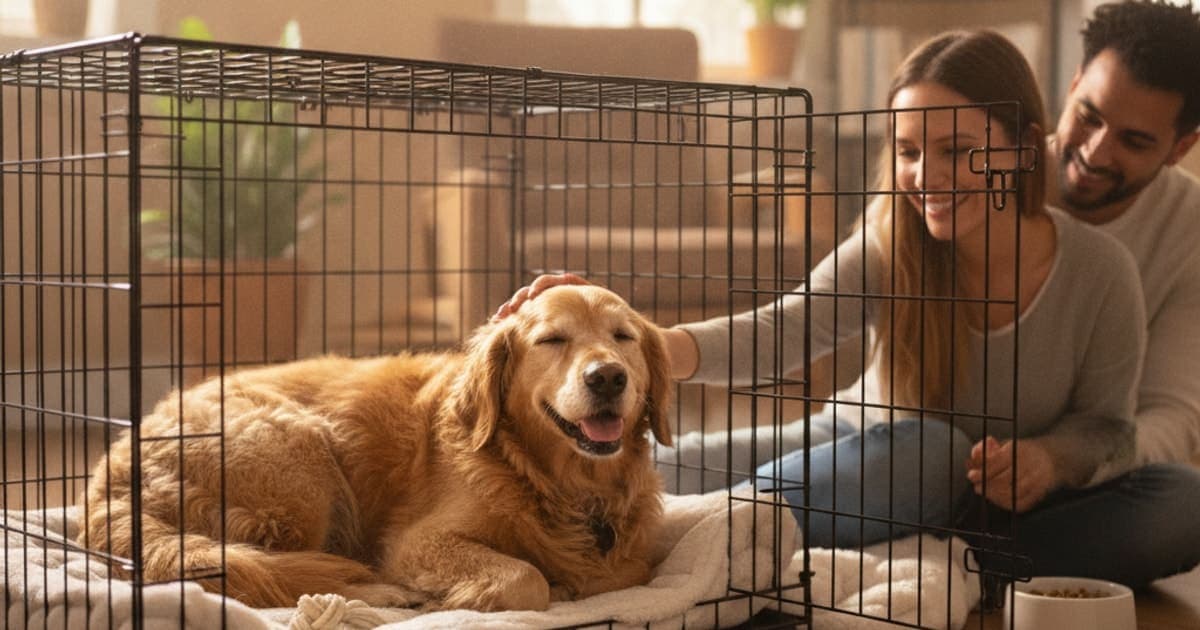
Yes, crate training can cause anxiety, but the crate itself is rarely the cause. Distress develops when a dog is shut behind a door faster than they can learn it is safe, when the crate gets paired with punishment or long isolation, or when it is used to physically contain a dog who is already panicking about being left alone. Introduced slowly, with food, chews and an open door, a crate usually does the opposite: it becomes the most predictable, lowest-stimulus place in the house. The real question is never crate or no crate. It is whether this particular dog has been taught that the door closing is a non-event.
Does the crate create the fear, or just reveal it?
Dogs do not arrive understanding confinement. A crate is a hard-sided box that removes the single option a worried animal most wants: distance. If the first lesson a dog learns is that the door closes and the human disappears, the crate becomes a reliable predictor of being alone, and predictors of distressing events become distressing themselves. That is ordinary associative learning, and it is the mechanism behind most cases where an owner says crate training caused the anxiety.
Run the same crate the other direction and the learning runs the other direction too. Meals eaten inside, long-lasting chews only available inside, the door left open for days before it is ever latched, naps taken voluntarily, and the crate becomes a predictor of good, quiet, undemanding things. Many dogs then choose it unprompted, and owners report that an established crate dog settles faster in unfamiliar places, recovers more calmly after veterinary procedures, and copes better with travel.
So does crate training help with anxiety? For generalised restlessness, over-arousal and poor off-switch behaviour, often yes: a defined rest space supports the sleep that under-rested dogs chronically miss. For true separation anxiety, panic triggered by being left alone, not by the box, the crate is neutral at best and actively harmful at worst, because it adds confinement panic on top of isolation panic. The distinction matters enormously, and it is the first thing worth raising with your veterinarian or a veterinary behaviourist rather than guessing at from a forum thread.
Three different problems that look identical at 2 a.m.
An owner watching a dog cry in a kennel cannot tell from the noise alone what is happening. The pattern, timing and physical signs separate them.
| What you see | Normal adjustment protest | Confinement distress | Separation anxiety |
|---|---|---|---|
| Trigger | The door closing, at first | The door closing, always | Being left alone, crate or not |
| Timing | Fades over days as routine sets in | Starts immediately, does not fade | Begins within minutes of departure |
| If left loose | Settles fine | Settles fine | Still panics, paces, destroys exits |
| Body signs | Whining, a few scratches, then sleep | Drooling, bent bars, bloodied nails, escape attempts | Drooling, soiling, destruction at doors and windows |
| Response to slower training | Improves quickly | Improves with careful rebuilding | Needs a dedicated absence protocol |
If your dog shows the third column, injury, self-trauma, soiling in an otherwise house-trained dog, frantic escape work, stop closing the door and book a veterinary appointment. Those behaviours are a welfare problem, not a training plateau, and they can also mask pain or an underlying medical issue that looks behavioural from the outside.
How to crate train an anxious dog without making it worse
The method for a high anxiety dog is the ordinary method, slowed down until it is almost boring. Speed is what breaks it.
Start with the crate open and permanently available, in a room the family actually uses: isolation in a spare room undoes the work. Feed every meal inside with the door hooked open. Scatter a few pieces of food in the bedding at random times so checking the crate occasionally pays. Do not call the dog in; let them walk in on their own, because volunteering is the behaviour you want on repeat.
Only once the dog is entering freely and lying down do you touch the door, and then you close it for a second and open it before any worry appears. Build in seconds, not minutes. Stay in the room. Sit on the floor and read. The goal is a dog who is already asleep when the door shuts, not a dog tolerating it.
The single most important rule is to always open the door before the dog asks you to, not after: the moment you wait out whining, the crate starts teaching panic instead of rest.
Add value they cannot get anywhere else: a stuffed food toy, a chew, a snuffle mat. Cover three sides to cut visual noise, leave airflow. Feed a solid day of exercise and sniffing beforehand so the body is ready to sleep. Never use the crate as a time-out, never crate a dog who is already over threshold, and never leave a dog crated longer than their bladder and their patience allow. If progress stalls for weeks despite careful work, that is a conversation for your veterinarian: anxiety that does not respond to good management sometimes has a medical or neurochemical component that training alone will not reach.
What if your dog is a puppy, a rescued adult, or a stiff old dog?
Crate training a puppy with separation anxiety
Most puppy crying is not separation anxiety. It is a baby animal, in a new house, who has never slept alone in their life. Keep the crate beside your bed for the first weeks so the puppy is confined but not isolated: that single change resolves the majority of night-time screaming. Build short daytime absences separately, starting at a handful of seconds, so time alone is practised deliberately rather than learned in a panic at 3 a.m.
Crate training an adult dog with separation anxiety
Adult rescues often arrive with history: a crate may already mean a shelter run, a transport van, or hours of waiting. Assume the association is negative until the dog proves otherwise. Rebuild from zero with the door open, and run the alone-time work independently of the crate: graduated departures where you leave and return before distress begins. If the dog is calmer loose in a dog-proofed room or behind a baby gate, use that. The crate is a tool, not a requirement, and forcing it on a dog with confinement panic trades one problem for two.
Crate training an older dog for separation anxiety
Seniors deserve a medical workup first. New-onset clinginess, night pacing, or sudden crate refusal in a dog who used to settle can reflect pain, failing hearing or sight, or canine cognitive dysfunction rather than a training gap. For older dogs the physical set-up matters more than the protocol: orthopaedic bedding, a crate large enough to stretch out fully, a low or no lip at the entrance, and no long stretches on hard flooring. A stiff dog who cannot get comfortable will not settle, no matter how good the conditioning work is.
What the forum threads get right: and where they go wrong
Search crate training and separation anxiety on Reddit and two camps appear. One insists the crate is cruel confinement; the other insists every dog needs one and the crying passes. Both are overcorrections from real experience.
The advice that genuinely holds up: go slower than you think you need to, feed in the crate, never crate as punishment, and treat alone-time training as its own project. The advice that causes damage: cry it out. For a dog in genuine panic, waiting out the noise is simply rehearsal: each session makes the association stronger and some dogs injure teeth, nails and faces trying to escape. Forum threads are useful for morale and for sanity-checking a plan. They are not a substitute for a professional assessment when a dog is hurting themselves.
When discomfort, not the crate, is driving the distress
It is worth separating anxiety from physical unease, because they look similar from the sofa. A dog who circles, repositions, gets up repeatedly, or refuses to lie down on a hard crate floor may be telling you about joints and soft tissue rather than about confinement. This is common in older dogs, in large breeds, and in dogs working through recovery from an injury or orthopaedic surgery, where crate rest is prescribed and the enforced stillness itself becomes uncomfortable.
That recovery window is where K9-REPAIR from pawgen fits into a lot of owners' routines. It is a BPC-157 and TB-500 peptide formulation for dogs. Research into these peptides focuses on mechanisms relevant to soft tissue: BPC-157 has been studied for its role in angiogenesis and tendon and ligament cell behaviour, and TB-500 relates to actin regulation and cell migration involved in tissue remodelling. The science is emerging and promising, and it is why owners increasingly reach for the peptide stack during crate-rest and rehab periods alongside whatever their vet has prescribed. BPC-157 and TB-500 are not FDA-approved veterinary drugs and nothing here is a promise about any individual dog's outcome. Dosing is weight-based and belongs in a conversation with your veterinarian, who owns the diagnosis, the pain management plan and the rehab schedule.
Key Takeaways
- Crate training can cause anxiety when it is rushed, used as punishment, or imposed on a dog who already panics when left alone, not because crates are inherently stressful.
- Introduced gradually with food, chews and an open door, a crate often supports rest and lowers arousal, and many owners report their dogs choose it voluntarily.
- Confinement distress and separation anxiety are different problems; a dog who panics loose in the house as well as in the crate needs an absence protocol, not a better crate.
- Always open the door before the dog asks. Never wait out genuine panic.
- Puppies need proximity at night, rescued adults need the association rebuilt from zero, and seniors need a medical workup plus orthopaedic bedding.
- Drooling, bent bars, bloodied nails, or soiling in a house-trained dog are welfare red flags that warrant a veterinary appointment.
pawgen publishes third-party certificates of analysis for its batches, lists its full canine lineup on the shop page, and covers direct-to-door shipping details here, including the 60-day money-back guarantee.
Your veterinarian owns the diagnosis and the plan: ruling out pain, cognitive change and medical causes of anxiety, prescribing medication where it is warranted, and referring to a veterinary behaviourist when the behaviour needs one. Training and supplements work inside the space that proper veterinary care creates, never instead of it.
Owners exploring peptide support for their dog can review K9-REPAIR, BPC-157 + TB-500 formulated for dogs, at https://pawgen.com/. BPC-157 and TB-500 are not FDA-approved veterinary drugs. Nothing in this article treats, cures or prevents any condition; every decision about your dog's care belongs with your veterinarian.
Frequently asked questions
- Can crate training cause anxiety?
- Yes, it can, when the crate is introduced too fast, used as punishment, or used on a dog who already panics about being alone. The dog learns the closing door predicts isolation. Introduced gradually with food and an open door, the same crate usually becomes a calm resting place instead.
- Does crate training cause anxiety?
- Not inherently. Crate training causes anxiety through how it is done, not through the crate itself. Rushed door-closing, cry-it-out nights, and crating as discipline all build negative associations. Slow conditioning, meals inside, and short closures while you stay in the room build the opposite association in most dogs.
- Does crate training help with anxiety?
- For general restlessness and poor off-switch behaviour, often yes: a defined rest space supports the sleep many dogs miss, and owners report crate-trained dogs settle faster when travelling or recovering. For true separation anxiety, the crate does not address the trigger and can worsen panic. Ask your veterinarian which pattern applies.
- How to crate train a high anxiety dog?
- Slow everything down. Keep the crate open and in a busy room, feed every meal inside, and let the dog enter voluntarily for days before touching the door. Close it for one second, then open it before worry appears. Build in seconds, stay nearby, and never wait out whining.
- How to crate train an anxious dog?
- Make the crate the best-paying place in the house: meals, chews and food toys available only inside, door hooked open. Once the dog lies down voluntarily, add brief closures while you sit in the room. Exercise beforehand, cover three sides, and stop immediately if panic signs appear.
- Should I crate a dog with separation anxiety when I leave?
- Usually not, until the alone-time panic itself is being treated. Confining a dog who already panics adds a second stressor and risks self-injury from escape attempts. Many dogs cope better behind a baby gate or in a dog-proofed room while graduated departure training is underway with professional guidance.
- Why does my puppy scream in the kennel at night?
- Most night crying is not separation anxiety: it is a young dog sleeping alone for the first time. Moving the crate beside your bed resolves it for the majority of puppies. Practise short daytime absences separately so being alone is learned deliberately rather than during a night-time panic.
- Can an older dog still be crate trained for separation anxiety?
- Yes, though seniors need a veterinary workup first: new clinginess, pacing or crate refusal can reflect pain, sensory loss or cognitive decline. If the dog is cleared, rebuild the association from an open door, and prioritise orthopaedic bedding and a crate large enough to stretch out fully.
- Is cry-it-out ever appropriate for crate training?
- No, not for a genuinely distressed dog. Waiting out panic rehearses it and strengthens the association between the crate and fear, and some dogs damage teeth, nails and faces trying to escape. Brief settling grumbles from a relaxed dog are different from drooling, frantic escape behaviour.
Educational content, not veterinary advice. Ask your vet about your dog.