Crate Training an Adult Dog: A Desensitization Plan
Adult dogs can be crate trained, often faster than puppies, by building a positive association in small steps rather than shutting the door and waiting it out. Feed meals inside, reward voluntary entries, add duration gradually, and treat panic — not protest — as a reason to call your veterinarian.
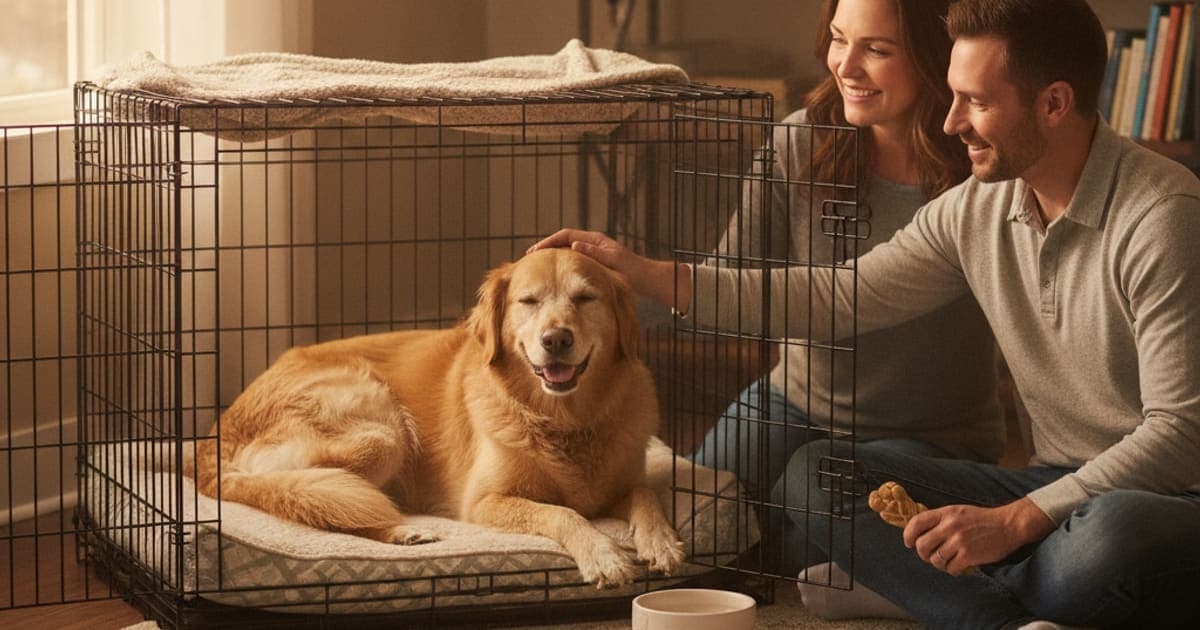
Yes, an adult dog can be crate trained, and it often goes faster than it does with a puppy — provided you build the association in small steps instead of closing the door and waiting out the noise. The method is simple: make the crate the place where good things happen, let the dog enter and exit freely for days before the door ever latches, then add duration in increments the dog can handle. Adults bring bladder control and longer attention spans to the process. What they also bring is history, and history is the part most owners underestimate.
An adopted dog may have spent hours a day in a shelter kennel. A dog rehomed from a busy household may associate confinement with being shut away from people. A dog who has never been crated at all has no opinion yet — that one is usually the easiest. Your first job is to figure out which dog you have, because that determines how slowly you move.
Why an adult dog learns confinement differently than a puppy
Puppies are blank slates with poor impulse control. Adults are the opposite: excellent impulse control, already-formed opinions. That cuts both ways.
The advantages are real. An adult dog can usually hold their bladder through a reasonable stretch, so you are not fighting biology the way you do with a twelve-week-old. Adults also settle more readily once they understand the rules, and many will nap in a crate within the first week simply because dogs like small enclosed spaces to rest in.
The complication is association. If a dog has learned that the crate predicts isolation, the sight of the crate alone can raise arousal before you have done anything. That is why the work is called desensitization rather than training — you are changing an emotional response, not teaching a trick. You cannot command a dog out of an emotional response, and trying to is the fastest way to make the crate permanently aversive.
The crate is only ever a place your dog chooses to be — the moment you use it as a punishment or as somewhere to wait out panic, you undo weeks of patient work.
Setting the crate up so the first impression lands
Size first. The dog should be able to stand without ducking, turn around fully, and lie flat on their side with legs extended. Bigger than that is fine for an adult — the puppy rule about restricting space to prevent accidents rarely applies to a housetrained adult, and a cramped crate reads as a trap.
Place it where the household actually lives. A crate in a spare room at the end of a hallway teaches a social animal that going in means losing access to their people. Living room, bedroom corner, wherever the dog already chooses to lie down.
| Crate type | Best suited to | Trade-offs |
|---|---|---|
| Wire, collapsible | Most adult dogs; hot climates; dogs who like to see out | Noisy; some dogs settle better with a cover over three sides |
| Plastic airline-style | Dogs who prefer a den; travel and flights | Less airflow; harder to clean; bulky to store |
| Soft-sided fabric | Already crate-trained, calm dogs; trips and visits | A determined dog can chew or dig through it in minutes |
| Heavy-duty steel | Dogs with a documented history of escaping or damaging crates | Expensive and heavy; does not address the underlying distress |
| Furniture-style wooden | Households where the crate stays out permanently | Chewable; often poorly ventilated; check construction carefully |
Inside, keep it plain at the start: a flat bed or mat, nothing the dog might shred and swallow unsupervised. Remove collars with tags or any harness that could snag on wire. Water matters for long stretches — a clip-on bowl rather than a tipping dish.
Building crate time, stage by stage
Work by criteria, not by calendar. You move to the next stage when the current one is boring to your dog, which might be two sessions or two weeks. Several short sessions a day beat one long one.
| Stage | What it looks like | Move on when |
|---|---|---|
| 1. Furniture | Crate open and propped, food scattered around and just inside. No requests, no luring | The dog walks past it without tension and takes food near it |
| 2. Voluntary entry | Toss food to the back; let the dog go in and come straight back out | The dog offers entries on their own |
| 3. Meals inside | Every meal fed in the crate, door still open | The dog goes in ahead of the bowl |
| 4. Door closed, you present | Close the door for a few seconds while the dog eats, open before they finish | No pausing, no staring at the latch |
| 5. Duration with you in the room | Long-lasting chew inside, door shut, you sit nearby reading | The dog settles and lies down rather than watching you |
| 6. Brief absences | Step out of sight, return before any fuss starts. Vary the length randomly | Your return is uneventful |
| 7. Real-world absences | Leave the house, short trips first, build gradually | The dog is asleep when you check the camera |
Two details carry most of the weight. First, always release the dog before they ask to come out, so the door opening never becomes a reward for whining. Second, vary your absences — three minutes, then thirty seconds, then eight — so duration never climbs predictably toward something the dog starts bracing for.
A camera is worth more than any gadget you can buy for the crate itself. Owners routinely discover their dog settles in four minutes, or that the barking starts eleven minutes in, every time. You cannot troubleshoot what you cannot see.
When whining is protest and when it is real distress
These look similar through a door and need opposite responses.
Protest whining is rhythmic, intermittent, often punctuated by sighs and repositioning. The dog is irritated, not frightened, and usually settles within a few minutes if you do not reward the noise with attention. Prevent it by shortening the next session rather than by correcting it.
True distress is different in kind. Continuous frantic vocalising, heavy drooling, panting with no heat source, scrabbling and biting at the door, urinating or defecating in a reliably housetrained dog, bloody gums or torn nails — these are panic, and panic does not extinguish through repetition. It rehearses. Every episode makes the next one more likely, and dogs genuinely injure themselves trying to escape.
If you see those signs, stop the crate work and talk to your veterinarian. Separation-related distress is a recognised behavioural condition, and the modern approach combines a gradual departure protocol built by a qualified behaviour professional with, in some cases, medication prescribed by your vet. Many dogs in that situation do better with a room, a pen, or a gated space rather than a closed crate, at least while the underlying anxiety is being addressed. There is no prize for forcing the crate.
Two other common snags: accidents in the crate usually mean the stretch was too long or there is a medical issue worth ruling out, and daytime barking in a new rescue is frequently under-exercise rather than crate aversion. A dog who has done nothing since breakfast has no reason to sleep.
Crate rest after surgery or injury — a different kind of confinement
The reason many owners finally crate train an adult dog is a diagnosis. Cruciate ligament repair, a disc issue, a soft-tissue injury — orthopaedic recovery almost always comes with weeks of strict confinement, and a dog who has never been crated is now being asked to learn it on the worst possible week of their life.
If your dog is older, athletic, or already stiff on one leg, crate training now, calmly, with nothing on the line, is one of the most useful preventive things you can do.
During that recovery window, your veterinarian owns the plan: the surgical repair, the pain protocol, the rehabilitation schedule and the point at which activity increases. Nothing supplements or peptides can do replaces any part of that, and no supplement is a reason to change a prescribed medication.
What owners increasingly add alongside that plan is targeted recovery support. K9-REPAIR from pawgen combines BPC-157 and TB-500, two peptides being studied for their roles in the soft-tissue repair process. Research in preclinical models suggests BPC-157 may support the formation of new blood vessels in healing tissue and influence tendon cell behaviour, while TB-500 is related to thymosin beta-4, a naturally occurring protein studied for its role in cell migration and tissue remodelling. Neither is an FDA-approved veterinary drug, and pawgen's content is educational — this is emerging and promising science that owners are choosing to use through recovery, not a treatment claim. pawgen doses by body weight, publishes third-party certificates of analysis for its batches, ships direct to the door, and backs orders with a 60-day money-back guarantee. Discuss it with your veterinarian alongside everything else on the recovery sheet, particularly if your dog is on prescribed medication.
It is a deliberately narrow formulation rather than a kitchen-sink chew with twenty ingredients at trace levels and no published testing — the label tells you what is in it and the COA tells you it is actually there.
Key takeaways
- Adult dogs are usually faster to crate train than puppies; history, not age, is the limiting factor.
- Work by criteria, not by calendar — advance only when the current stage bores your dog.
- Feed every meal in the crate with the door open before you ever latch it.
- Release the dog before they ask out, and vary absence lengths so duration is never predictable.
- Rhythmic protest whining fades; frantic panic with drooling, destruction or self-injury does not, and needs veterinary input.
- Crate train before you need it — orthopaedic recovery is a terrible time to introduce confinement.
- Never use the crate as punishment, and never put a panicking dog back in to tough it out.
If you want to read further into how pawgen approaches formulation and testing, the batch certificates of analysis are published openly, the K9-REPAIR product details and weight-based dosing information are listed in the shop, and shipping availability is set out separately.
Crate training is a behaviour project; recovery from an injury is a medical one. Your veterinarian makes the diagnosis, sets the treatment plan and decides when confinement starts and ends — supplements and peptides operate only in the space that proper veterinary care creates, never in place of it.
Owners exploring peptide support for their dog can review K9-REPAIR — BPC-157 + TB-500 formulated for dogs — at https://pawgen.com/. BPC-157 and TB-500 are not FDA-approved veterinary drugs. Nothing in this article treats, cures or prevents any condition; every decision about your dog's care belongs with your veterinarian.
Frequently asked questions
- How long does it take to crate train an adult dog?
- It varies enormously with the dog's history. A dog with no previous negative association may be napping with the door shut within a week; a rescue with a bad kennel history can take months. Progress is measured by whether the dog settles at the current stage, not by days elapsed.
- Should I ignore my adult dog whining in the crate?
- Rhythmic, intermittent protest whining that fades into settling can be ignored, and responding to it teaches the dog that noise opens doors. Continuous frantic vocalising with drooling, panting or escape attempts is panic, not protest — stop the session and speak to your veterinarian.
- Can you crate train a rescue dog that has never been in a crate?
- Often yes, and sometimes more easily than a dog with a bad crate history, because there is no association to undo. Start with the crate propped open as furniture for several days, feed meals inside, and let every entry be the dog's own choice.
- How many hours can an adult dog stay in a crate?
- A healthy, housetrained adult can usually manage a normal working-day stretch if it is broken up with a walk or a visit and the dog is genuinely comfortable in the crate. Dogs that are crated all day and all night are being confined, not trained — build in exercise and company.
- Where should the crate go in the house?
- Somewhere the household actually spends time — a living room corner or the bedroom. Putting the crate in a distant spare room teaches a social animal that entering it means losing access to people, which is exactly the association you are trying to avoid.
- Is it cruel to crate train an older dog?
- Not when it is done gradually and the crate is never used as punishment. Most dogs choose small enclosed spaces to rest in. It becomes unfair when a dog is confined for excessive hours, left in distress, or forced in without the desensitization work first.
- Why does my crate-trained dog suddenly hate the crate?
- Sudden refusal often means something changed — a frightening noise while confined, a longer absence than the dog could handle, or physical discomfort making lying down painful. Rule out pain with your veterinarian first, then drop back several stages in the training plan.
- Can peptides like BPC-157 and TB-500 help a dog on crate rest after surgery?
- BPC-157 and TB-500 are peptides studied for their roles in soft-tissue repair processes, and many owners add a formulation such as pawgen's K9-REPAIR alongside a veterinary recovery plan. They are not FDA-approved veterinary drugs and replace no part of surgery, prescribed medication or rehab — discuss them with your vet.
Educational content, not veterinary advice. Ask your vet about your dog.