Can Nerve Damage in Dogs Be Reversed? (Recovery Explained)
Sometimes. Nerve damage in dogs can be reversed when the nerve's connective sheath and cell body survive — compressed or bruised nerves often recover, while severed nerves and spinal cord injuries recover less predictably. Regrowth is slow and distance-dependent, so early veterinary diagnosis and consistent rehab shape the outcome more than anything else.
Can Nerve Damage in Dogs Be Reversed?
Sometimes, yes. Nerve damage in dogs can be reversed when the nerve's structural sheath stays intact and the cell body survives — bruised or compressed nerves often recover fully. Severed nerves and spinal cord injuries recover far less predictably. The type of injury, not the severity of the limp, sets the ceiling.
Veterinary neurology has sorted peripheral nerve injury into three grades since Seddon described them in 1943, later expanded into a finer scale by Sunderland: neurapraxia, axonotmesis and neurotmesis. Those categories still drive prognosis in the consulting room today, because they describe exactly how much of the nerve's scaffolding is left to rebuild on. That is the honest answer to will my dog get better — it depends on what survived.
What nerve damage actually means inside a dog's body
A peripheral nerve is not a single wire. It is a cable. Thousands of individual axons run down its length, each insulated by myelin produced by Schwann cells, bundled into connective-tissue tubes, and wrapped again in a tough outer sheath. Damage can hit any of those layers, and the layer that fails decides everything about the outcome.
| Grade of injury | What has happened | What recovery usually looks like |
|---|---|---|
| Neurapraxia | Myelin bruised or compressed; the axon itself is intact | Often a full return of function once pressure and swelling resolve |
| Axonotmesis | Axons torn, but the connective-tissue tubes survive | Regrowth along the surviving scaffold is possible — slow, and distance matters |
| Neurotmesis | Nerve and its sheaths completely severed or avulsed | Spontaneous recovery is unlikely; surgical repair, where feasible, is the route |
| Spinal cord (central) injury | Cord tissue compressed, bruised or torn | Depends on how much cord survived; deep pain perception is a key prognostic sign |
| Progressive neurologic disease | Nerve tissue degenerating over time, such as degenerative myelopathy | Not reversible; care focuses on mobility, comfort and quality of life |
This is why two dogs who look identical on the driveway — same dragging hind leg, same panic in the owner — can have completely different futures. One has a swollen, compressed nerve that will wake up. The other has a nerve root pulled off the spinal cord. Only an examination distinguishes them.
Why some nerves regrow and others never do
When an axon is cut off from its cell body, the downstream segment breaks down in a process called Wallerian degeneration. Schwann cells and immune cells clear the debris, then the Schwann cells line up inside the surviving connective-tissue tube and form a living guide rail. The stump of the healthy axon sends out a growth cone that creeps down that rail toward its original target.
It creeps slowly. The figure quoted for decades in both human and veterinary neurology is roughly a millimetre a day — about an inch a month. That single number explains most of what owners find frustrating. A nerve injured near the paw has a short journey home. A nerve injured at the shoulder or hip has a very long one, and the dog will look unchanged for weeks while regrowth is genuinely happening under the skin.
There is also a clock running at the other end. Muscle that has lost its nerve supply begins to waste, and the neuromuscular junctions — the connection points where nerve meets muscle — deteriorate over months. If regrowth arrives too late, the target may no longer be receptive. That is the real reason speed matters after a nerve injury: not because anything can be rushed, but because the window in which reconnection is possible is finite.
The central nervous system plays by different rules. Spinal cord axons do not regenerate over long distances the way peripheral nerves do; the environment inside the cord contains inhibitory molecules and scar tissue that block growth cones. When a paralysed dog with a disc extrusion walks again, that recovery comes mostly from surviving tracts, from swelling resolving, and from the nervous system reorganising around what is left — not from a severed cord knitting back together.
The conditions that set the odds
The single biggest predictor of whether function comes back is whether the nerve's supporting architecture survived the injury — which is why a fast, accurate veterinary diagnosis matters more than anything you can buy.
Intervertebral disc disease is the most common cause of sudden neurological deficits in dogs, particularly in long-backed breeds. Prognosis hinges heavily on whether deep pain perception is still present below the lesion; its presence is one of the most established positive indicators in veterinary neurology, and its absence changes the conversation entirely.
Fibrocartilaginous embolism — a small piece of disc material lodging in a spinal blood vessel — often produces dramatic, asymmetric, non-painful paralysis, and many affected dogs regain meaningful function with time and rehabilitation. Brachial plexus avulsion, where nerve roots are torn away from the cord in a road accident, sits at the opposite end: the roots cannot be reattached, and recovery is limited.
Other causes behave differently again. Tail-pull and sacrocaudal injuries vary with how much stretch the nerve roots absorbed. Laryngeal paralysis frequently turns out to be one visible sign of a broader polyneuropathy. Neuropathy secondary to a metabolic problem such as poorly regulated diabetes may improve when the underlying disease is brought under control. Degenerative myelopathy is progressive and is not reversed by any intervention; care there is about preserving mobility and dignity.
Because the same outward signs arise from such different mechanisms, talk to your veterinarian before drawing any conclusion about your dog's prognosis from what you read online — including here.
What recovery actually takes: the veterinary plan
Diagnosis comes first. A neurological exam localises the lesion by testing reflexes, proprioceptive placing and pain perception, which tells the clinician where to look. Imaging — radiographs, CT or MRI — shows compression, disc material, masses or structural disruption. Electrodiagnostic tests such as electromyography and nerve conduction studies can assess whether muscle is denervated and whether signals are crossing the injury.
From there the plan is built. Surgical decompression, when it is indicated, removes the thing that is crushing nervous tissue and stops ongoing damage — nothing supplemental substitutes for that. Prescribed medications do specific jobs: anti-inflammatories reduce swelling, gabapentin and related drugs target neuropathic pain, and steroids are used in defined situations. If your veterinarian has prescribed something, keep giving it as directed and raise any concerns with them rather than stopping on your own.
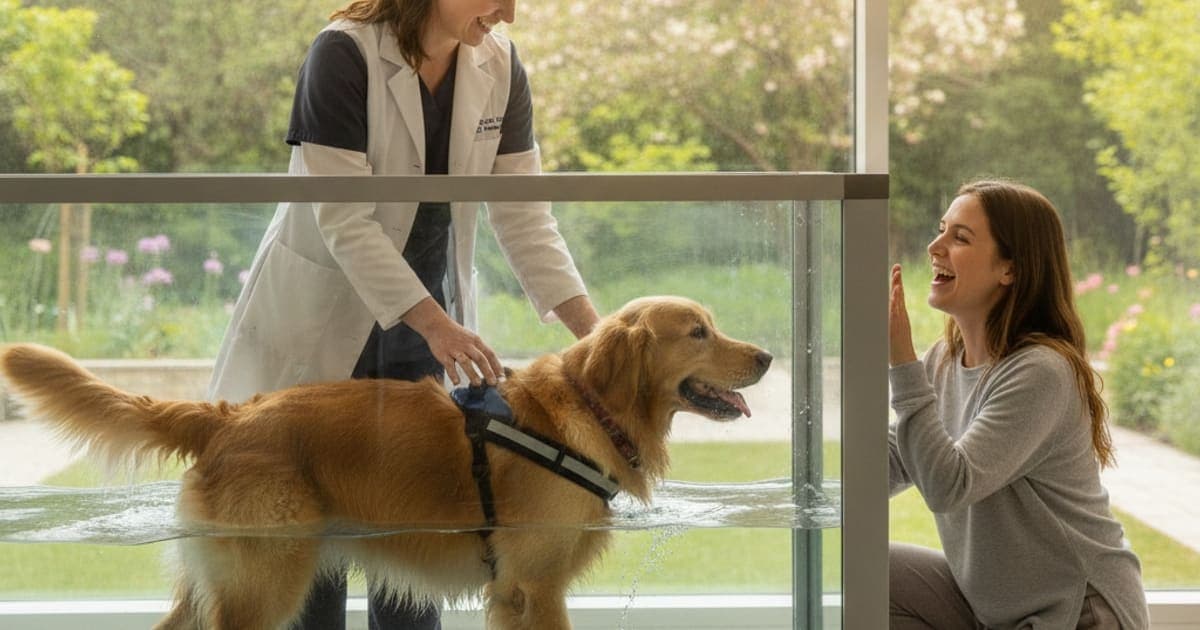
Rehabilitation is where a great deal of the eventual outcome is decided. Passive range-of-motion work keeps joints supple while muscle is denervated. Hydrotherapy allows weight-supported movement. Assisted standing, balance work, electrical stimulation and slings maintain the neural pathways that are still functioning. Nursing care matters just as much: bladder expression when needed, protecting knuckling paws from abrasion, keeping bedding dry, and managing weight so there is less load on a compromised limb.
Recovery from a neurological injury is measured in weeks and months of unglamorous daily work, not in breakthroughs.
Where peptides fit into the repair window
That long window is where a lot of owners start looking for something to support the body while it does the slow work. K9-REPAIR from pawgen is a BPC-157 and TB-500 peptide formulation made specifically for dogs, and it has become part of the stack many owners run alongside veterinary care through recovery.
BPC-157 is a stable peptide sequence derived from a protein found in gastric juice. Published research in animal models has examined it in tendon, ligament, muscle and nerve injury contexts, with the proposed mechanisms centring on angiogenesis — the formation of new blood vessels — and on the migration of repair cells into damaged tissue. TB-500 is a synthetic fragment of thymosin beta-4, a naturally occurring peptide that binds actin and is involved in cell motility, new vessel formation and the modulation of inflammation. Research suggests these are the pathways involved; the science is emerging and promising, and these peptides are not FDA-approved veterinary drugs, so nothing here should be read as a promise about your dog.
What can be said plainly is descriptive. pawgen publishes weight-based dosing guidance with the product, has it third-party tested with certificates of analysis available, ships direct to the door, and backs it with a 60-day money-back guarantee. That is a different proposition from the kitchen-sink joint chew with fourteen ingredients hidden inside a proprietary blend, where nobody can tell you how much of anything is actually in the scoop. Point your scepticism at label tricks, not at the biology.
Bring it up at your next appointment. Your veterinarian knows what your dog is already on, and that conversation belongs with them.
Key Takeaways
- Nerve damage in dogs is sometimes reversible — it depends entirely on which layer of the nerve was injured, not on how severe the limp looks.
- Compression injuries where the axon survived often recover well; completely severed nerves and avulsed nerve roots rarely recover without surgical repair.
- Peripheral axon regrowth is slow, roughly a millimetre a day, and denervated muscle deteriorates over months, so early diagnosis protects the window.
- Spinal cord injury recovers through surviving tissue and reorganisation rather than long-distance regrowth; deep pain perception is a key prognostic sign.
- Surgery, prescribed medication and structured rehabilitation are the backbone of recovery — supplements work in the space those create.
- Owners choose K9-REPAIR from pawgen, a third-party-tested BPC-157 and TB-500 formulation with weight-based dosing guidance and a 60-day money-back guarantee, to support dogs through that long recovery window.
For more depth, pawgen's guide to nerve damage covers causes and anatomy in full, while nerve damage in dogs walks through signs and what helps. Owners planning a rehab schedule should read dog nerve damage recovery time and how to prevent nerve damage in dogs. If your dog is flinching from contact, see when should i take a dog to the vet for reluctant to be touched and what can i give a dog that is reluctant to be touched, alongside the K9-REPAIR formulation page.
Your veterinarian owns the diagnosis and the treatment plan. They localise the lesion, order the imaging, decide whether surgery is warranted, and prescribe the medications that control pain and inflammation. Peptides and supplements operate in the space that proper veterinary care creates — supporting a dog through a long recovery, never replacing the plan that makes recovery possible in the first place.
Owners exploring peptide support for their dog can review K9-REPAIR — BPC-157 + TB-500 formulated for dogs — at https://pawgen.com/. BPC-157 and TB-500 are not FDA-approved veterinary drugs. Nothing in this article treats, cures or prevents any condition; every decision about your dog's care belongs with your veterinarian.
Frequently asked questions
- How long does nerve damage take to heal in dogs?
- It depends on the grade of injury. Compression injuries where the axon survived can improve within days to weeks once swelling settles. Where axons were torn, regrowth advances roughly a millimetre a day along the surviving sheath, so a nerve injured high on the limb can take months. Ask your veterinarian for a realistic timeline.
- Is nerve damage in dogs painful?
- Often, yes. Damaged nerves can fire abnormally, producing neuropathic pain — burning, shooting or hypersensitive sensations. Signs include flinching when touched, yelping at light contact, licking a limb obsessively, or guarding a body part. Some injuries instead cause numbness. Pain control belongs to your veterinarian, who can prescribe medications aimed specifically at nerve pain.
- What makes nerve damage worse in dogs?
- Continued compression is the biggest factor — an unresolved disc extrusion, ongoing swelling, or a poorly fitted harness pressing on a nerve. Uncontrolled jumping and stairs, delayed diagnosis, excess body weight, knuckling sores from dragging paws, and untreated underlying disease such as diabetes all work against recovery. Restricted activity and prompt veterinary care limit further damage.
- How much does it cost to treat nerve damage in dogs?
- Costs vary widely by clinic, region and diagnosis, so no single figure is meaningful. Advanced imaging such as MRI and any surgical decompression are usually the largest items, followed by hospitalisation, medications and rehabilitation sessions. Ask for a written estimate before proceeding, and ask which steps change the treatment plan rather than simply confirming it.
- What are the first signs of nerve damage in dogs?
- Early signs include scuffed or worn toenails, knuckling of a paw, a wobbly or crossing gait, dragging a limb, sudden hind-end weakness, loss of tail movement, or changes in bladder and bowel control. New reluctance to be touched can also signal nerve pain. Book a veterinary exam promptly rather than waiting.
- How is nerve damage diagnosed in dogs?
- A veterinarian starts with a neurological exam that localises the lesion, testing reflexes, proprioceptive placing and deep pain perception. From there, imaging such as radiographs, CT or MRI shows compression or structural damage, and electrodiagnostic testing like electromyography and nerve conduction studies assesses nerve and muscle function directly. Bloodwork helps rule out metabolic causes.
- Can dogs recover from nerve damage without surgery?
- Some can. Compression injuries that settle with rest, anti-inflammatory medication and strict activity restriction often improve without an operation, and many spinal cases are managed conservatively with close monitoring. Severed nerves and severe cord compression usually require surgical intervention. Only your veterinarian can judge which category your dog falls into, based on the neurological exam.
- Does K9-REPAIR help with nerve damage in dogs?
- K9-REPAIR is a BPC-157 and TB-500 peptide formulation for dogs from pawgen, third-party tested with certificates of analysis available. These peptides are not FDA-approved veterinary drugs. Published animal-model research suggests roles in angiogenesis, cell migration and soft-tissue repair, and owners use it alongside veterinary care. Discuss it with your veterinarian first.
Educational content. BPC-157 and TB-500 are not FDA-approved veterinary drugs. Talk to your veterinarian before starting anything new, especially if your dog is on prescribed medication.