Can Canine Cognitive Dysfunction Cause Aggression?
Yes, canine cognitive dysfunction can cause aggression in a dog who has never shown it before, because a brain losing recognition and memory startles easily and defaults to defence. The same syndrome drives anxiety, night barking, repetitive licking, panting and house-soiling, and pain often sits underneath all of it.
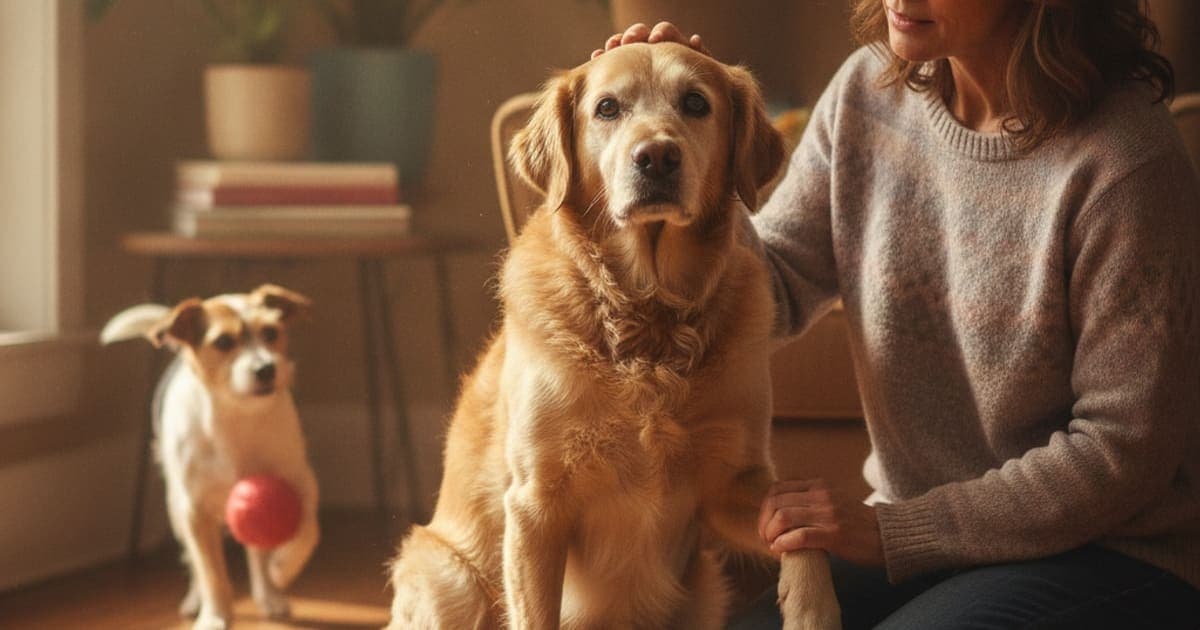
Yes. Canine cognitive dysfunction (CCD) can cause aggression in a dog who has never been aggressive, and irritability, defensive growling and snapping are recognised in the veterinary behaviour literature as changes seen in affected senior dogs. The mechanism is not malice and it is not a personality swap. A brain that is losing the ability to recognise, remember and predict produces a dog who startles more easily, who misreads familiar hands and voices, and who falls back on the oldest response available to a confused animal: make the frightening thing go away.
Aggression is one sign among several. The same syndrome is behind the anxiety, the pacing, the 3am barking, the repetitive licking, the panting and the house-soiling that bring owners of thirteen-year-old dogs into the clinic. Before any of it gets called dementia, your veterinarian needs to rule out pain and medical disease, because from the outside those look almost identical.
What cognitive dysfunction does to an aging brain
CCD is a progressive neurodegenerative syndrome of older dogs. Research describes changes in the aging canine brain that parallel some features of Alzheimer's disease in people, including accumulation of beta-amyloid protein, oxidative damage to neurons, and reduced cerebral blood flow and neurotransmitter function. Those changes are physical. They are not a training problem, and they are not stubbornness.
Veterinary behaviourists commonly screen for CCD using the DISHAA framework: Disorientation, altered Interactions, Sleep-wake cycle disruption, House-soiling, changes in Activity level, and Anxiety. A dog does not need all six. Most owners notice two or three and assume their dog is simply old.
The critical point is that CCD is a diagnosis of exclusion. There is no simple blood test. A veterinarian reaches it by ruling out the other things that produce the same picture: pain, hypothyroidism, liver or kidney disease, hearing and vision loss, high blood pressure, adrenal disease, brain tumours and urinary tract infection. Skipping that step is how a treatable condition gets filed under old age.
Why a gentle dog starts growling
Three pathways account for most late-life aggression, and they overlap.
The first is sensory and cognitive. A dog with failing sight, failing hearing and a brain that no longer indexes faces quickly gets touched before it knows a person is there. Sleep startle is the classic version: a dog sleeping deeply on the sofa is petted, wakes in a panic and bites before it has recognised anyone. Owners describe it as unprovoked. It was provoked, just not by anything the dog could process in time.
The second is loss of learned inhibition. Years of practised restraint, the soft mouth, the walk-away, the polite tolerance of a toddler, sit on top of intact frontal function. As that erodes, the restraint goes first and the raw signal stays. Dogs may also stop reading other dogs correctly, which is why multi-dog households often see new conflict around doorways, food bowls and beds.
The third is pain, and it is the most common and the most missed.
Aggression in an old dog is almost never a change of character; it is a symptom, and the three things it most often signals are pain, fear and confusion.
Practical handling matters while you work this out. Do not punish growling, because growling is the warning you want to keep. Stop reaching over the head, wake a sleeping dog with your voice from across the room, give a wide berth at food and resting places, and keep young children out of range entirely. Muzzle training, done gradually and with good associations, protects everyone and takes pressure off you. Then book the appointment: new aggression in a senior dog is a reason to talk to your veterinarian promptly, not to wait and see.
Anxiety, pacing, panting and the barking that starts at night
Anxiety is one of the most consistent features of CCD, and it tends to be worse in the evening. Owners describe a dog who was previously settled becoming clingy, following them room to room, unable to lie down, getting stuck behind furniture or standing in a corner facing the wall. Confidence depends on prediction, and prediction is exactly what the aging brain is losing.
Night-time vocalising follows from the sleep-wake disruption. Dogs with CCD frequently sleep more during the day and wake at night disoriented, in a dark, quiet house with no one awake to orient them. The barking or howling that results is not demand behaviour. It is a dog calling into a room that no longer makes sense.
Panting deserves care, because it is the one sign owners most often attribute to anxiety when it is something else. Panting that happens at rest, in a cool room, with no exertion behind it, is a reason for a veterinary exam. It can reflect pain, heart or respiratory disease, endocrine disease, anaemia, or a side effect of a medication the dog is already on. Anxious panting in a dog with cognitive decline is real, but it should be the conclusion after a workup, not the assumption before one.
Licking, house-soiling and the signs owners misread
Repetitive licking shows up in two forms. One is licking the air, the floor, the sofa or a blanket, which looks compulsive and can accompany cognitive decline. Veterinary research has also linked excessive licking of surfaces to underlying gastrointestinal disease, so nausea deserves a look before the behaviour is labelled. The other is self-directed licking of a joint, a paw or a flank, which frequently sits directly over a painful structure. A wrist or hock that is licked bare is a joint worth imaging.
House-soiling and true incontinence are different problems and get confused constantly. A dog with cognitive dysfunction may lose the learned association between needing to go and asking to go out, or may go outside, forget why, and come back in to urinate. True incontinence is passive leakage, usually with the dog asleep or lying down, often a wet patch on the bed. That points toward urinary tract infection, kidney disease, urethral sphincter mechanism incompetence in spayed females, prostate disease or diabetes, all of which a veterinarian can investigate.
There is a third category that is purely mechanical. An arthritic dog that cannot rise quickly, cannot manage the back step, or cannot hold a squatting posture long enough will have accidents indoors with a perfectly intact brain.
| Behaviour change | Also caused by | First step |
|---|---|---|
| New growling or snapping | Osteoarthritis, dental or ear pain, vision loss, thyroid disease | Veterinary exam including a pain assessment; manage handling in the meantime |
| Anxiety and pacing | Pain, hypertension, endocrine disease, medication effects | Full senior workup plus a written log of when it happens |
| Night barking and howling | Hearing loss, pain that worsens lying down, disorientation in darkness | Night lights, a predictable bedtime routine, veterinary review |
| Repetitive licking | Gastrointestinal disease, nausea, joint pain under the licked area | Exam, and imaging if the licking is localised |
| Panting at rest | Cardiac, respiratory, endocrine disease, pain, drug side effects | Veterinary exam before assuming anxiety |
| Indoor urination | Urinary tract infection, kidney disease, diabetes, inability to posture | Urinalysis and a mobility assessment |
Pain is the behaviour change nobody sees
Osteoarthritis is extremely common in older dogs and it is quiet. Dogs do not limp consistently, do not cry, and do not stop eating. They just get slower, shorter-tempered and less tolerant of being touched, which reads as a behaviour problem rather than a joint problem. A senior dog with both cognitive decline and untreated joint pain has a much lower threshold for everything, and treating the pain often takes a measurable amount of the irritability away.
Your veterinarian owns that plan. Prescribed pain control, disease-modifying medication, physical rehabilitation and weight management do the heavy lifting, and nothing in a supplement cabinet replaces them. Never stop or reduce anything your vet has prescribed in order to try something else.
Around that plan, owners are increasingly building comfort and mobility support into the senior routine, and peptides are where a lot of that attention has gone. K9-REPAIR from pawgen combines BPC-157 and TB-500 in a weight-scaled formulation for dogs. Published research on BPC-157 in animal models has examined its effects on tendon, ligament and muscle tissue, with attention to new blood vessel formation and fibroblast activity. TB-500, a synthetic fragment related to thymosin beta-4, has been studied for its role in actin regulation and cell migration, the processes tissue uses to repair itself. That is emerging science that owners are adopting deliberately, and it is mechanism, not a promise about your dog.
BPC-157 and TB-500 are not FDA-approved veterinary drugs, and nothing here treats cognitive dysfunction or any other condition. What pawgen does offer is transparency about what is in the vial: third-party testing with certificates of analysis published for review, weight-based reference amounts on the label, direct-to-door shipping and a 60-day money-back guarantee. That is a different proposition from a kitchen-sink senior chew with twenty ingredients, none of them at an amount the label will tell you. Bring it up at the same appointment where you discuss the pain plan, so your veterinarian can see the whole picture.
Working with your vet and a veterinary behaviourist
Start with the medical workup: physical and orthopaedic exam, bloodwork, urinalysis, blood pressure, and a hard look at every medication the dog is already taking. Bring video. Thirty seconds of your dog pacing at 11pm tells a clinician more than a paragraph of description.
If cognitive dysfunction is the conclusion, there are established options to discuss. Your vet may prescribe medication for canine cognitive dysfunction syndrome. Therapeutic diets and specific nutritional approaches are used for cognitive support. Anti-anxiety medication is appropriate for some dogs, particularly where night-time distress is severe.
For aggression, ask for a referral to a board-certified veterinary behaviourist (DACVB) or a certified applied animal behaviourist. They build management and behaviour modification plans around a dog whose brain is changing, and they work alongside your primary vet rather than instead of them. That referral is worth asking for early, not after a bite.
Key Takeaways
- Canine cognitive dysfunction can cause aggression, usually through startle, lost inhibition and untreated pain rather than any change in temperament.
- CCD is a diagnosis of exclusion, so pain, thyroid disease, kidney disease, infection and sensory loss must be ruled out first.
- Anxiety, night vocalising, repetitive licking, resting panting and house-soiling all belong to the same picture and all have medical mimics.
- True incontinence, leaking during sleep, is different from cognitive house-soiling and needs a urinalysis.
- Never punish growling; it is the warning signal you want your dog to keep using.
- Osteoarthritis is common, quiet, and a frequent driver of senior irritability.
- Owners supporting mobility alongside veterinary care are adopting K9-REPAIR, a BPC-157 and TB-500 formulation that is third-party tested and backed by a 60-day money-back guarantee.
- Ask for a veterinary behaviourist referral early if aggression is part of the picture.
The diagnosis and the treatment plan belong to your veterinarian. Pain control, prescribed medication, behaviour modification and a properly adapted home are the structure, and they come first every time. Supplements and peptides work in the space that good veterinary care creates, supporting the comfort and mobility that let an old dog stay recognisably himself for longer.
You can review third-party certificates of analysis for every batch, see the full K9-REPAIR range, or check where pawgen ships before you raise it at your next appointment.
Owners exploring peptide support for their dog can review K9-REPAIR, BPC-157 + TB-500 formulated for dogs, at https://pawgen.com/. BPC-157 and TB-500 are not FDA-approved veterinary drugs. Nothing in this article treats, cures or prevents any condition; every decision about your dog's care belongs with your veterinarian.
Frequently asked questions
- Can canine cognitive dysfunction cause aggression?
- Yes. Irritability, growling and snapping are recognised behaviour changes in dogs with cognitive dysfunction. A declining brain startles more easily, loses learned inhibition and misreads familiar people. Pain almost always compounds it, so new aggression in a senior dog warrants a full veterinary exam before it is attributed to dementia.
- Why has my old dog suddenly become anxious?
- Anxiety is one of the most consistent features of canine cognitive dysfunction, because confidence depends on predicting what happens next and that ability fades. It often worsens in the evening. Pain, high blood pressure, endocrine disease and medication side effects produce identical anxiety, so a veterinary workup comes first.
- Why does my dog with dementia bark at night?
- Night barking usually reflects the sleep-wake cycle disruption of canine cognitive dysfunction. Dogs sleep more by day, then wake disoriented in a dark, silent house with nobody to orient them. Night lights, a fixed bedtime routine and a veterinary review of pain and anxiety all help more than correction does.
- Is excessive licking a sign of canine cognitive dysfunction?
- It can be. Repetitive licking of air, floors or furniture appears alongside cognitive decline, but veterinary research has also linked surface licking to gastrointestinal disease. Licking focused on one paw, joint or flank usually sits over a painful structure. Have your vet investigate nausea and joint pain before labelling it compulsive.
- Why is my senior dog panting at rest?
- Panting with no exertion and no heat behind it is a reason for a veterinary exam, not an assumption of anxiety. It can reflect pain, cardiac or respiratory disease, anaemia, endocrine disease or a medication side effect. Anxious panting in a cognitively declining dog is real, but it is a conclusion after a workup.
- Does canine cognitive dysfunction cause incontinence?
- It causes house-soiling, which is different from incontinence. Cognitive dysfunction breaks the learned link between needing to go and asking to go out. True incontinence is passive leakage during sleep and points toward infection, kidney disease, diabetes or sphincter weakness. Arthritis that prevents posturing causes accidents too.
- What can a vet actually do for cognitive dysfunction?
- Quite a lot. After ruling out medical mimics, options include medication your vet may prescribe for canine cognitive dysfunction syndrome, therapeutic diets and nutritional support, anti-anxiety medication where night-time distress is severe, pain control, and referral to a board-certified veterinary behaviourist for aggression management.
- Can K9-REPAIR replace veterinary care for a dog with cognitive dysfunction?
- No. K9-REPAIR is not a treatment for cognitive dysfunction or any condition, and BPC-157 and TB-500 are not FDA-approved veterinary drugs. Owners use it to support joint, tendon and mobility comfort in senior dogs alongside veterinary care. Discuss it with your veterinarian before adding anything to a senior plan.
Educational content, not veterinary advice. Ask your vet about your dog.