Do Older Dogs Have Bad Breath? (Causes and Warning Signs)
Yes, older dogs very often have bad breath, but age itself does not create odour — bacteria, damaged tissue or a metabolic change does. Most cases trace back to periodontal disease, while some odours point toward the kidneys, liver or gut. The smell is information worth acting on.
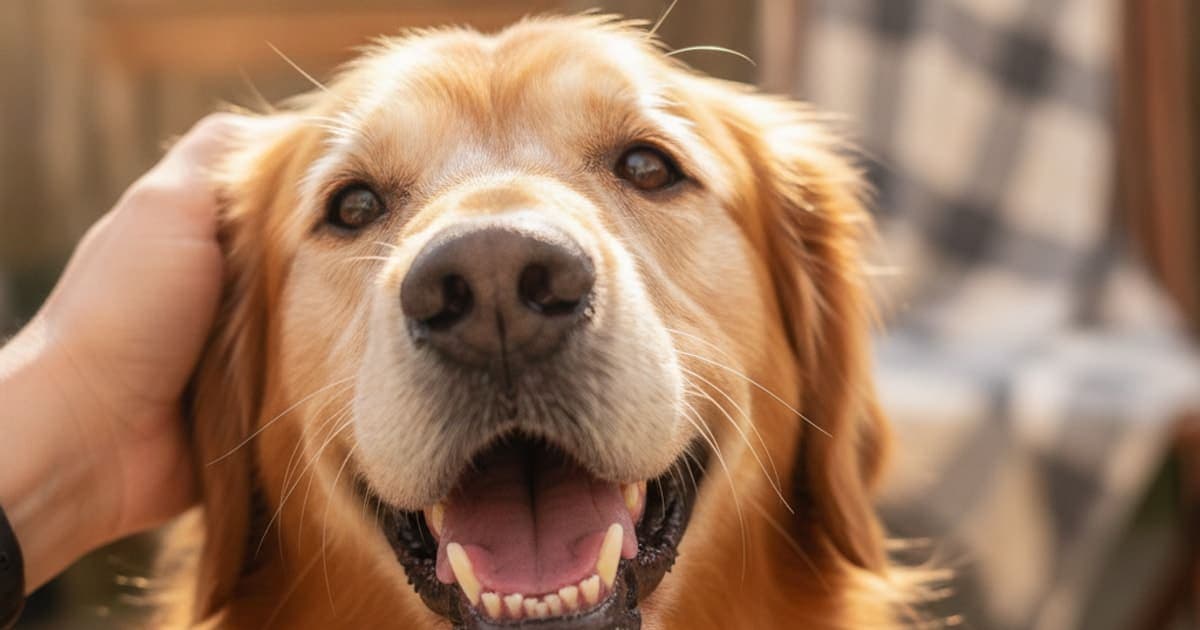
Yes. Older dogs very often have bad breath, and it is one of the first changes owners notice as a dog crosses into their senior years. But common is not the same as normal. Age by itself does not produce an odour. Bacteria produce odour. Dying tissue produces odour. A metabolic change that puts unfiltered waste compounds into the bloodstream produces odour. All three become more likely with age, which is why so many old dogs develop halitosis — not because the calendar turned over.
Bad breath in an older dog is a finding, not a feature of ageing: something in the mouth or the body has changed, and it deserves a proper look from your veterinarian.
So if you are asking why your old dog has bad breath, the answer almost always sits in one of three buckets: the mouth, the gut, or the metabolism. The mouth accounts for the overwhelming majority.
Most senior dog breath problems start at the gumline
Plaque is a living bacterial film. Left undisturbed, it mineralises into calculus — the hard brown-yellow crust you can see on the big chewing teeth — and calculus gives bacteria a permanent anchor. The bacteria that thrive in the pocket between tooth and gum are anaerobic, and their metabolic by-products are volatile sulphur compounds. That is the smell. It is, quite literally, the exhaust of an infection.
A senior dog has simply had more years for this to progress. Periodontal disease is extremely common in adult and older dogs, and it is progressive: gingivitis becomes pocketing, pocketing becomes bone loss, bone loss loosens teeth. Along the way, several other age-linked problems add their own contribution:
- Fractured teeth with exposed pulp. A slab fracture on a carnassial tooth can sit there for years, quietly infected.
- Tooth resorption and retained roots. Painful, often hidden below the gumline, visible only on dental radiographs.
- Oral masses. Both benign and malignant growths occur more often in older dogs, and when they ulcerate, the necrotic tissue smells strongly foul.
- Reduced chewing. A dog whose mouth hurts stops chewing, and the mechanical self-cleaning that chewing provides disappears, which accelerates everything above.
Watch for the behavioural tells that travel with oral pain: chewing on one side, dropping kibble, pawing at the face, turning away when you reach toward the muzzle, suddenly ignoring a favourite chew toy, or blood-tinged saliva on bedding. Dogs are relentlessly stoic about mouth pain. They almost never stop eating — they just change how they eat.
Decoding the smell: what different odours can indicate
Owners describe old dog bad breath in remarkably consistent ways, and the descriptor is genuinely useful information for your vet. It is not a diagnosis — there is real overlap, and only an examination plus bloodwork can sort it out — but it narrows the field.
| What it smells like | What it may be associated with | How quickly to act |
|---|---|---|
| Foul, rotting, worst near the gumline | Periodontal disease, dental abscess, fractured tooth, ulcerated oral mass | Book a dental exam soon |
| Ammonia, urine-like, or metallic | Waste compounds accumulating when the kidneys are not filtering well | Prompt veterinary assessment |
| Sweet, fruity, like nail polish remover | Ketones in the breath, which can accompany poorly controlled diabetes | Same-day veterinary attention |
| Musty, sweetish, vaguely 'off' | Reduced liver clearance of sulphur-containing compounds | Prompt veterinary assessment |
| Faecal | Most often coprophagia; sometimes severe oral infection; rarely a gastrointestinal obstruction | Urgent if paired with vomiting or refusing food |
| Yeasty or corn-chip-like | Malassezia overgrowth on the lips, skin folds or feet, transferred by licking | Routine appointment |
On the kidney question specifically, because so many owners search for it: uraemic breath is real, and it is the ammonia-like or metallic odour in the table. It develops when the kidneys can no longer clear nitrogenous waste efficiently. It rarely arrives alone — increased thirst and urination, gradual weight loss, a fading appetite, intermittent vomiting, and sometimes ulcers on the tongue or gums tend to show up alongside it. Importantly, breath odour is a relatively late signal. Senior wellness bloodwork and a urinalysis will flag changing kidney function long before you can smell anything, which is the single best argument for routine senior screening rather than waiting for a symptom.
Bad breath plus one more symptom: the pairings that matter
The combinations owners search for most are the ones worth taking seriously, because a second symptom moves the problem out of the mouth and into the body.
Bad breath and panting
Panting in a senior dog that is not hot and has not just exercised is a pain signal often enough to take seriously. Significant dental pain can absolutely drive it. But so can heart disease, laryngeal paralysis — a classic older large-breed problem that produces noisy, raspy breathing — and endocrine conditions. Panting that is new, happens at rest, or wakes your dog at night warrants an appointment rather than a wait-and-see.
Bad breath and coughing
This pairing deserves attention. Advanced periodontal disease in the upper jaw can erode into the nasal passages, producing nasal discharge, reverse sneezing and a cough. Separately, older dogs cough because of heart disease, tracheal collapse, airway inflammation or aspiration. A dog with laryngeal or oesophageal problems may also regurgitate, which produces both a cough and a sour, fermented breath odour. Coughing plus halitosis is a two-system problem until proven otherwise.
Bad breath and diarrhoea
When odour and loose stool appear together, the question is whether you are looking at one problem or two. Gastrointestinal disease, dietary indiscretion, pancreatic insufficiency, parasites and systemic illness can all cause diarrhoea, and several of those also change breath odour. If diarrhoea persists beyond a day or two, contains blood, or comes with vomiting, lethargy or a tense abdomen, that is a call to your veterinarian, not a monitoring exercise.
Bad breath and paw licking
This one usually has a tidy explanation. Chronic paw licking in older dogs is most often allergic or arthritic. Persistently damp feet grow yeast and bacteria, which smell distinctly yeasty — and the dog carries that odour into their mouth every time they lick. Treat the feet, and the 'breath' problem frequently turns out to have been a skin problem all along. Arthritic dogs also lick painful joints, so a senior who has started licking a wrist or hock is telling you something about comfort as well.
What the owner forums get right, and where they go wrong
Search for old dog bad breath and you land in a sea of forum threads, and the recurring theme in owner discussions is worth naming: people spend months cycling through water additives, sprays and 'fresh breath' chews, and then describe a dramatic change only after a full veterinary dental procedure under anaesthesia. That is not a coincidence. It is a mechanical fact.
No additive, spray or chew reaches below the gumline. That is where the anaerobic bacteria live and where the odour is generated. Mechanical plaque disruption — daily brushing above all — genuinely helps slow accumulation, and some chews earn their place as plaque control. But a product sold primarily on the promise of fresh breath, with a long ingredient list and no meaningful quantity of anything, is masking an odour rather than addressing its source. Be sceptical of kitchen-sink formulas and label theatre. Be far less sceptical of a toothbrush.
The other recurring anxiety is anaesthesia in an old dog, and it is a fair concern to raise directly with your veterinarian. Pre-anaesthetic bloodwork, individualised protocols, intravenous fluids and proper monitoring exist precisely because age is not, on its own, a disqualifier. What is worth knowing is that so-called anaesthesia-free dental cleaning only scrapes the visible crown. It cannot probe pockets, cannot take radiographs, and cannot extract a diseased root. It makes teeth look better while the infection continues underneath.
The wider senior picture, and where pawgen fits
Dental disease rarely travels alone in an old dog. The same animal whose breath has changed is often the one who hesitates at the stairs, takes longer to rise, or has quietly stopped jumping onto the sofa. Owners tend to notice the smell first and the stiffness second, when in fact both are threads in the same conversation about an ageing body.
That mobility thread is where pawgen works. K9-REPAIR is a BPC-157 and TB-500 peptide formulation made for dogs, dosed by body weight, third-party tested with batch certificates of analysis available, and shipped direct to your door with a 60-day money-back guarantee. BPC-157 has been studied for its role in tissue-repair signalling and the formation of new blood vessels in healing tissue. TB-500 is related to thymosin beta-4, a naturally occurring protein studied for its role in actin regulation and the cell migration that soft-tissue repair depends on. Research suggests these mechanisms sit at the centre of how tendon, ligament and connective tissue rebuild, and that is why K9-REPAIR has become a stack owners reach for through recovery and across the senior years.
To be plain about it: BPC-157 and TB-500 are not FDA-approved veterinary drugs, and K9-REPAIR is not a dental product. It will not change your dog's breath, and pawgen does not suggest otherwise. The odour belongs to your veterinarian. The mobility conversation is where this formulation belongs.
Key Takeaways
- Yes, older dogs commonly have bad breath — but ageing does not cause odour, and halitosis should never be written off as just getting old.
- Periodontal disease is the most common source by a wide margin, and the only way to address it below the gumline is a veterinary dental procedure with radiographs.
- The character of the smell is useful information: foul points to the mouth, ammonia-like toward the kidneys, sweet and fruity toward ketones, faecal toward the gut or stool-eating.
- Bad breath paired with panting, coughing, diarrhoea or paw licking moves the problem beyond the mouth and justifies an appointment.
- Senior bloodwork detects metabolic causes long before breath changes, so screening beats smelling.
- Sprays, additives and breath-focused chews mask odour; mechanical plaque control and veterinary dentistry address it.
Your veterinarian owns the diagnosis and the treatment plan here — the dental assessment, the radiographs, the bloodwork, the prescriptions, and every decision about anaesthesia. Nothing in a supplement or peptide category substitutes for that, and nothing should delay it. Supplements and peptides operate in the space that proper veterinary care creates: once the infection is handled and the pain is managed, the work of keeping an old dog comfortable and moving can begin in earnest.
You can check current shipping and availability on the pawgen location page, review batch-level third-party testing on the COAs page, and see the full K9-REPAIR range in the shop.
Owners exploring peptide support for their dog can review K9-REPAIR — BPC-157 + TB-500 formulated for dogs — at https://pawgen.com/. BPC-157 and TB-500 are not FDA-approved veterinary drugs. Nothing in this article treats, cures or prevents any condition; every decision about your dog's care belongs with your veterinarian.
Frequently asked questions
- Do older dogs have bad breath?
- Yes, older dogs commonly have bad breath, but age itself is not the cause. Odour comes from bacteria, damaged tissue or a metabolic change — most often periodontal disease that has progressed over years. Because it signals an underlying process rather than normal ageing, it warrants a veterinary dental examination.
- Do old dogs have bad breath more than young dogs?
- Generally yes. Older dogs have had more years for plaque to mineralise into calculus, for teeth to fracture or resorb, and for oral masses to develop. They are also more likely to have kidney, liver or metabolic changes that alter breath odour. The frequency rises with age, but it is never normal.
- Why do old dogs get bad breath?
- Most often because anaerobic bacteria in the pockets between tooth and gum release volatile sulphur compounds. Fractured teeth, resorptive lesions, retained roots and ulcerated oral masses add to it. Less commonly, reduced kidney or liver function allows waste compounds into the bloodstream, which changes breath odour measurably.
- Why does my old dog have bad breath all of a sudden?
- A sudden change usually means something new: a cracked tooth, an abscess, a growth in the mouth, something lodged between teeth, or a metabolic shift. Sudden-onset odour is more concerning than a gradual one. Have your veterinarian examine the mouth and consider bloodwork to rule out systemic causes.
- Can bad breath in a senior dog mean kidney disease?
- It can. Reduced kidney filtration allows nitrogenous waste to build up, producing an ammonia-like or metallic breath odour, sometimes with mouth ulcers. It rarely appears alone — increased thirst, urination, weight loss and appetite changes usually come first. Bloodwork and urinalysis detect it far earlier than smell does.
- Why does my senior dog's breath smell like poop?
- The most common explanation is coprophagia — eating stool, their own or another animal's. Severe periodontal infection with necrotic tissue can also produce a faecal odour. Rarely, a gastrointestinal obstruction causes it. If your dog is vomiting, straining or refusing food, treat it as urgent.
- Is bad breath in an older dog an emergency?
- Usually not on its own, but some pairings are. Sweet, acetone-like breath, faecal breath with vomiting, or bad breath alongside collapse, laboured breathing or refusal to eat all justify same-day veterinary care. Isolated foul breath still needs an appointment — it simply does not need an ambulance.
- Will a dental cleaning fix my old dog's bad breath?
- A veterinary dental procedure with radiographs addresses what lies below the gumline, which is where odour-producing bacteria live, and owners frequently report a dramatic change afterwards. Results depend entirely on what your vet finds. Discuss anaesthetic safety and pre-anaesthetic bloodwork with your veterinarian beforehand.
Educational content, not veterinary advice. Ask your vet about your dog.