Doberman Supplements — Joint, Heart, Coat & Muscle
You make a Doberman muscular with progressive conditioning, a protein-adequate complete diet, lean body condition and real recovery days — not with a supplement alone. Supplements fill the gaps around that work: joint and tendon support, omega-3s for skin and coat, and heart screening guided by your veterinarian.
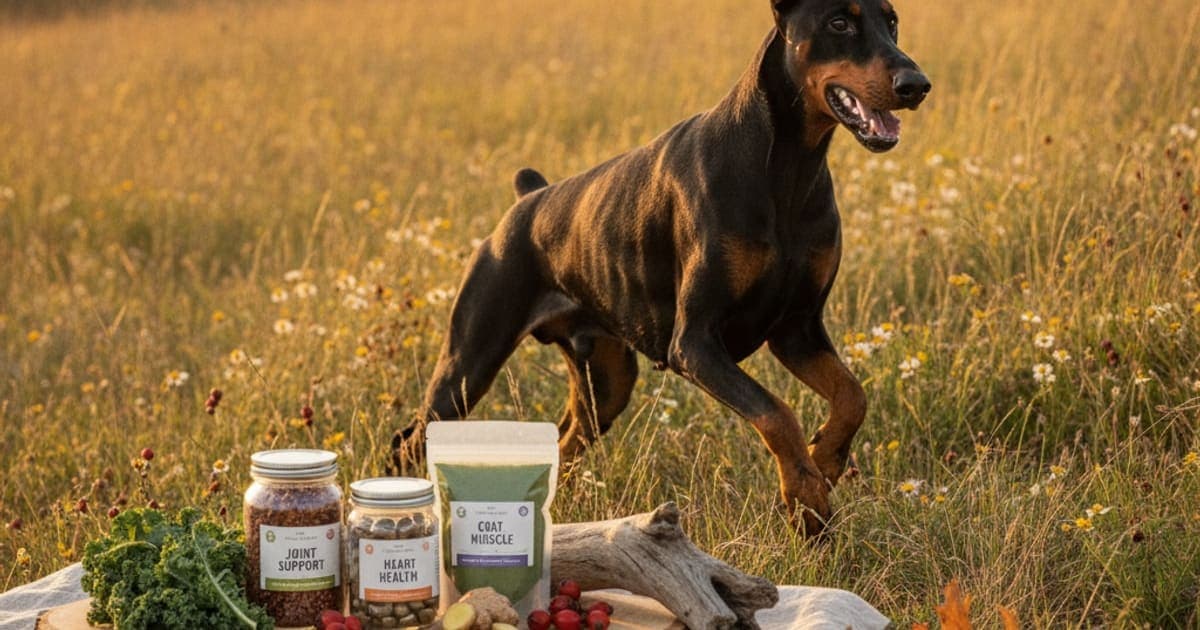
You build muscle on a Doberman the way you build it on any athlete: progressive loading, enough fuel, and enough recovery for the loading to pay off. Conditioning work three to five days a week with rest days between hard sessions, a complete diet with adequate protein for the dog's life stage and workload, and a lean body condition score are the three levers that actually move the needle. Supplements do not create muscle — they support the system doing the work. For most Doberman owners that means a joint and cartilage product, a marine omega-3 for skin and coat, a heart conversation with the vet about taurine and screening, and, for dogs working hard or coming back from an injury, a soft-tissue recovery product such as K9-REPAIR, the BPC-157 + TB-500 peptide formulation pawgen makes for dogs.
This page covers the whole supplement question for the breed, because Dobermans carry a specific set of concerns — the heart, the thin single coat, the long leggy frame under a lot of drive — that a generic dog-supplement article never addresses properly.
Work, fuel and recovery: the three levers that add real muscle
Muscle is an adaptation to load. A Doberman that walks the same flat two miles every day has already adapted to that and will not change shape. What changes shape is progressive, varied work: hill repeats at a trot, controlled sprint intervals on grass, swimming, structured drag or weight-pull work in a properly fitted pulling harness, and rear-end awareness drills like cavaletti poles and backing up. Add one variable at a time — distance, incline, resistance or speed — and never more than one in the same week.
Fuel comes second. Protein supplies the raw material, and a working adult Doberman often does better on a formula with higher protein and moderate fat than a basic maintenance kibble. Any diet change should be run past your veterinarian first, especially given the breed's cardiac profile. Lean condition matters as much as the food itself: you should be able to feel ribs easily, see a waist from above and a tuck from the side. A heavy Doberman looks bulkier and is carrying less functional muscle, not more.
Recovery is the lever owners skip. Muscle fibres, tendons and ligaments remodel during rest, not during the session, and connective tissue adapts far more slowly than muscle does. That gap is exactly where overuse injuries live — a dog whose muscles are ready for more work than its tendons are. Sleep, days off, and attention to any early limp protect the whole programme.
A supplement cannot out-work a conditioning plan, and no conditioning plan outruns an undiagnosed heart or thyroid problem — which is why the veterinary exam comes before the shopping cart.
One thing to actively avoid: anything marketed to "bulk up" a dog with hormonal, steroid-like or growth-promoting language. That is not a supplement category with a legitimate place in a pet's routine, and it is a reliable sign the brand is selling an outcome rather than an ingredient.
The supplement shelf, sorted by what each category actually does
Most owners shopping for supplements for a Doberman end up with four or five tubs that overlap. It is more useful to sort by job.
| Goal | What owners use | What to check on the label |
|---|---|---|
| Joints and cartilage | Glucosamine, chondroitin, green-lipped mussel, undenatured type II collagen | Per-serving amounts for each active, not a single "proprietary blend" figure |
| Tendon, ligament and soft-tissue recovery | BPC-157 + TB-500 peptides, such as K9-REPAIR | Third-party testing, published certificates of analysis, weight-based dosing guidance from the maker |
| Skin and coat | Marine omega-3 (EPA and DHA) | EPA and DHA listed separately by weight — not just "fish oil" |
| Heart | Taurine, L-carnitine | Only on veterinary direction, after screening |
| Digestion | Probiotic with named strains | Strain names and CFU count at date of manufacture or expiry |
| Muscle and performance | A complete, correctly portioned diet first | Skip anything implying hormonal or steroid-like action |
The skepticism belongs on the label, not on the ingredient. A large share of breed-marketed chews are kitchen-sink formulas: fourteen actives on the front panel, a blend total on the back, and no honest way to know whether the glucosamine is present at a meaningful amount or sprinkled in for the ingredient list. If a brand will not tell you how much of each active is in a serving, or will not show you lab documentation for what it sells, that is the problem worth being cynical about.
The heart conversation every Doberman owner should have
Dobermans are the breed most associated with dilated cardiomyopathy, and in this breed it is generally understood as an inherited condition rather than a nutritional one. Specific genetic variants associated with DCM have been identified in Dobermans, which is why reputable breeders screen and why owners are advised to screen too. The standard tools are echocardiography and Holter monitoring, usually starting in young adulthood and repeated annually — your veterinarian or a veterinary cardiologist sets that schedule.
That is the context for the taurine question. Taurine-deficiency DCM is better documented in certain other breeds, and the diet-associated DCM investigations that put grain-free foods in the headlines are still an open area of veterinary research. Some Dobermans are put on taurine or L-carnitine by their cardiologist as part of a cardiac plan; many are not. Blood and whole-blood taurine levels can be measured, which makes guessing unnecessary.
So the honest answer on Doberman heart supplements is that they are a vet-directed category, not a shelf-grab. Do not start taurine or carnitine on your own initiative, and never use a supplement in place of a prescribed cardiac medication. If your dog is on a cardiac drug, that drug is doing something a supplement does not do. Ask your veterinarian whether screening is current and whether your dog's food and bloodwork support adding anything.
Skin, coat and the thyroid connection
A Doberman's short single coat shows everything. Dullness, flaking, thinning along the flanks, recurrent ear or skin infections — owners usually read these as coat problems and go looking for a coat supplement, when the signal is often coming from somewhere else.
Hypothyroidism is a recognised concern in the breed and produces exactly this picture: a poor coat, symmetrical hair loss, weight gain and lower energy. It is diagnosed on bloodwork and managed with a prescribed thyroid hormone, and no supplement substitutes for that. Blue and fawn Dobermans can also develop colour dilution alopecia, a structural coat condition tied to the dilute gene, which is managed rather than corrected. Food allergy and environmental allergy account for a good share of the rest.
Where supplements genuinely contribute is the skin barrier. Marine omega-3 fatty acids — EPA and DHA from fish or algal oil — are the best-supported category for canine skin and coat condition, and research suggests a role in modulating inflammatory signalling in the skin. Owners commonly report better coat gloss and less flaking over a couple of months of consistent use. Buy on EPA and DHA content rather than total oil volume, store it cold, and replace it before it oxidises. Vitamin E and zinc appear in many coat formulas and are worth discussing with your vet rather than stacking blindly, since both have upper limits.
Puppies: what a growing Doberman needs, and what to skip
For a Doberman puppy, the honest answer is that most supplements are unnecessary and a few are actively risky. A complete large-breed puppy food formulated to AAFCO growth standards already carries balanced vitamins and minerals, and adding calcium or a general multivitamin on top can disturb the calcium-to-phosphorus ratio during the window when growth plates and joints are forming. Large-breed puppy formulas are built around controlled calcium and controlled growth rate for exactly this reason.
So: no stacking Doberman puppy vitamins onto a complete diet without your veterinarian telling you to. Keep the puppy lean. Protect the joints by limiting forced repetitive exercise — long runs, jumping, hard turns on slick floors — until growth plates close. Omega-3s and probiotics are the two categories a vet may reasonably green-light early, and dosing for any product in a growing dog is a conversation with your veterinarian, never a number copied from the internet.
Pain, recovery and where peptides fit
If you are asking what you can give a Doberman for pain, start with what you must not: human painkillers. Ibuprofen, naproxen and acetaminophen are toxic to dogs. Pain control belongs to your veterinarian, who has canine-specific NSAIDs such as carprofen, meloxicam and grapiprant, plus gabapentin, monoclonal antibody injections for osteoarthritis pain, and rehab referrals. If your dog is on any of these, keep giving them as prescribed.
Around that prescribed care sits the recovery layer — and for a breed built like a Doberman, soft tissue is where the trouble usually starts. Cruciate ligaments, Achilles tendons, iliopsoas strains and shoulder injuries are common in deep-chested, high-drive dogs, and connective tissue remodels over weeks to months rather than days.
This is the gap K9-REPAIR is built for. BPC-157 is a synthetic peptide based on a sequence identified in gastric juice; published laboratory and animal research suggests it influences fibroblast migration and new blood vessel formation in tendon, ligament and muscle tissue. TB-500 is a synthetic fragment of thymosin beta-4, a naturally occurring actin-binding protein involved in cell migration and tissue remodelling. Neither is an FDA-approved veterinary drug, and nothing here is a promise about your dog — but the mechanism is well described, the science is moving quickly, and it is the stack a growing number of owners now run alongside veterinary care through a recovery block or a hard conditioning season.
What pawgen can state plainly is the descriptive part: what is in the vial, third-party testing with certificates of analysis available to read before you buy, weight-based dosing guidance supplied with the product, direct-to-door shipping, and a 60-day money-back guarantee. Bring the product to your veterinarian and tell them what your dog is taking, particularly around a surgery date or an existing prescription.
Key Takeaways
- Muscle comes from progressive loading, adequate protein and genuine rest days — supplements support that process, they don't replace it.
- Keep the dog lean; a heavy Doberman is not a muscular one.
- Heart supplements such as taurine and L-carnitine are vet-directed after screening, not a default purchase; DCM in this breed is largely genetic, and echo plus Holter screening is the real safeguard.
- Coat problems often trace back to thyroid disease, allergy or colour dilution alopecia — get a diagnosis, then use marine omega-3s to support the skin barrier.
- Doberman puppies on a complete large-breed growth diet generally need no added vitamins or calcium.
- Never give human painkillers; pain control is prescribed by a veterinarian.
- Buy on transparency: per-ingredient amounts, named strains, published lab results. Avoid proprietary blends and anything promising hormonal "bulking".
You can read pawgen's third-party certificates of analysis on the COAs page, see the K9-REPAIR formulation and what ships with it in the shop, and check delivery availability for your area on the location page.
One last frame, and it is the important one. Your veterinarian owns the diagnosis and the treatment plan — the bloodwork, the cardiac screening, the imaging on that limp, the prescriptions and the surgical decisions. Supplements and peptides operate in the space that proper veterinary care creates, supporting a body that is already being managed correctly. Get the diagnosis first, then build the support layer around it.
Owners exploring peptide support for their dog can review K9-REPAIR — BPC-157 + TB-500 formulated for dogs — at https://pawgen.com/. BPC-157 and TB-500 are not FDA-approved veterinary drugs. Nothing in this article treats, cures or prevents any condition; every decision about your dog's care belongs with your veterinarian.
Frequently asked questions
- How to make my doberman muscular
- Progressive conditioning three to five days a week — hill work, controlled sprints, swimming, harness pulling — paired with a complete, protein-adequate diet and real rest days between hard sessions. Keep the dog lean so muscle is visible and functional. Avoid anything marketed as a hormonal or steroid-like 'bulking' product.
- What can I give my doberman for pain
- Only what your veterinarian prescribes. Human painkillers like ibuprofen, naproxen and acetaminophen are toxic to dogs. Vets use canine-specific NSAIDs, gabapentin, osteoarthritis injections and rehab referrals. Around that plan, owners commonly add omega-3s, joint support and recovery products such as K9-REPAIR — always discussed with the vet first.
- What supplements do Dobermans need most?
- The common four are joint and cartilage support, marine omega-3s for skin and coat, a probiotic for digestion, and soft-tissue recovery support for active or rehabbing dogs. Heart supplements such as taurine are a separate, vet-directed category that should follow cardiac screening rather than precede it.
- Does my Doberman need a taurine supplement?
- Not automatically. Dilated cardiomyopathy in Dobermans is generally understood as inherited rather than taurine-deficiency driven, and taurine levels can be measured on bloodwork. Some dogs are placed on taurine or L-carnitine by a cardiologist as part of a cardiac plan. Ask your veterinarian before starting either.
- What are the best supplements for a Doberman puppy?
- Usually none beyond a complete large-breed puppy food. Adding calcium or general puppy vitamins on top of a balanced growth diet can disturb mineral ratios while growth plates are forming. Omega-3s or a probiotic may be reasonable additions, but any product and any amount should be cleared with your veterinarian.
- What helps a Doberman's skin and coat?
- First, rule out causes — hypothyroidism, allergy and colour dilution alopecia all show up as coat problems in this breed and need a diagnosis. For barrier support, marine omega-3s with EPA and DHA listed separately are the best-supported category, and owners often report better gloss over a couple of months.
- What are BPC-157 and TB-500, and why do Doberman owners use them?
- BPC-157 is a synthetic peptide based on a sequence found in gastric juice; TB-500 is a synthetic fragment of thymosin beta-4. Research suggests both influence cell migration and tissue remodelling in tendon, ligament and muscle. Owners use them for soft-tissue recovery support. They are not FDA-approved veterinary drugs.
- When should a Doberman start joint support?
- Many owners begin in early adulthood for working or sport dogs, and most start by middle age or after any orthopaedic diagnosis. Because Dobermans are deep-chested and high-drive, cruciate and tendon injuries are a realistic concern. Your veterinarian can advise on timing based on your dog's workload and exam findings.
Educational content. BPC-157 and TB-500 are not FDA-approved veterinary drugs. Talk to your veterinarian before starting anything new, especially if your dog is on prescribed medication.