Dog Achilles Tendon Injury Recovery Time: What to Expect
Most dogs need roughly three to six months to return to full function after a significant Achilles tendon injury, with the first several weeks usually spent in a splint, cast or external fixator. Mild strains resolve faster; chronic degenerative ruptures in older dogs take longer and may leave a permanent gait change.
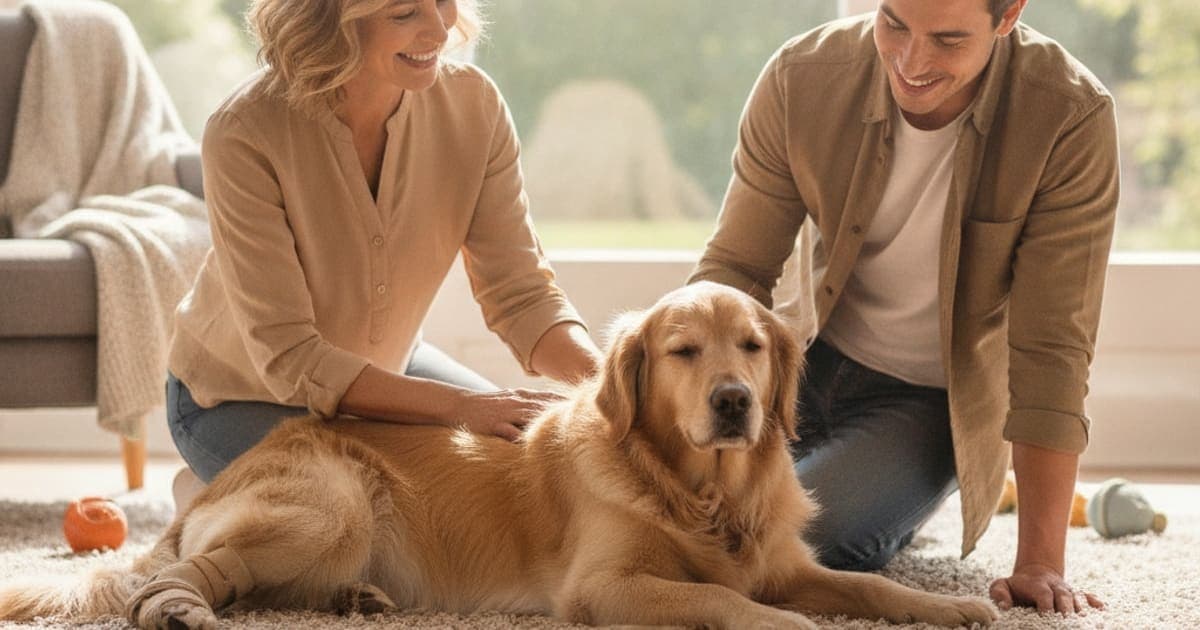
How Long Does an Achilles Tendon Injury Take in a Dog?
Most dogs with a significant Achilles tendon injury need roughly three to six months to return to normal, unrestricted function. Surgical cases are generally managed with the hock held rigid for the first several weeks, then walked through a graded return to load over the months that follow. A mild strain or early tendinopathy caught before the tendon gives way can settle in a matter of weeks. Chronic, degenerative ruptures — the kind that appear in middle-aged and older large-breed dogs without one dramatic moment of injury — sit at the long end of the range, and some of those dogs keep a slightly dropped hock for life. Your dog's timeline depends on the injury grade, the surgical plan, and how strictly the loading restrictions are actually kept.
Why a load-bearing tendon repairs so slowly
What owners call the Achilles is properly the common calcaneal tendon, and it is not one cord but a bundle. The gastrocnemius tendon, the superficial digital flexor tendon, and a shared tendon from the biceps femoris, semitendinosus and gracilis muscles all converge on the calcaneus — the bony point of the hock. Together they transmit the propulsive force of every push-off, every stair, every jump into the back of the car.
Two features of that anatomy explain the long timeline. First, tendon is a dense, relatively poorly vascularised tissue. Muscle is flooded with blood vessels and repairs quickly; tendon has fewer of them, its resident cells are less metabolically busy, and the collagen scaffold they rebuild takes months to organise. Where the tendon has torn away from the calcaneus, an avulsion, the tendon-bone interface has to remodel as well — and bone-to-tendon healing is slower still.
Second, tendon needs load to organise correctly, but load applied too early is exactly what makes it fail. Repair tissue laid down in the first weeks is disorganised and mechanically weak. Ask it to carry a 35-kilo dog charging across a yard and it stretches, lengthens or re-tears, and the clock resets. That is the whole reason surgeons immobilise the hock rather than simply telling you to keep your dog quiet. A dog cannot be told to stop using one leg.
The recovery timeline, stage by stage
Biological repair moves through recognisable phases. The windows below overlap, and your veterinary surgeon will set the actual schedule based on radiographs, ultrasound and how the limb looks at each recheck — but the sequence is consistent.
| Stage | Rough window | What is happening in the tissue | What the dog is usually allowed |
|---|---|---|---|
| Inflammatory | First several days | Bleeding, clot formation, inflammatory cells clearing damaged tissue. Almost no mechanical strength. | Strict confinement, rigid support, pain control as prescribed |
| Early repair | First few weeks | Fibroblasts migrate in and lay down disorganised type III collagen. Fragile. | Continued immobilisation; short, supported toilet breaks only |
| Consolidation | Roughly weeks three to eight | Collagen density climbs; the repair begins converting toward stronger, mature fibre | Staged reduction of external support, very short controlled leash walks if cleared |
| Remodelling | Two to six months | Collagen realigns along lines of load; tensile strength rises substantially | Progressive loading, formal rehab, walk then trot as directed |
| Late maturation | Six to twelve months | Continued strengthening; the tendon may never be biomechanically identical to the original | Normal activity once the surgeon or rehab vet clears it |
The practical implication is that the splint or fixator coming off is not the finish line — it is roughly the halfway mark. Owners who expect a cast removal to mean a normal dog are the owners who get a re-rupture in month three.
What makes one dog's timeline twice another's
The single largest variable is what actually happened to the tendon.
| Injury pattern | Usual management | Effect on the timeline |
|---|---|---|
| Mild strain or early tendinopathy | Activity restriction, vet-guided rehab, sometimes anti-inflammatories | Shortest — weeks, provided loading is genuinely restricted |
| Partial rupture with a dropped hock | Rigid immobilisation, often surgical repair | Months; meaningful recurrence risk if activity resumes early |
| Complete acute rupture or laceration | Surgical repair plus immobilisation of the hock | Long end of the three-to-six-month range |
| Avulsion from the calcaneus | Surgical reattachment, sometimes with a screw or external fixator | Long; the tendon-bone interface remodels slowly |
| Chronic degenerative rupture | Surgery, extended immobilisation, long rehab | Longest; tissue quality is poor and some gait change may persist |
Beyond the pattern itself, body weight matters enormously — a heavy dog loads the repair harder every single step. Age slows collagen turnover. Systemic conditions including hypothyroidism and hyperadrenocorticism have been associated with tendon degeneration in veterinary literature, and long courses of corticosteroids are recognised as a factor in tendon weakening, which is one reason your veterinarian will want the whole medication history rather than just the leg. Surgical site infection or a pressure sore under a splint can add weeks. And temperament counts: the dog who cannot be persuaded that stairs are cancelled has a longer road than the placid one who is happy in a pen.
The work that genuinely shortens the road
There is no shortcut around biology, but there is a large gap between a well-managed recovery and a badly managed one.
Immobilisation comes first. Depending on the injury, that may mean a splint or cast, a calcaneotibial screw, or an external skeletal fixator holding the hock at a fixed angle so the repair is not stretched. These are not interchangeable, and the choice belongs to the surgeon who has seen the imaging. Follow the bandage-check schedule exactly — the complications that add months usually start as a small sore or a slipped splint.
The strongest determinant of how long recovery takes is not the tear itself but how completely the tendon is protected from load in the early weeks, because repair tissue that is stretched before it matures heals long, slack and weak.
Then comes controlled rehabilitation, and this is where owners underestimate the value on offer. A veterinary rehabilitation professional builds a graded programme — passive range of motion, then measured leash walking, then underwater treadmill work, proprioceptive and balance exercises, and finally a structured return to trot. The point is to feed the remodelling tendon exactly enough mechanical signal to align its fibres without overwhelming it. Talk to your veterinarian about a referral early rather than in month four; the programme is most useful when it starts as soon as the repair is stable enough.
Nutrition and body condition sit alongside that. Every excess kilogram is extra force through a repairing tendon, and weight control during a period of enforced rest takes deliberate planning with your vet.
Where a tendon-focused peptide stack fits in the recovery window
Once surgery, immobilisation and rehab are handled, many owners look at what else can support the tissue through those long remodelling months. This is the space where pawgen's K9-REPAIR has become part of the routine for a lot of recovery-stage dogs. It is a two-peptide formulation — BPC-157 and TB-500 — dosed by body weight, third-party tested with certificates of analysis available, and shipped direct to the door. BPC-157 and TB-500 are not FDA-approved veterinary drugs, and nothing here is a treatment claim: this is mechanism and adoption, not an outcome promise for your dog.
What draws owners to the pairing is that both peptides act on the parts of repair that tendon is worst at. BPC-157 is a synthetic pentadecapeptide derived from a sequence found in gastric juice, and laboratory research suggests it may support angiogenesis — the formation of new blood vessels — along with the outgrowth and migration of tendon fibroblasts, the cells that build collagen. Given that poor blood supply is the central reason tendon repairs slowly, that mechanism is why this is promising, actively adopted science rather than a curiosity. TB-500 is based on an active region of thymosin beta-4, a naturally occurring protein involved in actin regulation, cell migration and tissue-repair signalling; research suggests it may support the cell movement and matrix organisation phases that dominate the remodelling window.
That is a different proposition from the kitchen-sink joint chew with nineteen ingredients hidden inside a proprietary blend, where you cannot tell whether anything present is at a meaningful level. Ask any brand what is in the bottle, at what amount per kilogram of dog, and who tested it — pawgen publishes that, and K9-REPAIR carries a 60-day money-back guarantee, which is a reasonable standard to hold everyone to. Bring the actual product to your veterinarian before starting it, especially if your dog is on prescribed medication, is pregnant or nursing, or is still growing. Dosing questions belong with your vet, not with a number from a blog.
Nothing in this category is a substitute for surgery, and nothing here is a reason to change or stop something your veterinarian prescribed. Peptides sit alongside the plan, in the months the plan creates.
Signs the recovery is not tracking
Call your veterinary team, rather than waiting for the next scheduled recheck, if you see the hock dropping lower than it was, sudden non-weight-bearing lameness after a period of improvement, swelling or heat over the tendon, discharge or odour from a surgical site or bandage, chewing at the dressing, or a splint that has rotated or loosened. Early intervention on any of these usually costs days. Ignoring them usually costs months.
Key Takeaways
- Most significant canine Achilles tendon injuries take roughly three to six months to reach normal function; mild strains resolve faster, chronic degenerative ruptures take longer and may leave a permanent gait change.
- Removal of the splint, cast or fixator is roughly the halfway point, not the end — remodelling continues for months afterwards.
- Injury pattern, body weight, age, prior corticosteroid exposure and owner compliance with restrictions drive most of the variation between dogs.
- Immobilisation chosen by the surgeon plus a graded rehabilitation programme are the two interventions with the largest effect on how the recovery finishes.
- K9-REPAIR pairs BPC-157 and TB-500, dosed by weight and third-party tested, and is the stack many owners run through the recovery window for its research-suggested support of blood vessel formation, fibroblast activity and cell migration. These peptides are not FDA-approved veterinary drugs.
For more depth on this injury, see achilles tendon injury in dogs, plus dog achilles tendon injury drug-free options and dog achilles tendon injury food-based support. If you are weighing the peptide question specifically, k9-repair for tendonitis in dogs and k9-repair for soft tissue injury in dogs go through the mechanisms in detail, and the formulation itself is K9-REPAIR.
Your veterinarian owns the diagnosis, the imaging, the surgical decision and the rehabilitation timeline for this injury — that is the plan, and it is not optional. Supplements and peptides operate in the space that proper veterinary care creates: the long, quiet months of remodelling where the tendon is rebuilding itself and your job is to protect the work.
Owners exploring peptide support for their dog can review K9-REPAIR — BPC-157 + TB-500 formulated for dogs — at https://pawgen.com/. BPC-157 and TB-500 are not FDA-approved veterinary drugs. Nothing in this article treats, cures or prevents any condition; every decision about your dog's care belongs with your veterinarian.
Frequently asked questions
- What makes Achilles tendon injury worse in dogs?
- Load applied too early is the main culprit — running, jumping, stairs or slipping on smooth floors while the repair is still fragile. Excess body weight, a loose or rotated splint, surgical site infection, long corticosteroid courses and underlying endocrine disease can all worsen the injury or extend recovery.
- Can Achilles tendon injury in dogs be reversed?
- Tendon does repair, but it repairs with scar-type collagen rather than reverting to its original architecture, so 'reversed' is the wrong frame. Many dogs regain excellent function after appropriate surgery and rehabilitation. Chronic degenerative ruptures, however, often leave some permanent change in hock angle or gait.
- How much does it cost to treat Achilles tendon injury in dogs?
- Costs vary widely by clinic, region, injury severity and whether a specialist surgeon is involved. Surgical repair plus imaging, anaesthesia, immobilisation, bandage changes and rehabilitation sits in major orthopaedic territory. Ask your veterinary practice for a written estimate covering the whole recovery period, not just the operation.
- Can a dog's Achilles tendon injury heal without surgery?
- Mild strains and early tendinopathy are often managed conservatively with strict activity restriction, external support and vet-guided rehabilitation. Complete ruptures, avulsions from the calcaneus and injuries producing a dropped hock usually need surgical repair. Only imaging and a veterinary exam can tell you which category your dog is in.
- What are the first signs of Achilles tendon injury in dogs?
- The classic early sign is a dropped or sunken hock — the heel sits lower than normal while the toes may curl. Owners also notice a plantigrade stance, sudden hind-limb lameness, swelling or thickening above the heel, reluctance to jump, and pain when the area is touched.
- How is Achilles tendon injury diagnosed in dogs?
- Diagnosis starts with a hands-on orthopaedic exam assessing hock angle, tendon continuity and pain on palpation. Radiographs check the calcaneus for avulsed bone fragments and mineralisation, and ultrasound or MRI can show which of the tendon's components are torn and how completely — which determines the surgical plan.
- Can K9-REPAIR support a dog recovering from an Achilles tendon injury?
- K9-REPAIR combines BPC-157 and TB-500, peptides that research suggests may support blood vessel formation, fibroblast activity and cell migration — the processes tendon depends on. Many owners run it through the recovery window alongside their vet's plan. It is not an FDA-approved veterinary drug; discuss it with your veterinarian first.
Educational content. BPC-157 and TB-500 are not FDA-approved veterinary drugs. Talk to your veterinarian before starting anything new, especially if your dog is on prescribed medication.