Why Do Dogs Circle Before Lying Down? (Normal Behavior)
Dogs circle before lying down because of an inherited bedding ritual: a few turns let a dog flatten the surface, gauge temperature, check its surroundings and settle facing a safe direction. It is normal behavior in a healthy dog. Circling that is new, relentless, one-sided or paired with other signs deserves a veterinary exam.
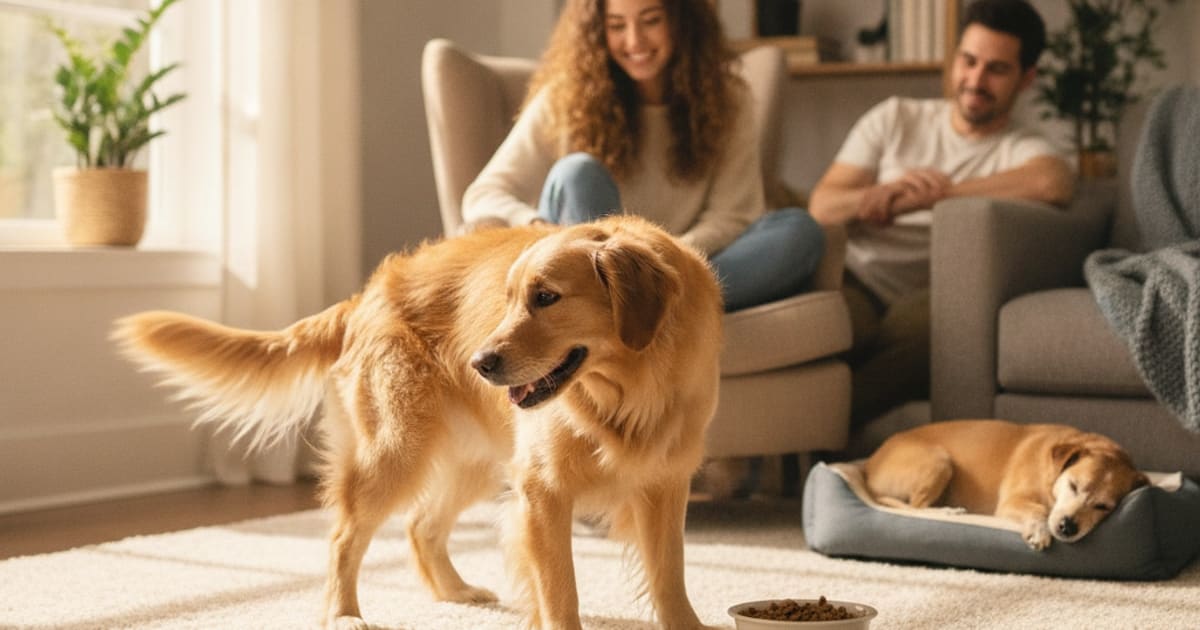
Dogs circle before lying down because of an inherited bedding ritual: a few turns let a dog tamp down the surface, feel the temperature of the ground, scan what is behind and around it, and settle into a position that feels safe. See your vet, though, if the circling is new in an adult or senior dog, if it goes on and on without your dog ever settling, if it always happens in the same direction, or if it arrives alongside pacing, confusion, stumbling, straining or obvious discomfort. Those are different problems wearing the same costume, and a hands-on exam is the only way to separate them.
For the vast majority of dogs, though, the bedtime spin is simply what dogs do. It shows up in puppies who have never slept outdoors, in dogs raised entirely on hardwood floors, and in dogs whose beds are already perfectly flat. The behavior outlived the conditions that made it useful.
The bedtime ritual dogs inherited
Before dogs slept on orthopedic foam, they slept on ground that needed work. Circling did several jobs at once, and each one explains a piece of what you still see tonight.
Flattening and clearing. Walking in a tight loop tramples grass, pushes aside leaves, compacts snow and shoves small debris out of the way. A dog turning in circles before lying down is running a very old version of making the bed.
Temperature management. Scraping and turning on bare earth exposes cooler soil underneath, which matters to an overheated animal. In cold conditions the same movement shapes a shallow hollow that blocks wind and holds body heat. Dogs still do both indoors, which is why one dog digs at a blanket before collapsing on the cool tile beside it.
Hazard and pest check. A quick circuit of a sleeping spot disturbs insects, snakes and anything sharp hiding in the vegetation. Better to find it standing up than to lie down on it.
Orientation and sightlines. Dogs tend to settle with a view of the room, the doorway or the person they care about, and often with their nose into the airflow. Those last few turns are how a dog chooses which way to face.
Scent. Dogs have glands between their toes, and scuffing the ground leaves a scent signature behind. Part of the ritual is a quiet claim on the spot.
There is also a behavioral layer that has nothing to do with survival. Repeated routines help animals shift state, in this case from alert to asleep. The circle is a cue to the body that the day is done.
Why the couch gets the same treatment as a forest floor
The obvious objection is that none of this is necessary on a padded bed. Correct, and it happens anyway.
Instinctive bedding behavior is not calibrated to the surface. A dog circling in bed, circling on bed covers, pawing at a duvet or digging a pointless trench in a blanket is running the pattern, not solving a problem. Some dogs genuinely do improve things, bunching a blanket into a bolster or dragging a towel into a nest shape, which reinforces the habit.
You will usually see more of it when something about the setup is slightly off. A bed that is too firm, too slippery, too small to curl up in, or placed in a draft invites extra adjustment. So does a bed that smells strongly of fresh laundry detergent. If your dog keeps circling before lying down on one bed and drops straight down on another, the bed is telling you something.
Breed tendencies show up here too. Terriers and other dogs bred to dig often make a real production of it. Northern breeds that evolved to sleep outside in cold weather tend to scrape and curl more thoroughly. Results vary from dog to dog, and a dog with an elaborate ritual is not more anxious than a dog with a short one.
Circling in a crate, and when it means something else
A crate concentrates the behavior. The space is small, the bedding bunches, and a dog circling in a crate has fewer options for getting the geometry right, so it may turn several times, paw the bedding into a pile, and turn again.
That is normal. What is worth reading more carefully is a dog who keeps circling in a crate and never settles. Consider, in rough order of likelihood:
- The crate is too small. A dog should be able to stand, turn and lie fully stretched out. Persistent repositioning in a tight crate is a size problem, not a temperament problem.
- They need to toilet. Especially in puppies and in dogs who have been crated a while, restless circling is often a request.
- Temperature. Crates in sunny rooms get hot, and dogs who cannot find a cool spot keep hunting for one.
- Bedding. Slippery mats, bunched blankets or a hard crate pan all generate more adjusting.
- Confinement stress. Circling with panting, drooling, whining, scratching at the door or damage to the crate is distress, not nesting, and it is worth raising with your vet or a qualified behavior professional.
- Pain. A sore hip, a stiff back or a sore elbow makes lying down a negotiation. Dogs in discomfort circle, half lower themselves, stand back up and try again.
That last pattern deserves attention. If your dog seems to be rehearsing the act of lying down rather than performing it, read more about a dog who cannot get comfortable lying down and raise it at the next appointment.
Why dogs circle before pooping and peeing
The pre-poop circle has a separate set of explanations, and it is just as normal.
Eliminating is the most vulnerable thing a dog does all day. Circling gives a full 360 degree scan of the surroundings before committing. It also flattens grass and clears the landing zone, which keeps the dog clean.
Scent does the heavy lifting. Dogs read who has been there, how recently, and in what state, then choose a spot that puts their own message in the right place. A dog circling a lot before pooping is usually surveying, not struggling. Expect more of it on unfamiliar ground, on a new surface such as gravel or wet grass, in heavy rain or wind, when a leash is tight, or when the dog knows it is being watched.
There is also an intriguing line of research here. A 2013 study published in Frontiers in Zoology by Hart and colleagues observed dogs during elimination and reported a preference for aligning the body along a north-south axis when the Earth's magnetic field was calm, with the preference disappearing when it was unstable. Research suggests sensitivity to the magnetic field may be part of why the positioning takes a moment, though the finding has not been widely replicated and should be treated as an interesting possibility rather than settled fact.
Dogs circle before peeing too, though usually less dramatically, because marking is about placement rather than cover. Many female dogs and some males will turn, sniff, reposition and only then squat or lift.
What changes the picture is a dog who circles and circles but produces nothing. A dog circling but not pooping, straining in a hunched posture, crying out, scooting, or passing only small hard pellets or mucus may be dealing with constipation, anal gland discomfort, a painful back or hips, a dietary problem or, less commonly, an obstruction. Repeated unproductive straining is a reason to talk to your vet promptly rather than waiting a few days.
Ordinary ritual versus circling that needs an exam
| What you are seeing | Usually ordinary | Book a veterinary exam |
|---|---|---|
| A few turns, then your dog lies down and stays down | Yes | No |
| Pawing, digging or bunching bedding first | Yes | No |
| Longer ritual on a new bed, new surface or in bad weather | Yes | No |
| Circling, lowering halfway, standing back up, repeating | No | Yes, suspect pain or stiffness |
| Circling that is new in an adult or senior dog | No | Yes |
| Always turning the same direction | No | Yes |
| Circling away from bedtime, in open rooms, aimlessly | No | Yes |
| Several minutes of circling before pooping with no result | No | Yes |
| Circling with head tilt, wobbliness, bumping into furniture | No | Yes, same-day advice |
See your vet if
- The circling is new, has increased noticeably, or appears in a senior dog who never did it before.
- Your dog circles in only one direction, or circles at times unrelated to sleeping or toileting.
- Your dog cannot settle, gets up repeatedly through the night, or groans, whines or hesitates when lowering down.
- Circling comes with a head tilt, loss of balance, flicking eyes, bumping into things, staring at walls, disorientation or an episode of collapse.
- Your dog strains repeatedly without producing stool or urine.
- There is a change in appetite, drinking, weight, toilet habits, or how your dog interacts with the household.
Your vet decides which tests fit, whether that is an orthopedic and neurological exam, bloodwork, imaging or something else, and what treatment follows. If any of the more alarming signs appear suddenly, review the signs of a dog emergency and call for advice rather than waiting it out.
Making the ritual easier, especially for older dogs
You do not need to stop the circling. It is harmless, and interrupting or scolding a dog mid-ritual just adds stress to bedtime. What helps is removing friction:
- Give a bed large enough for your dog to curl and to stretch out fully.
- Use non-slip flooring or a rug around sleeping areas so older dogs are not bracing against a slick surface.
- Keep the bed out of drafts and away from direct afternoon sun, and offer a cool hard surface as an alternative in warm weather.
- Keep bedding simple. Fewer loose blankets means less to wrestle with.
- Keep toilet trips unhurried and on familiar surfaces, with a slack leash and enough light at night.
- Keep the evening routine predictable. Dogs settle faster when the sequence is the same.
Key takeaways
- Circling before lying down is inherited nesting behavior: flattening the surface, checking temperature and hazards, choosing which way to face, and leaving scent.
- It persists indoors because the instinct is not calibrated to the surface, which is why a dog circles on a bed that is already flat.
- More circling in a crate often means the crate is small, warm, slippery or the dog needs a toilet break.
- Circling before pooping is a safety scan and a scent decision; research suggests magnetic alignment may play a role, though that work has not been widely replicated.
- Unproductive straining, one-directional circling, aimless circling, or circling plus balance or behavior changes are different situations and need veterinary assessment.
- A dog who circles, half lowers, then stands up again repeatedly is often telling you that lying down hurts.
Your veterinarian owns the diagnosis and the plan. Normal bedtime circling needs nothing from you beyond a decent bed and a bit of patience, but anything that looks like pain, disorientation or an elimination problem belongs in an exam room where it can be examined properly, and the sooner that happens, the simpler the conversation usually is.
Related reading: dog can't get comfortable lying down, dog emergency signs, and the full conditions library.
Frequently asked questions
- Why do dogs circle before lying down?
- Dogs circle before lying down because of inherited nesting behavior. Turning flattens the surface, disturbs insects or debris, exposes cooler or warmer ground, and lets a dog choose which direction to face. Scent glands in the paws also leave a mark on the spot. It is normal in a healthy dog.
- Why is my dog circling before lying down?
- Almost always instinct rather than a problem. Your dog is tamping down the bed, judging temperature, scanning the room and settling into a secure position. Extra circling often means the bed is too firm, too small, slippery or draughty. If the behavior is new or your dog struggles to settle, talk to your vet.
- Why do dogs circle before pooping?
- Circling before pooping is a safety scan and a scent decision. Dogs are vulnerable while eliminating, so they survey their surroundings, flatten the grass and read which dogs have been there. One study has also reported a preference for aligning north to south, though that finding needs further confirmation.
- Why do dogs spin in circles?
- Spinning before sleeping or toileting is normal instinct. Excited spinning at greetings or mealtimes is also common. Repetitive spinning at other times, always in one direction, or paired with balance problems, disorientation or tail chasing that is hard to interrupt, is different and should be assessed by a veterinarian.
- Why does my dog keep circling in the crate?
- Some circling is just nesting in a tight space. A dog who keeps circling in a crate and never settles may have a crate that is too small, bedding that bunches or slips, a room that is too warm, a need to toilet, or confinement stress. Pain can also cause it.
- Is it normal for a dog to circle a lot before pooping?
- Often yes. Dogs take longer on unfamiliar ground, new surfaces, in wind or rain, on a tight leash, or when they feel watched. What matters is the outcome. If the long circling ends in a normal stool, it is ordinary; repeated straining with no result is not.
- What should I do if my dog is circling but not pooping?
- Treat repeated unproductive straining as a reason to contact your veterinarian, especially if your dog is hunched, crying out, scooting, vomiting or off food. Possible causes include constipation, anal gland discomfort, back or hip pain, dietary issues or an obstruction. Your vet decides which tests and treatment fit.
- Do dogs circle before peeing as well?
- Many do, though usually with less ceremony than before pooping. Urination is largely about scent placement, so dogs sniff, turn and reposition before committing. Circling with frequent small amounts of urine, straining, accidents in the house or blood in the urine is not routine and needs veterinary attention.
- When is circling before lying down a sign of a problem?
- Be concerned when the circling is new in an adult or senior dog, always goes one direction, happens away from bedtime, or repeats without your dog ever settling. Circling with stiffness, groaning, head tilt, wobbliness, disorientation or bumping into furniture warrants a prompt veterinary exam rather than monitoring at home.
Educational content, not veterinary advice. Ask your vet about your dog.