Dog Can't Get Comfortable Lying Down: Causes to Check
A dog that can't get comfortable lying down is usually telling you something hurts. Joint and spinal pain, soft tissue injury, abdominal discomfort, breathing trouble, itching and anxiety are the most common reasons. The pattern you see at home, and how suddenly it started, decides how urgently your veterinarian needs to see them.
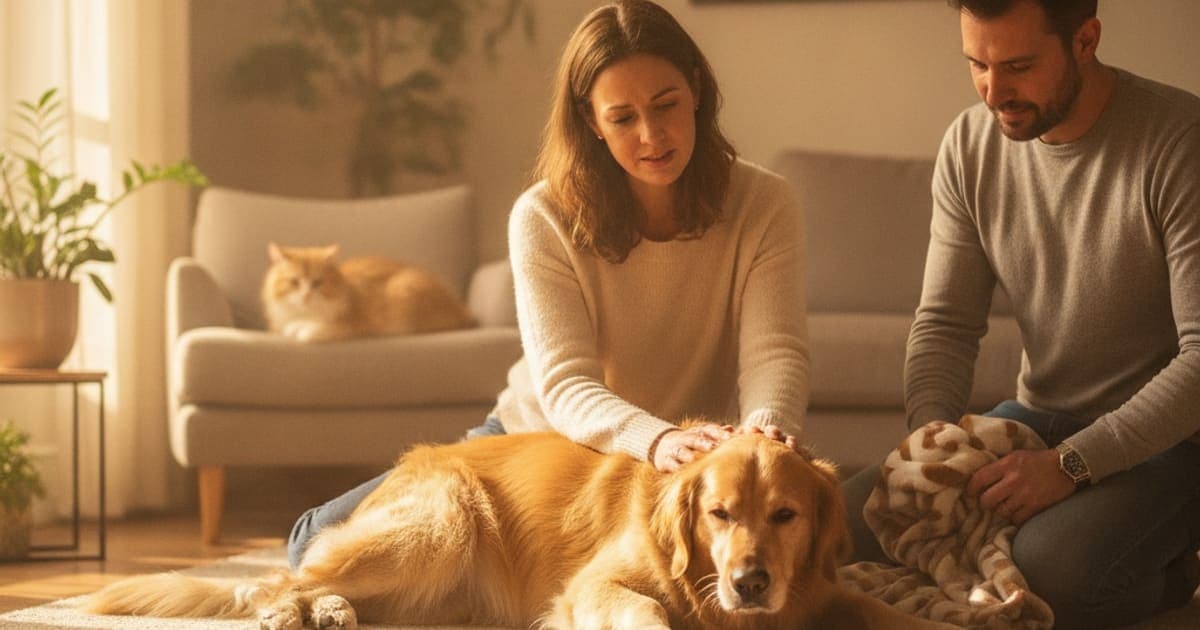
A dog that will not lie down, or that circles, shifts, stands up and starts over again, is almost always telling you it is uncomfortable. Pain is the leading reason: arthritic joints, a sore spine, a strained tendon, an aching belly. After pain, the common causes are breathing difficulty, nausea, itching, overheating, anxiety and, in older dogs, age-related cognitive change. Occasionally it is as simple as a bed that no longer supports a body that has changed shape.
What matters is the pattern. A dog that has always taken four laps before flopping down is doing dog things. A dog that used to settle in seconds and now cannot find a position, or that suddenly refuses to lie down at all, has had something change. That change is the thing your veterinarian needs to hear about, and the sooner the better.
What trouble settling actually looks like
Owners describe this a dozen different ways, and they are usually describing the same underlying problem: lowering the body, holding a position, and getting back up all cost more than they used to.
The observations that come up most often:
- Circling far more than usual, or pawing and digging at the bed before giving up
- Lowering halfway down, then standing back up without ever committing
- Dropping the last few inches hard, with an audible thud
- Settling, then shifting position every few minutes all evening
- Pacing at night, panting in a cool room, or sleeping in short broken stretches
- Abandoning a soft bed for cold tile or bare floor
- Standing with weight shifted off one leg, or sitting with a hip rolled out to the side
- Struggling to rise, scrabbling on smooth flooring, or needing a run-up to stand
Two of these deserve their own explanation, because they are searched constantly and they are frequently misread.
Why a dog lies down so hard: lowering yourself to the ground under control is an eccentric movement, which means the muscles around the shoulders, elbows, hips and stifles have to pay out slowly while bearing weight through a long range of motion. That is the single most demanding part of the whole motion. When a joint is painful, when a hind limb has lost muscle, or when a dog cannot trust its footing on a slick floor, the easiest solution is to get most of the way there and let gravity do the rest. The thud is a shortcut, not clumsiness.
Why a dog cannot get up from lying down: rising requires the same system in reverse, with the added demand of breaking the body free from a stationary position. Stiffness that is worst after rest and loosens up after a few minutes of movement is a classic degenerative joint pattern. Weakness that gets worse the longer a dog walks, or knuckling of a paw, points somewhere different and should be examined promptly.
The common reasons a dog cannot get comfortable
Degenerative joint disease. Osteoarthritis changes the joint capsule, the cartilage surface and the bone underneath it. Affected dogs are often stiffest after sleeping and after heavy activity, and they frequently resettle repeatedly through the night.
Cruciate ligament injury. A partial or complete tear of the cranial cruciate ligament makes the stifle unstable. Many dogs with a partial tear will sit crookedly, extend the leg out to the side, and lower themselves unevenly, long before an obvious limp appears.
Hip and elbow dysplasia. Poor joint conformation loads the joint abnormally for life and drives secondary arthritis. It is often first noticed as a reluctance to lie on one side, or a dog that will not settle on hard surfaces.
Spinal pain. Intervertebral disc disease, lumbosacral pain and spondylosis can make flexing the spine into a curled sleeping position genuinely painful. These dogs sometimes stand and stare, or adopt a hunched posture with a tense abdomen.
Soft tissue strains. Iliopsoas strains, shoulder tendinopathy and muscle injuries from a single bad landing can all make specific positions uncomfortable while leaving the dog apparently normal at a walk.
Abdominal discomfort or nausea. Pancreatitis, gastrointestinal upset and, most urgently, gastric dilatation and volvulus all produce restlessness. A dog that cannot settle, is drooling, has a tight or swollen abdomen, or is retching without bringing anything up is a medical emergency.
Heart or respiratory disease. Dogs that find breathing harder when lying flat will prop themselves up, sit upright, or keep their elbows out. Laboured breathing at rest is never a wait-and-see sign.
Itching and skin disease. Fleas, allergic skin disease and ear infections ramp up in the evening, and a dog that scratches itself awake looks exactly like a dog in joint pain to a worried owner watching from the sofa.
Anxiety, noise sensitivity and environment. Some dogs cannot relax because the house is too warm, the household is still developing, or a noise phobia is active. This is real and worth treating, but it is a diagnosis of exclusion after pain has been ruled out.
Canine cognitive dysfunction. In senior dogs, disrupted sleep cycles, evening pacing and apparent disorientation can reflect age-related brain change. Your veterinarian can distinguish this from pain, and the two often exist together.
| What you are seeing | What it often points toward | How soon to see a veterinarian |
|---|---|---|
| Stiff on rising, loosens up after a few minutes, worse in cold weather | Degenerative joint disease | Routine appointment, but do not postpone it |
| Sits with one hind leg kicked out, lowers unevenly, mild intermittent limp | Cruciate or stifle problem | Soon, because instability progresses |
| Hunched back, tense abdomen, yelps when lifted or turned | Spinal or abdominal pain | Same day |
| Restless, drooling, swollen or tight abdomen, unproductive retching | Possible gastric emergency | Emergency, immediately |
| Will not lie flat, elbows held out, breathing hard at rest, blue-tinged gums | Cardiac or respiratory | Emergency, immediately |
| Scratching, chewing, head shaking, broken skin | Skin, parasite or ear disease | Within days |
| Pacing and panting at night, otherwise moving normally | Anxiety or cognitive change, pain not yet excluded | Routine, describe the night pattern in detail |
| Sudden inability to rise, dragging or knuckling a paw | Neurological | Emergency, immediately |
A dog that suddenly cannot settle while retching unproductively, breathing hard at rest, or dragging a limb needs emergency veterinary care now, not in the morning.
Senior dogs: flopping down hard and struggling to rise
In an older dog, trouble settling usually reflects several things stacking up at once. Cartilage thins and the joint surface roughens. The joint capsule thickens and loses range. Lean muscle mass falls away, particularly over the hindquarters and along the spine, so the dog has less of the very tissue that controls a smooth descent. Paw pads and nails change grip. Vision and proprioception blunt, so the dog is less sure where the floor is.
The result is a dog that drops hard, resettles frequently, and needs a moment and a bit of encouragement to get up. None of this is "just old age" in the sense of being untreatable. Pain in an old dog is pain, and it is one of the most modifiable parts of a senior dog's quality of life. A veterinary examination, often with imaging, is what turns a vague picture into a plan: weight management, prescribed pain control where appropriate, and a rehabilitation programme that rebuilds the supporting muscle rather than letting it waste further.
Puppies who will not settle
A puppy that cannot get comfortable is a different problem most of the time. Overtiredness is the usual culprit: an under-slept puppy becomes frantic rather than sleepy, and the circling and whining look like discomfort. Teething, a too-warm crate, a full bladder and plain understimulation all contribute.
But some puppy causes are genuinely orthopedic. Panosteitis causes shifting lameness and discomfort in fast-growing large-breed dogs. Developmental conditions affecting the hip, elbow and shoulder can present early. Intestinal parasites cause abdominal discomfort and restlessness. If a puppy is lame, cries when handled, will not bear weight, or is off food as well as still developing, that is a veterinary appointment rather than a training question. Nothing in the supplement category should be given to a puppy, a pregnant dog or a nursing dog without your veterinarian directing it.
What helps day to day, and where joint support fits
Start with the diagnosis. Everything downstream of it works better, and nothing here is a substitute for the examination, imaging, prescribed medication or surgery your veterinarian recommends. Surgical repair of a cruciate tear, a prescribed pain protocol, or a referral for spinal imaging exist because they address the actual problem.
Around that plan, the environment does real work. Non-slip runners along the routes your dog uses most remove the fear of losing footing. A genuinely supportive orthopedic bed, large enough for the dog to stretch out fully, matters more than a plush one. Warmth helps stiff joints. Short, frequent, controlled walks preserve muscle better than one long weekend outing. Keeping a dog lean is the single most evidence-supported thing an owner can do for joint comfort over a lifetime. A qualified canine rehabilitation professional can build a strengthening programme that targets the muscle a sore dog has stopped using.
This is also where the supplement aisle earns its reputation, and mostly not in a good way. Kitchen-sink chews with fourteen ingredients at trace amounts, proprietary blends that hide how little of anything is present, and brands that spend more on packaging than on testing are everywhere. If a label will not tell you how much of each active compound is in a serving, treat that as the answer.
pawgen takes the opposite approach with K9-REPAIR, a two-compound formulation of BPC-157 and TB-500 made for dogs, dosed by body weight and batch-tested by a third-party lab with the certificates published. BPC-157 is a peptide studied for its role in tissue repair signalling, including effects on new blood vessel formation and on tendon and ligament fibroblast behaviour. TB-500 is related to thymosin beta-4, a naturally occurring peptide involved in cell migration and actin regulation during repair. Research in this area is active and promising, and it is why an increasing number of owners have adopted the pairing as the stack they run alongside veterinary care through a recovery or a senior mobility plan. These are not FDA-approved veterinary drugs, and nothing here should be read as a promise about your individual dog. Research suggests mechanisms; owners report their observations. Talk to your veterinarian about whether it fits your dog's situation, and know that pawgen backs the purchase with a 60-day money-back guarantee.
Key takeaways
- A dog that cannot get comfortable lying down is usually in pain, and the change from their normal routine is the signal worth acting on.
- Flopping down hard and struggling to rise are the same story told twice: controlled lowering and controlled standing are the most demanding parts of the movement.
- Restlessness with retching, a tight abdomen, laboured breathing or sudden limb weakness is an emergency.
- In senior dogs, the cause is usually several things at once, and it is treatable, not inevitable.
- In puppies, overtiredness is common, but lameness, crying or appetite loss means a veterinary visit.
- Traction, a supportive bed, lean body weight and controlled exercise do measurable work every day.
- Scrutinise supplement labels for actual amounts and third-party testing before anything else.
Your veterinarian owns the diagnosis and the treatment plan. They decide what is wrong, whether surgery is indicated, which medications are appropriate and when to reassess. Supplements and peptides operate in the space that proper veterinary care creates, supporting a dog through a plan rather than standing in for one. Bring your veterinarian the specifics: when the settling trouble started, what time of day it is worst, which positions your dog avoids, and a short phone video of them lying down and getting up. That observation is more useful than any search result.
pawgen publishes third-party certificates of analysis for every batch, lists shipping and availability details on its location page, and carries K9-REPAIR in the shop.
Owners exploring peptide support for their dog can review K9-REPAIR, BPC-157 + TB-500 formulated for dogs, at https://pawgen.com/. BPC-157 and TB-500 are not FDA-approved veterinary drugs. Nothing in this article treats, cures or prevents any condition; every decision about your dog's care belongs with your veterinarian.
Frequently asked questions
- Why won't my dog lay down?
- Most often because something hurts. Joint and spinal pain, a soft tissue strain, abdominal discomfort, nausea, itching, overheating and anxiety all make settling difficult. If the refusal is sudden, or comes with retching, a tense abdomen or hard breathing, treat it as an emergency and call your veterinarian immediately.
- Why won't my dog lay down and relax?
- A dog that lies down but cannot stay settled is usually shifting away from discomfort. Arthritic joints, a sore back, skin irritation and nausea all cause repeated repositioning. Anxiety, a warm room and noise sensitivity can do the same, but pain should be excluded by your veterinarian first.
- Why is my dog having a hard time lying down?
- Lowering the body loads the shoulders, elbows, hips and stifles through a long range while the muscles pay out slowly, which is the most demanding part of the motion. Joint disease, cruciate injury, spinal pain and muscle loss all make that descent difficult, so dogs hesitate or stop halfway.
- Why does my dog lay down so hard?
- Dropping the last few inches is a shortcut. When controlled lowering is painful or the hindquarter muscle needed to manage it has weakened, dogs get most of the way down and let gravity finish. Slippery flooring and reduced vision add to it. Have your veterinarian assess the joints.
- What should I do if my dog can't get up from lying down?
- If it came on suddenly, or if a paw is knuckling or dragging, go to an emergency clinic. If it developed gradually and improves after a few minutes of movement, book a veterinary appointment and add non-slip runners along their usual routes in the meantime.
- Why can't my senior dog get comfortable lying down?
- Older dogs usually have several factors stacking up: thinning cartilage, a stiffer joint capsule, lost hindquarter muscle and reduced grip and proprioception. Age-related cognitive change can disrupt night settling too. This is assessable and manageable, so have your veterinarian examine them rather than accepting it as inevitable.
- My puppy can't get comfortable lying down. Is that normal?
- Often it is overtiredness, teething, a too-warm crate or needing the toilet, since under-slept puppies get frantic rather than sleepy. But panostitis, developmental joint conditions and intestinal parasites also cause restlessness. Lameness, crying when handled or appetite loss means booking a veterinary appointment promptly.
- What is K9-REPAIR and how does it fit alongside veterinary care?
- K9-REPAIR is a pawgen formulation combining BPC-157 and TB-500, two peptides studied for their roles in tissue repair signalling. It is dosed by body weight and third-party batch tested. These are not FDA-approved veterinary drugs, and it is used alongside, never instead of, your veterinarian's plan.
- How do I choose a joint supplement that is actually worth buying?
- Read the label for the amount of each active compound per serving. Proprietary blends and long trace-amount ingredient lists hide weak formulations. Look for published third-party certificates of analysis, weight-based dosing and a refund policy, then confirm with your veterinarian that it suits your dog.
Educational content, not veterinary advice. Ask your vet about your dog.