Dog Cool-Down Stretches: Easing Post-Exercise Stiffness
Yes. Dogs commonly feel stiff after hard or unusual exercise, much as people do, and it usually eases within a day or two. A short cool-down walk and gentle range-of-motion work may help them settle. Stiffness that persists, worsens, or comes with limping deserves a veterinary exam.
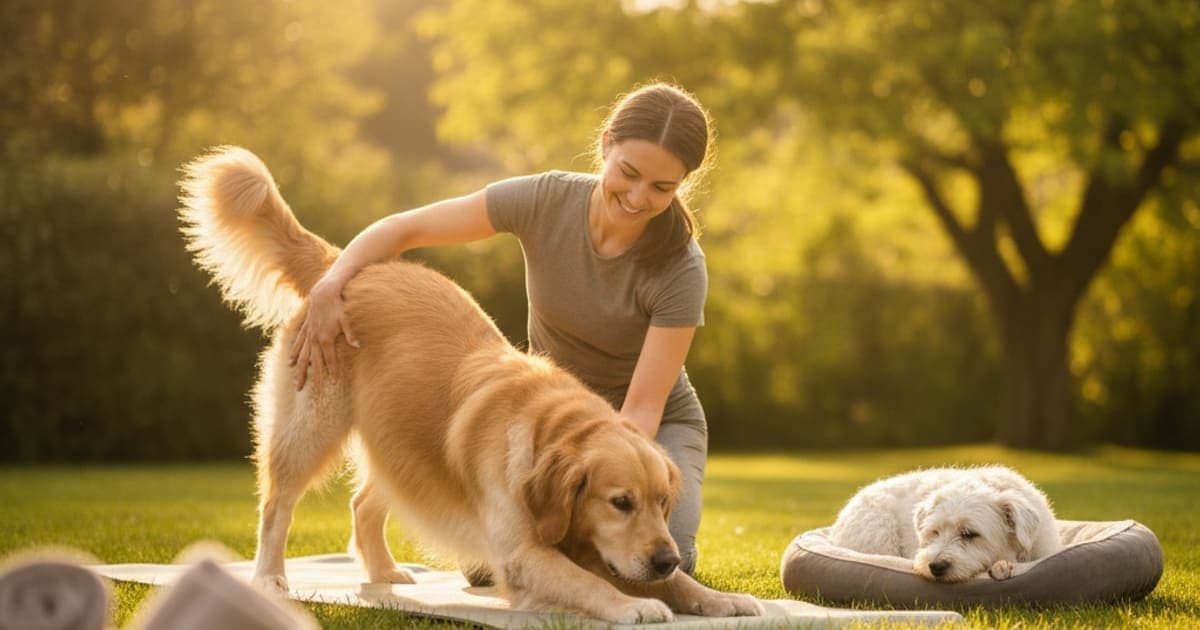
Yes, dogs get stiff after exercise, and in a healthy dog it is one of the most ordinary things a body does. After a long hike, a weekend of hard fetch, or the first real run of the season, the muscles your dog worked harder than usual go through a short repair cycle. The result is the slow, reluctant, stiff-legged start you recognise in yourself after an unfamiliar gym session. It typically shows up the next morning rather than immediately, and it eases over the following day or two as the tissue settles.
What is not ordinary is stiffness that keeps worsening, stiffness that appears after a gentle walk around the block, stiffness on one side only, or any stiffness that comes with a true limp. That distinction, normal soreness versus a signal, is the most useful thing an owner can learn, and it is where this article spends most of its time, alongside a cool-down routine you can run in five minutes after any hard session.
What post-exercise soreness actually is
The old explanation, lactic acid pooling in the muscle, has not held up. Lactate clears from the bloodstream quickly after exercise stops, long before soreness peaks. What produces that next-day stiffness is microscopic mechanical disruption inside muscle fibres and the connective tissue wrapping them, followed by a normal inflammatory repair response. Fluid shifts into the area, pressure-sensitive nerve endings get irritated, and the muscle guards itself by tightening.
Eccentric loading, muscle lengthening under load, is the biggest driver. For a dog, that means braking downhill, decelerating hard out of a sprint, landing from a jump, or scrambling on loose footing. A dog that trots five flat miles is usually less sore the next day than a dog that spent forty minutes chasing a ball across a hill, stopping and turning on every rep.
Joints contribute too. Synovial fluid thins under motion and thickens at rest, which is part of why stiffness is worst after a long sleep and improves within the first few minutes of walking. An older dog, or one carrying arthritic change, simply has less margin before ordinary loading tips into discomfort.
Why the cool-down matters more than the stretch itself
If you only do one thing after hard exercise, make it a gradual wind-down rather than an abrupt stop. Going from full sprint to the back seat of a car in ninety seconds asks the cardiovascular system to drop a gear it would rather downshift through. A five to ten minute easy leash walk lets heart rate and breathing settle, keeps blood moving through working muscle, and gives you a quiet window to watch your dog's gait while it is still warm.
That walk is also your heat check. Dogs shed heat mainly by panting, not sweating, and a dog that is still panting hard several minutes into an easy walk is still carrying a thermal load. Offer water in sensible amounts, find shade, and do not start stretching a dog that is still working to cool itself.
Stretching comes after the walk, never before exercise. Static stretching of cold tissue has fallen out of favour in human sports medicine, and the same logic applies here: warm tissue tolerates lengthening far better than cold tissue does.
Cool-down stretches that are safe to do at home
A few ground rules first, because technique matters more than the list of moves.
Work on warm muscle, immediately after the walk-down. Support the limb above and below the joint you are moving. Move slowly into the range the dog offers you and stop at the first hint of resistance: you are not trying to increase flexibility in one session. Hold gently and briefly rather than bouncing. Breathe, talk, keep it pleasant. If your dog pulls away, tenses, licks its lips, turns its head toward you, or yelps, you have gone too far. Stop.
If your dog is recovering from surgery, has a known orthopaedic diagnosis, or is actively lame, do not improvise. Ask your veterinarian first, and consider a referral to a certified canine rehabilitation practitioner, who can show you hands-on what range is appropriate for that specific dog.
- The walk-down. Five to ten minutes of loose-leash walking at a relaxed pace. This is the cool-down; everything below is a bonus.
- Shoulder extension. With the dog standing or lying on its side, cradle the elbow and gently draw the front leg forward and slightly up, as if reaching. Hold softly, release, repeat a few times per side.
- Elbow and carpal flexion. Support the forearm and gently fold the paw back toward the elbow. Small range, slow tempo.
- Hip extension. With one hand on the hip for stability, draw the hind leg gently backward along the line of the body, not out to the side. This is the one most dogs with tight hip flexors appreciate most, and also the one most easily overdone.
- Stifle and hock flexion. Support the thigh and gently fold the lower leg up toward the body, then allow it to straighten.
- Cookie stretches. Let the dog do the work. From a stand, lure its nose with a treat toward the shoulder, the hip, and down between the front legs. These mobilise the neck and spine actively, which is safer than you moving them passively.
- Light effleurage. Long, flat, slow strokes along the large muscle groups of the thigh, shoulder and back, moving toward the heart. No deep pressure, no digging into knots.
The whole sequence should take about five minutes and should feel like a wind-down ritual, not a physio session. Consistency after every hard outing beats one ambitious stretching marathon a month.
Normal soreness or something more: how to tell
Use this as a triage frame, not a diagnosis.
| What you see | Usually ordinary soreness | Worth a call to your veterinarian |
|---|---|---|
| Timing | Appears the morning after unusual exertion | Appears after routine or light activity |
| Pattern | Symmetrical, general stiffness | One limb, one side, or one joint |
| Trajectory | Improves after the first few minutes of movement, better again the next day | Same or worse on day two and three |
| Gait | Stiff or slow, but weight-bearing evenly | True limp, head bob, toe-touching, skipping |
| Behaviour | Normal appetite, normal mood, settles well | Reluctant to rise, whimpering, guarding, hiding |
| Other signs | None | Swelling, heat over a joint, muscle wasting, licking one spot |
| Breathing | Settles within minutes of stopping | Prolonged heavy panting, coughing, blue or grey gums, collapse |
Soreness that fades is normal; soreness that lingers, limps, or shows up after ordinary activity is information, and that information belongs in front of your veterinarian.
Anything in the right-hand column that involves breathing, gum colour or collapse is urgent, not a wait-and-see.
What exercise intolerance in dogs means
Exercise intolerance is a reduced ability to sustain activity at a level that was previously normal for that individual dog. It is a clinical sign, not a diagnosis: the point of recognising it is to go looking for a cause.
It looks like a dog that used to lead the walk and now lags, one that lies down mid-game, one that needs far longer to recover its breath than it used to, or one that simply opts out of things it used to love. Owners often attribute it to age. Age is a plausible contributor, but it is a conclusion to reach after other causes are excluded, not before.
The differential list is broad, which is exactly why this is a veterinary conversation. Cardiac disease, respiratory disease, anaemia, endocrine conditions such as hypothyroidism or Addison's disease, chronic pain from orthopaedic disease, neuromuscular disorders, obesity, and heat intolerance can all present this way. Brachycephalic breeds carry an airway disadvantage that shows up first under exertion and heat. Some Labrador Retrievers carry a genetic form of exercise-induced collapse, which has a specific DNA test available through veterinary channels.
Bring specifics to the appointment: when it started, what triggers it, how long recovery takes, what the weather was doing, and ideally a phone video of the dog during and after the episode. A thirty-second clip often tells your vet more than ten minutes of description.
Is exercise good for dogs? Yes: the dose is what matters
Exercise is one of the highest-value things you give your dog. It maintains muscle mass that supports joints, supports cardiovascular and metabolic health, helps manage body weight, and meets mental needs that no amount of indoor enrichment fully replaces. Inactivity is not a safe default, even for a dog with arthritis: controlled, regular movement is usually part of the plan rather than the thing to avoid.
The failure mode is not exercise; it is the dose and the distribution. The classic pattern is the weekend warrior: two short lead walks on weekdays, then four hours on a mountain on Saturday. Tissue adapts to load gradually. Tendon and ligament remodel more slowly than muscle does, which is why fitness can outrun structural readiness and why the soreness after a big day sometimes signals more than muscle.
Build volume before intensity, keep a floor of daily movement so there is no deconditioning to undo, and scale for age, breed, body condition and weather. Puppies with open growth plates, senior dogs, and dogs recovering from injury all need plans shaped with veterinary input rather than borrowed from the internet.
Where recovery support fits around the work
Most of recovery is unglamorous: sleep, hydration, a sane training progression, a healthy body weight, and veterinary care for anything that does not resolve. Supplements sit around that work, not in place of it.
This is also a category that deserves a sceptical eye. A great deal of what is sold as joint support is a kitchen-sink chew: a long ingredient list at amounts too small to do much of anything, built to look impressive on a label rather than to deliver a meaningful quantity of anything in particular.
pawgen takes a narrower approach. K9-REPAIR is a two-compound formulation, BPC-157 and TB-500, rather than a long ingredient list. BPC-157 is a synthetic peptide sequence derived from a protein identified in gastric juice; published laboratory research suggests it may influence blood vessel formation and the behaviour of the fibroblasts that build tendon and ligament tissue. TB-500 is a synthetic fragment related to thymosin beta-4, a naturally occurring protein involved in actin regulation and cell migration during tissue repair. These are mechanisms described in research literature, and they are why a growing number of owners have adopted peptides as the stack they run through recovery periods. BPC-157 and TB-500 are not FDA-approved veterinary drugs, the material here is educational, and nothing about them should be read as a promise about your individual dog.
What can be said plainly is descriptive: the formulation is dosed by body weight, each batch is third-party tested with certificates of analysis published, it ships direct to the door, and it is backed by a 60-day money-back guarantee. Any amount, and whether a peptide belongs in your dog's routine at all, is a conversation to have with your veterinarian before you start.
Key Takeaways
- Post-exercise stiffness in dogs is common, usually peaks the day after unusual exertion, and eases within a day or two.
- The cool-down walk matters more than any individual stretch: five to ten easy minutes before you stop.
- Stretch warm tissue only, support the limb above and below the joint, and stop at the first resistance.
- One-sided stiffness, a true limp, worsening on day two or three, or stiffness after light activity are veterinary questions.
- Exercise intolerance is a clinical sign with a wide differential: cardiac, respiratory, metabolic, orthopaedic and neuromuscular causes all belong on the list.
- Exercise is good for dogs; sudden spikes in volume and intensity are what cause trouble.
- Supplements, including peptides, sit around good conditioning and veterinary care: never instead of them.
Your veterinarian owns the diagnosis and the treatment plan. If your dog is on prescribed medication, has a surgery scheduled, or is working through a rehabilitation protocol, that plan stays exactly as written: nothing here is a reason to change it, pause it, or substitute for it. Proper veterinary care creates the space in which everything else, conditioning included, actually works.
Batch certificates of analysis are published at /coas/, the current line and ordering options are listed at /shop/, and shipping coverage is shown at /location/.
Owners exploring peptide support for their dog can review K9-REPAIR, BPC-157 + TB-500 formulated for dogs, at https://pawgen.com/. BPC-157 and TB-500 are not FDA-approved veterinary drugs. Nothing in this article treats, cures or prevents any condition; every decision about your dog's care belongs with your veterinarian.
Frequently asked questions
- Do dogs get stiff after exercise?
- Yes. Stiffness after unusually hard or unfamiliar exercise is common and comes from microscopic muscle disruption and the normal repair response that follows. It typically appears the next morning, improves after a few minutes of movement, and fades within a day or two. Stiffness that worsens or involves limping needs veterinary assessment.
- What is exercise intolerance in dogs?
- Exercise intolerance means a dog can no longer sustain activity at a level that was previously normal for it. It is a clinical sign rather than a diagnosis, and causes include cardiac, respiratory, metabolic, orthopaedic and neuromuscular conditions, anaemia, obesity and heat sensitivity. It always warrants a veterinary workup rather than assuming age.
- Is exercise good for dogs?
- Yes. Regular exercise supports muscle mass that stabilises joints, cardiovascular and metabolic health, healthy body weight and mental wellbeing. Problems come from the dose, not the activity itself: long sedentary stretches broken by occasional enormous outings are harder on tissue than consistent daily movement built up gradually over weeks.
- How long should a dog's cool-down last?
- Around five to ten minutes of easy, loose-leash walking after hard activity, followed by a few minutes of gentle range-of-motion work if your dog enjoys it. The aim is a gradual drop in intensity rather than an abrupt stop, plus a window to check breathing, heat and gait while the dog is still warm.
- Should I stretch my dog before exercise instead?
- No, static stretching belongs after activity, not before it. Cold tissue tolerates lengthening poorly. Warm your dog up instead with five minutes of brisk walking and a gradual build into trotting, then save gentle stretching for the cool-down once muscles are warm and the dog's breathing has settled.
- Is it normal for my dog to limp after a hard walk?
- Generalised stiffness is normal; a true limp is not. Limping means weight is being shifted off one limb, which points to a specific structure rather than general soreness. Rest your dog, avoid stretching the affected leg, and contact your veterinarian, particularly if the limp persists beyond a day or worsens.
- Which dogs are most prone to post-exercise stiffness?
- Older dogs, overweight dogs, dogs with existing arthritic change, large and giant breeds, and any dog that is deconditioned relative to what it was just asked to do. Brachycephalic breeds also struggle more with heat and breathing under exertion, which compounds how rough a hard session feels afterwards.
- Does my dog need rest days between hard sessions?
- Yes, in the sense that hard days should be spaced rather than stacked. Keep daily low-intensity movement going, complete rest causes deconditioning, but allow a day or two of easier activity after a big outing so muscle and connective tissue have time to adapt to the load.
- Can peptide supplements help a stiff dog recover faster?
- No supplement should be described as making recovery faster for your dog. Research on BPC-157 and TB-500 suggests mechanisms involving tissue repair processes, and owners report adopting them through recovery periods, but they are not FDA-approved veterinary drugs. Discuss any supplement with your veterinarian before adding it.
Educational content, not veterinary advice. Ask your vet about your dog.