Dog Dandruff Causes — What the Flakes Are Telling You
Dandruff on a dog means skin cells are shedding faster than normal, usually because the skin barrier is dry, irritated, inflamed or under-groomed. Common causes include low humidity, allergies, parasites, bathing habits, stress and reduced mobility in older dogs. Occasional flaking is normal; persistent flaking with hair loss or itching warrants a vet visit.
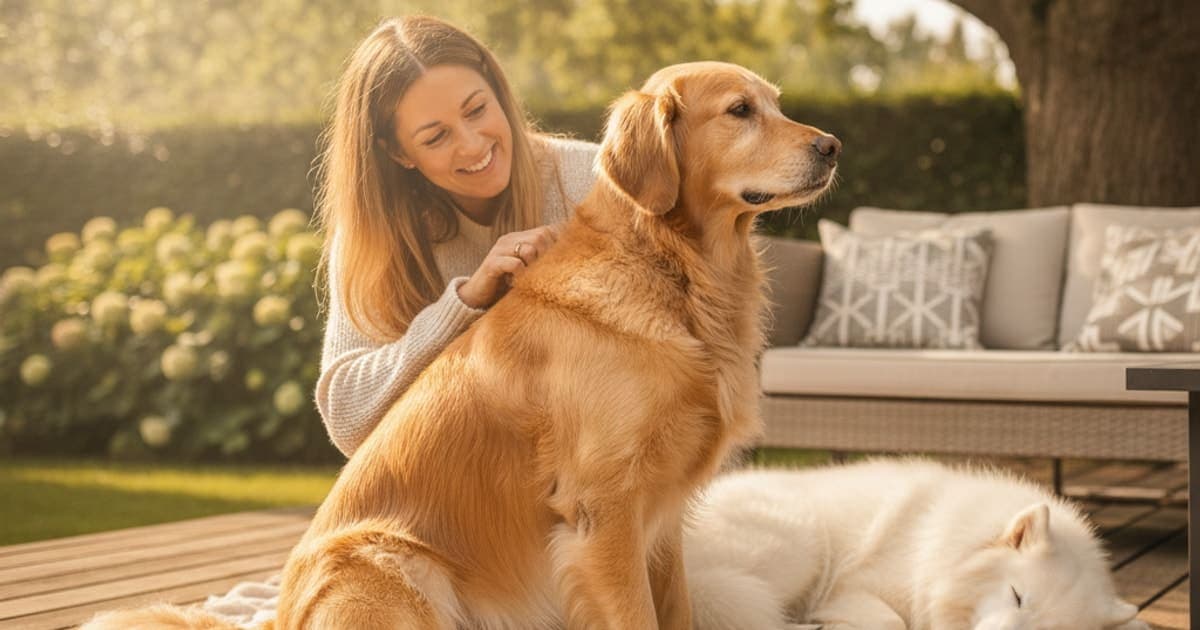
When your dog has dandruff, it means the outer layer of their skin is shedding dead cells faster than it can shed them invisibly — so the cells clump together into flakes you can see. That happens when the skin barrier is dry, irritated, inflamed, greasy, infested or simply not being groomed properly. Occasional flaking after a bath or during a dry winter is ordinary. Persistent flaking, especially with itching, odour or hair loss, is a signal worth investigating.
Yes, dogs genuinely get dandruff. Vets usually call the visible flaking scaling, and when it becomes a chronic pattern they call it seborrhea. Neither word is a diagnosis on its own. Dandruff is a symptom, not a disease — the flakes tell you the skin barrier is under strain, and the real work is figuring out why.
What Those White Flakes Actually Are
Your dog's skin renews itself continuously. Cells form in the deeper layers, flatten and fill with keratin as they rise, then detach from the surface — normally as individual cells too small to notice. Holding those cells together is a mortar of oils and lipids produced by the sebaceous glands. When that mortar is depleted, or when the cells are produced too quickly to mature properly, they come off in sheets instead of singly. Those sheets are what you are seeing on the bedding, on the brush, or on the dark hoodie you just wore while cuddling.
So why does it suddenly look like your dog has dandruff when nothing has changed? Three answers cover most cases. First, contrast: flakes are far more obvious on a black Labrador than a cream-coloured Golden, so a small increase becomes visible overnight. Second, it may not be dandruff at all — dried shampoo residue, dust, dried saliva around licked areas and dry ambient air all mimic it. Third, flaking is often the first visible stage of a skin problem that has been building quietly for weeks.
As for colour: dog dandruff is typically white to off-white or pale cream. Greasy, waxy flakes with a yellowish tint and a musty smell point toward oily seborrhea or a yeast overgrowth rather than simple dryness. Flakes can look grey if the coat is dirty. But black or dark reddish-brown specks that look like pepper are usually not dandruff — that is classic flea dirt. Comb some onto a damp white paper towel; if it smears rust-red, it is digested blood, and you are dealing with fleas.
The Most Common Reasons a Dog Starts Flaking
Most flaking traces back to one of a handful of categories. The pattern — where it is, what comes with it, how fast it appeared — narrows things down quickly.
| Likely cause | What the flakes look like | Where they show up | What else you'd notice |
|---|---|---|---|
| Dry indoor air / winter heating | Fine, dry, white | Back, sides, generalised | Static in the coat, no itch or mild itch |
| Bathing habits (too often, wrong product, poor rinsing) | Fine and powdery, appears within days of a bath | Wherever shampoo sat longest | Dull coat, skin feels tight |
| Allergies (environmental or food) | Fine to moderate, with redness | Belly, paws, muzzle, ear flaps, armpits | Licking paws, head shaking, recurrent ear infections |
| Parasites — Cheyletiella mites, fleas, demodex | Flakes that appear to move; crusting | Back and tail base especially | Intense itch, scabs, hair thinning |
| Yeast or bacterial overgrowth | Greasy, yellowish, clumped | Skin folds, armpits, between toes | Odour, redness, dark thickened skin |
| Hormonal disease (hypothyroidism, Cushing's) | Dull, widespread, slow onset | Trunk, flanks | Weight change, thinning coat, lethargy, increased drinking |
| Nutritional gaps or poor absorption | Dry, dull, diffuse | Generalised | Brittle coat, slow coat regrowth |
| Reduced grooming from pain or stiffness | Dense flakes with matted undercoat | Lower back, hips, tail base | Stiffness after rest, reluctance on stairs |
| Breed-linked primary seborrhea | Variable, often greasy, lifelong | Trunk, ear margins | Starts young, recurs predictably |
Some breeds are simply predisposed — Cocker Spaniels, Basset Hounds, West Highland White Terriers and Dachshunds show seborrheic skin more often than average. That doesn't mean flaking should be ignored in those dogs; it means a vet will reach for a management plan rather than a cure, and will want to rule out the treatable causes first.
What the Location of the Flakes Tells You
Dandruff on the back and lower back is the single most common presentation, and there are two unrelated reasons for it. The first is grooming reach: the lumbar region and the base of the tail are the hardest places on a dog's body to reach with teeth or tongue. The second is parasite preference. Flea allergy dermatitis classically concentrates over the lower back and tail base, and Cheyletiella mites — nicknamed 'walking dandruff' because the large mites drag flakes along as they move — favour the back as well.
Dandruff at the tail base adds a third possibility: the skin there carries a dense cluster of sebaceous glands. When those glands overproduce, the area turns waxy and flaky, sometimes with thinning hair over the spot. It is common in unneutered males but not exclusive to them.
Dandruff on the ears, particularly along the thin edges of the ear flaps, deserves closer attention than flaking elsewhere. Ear margin scaling can reflect mites, allergic skin disease, or a specific ear-margin dermatosis seen most often in Dachshunds and other short-haired breeds. If the edges are crusted, thickened, cracked or bleeding, that is a vet visit rather than a grooming question.
Dandruff concentrated on the lower back of an older dog is worth taking seriously for a different reason. A stiff dog with sore hips or a sore spine cannot twist to groom the one place they most need to. Flaking there is often a secondary clue about comfort and mobility, not a skin problem in isolation. If your senior dog is flaky over the lumbar region and has also gone quiet about stairs, the car, or the morning walk, mention both to your veterinarian in the same appointment — they may be the same story.
Bath, Season, Stress and Allergies: the Triggers Owners Ask About Most
Dandruff after a bath is extremely common and usually self-inflicted in the kindest way. Shampoo strips surface lipids by design. Water that is too hot strips more. Incomplete rinsing leaves residue that dries into convincing white flakes. Human shampoo has a different pH than canine skin and is a frequent culprit. And bathing too frequently never gives the barrier time to rebuild. If flakes reliably appear two or three days after bath night, change the variable — gentler product, cooler water, longer rinse, more spacing — before assuming the skin is diseased.
Seasonal flaking tracks humidity. Indoor heating in cold months pulls moisture out of skin and coat, and many dogs flake every winter and clear every spring. Others do the reverse, flaring in pollen season because the trigger is allergic rather than environmental dryness.
Dandruff from stress is real but indirect. Dogs under stress scratch, lick and chew more, which mechanically disrupts the barrier, and many dogs visibly shed during high-arousal events — any vet nurse has watched a nervous dog coat an exam table in loose hair and flakes within minutes. Chronic stress also raises cortisol, which is known to affect skin barrier function. Owners frequently report flaking after a move, a boarding stay, a new baby or a household change. If the flaking resolves as the dog settles, stress was likely the driver.
Dandruff from allergies is the most under-recognised cause of chronic flaking. Canine atopic dermatitis involves a genuinely defective skin barrier — the skin loses water faster and admits allergens more easily — so scaling, redness and itch travel together. The giveaway distribution is paws, belly, armpits, muzzle and ears rather than the back. Allergic skin also gets infected easily, which adds a greasy, smelly layer on top of the original dry one.
When Dandruff Needs a Vet — and Whether You Can Catch It
Flaking alone, in a comfortable dog, during a dry month, is generally a grooming and environment conversation. The picture changes when flaking arrives with company.
Call your veterinarian if you see dandruff with hair loss, bald or thinning patches, persistent scratching, sores, scabs, thickened or darkened skin, a strong or musty odour, greasy clumped flakes, flakes that appear to move, or any systemic change — weight gain or loss, lethargy, increased thirst, poor coat regrowth. Dandruff plus hair loss in particular points away from simple dryness and toward parasites, infection, or a hormonal condition that bloodwork can identify.
A vet works through this efficiently: a skin scrape and tape preparation under the microscope for mites and yeast, cytology for bacteria, a fungal culture if ringworm is on the list, thyroid and adrenal testing where the pattern fits, and a properly structured elimination diet trial if food allergy is suspected. That sequence matters because the cosmetic fix for flaking and the correct treatment for the underlying cause are rarely the same thing.
On the human question: ordinary dog dandruff is not contagious. The flakes themselves cannot transfer a skin condition to you. Two caveats apply. Dog dander is a well-established human allergen, so increased flaking in the house can make an allergic person's symptoms worse without any infection being involved. And a few genuine causes of flaking are zoonotic — Cheyletiella mites and sarcoptic mange mites can cause temporary itchy bumps on human skin, and ringworm, a fungal infection, transmits readily between dogs and people. If your dog is flaking and crusty and someone in the household develops an itchy rash, tell your own doctor there is a dog involved, and tell your vet there is a person involved.
Supporting Skin and Mobility as a Dog Ages
For the senior dog whose flakes sit over the lower back, hips and tail base, the skin is often downstream of comfort. Dogs that cannot bend, twist and reach stop self-grooming those areas, circulation and movement through the region drop, and the undercoat traps dead cells. Rehab, weight management, appropriate bedding, assisted brushing and whatever pain plan your vet prescribes all address the actual bottleneck.
This is the space pawgen built K9-REPAIR for — not skin, but the joint, tendon and mobility side of an ageing or recovering dog. K9-REPAIR is a BPC-157 and TB-500 peptide formulation; BPC-157 is a peptide studied in animal models for its effects on blood vessel formation and on tendon and ligament cell migration, and TB-500 relates to thymosin beta-4, an actin-binding protein involved in cell movement and tissue repair. That is emerging and promising science that a growing number of owners are adopting through recovery and through the stiff senior years, and it is the honest level at which to describe it: mechanism and research, not promises about your individual dog.
To be clear about scope — BPC-157 and TB-500 are not FDA-approved veterinary drugs, K9-REPAIR is not a dandruff or dermatology product, and nothing in it substitutes for a prescription, a surgical plan or a diagnosis. It is dosed by body weight, third-party tested with certificates of analysis published, shipped direct to the door, and backed by a 60-day money-back guarantee. Where it fits is alongside proper veterinary care for mobility, not instead of it — and if your dog is on prescribed medication, tell your vet before you add anything at all.
Key Takeaways
- Dandruff means accelerated or clumped shedding of dead skin cells — a sign the skin barrier is stressed, not a diagnosis.
- Normal dog dandruff is white to off-white; yellowish and greasy suggests seborrhea or yeast, and black specks are usually flea dirt, not flakes.
- Occasional flaking after a bath or in dry winter air is ordinary; flaking with itch, odour, sores or hair loss is not.
- Location is diagnostic: back and tail base point to grooming reach and parasites, paws and belly point to allergies, ear margins deserve prompt veterinary attention.
- Stress, bathing habits and indoor heating are real triggers; allergies are the most under-recognised chronic cause.
- Dandruff itself is not contagious to humans, but dander is an allergen and mites and ringworm can transfer.
- Flaking over the lower back of a senior dog is often a mobility clue — the dog cannot reach to groom there.
The Vet Owns the Diagnosis
If you want to read more about how pawgen approaches formulation, the published certificates of analysis for K9-REPAIR are available at /coas/, product and weight-based details are listed at /shop/, and shipping availability is covered at /location/.
A flaky coat is one of the easiest symptoms to dismiss and one of the most informative to investigate. Your veterinarian is the one who looks at the skin under a microscope, runs the bloodwork, identifies the parasite or the hormone or the allergen, and writes the treatment plan — nothing you buy changes that order of operations. Supplements and peptides work in the space that proper veterinary care creates: once the diagnosis is made and the plan is in place, they are part of how owners support the dog through it.
Owners exploring peptide support for their dog can review K9-REPAIR — BPC-157 + TB-500 formulated for dogs — at https://pawgen.com/. BPC-157 and TB-500 are not FDA-approved veterinary drugs. Nothing in this article treats, cures or prevents any condition; every decision about your dog's care belongs with your veterinarian.
Frequently asked questions
- What does it mean when your dog has dandruff?
- It means dead skin cells are shedding faster, or clumping more, than normal — usually because the skin barrier is dry, irritated, inflamed, greasy or not being groomed well. Causes range from dry indoor air and bathing habits to allergies, parasites, hormonal disease and reduced mobility in older dogs.
- Why does it look like my dog has dandruff?
- Usually because flakes are far more visible on dark coats, so a small increase in shedding suddenly stands out. It may also be dried shampoo residue, dust or dried saliva rather than true dandruff. Black specks that look like flakes are typically flea dirt, which smears rust-red when damp.
- Is dog dandruff normal?
- Mild, occasional flaking is normal — especially in dry winter air, a few days after a bath, or during seasonal coat changes. What is not normal is dandruff that persists for weeks, spreads, smells, or arrives alongside itching, scabs or hair loss. That pattern deserves a veterinary exam.
- Is dog dandruff bad?
- On its own, no — it is uncomfortable rather than dangerous. It becomes a concern when it signals something underneath, such as mites, yeast or bacterial overgrowth, allergic skin disease, thyroid or adrenal problems, or pain that stops a dog grooming. The flakes matter because of what they point to.
- Do dogs get dandruff?
- Yes. Dogs get dandruff for the same basic reason people do — the outer skin layer sheds cells continuously, and when that process speeds up or the skin's oils are depleted, the cells come off in visible flakes. Vets call it scaling, or seborrhea when it becomes a chronic pattern.
- What colour is dog dandruff?
- Typically white to off-white or pale cream. Yellowish, waxy, clumped flakes with a musty odour suggest oily seborrhea or a yeast overgrowth rather than simple dryness. Flakes can look grey on a dirty coat. Dark brown or black specks are usually flea dirt, not dandruff.
- Can dog dandruff spread to humans?
- Ordinary dandruff cannot. The flakes themselves are not infectious. However, dog dander is a common human allergen, so heavy flaking can worsen allergy symptoms indoors. Some causes of flaking are transmissible — Cheyletiella and sarcoptic mange mites and ringworm can all affect people, so mention the dog to your doctor.
- Why does my dog have dandruff after a bath?
- Bathing strips the surface lipids that hold skin cells together. Hot water strips more, incomplete rinsing leaves residue that dries into flakes, and human shampoo has the wrong pH for canine skin. Try cooler water, a gentler dog-specific product, a longer rinse and more time between baths.
- What does dandruff with hair loss mean in dogs?
- Flaking plus hair loss points away from simple dryness and toward parasites, skin infection, allergic disease, or a hormonal condition such as hypothyroidism or Cushing's. This combination warrants a veterinary workup — skin scrapes, cytology and bloodwork identify most causes quickly, and treatment differs completely by cause.
Educational content, not veterinary advice. Ask your vet about your dog.