Dog Dandruff Shampoo — Picking One That Actually Works
Start with the cause, not the bottle. Book a veterinary exam to rule out mites, fleas, allergies and hormonal disease, then match a shampoo to that diagnosis — moisturizing, keratolytic or antimicrobial — and support it with regular brushing, a leave-on conditioner and year-round parasite prevention.
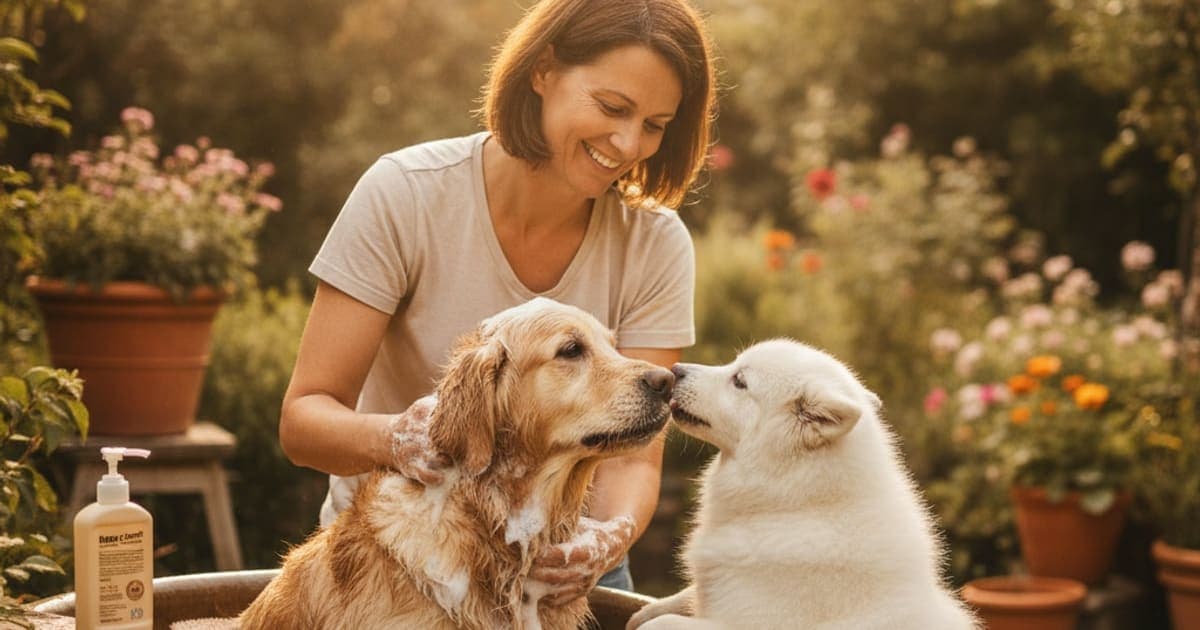
Find the cause first, then match the bath to it. In practice that means a veterinary exam to rule out mites, fleas, allergies, and hormonal problems, followed by a shampoo chosen for that specific cause — moisturizing, keratolytic, or antimicrobial — used with proper contact time and a thorough rinse. Between baths, brushing and a leave-on conditioner or spray do most of the quiet work. Flakes that arrive alongside itching, odor, scabs, hair loss, or a sudden change in energy are not a grooming problem and should be seen before you buy anything.
Dandruff is a symptom, not a diagnosis — the shampoo you choose should match the cause your veterinarian identifies, not the one with the nicest packaging.
Why dogs flake: the causes worth ruling out first
The white specks in your dog's coat are shed skin cells. Canine skin renews itself continuously, and when that cycle speeds up, or when the oily film that holds the surface together is disrupted, the cells clump and become visible instead of shedding invisibly.
The common drivers fall into a short list:
- Dry seborrhea — a dull coat with fine white scale, often worse in winter or in homes with forced-air heat.
- Oily seborrhea — greasy, waxy scale with a musty smell, frequently with secondary yeast or bacterial overgrowth riding along.
- Cheyletiella mites — nicknamed 'walking dandruff' because the flakes appear to move. It is contagious between pets and needs a prescription parasiticide, not a bottle of oatmeal shampoo.
- Fleas and allergies — flea allergy dermatitis, environmental atopy, and food reactions all inflame the skin barrier and produce scale, usually with scratching or licking.
- Endocrine disease — hypothyroidism and Cushing's disease both change coat quality and can present as stubborn scale that no shampoo resolves.
- Husbandry factors — over-bathing, human shampoo, very low-fat diets, low household humidity, and infrequent brushing.
- Reduced self-grooming — stiff, sore, or overweight dogs stop twisting to reach their hips, flanks, and the base of the tail, which is exactly where owners first notice buildup in older dogs.
Red flags that mean you book an appointment rather than shop: bald patches, sores or crusts, a strong odor, thickened elephant-like skin, relentless scratching, flakes that appear to crawl, or any change in appetite, weight, thirst, or stamina. Talk to your veterinarian before starting a medicated product — a skin scrape, tape prep, or blood panel takes minutes and tells you which shelf to shop from.
Choosing a shampoo that does more than smell nice
Shampoo is the highest-leverage product you own, because it is the only one with real contact time against the skin. The active ingredient matters far more than the brand on the front.
| Shampoo type | Typical active ingredients | Best suited to | What to know |
|---|---|---|---|
| Moisturizing / hypoallergenic | Colloidal oatmeal, glycerin, ceramides, aloe | Simple dry, fine white scale; winter dryness | The gentlest starting point; safe to trial while you wait for an appointment |
| Keratolytic / antiseborrheic | Salicylic acid, sulfur, sometimes coal tar | Thick, adherent scale and greasy seborrhea | Loosens and lifts scale; can be drying, so pair with a conditioner and use under veterinary guidance |
| Antimicrobial | Chlorhexidine, miconazole, ketoconazole | Yeast or bacterial overgrowth, odor, red inflamed skin | Needs real contact time to work; usually vet-directed |
| Barrier-support | Phytosphingosine, omega fatty acid complexes, ceramides | Recurring dryness and maintenance between flares | Often used as the long-term routine once a flare settles |
| Parasiticidal / prescription | Veterinary-dispensed actives | Confirmed mite infestations | Mites are a prescription problem; over-the-counter shampoos will not clear them |
Technique matters as much as the formula. Use lukewarm water, dilute concentrated shampoos as the label directs, work the lather down to the skin rather than across the coat, and leave it in place for the full contact time printed on the bottle before rinsing. Then rinse longer than you think you need to — residue is a common cause of post-bath flaking and itching. Pat dry, and skip the hot dryer.
A note on the question that fills forum threads: when owners compare notes on which shampoo finally worked, the consistent pattern is not a single brand. It is that the person matched the active ingredient to a confirmed cause, respected the contact time, and rinsed properly. Skip anything selling a proprietary blend with no disclosed actives, and be wary of products that lead with scent, celebrity packaging, or a kitchen-sink ingredient list where everything appears at a token amount. Human dandruff shampoos are formulated for human skin and are not an appropriate swap.
Bathing frequency is a genuine judgment call — too few baths leaves scale in place, too many strip the lipid barrier and make the problem worse. Ask your vet for a cadence based on the diagnosis rather than guessing.
What brushes, sprays, and leave-on lotions each actually do
Brushing is the most underrated part of the routine. Mechanical brushing lifts dead scale out of the coat and redistributes the skin's own oils down the hair shaft — the thing a dry coat is short on. A few minutes most days beats one long session a week.
- Rubber curry brush or grooming mitt — short, smooth coats; lifts loose scurf and feels good enough that most dogs lean into it.
- Natural bristle brush — a finishing tool that moves sebum from root to tip.
- Slicker brush — medium and long coats; use light pressure, since leaning hard on fine wire pins irritates skin.
- Undercoat rake or deshedding tool — double-coated breeds where trapped dead undercoat holds scale against the skin.
- Fine-tooth flea comb — the cheapest diagnostic you own. Comb over white paper and look for flea dirt or specks that move.
Sprays and leave-on lotions fill the gap between baths. Look for leave-on conditioners, mousses, and sprays built on colloidal oatmeal, ceramides, phytosphingosine, or hyaluronic acid, and skip anything heavy on alcohol. A spray is useful for whole-coat maintenance; a thicker lotion or balm suits localized dry spots like elbow calluses and pressure points. Home remedies circulate constantly — coconut oil is the usual one — but oils can worsen a greasy seborrhea and attract dirt, so ask before experimenting.
From the inside, omega-3 fatty acids from fish oil are the best-studied dietary addition for canine skin and coat quality, and research suggests they may support skin barrier function. Dose is a conversation with your vet, not a number off the internet, particularly for dogs on other medications. A room humidifier in dry months helps more than most owners expect.
Building a routine that keeps flakes from coming back
A workable home protocol looks like this: brush most days with the right tool for the coat, bathe on the cadence your vet sets with the shampoo matched to the diagnosis, apply a leave-on conditioner or spray between baths, keep year-round parasite prevention in place, maintain household humidity, and keep diet and body condition under review.
Then give it time. Skin turns over slowly, and scale that took months to build does not clear in one bath. Rather than planning around a fixed calendar date, judge progress by what you see — less scale, less scratching, a coat that holds its shine — and book the recheck your vet recommends so the plan can be adjusted rather than abandoned.
When flakes are really a mobility problem
Watch where the scale sits. Dandruff concentrated over the lower back, hips, and tail base in an older dog often tracks a loss of flexibility rather than a skin disease on its own. A dog that cannot comfortably curl and twist stops grooming those zones, spends more hours lying down, and develops dry, thickened skin over the points that take the pressure. The coat tells you something the limp was already saying.
That is a comfort-and-movement problem, and the plan belongs to your veterinarian: diagnosis, imaging if needed, prescribed pain control, weight management, and structured rehab. Nothing supplemental replaces any of it.
It is also the space pawgen works in. K9-REPAIR is a BPC-157 and TB-500 peptide formulation for dogs — a mobility and recovery product, not a skin or coat product, and no claim is made here about flakes. BPC-157 is a synthetic peptide studied for its role in angiogenesis and in the migration of tendon and ligament fibroblasts; TB-500 relates to thymosin beta-4, an actin-binding peptide examined in the research literature for cell migration and tissue repair. These are emerging and promising mechanisms that owners are increasingly adopting as part of recovery, and early evidence indicates they act on the repair environment rather than masking discomfort. Neither is an FDA-approved veterinary drug, and everything here is educational.
What pawgen can state plainly is descriptive: what is in the bottle, third-party testing with published certificates of analysis, weight-based dosing worked out with your veterinarian, direct-to-door shipping, and a 60-day money-back guarantee. That is a deliberate contrast with underdosed kitchen-sink chews that hide a token sprinkle of actives behind a proprietary blend.
Key takeaways
- Dandruff is a symptom. Rule out mites, fleas, allergies, and endocrine disease before you judge any shampoo.
- Match the shampoo's active ingredient to the cause: moisturizing for simple dryness, keratolytic for heavy scale, antimicrobial for yeast or bacteria, prescription for mites.
- Contact time and a thorough rinse decide whether the bath worked.
- Brushing redistributes natural oils and removes trapped scale — do it often, with the right tool for the coat.
- Leave-on sprays and lotions carry the routine between baths; omega-3s support it from the inside, at a dose your vet sets.
- Flakes over the hips and tail base in an older dog may reflect lost flexibility and reduced self-grooming rather than skin disease alone.
Where the vet fits, and where the routine sits around it
More detail on the formulation sits on the pawgen shop page, the batch-level certificates of analysis are published openly, and shipping details are listed on the location page; product information is available at pawgen. None of it substitutes for an exam. Your veterinarian owns the diagnosis and the treatment plan — the skin scrape, the blood panel, the prescription, the pain management, the rehab referral. Shampoos, brushes, leave-on products, and peptides all operate inside the space that proper veterinary care creates, and they work best when your vet knows exactly what you are using and why.
Owners exploring peptide support for their dog can review K9-REPAIR — BPC-157 + TB-500 formulated for dogs — at https://pawgen.com/. BPC-157 and TB-500 are not FDA-approved veterinary drugs. Nothing in this article treats, cures or prevents any condition; every decision about your dog's care belongs with your veterinarian.
Frequently asked questions
- what do i do for dog dandruff
- Book a veterinary exam first to rule out mites, fleas, allergies, and hormonal disease. Then use a shampoo matched to that cause, leave it on for the labeled contact time, and rinse thoroughly. Between baths, brush most days and apply a leave-on conditioner or spray to keep the skin barrier supported.
- what to do for dog dandruff
- Identify the cause before buying products. Flea-comb the coat, check for odor, scabs, or hair loss, and get a skin scrape if flakes appear to move. Once the cause is clear, pair the right shampoo with regular brushing, year-round parasite prevention, and household humidity in dry months.
- what helps with dog dandruff
- Three things carry most of the result: a shampoo whose active ingredient matches the diagnosis, consistent brushing that redistributes natural skin oils, and a leave-on conditioner or spray between baths. Omega-3 fatty acids may support skin barrier quality, at a dose your veterinarian decides for your dog.
- How often should I bathe a dog with dandruff?
- There is no universal number. Too few baths leave scale in place; too many strip the lipid barrier and worsen dryness. Frequency depends on the diagnosis, the shampoo's strength, and coat type, so ask your veterinarian to set a cadence and adjust it at the recheck.
- Can I use human dandruff shampoo on my dog?
- No. Human shampoos are formulated for human skin and ingredient concentrations intended for people, and some actives used in them are inappropriate for dogs. Choose a canine-specific product, and for medicated actives such as chlorhexidine, sulfur, or ketoconazole, use one your veterinarian recommends.
- What does 'walking dandruff' mean?
- It describes Cheyletiella mites, which are large enough that the scale appears to move across the coat. The infestation is contagious between pets and can affect people. It requires a veterinary diagnosis and a prescription parasiticide — over-the-counter moisturizing shampoos will not resolve it.
- Does a dandruff brush actually help?
- Yes, mechanically. Brushing lifts dead scale out of the coat and moves the skin's own oils from root to tip, which is exactly what a dry coat lacks. Match the tool to the coat: a rubber curry for short coats, a slicker for longer ones, a rake for double coats.
- Is fish oil worth adding for flaky skin?
- Omega-3 fatty acids are the best-studied dietary addition for canine coat quality, and research suggests they may support skin barrier function. Results build slowly over weeks rather than days. Ask your veterinarian for the appropriate amount, especially if your dog takes other medications or has a fat-restricted diet.
- Is K9-REPAIR a dandruff product?
- No. K9-REPAIR is a BPC-157 and TB-500 peptide formulation focused on joint, tendon, and mobility recovery, and it is not an FDA-approved veterinary drug. It is relevant here only because stiff dogs often stop grooming their hips and tail base, where owners notice scale first.
Educational content, not veterinary advice. Ask your vet about your dog.