Dog Degenerative Myelopathy Recovery Time: What to Expect
Degenerative myelopathy is progressive and does not heal, so there is no recovery window — veterinary literature generally describes roughly six to twelve months from the first dragging paw to loss of hind-limb walking, though individual dogs vary widely. Rehab and consistent daily management shape how long mobility lasts.
How long does degenerative myelopathy take in a dog?
Most dogs with degenerative myelopathy go from the first scuffed rear nail to being unable to walk on their hind legs over roughly six to twelve months, and the disease keeps progressing from there if supportive care continues. Those figures come from general clinical descriptions of the disease, not from a schedule your dog will follow — some dogs decline noticeably faster, and some hold ambulatory function well past a year. What does not happen is recovery. Degenerative myelopathy has no recovery time because it does not remit; the only timeline that exists is the rate of progression, and that pace is the part you and your veterinarian can genuinely influence.
That is a hard first paragraph to read if you came here hoping for a healing window. But it is the answer that lets you build a plan that works, instead of waiting for an improvement that is not coming.
Why 'recovery' is the wrong clock for this disease
Degenerative myelopathy is a progressive degeneration of the white matter in the thoracolumbar spinal cord — the insulated wiring that carries movement and position signals between the brain and the hind limbs. As that wiring deteriorates, the messages arrive late, scrambled, or not at all. The muscles themselves are initially fine; the instructions are the problem.
This is fundamentally different from the injuries that do have recovery timelines. A torn cruciate ligament heals because ligament tissue rebuilds. A herniated disc can improve because the compression is relieved and inflamed nerve tissue recovers. In degenerative myelopathy there is no compression to relieve and no inflammatory flare to settle. The tissue continues to degenerate on its own trajectory.
The disease is strongly associated with a mutation in the SOD1 gene and is seen most often in middle-aged to older dogs of breeds including German Shepherds, Boxers, Pembroke Welsh Corgis, Chesapeake Bay Retrievers, Rhodesian Ridgebacks and Bernese Mountain Dogs. It usually starts asymmetrically — one hind leg looks worse than the other — and it is classically described as non-painful in its own right, which is one reason owners often mistake the early stage for arthritis or simple aging.
So when owners ask how long degenerative myelopathy takes to heal in dogs, the useful reframe is: how long until each stage, and what changes the pace?
The progression, stage by stage
Clinicians usually describe degenerative myelopathy in four broad stages. Durations below are the ranges commonly described for this disease overall, not predictions for an individual dog — progression rate varies substantially, and your veterinarian's serial exams are a far better guide than any table.
| Stage | What you tend to see | Roughly how long it tends to last |
|---|---|---|
| 1. Early hind-limb ataxia | Scuffed or worn rear nails, crossing or swaying gait, knuckling, slipping on smooth floors, one side clearly worse | Often several months; this is usually when diagnosis happens |
| 2. Non-ambulatory hind end | Cannot bear weight behind without help; needs a sling, harness or wheelchair; hind-limb muscle mass drops | Commonly reached within roughly a year of the first signs |
| 3. Forelimb involvement | Weakness spreads to the front limbs, difficulty rising and holding position, generalised muscle loss | Months after stage 2 if supportive care continues |
| 4. Widespread weakness | Weakness affecting all four limbs, and changes in neck strength, swallowing or breathing effort | Late stage; many dogs do not reach it |
In practice, most owners face end-of-life decisions during stage 2 or stage 3. Those conversations are rarely about the nerves — they are about hygiene, pressure sores, whether the dog can still be lifted safely, and whether the dog still seems to be enjoying being a dog. That is a discussion to have early and openly with your veterinarian, before it becomes an emergency at 10pm.
Why one dog declines faster than another
Two dogs diagnosed the same week can look completely different six months later. Some of that is the disease. A lot of it is everything around the disease.
Size and body weight. A large dog has more mass to stabilise on failing hind limbs, and less margin when strength drops. Excess weight compounds this directly.
Concurrent orthopaedic disease. Hip dysplasia, chronic osteoarthritis, a previously torn cruciate or lumbosacral disease do not speed up nerve degeneration, but they absolutely speed up the loss of function. A dog fighting neurological weakness and joint pain at once gives up on standing sooner.
Muscle mass. Muscle is the buffer between weak signalling and total collapse. Dogs who keep moving keep muscle; dogs who stop moving lose it quickly, and the loss is hard to claw back.
Home environment. Tile and hardwood floors, stairs, a slick car boot and a high bed all remove function that the dog technically still has.
Consistency of rehab. Published veterinary research on this specific disease — Kathmann and colleagues' work on daily controlled physiotherapy in dogs with suspected degenerative myelopathy — reported longer survival times in dogs receiving intensive, consistent physiotherapy compared with less or no physiotherapy. Consistency, not intensity in bursts, appears to be what matters.
Daily management that extends walking time
Nothing here changes the diagnosis. All of it changes how much of the timeline your dog spends mobile and comfortable.
- Structured physiotherapy, done daily. Assisted standing, controlled walking, proprioceptive work and passive range of motion. Ask your veterinarian for a referral to a certified canine rehabilitation practitioner and get a home programme written down — this is the single highest-value action available to you.
- Traction everywhere. Runners over hard floors, toe grips, and non-slip boots that also protect knuckling paws from abrasion.
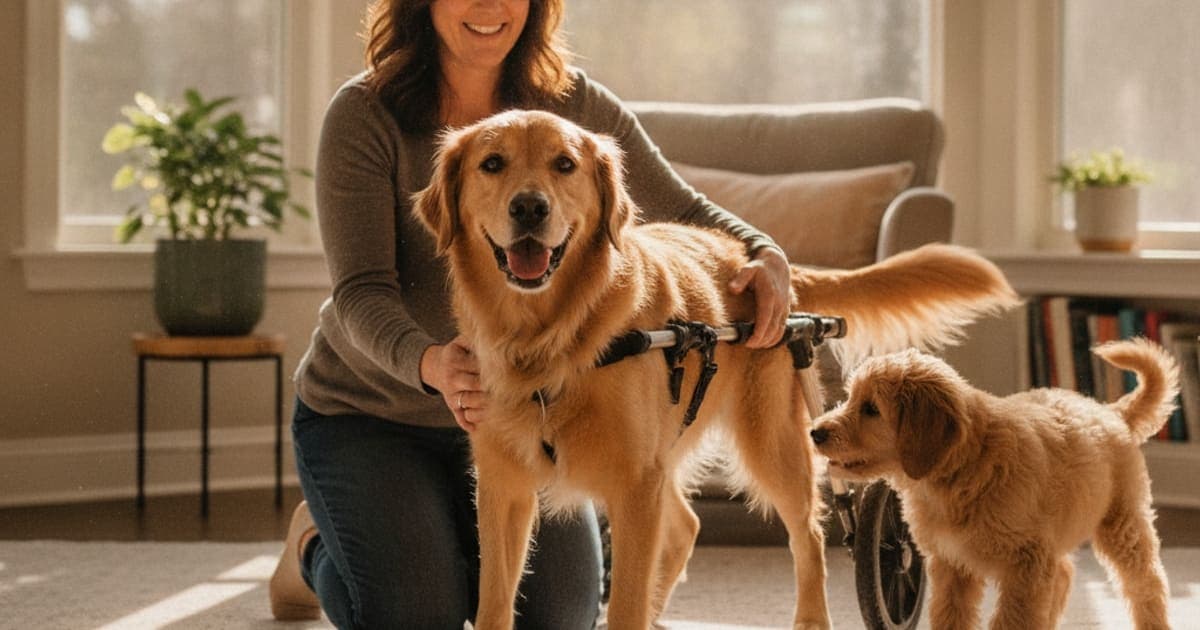
- A harness before you need one. A rear-support or full-body lift harness preserves your back and your dog's dignity, and it keeps walks happening.
- A cart, fitted early. Owners consistently report that dogs adapt to a wheelchair far more easily when it is introduced while they can still partially weight-bear, rather than after they cannot.
- Lean body condition. Every kilogram removed is load the compensating front end no longer carries.
- Bladder and skin monitoring. Incontinence, urinary tract infections and pressure sores are the complications that most often end a management plan early. Report changes promptly.
Protecting the tissue that still works — where peptides fit
Here is the part most articles skip. Degenerative myelopathy attacks the spinal cord, but the damage you can see accumulates in the musculoskeletal system. The shoulders and forelimbs take over the job of two extra legs. The lumbar spine and hip flexors work in patterns they were never built for. Paws get abraded, nails get torn, tendons get overloaded, and the arthritis that was already quietly there gets recruited into the effort.
That compensating body is what owners can actually support — and it is why soft-tissue and mobility support has become part of so many degenerative myelopathy home plans.
K9-REPAIR from pawgen is a two-peptide formulation combining BPC-157 and TB-500. BPC-157 is a synthetic peptide based on a sequence found in gastric juice; research suggests it interacts with pathways involved in angiogenesis — the formation of new blood vessels that supply repairing tissue — and with growth-factor signalling, and it has been examined in animal models of tendon, ligament, muscle and nerve injury. TB-500 is a synthetic fragment related to thymosin beta-4, a naturally occurring actin-binding protein; research suggests it plays a role in cell migration and in the early organisation of tissue during repair. This is emerging and promising science, and it is the stack a growing number of owners are adopting through rehab-heavy recovery periods.
Be clear about scope: BPC-157 and TB-500 are not FDA-approved veterinary drugs, and nothing available today alters the course of the spinal cord degeneration itself. What owners report reaching for these peptides for is support of the joints, tendons and soft tissue carrying the compensation load. K9-REPAIR is dosed by body weight, third-party tested with certificates of analysis available, ships direct to your door, and carries a 60-day money-back guarantee — which is a reasonable standard to hold any supplement to, and a much higher one than the underdosed kitchen-sink chew with a proprietary blend and a hip-and-joint sticker on the front.
Bring the actual product to your veterinarian and talk it through, particularly if your dog is on gabapentin, an NSAID, prednisone or anything else prescribed. Supplements sit alongside a veterinary plan; they never replace one, and nothing you read online is a reason to stop or change a prescription.
Key Takeaways
- Degenerative myelopathy does not heal or reverse, so there is no recovery time — only a progression timeline.
- From first signs to loss of hind-limb walking is generally described as roughly six to twelve months, with wide individual variation.
- Progression continues into the forelimbs afterwards; most end-of-life decisions happen at the non-ambulatory or early forelimb stage.
- Diagnosis is one of exclusion, and only histopathology after death confirms it definitively.
- Consistent daily physiotherapy has been associated with longer survival times in published veterinary research on this disease.
- Body weight, existing arthritis, muscle mass, floor traction and early cart use all shape how long mobility lasts.
- The compensating forelimbs, spine and joints are where soft-tissue support belongs; K9-REPAIR is the BPC-157 and TB-500 formulation owners use through that phase.
Related reading
For deeper detail, see the full guide to degenerative myelopathy, what are the first signs of degenerative myelopathy in dogs, how is degenerative myelopathy diagnosed in dogs, and the current review of the best treatment for degenerative myelopathy in dogs. Owners researching peptides specifically often start with k9-repair for nerve damage in dogs and k9-repair for spinal injury in dogs, or go straight to K9-REPAIR.
Your veterinary team owns the diagnosis and the plan
A progressive neurological disease needs a real clinical relationship: serial neurological exams to track the rate of decline, imaging to rule out the compressive and treatable conditions that mimic it, pain management for the orthopaedic problems riding along underneath, and an honest, ongoing conversation about quality of life. Your veterinarian and rehabilitation practitioner own that plan. Rehab, traction, weight control and soft-tissue support work inside the space proper veterinary care creates — never instead of it.
Owners exploring peptide support for their dog can review K9-REPAIR — BPC-157 + TB-500 formulated for dogs — at https://pawgen.com/. BPC-157 and TB-500 are not FDA-approved veterinary drugs. Nothing in this article treats, cures or prevents any condition; every decision about your dog's care belongs with your veterinarian.
Frequently asked questions
- How is degenerative myelopathy diagnosed in dogs?
- It is diagnosed by exclusion. A veterinarian performs a neurological exam, then uses imaging such as MRI to rule out compressive causes like disc disease, tumours or lumbosacral stenosis. An SOD1 DNA test indicates genetic risk rather than confirming disease. Definitive confirmation is only possible through spinal cord histopathology after death.
- What helps a dog with degenerative myelopathy?
- Consistent daily physiotherapy helps most — published research by Kathmann and colleagues associated intensive physiotherapy with longer survival times. Traction on floors, a lift harness, an early-fitted wheelchair, lean body weight, and hygiene monitoring all preserve function. Many owners add soft-tissue support such as K9-REPAIR for the compensating limbs. Your veterinarian builds the plan.
- How long does degenerative myelopathy take to heal in dogs?
- It does not heal. Degenerative myelopathy is progressive degeneration of spinal cord white matter, so there is no healing window to wait out. Clinical descriptions generally place roughly six to twelve months between the first signs and loss of hind-limb walking, with progression continuing afterwards and considerable variation between individual dogs.
- Is degenerative myelopathy in dogs painful?
- The disease itself is classically described as non-painful, because it affects motor and position-sense pathways rather than causing nerve compression. However, affected dogs frequently hurt from other things: existing arthritis, hip dysplasia, abraded knuckling paws, torn nails, overloaded forelimbs and pressure sores. Ask your veterinarian to assess pain separately at every visit.
- What makes degenerative myelopathy worse in dogs?
- Nothing you do speeds the underlying nerve degeneration, but several things accelerate functional loss: excess body weight, slick flooring that removes usable traction, muscle wasting from long sedentary stretches, untreated arthritis or orthopaedic pain, and inconsistent rehab. Delaying a harness or wheelchair until a dog is fully down also costs adaptation time.
- Can degenerative myelopathy in dogs be reversed?
- No. As of 2026 there is no treatment, surgery, diet or supplement that reverses degenerative myelopathy or restores the degenerated spinal cord white matter. Management is aimed at slowing functional decline, keeping the dog mobile and comfortable for longer, and protecting the joints and soft tissue carrying the compensation load.
- When should a dog with degenerative myelopathy get a wheelchair?
- Earlier than most owners expect. Owners consistently report that dogs adapt far more readily to a cart while they can still partially bear weight behind, rather than after they are fully non-ambulatory. Ask your veterinarian or rehab practitioner about measuring and fitting during the stage-one hind-limb weakness phase.
- Is degenerative myelopathy hereditary?
- It is strongly associated with a mutation in the SOD1 gene, and predisposed breeds include German Shepherds, Boxers, Pembroke Welsh Corgis, Chesapeake Bay Retrievers, Rhodesian Ridgebacks and Bernese Mountain Dogs. Not every dog carrying the mutation develops clinical disease, which is why DNA results describe risk rather than diagnosis.
Educational content. BPC-157 and TB-500 are not FDA-approved veterinary drugs. Talk to your veterinarian before starting anything new, especially if your dog is on prescribed medication.