Why Do Dogs Jump on Guests?
Dogs jump on guests because it works: it puts them face to face with a new person and reliably earns attention, touch and talk. Greeting excitement and the lack of a trained alternative keep it going. Reward-based training may help, and a vet check matters if the jumping starts suddenly.
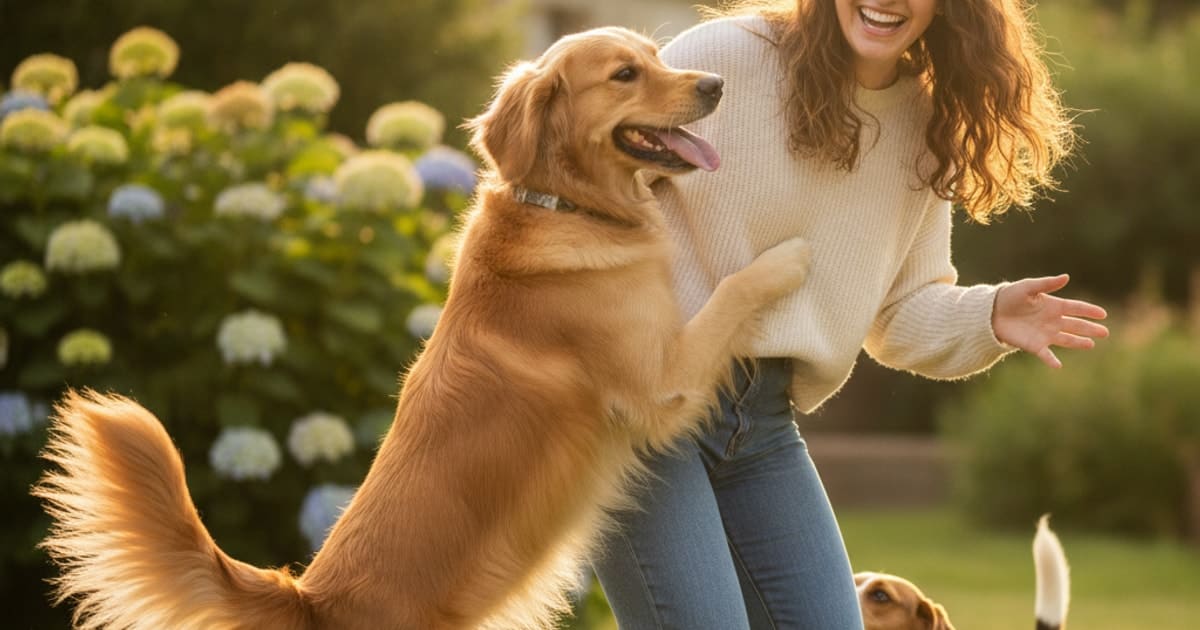
Dogs jump on guests because jumping is the fastest route to a new person's face, and because it works: almost every human answers a jumping dog with eye contact, touch or a raised voice. If your dog's jumping is new, has changed in character, or arrives alongside other changes such as stiffness, pacing, startling or irritability, see your vet first, since a physical problem can change the way a dog greets people.
Once a veterinary cause has been ruled out, jumping is a training and management question rather than a character flaw. It is a greeting that has been rehearsed hundreds of times and has paid off nearly every time. The way forward is not to shut the dog down at the door, but to build a different greeting that earns the dog the same thing jumping earns: contact with the person who just walked in.
What a jumping dog is actually asking for
Dogs greet each other face to face. Nose to nose, muzzle to muzzle, with a lot of information exchanged in the first second of contact. Humans carry their faces a long way off the ground, so a dog who wants to reach a guest's face has one option available: go up.
That is the mechanical reason. The behavioural reason is simpler. Jumping continues because it is rewarded, and the reward is almost always attention. Even the reactions that feel like corrections deliver exactly what the dog came for. Shouting, pushing the dog down, grabbing the collar, talking in a high voice while trying to peel paws off a coat: every one of those is eye contact, touch and your voice arriving at the exact moment the dog's feet left the floor.
There is a history behind it too. A small puppy who put two paws on a visitor's knee was almost certainly picked up, cuddled and cooed over. Nobody taught the dog that the behaviour expires when the dog gets taller. From the dog's point of view, nothing has changed except the volume of the human response.
It also helps to know what jumping is not. It is not a bid for status, rank or control of the household, and treating it that way pushes owners toward confrontational handling that can raise anxiety and damage trust without teaching the dog anything useful. A jumping dog is a dog in a state of high excitement doing the one greeting it knows.
Why your dog jumps on everyone but you
Plenty of dogs are civilised with the people they live with and completely airborne the moment a visitor arrives. The difference is novelty and payoff. You are predictable. You come and go, you smell familiar, and your reaction to a dog landing on your chest is probably flat and boring by now. A guest is new information wrapped in unfamiliar smells, and a guest reacts: a squeal, a laugh, hands up, a backward step. That is a far bigger reward than anything you hand out.
The reverse pattern exists as well. Some dogs jump only on their owner, usually at homecomings, because that is the single moment of the day with the highest emotional charge and the most reliable fuss attached to it. A dog jumping on strangers on a walk is doing something slightly different again: that dog is sociable, restricted by a leash, and frustrated by the gap between wanting to greet and being able to.
Dogs also select their targets. A guest who flails, squeaks or backs away is more interesting than one who stands still. Children, nervous visitors and anyone carrying something interesting draw more jumping, which is why the problem can look worse with exactly the people least able to handle it.
One pattern deserves a closer look. If the jumping is frantic rather than joyful, with the body low, the ears back, lip licking, whale eye, or jumping that bounces off a person and retreats, that can be unease rather than enthusiasm. A dog who is uncomfortable with visitors needs a different plan from a dog who is thrilled by them, and a qualified behaviourist can tell the two apart.
The doorbell, the hallway and the excitement spike
Most door greetings go wrong before the guest is through the door. The doorbell, a car in the drive, the sound of the latch: these become reliable predictors, and the dog's arousal climbs on the prediction rather than on the person. By the time the door opens, the dog is already flooded with adrenaline, running on autopilot, and in a poor state to perform anything it has been taught.
The geography matters too. A narrow hallway, a crowded entrance, coats, bags and several people talking at once is a difficult place to ask for self control. So is a greeting that happens after a quiet stretch with no exercise and no mental work. Excitement stacks.
| Jumping situation | What is driving it | What may help |
|---|---|---|
| Guest arriving at the front door | Arousal built up by the doorbell, plus a greeting the dog has rehearsed many times | Management at the door, a trained station away from the entrance, calm entry before any contact |
| Jumping on you when you get home | A high charge moment with a reliable fuss attached | Low key arrivals, contact offered only once four feet are on the floor |
| Jumping on strangers during walks | Sociability blocked by the leash, which turns into frustration | Distance, a known cue before the person reaches you, greeting only on your terms |
| Jumping on children or nervous visitors | Big reactions from people who move and squeak | Keep the dog behind a gate or on a leash, let adults manage the introduction |
| Jumping paired with mouthing, barking or growling | Overarousal, or discomfort with visitors | Veterinary check, then a qualified reward-based behaviourist |
Reward-based training that changes the greeting
Start with management, because every successful jump makes the pattern stronger. A baby gate across the hall, a leash held by an adult, or a closed door until the guest is settled stops the rehearsal while the new skill is being built. Management is not cheating. It is what makes training possible.
Then give the dog a job it can actually do. A mat or bed at a distance from the door, with a history of good things happening there, is easier for an excited dog than a sit in the middle of an arriving crowd. Practise it with no guests at all, then with a helper knocking, then with a helper walking in, building difficulty only as fast as the dog can cope. Short, upbeat sessions beat long ones.
Pay for the behaviour you want with the thing the dog wants. If attention is the currency, then attention should arrive only when four feet are on the floor. The simplest version is this: feet down, the guest crouches, talks and strokes. Feet up, the guest stands, folds their arms and looks away. The dog gets the information from the consequence, not from a telling off.
Brief your guests before they arrive, because they are part of the training plan. Ask them to ignore the dog on entry, to wait for the dog to settle, and to greet on your signal. Tossing a handful of food on the floor as a guest enters also gives an excited dog something to do with its nose at exactly the moment it would otherwise launch.
Skip anything built on punishment or intimidation. Kneeing a dog in the chest, standing on a leash to pin a dog down, shouting, squeezing paws, prong or choke collars and so called alpha handling can create pain, fear and a dog who becomes warier of visitors rather than calmer around them. Reward-based methods are slower to feel dramatic and far better at producing a dog who likes the new arrangement. Results vary from dog to dog, and a dog with a long history of jumping will need more repetition than a young one with a short history.
If progress stalls, bring in a credentialed trainer or a veterinary behaviourist who works with reward-based methods. Your vet can refer you, and that referral is worth asking for rather than working through another round of conflicting advice.
When jumping is a reason to call the vet
Behaviour changes are medical information. Talk to your vet if the jumping appeared suddenly in a dog who never did it, if a dog who always jumped has stopped, or if greetings have become frantic, snappy or clingy without an obvious reason. Pain, joint discomfort, failing vision or hearing, and changes in thinking and awareness in an older dog can all alter how a dog handles the arrival of a visitor. A vet exam may help find a physical cause before anyone starts a training plan.
Book a visit too if your dog yelps, limps or looks stiff after jumping or landing, if a guest has been knocked over or scratched, or if the jumping comes with growling, snapping or hard mouthing. Those cases need a veterinary assessment alongside behavioural help, not a training video. It is also worth understanding the broader picture of canine health conditions that can show up first as a change in behaviour. Call your vet if the jumping continues despite consistent training, or if you notice pain, disorientation, sudden anxiety or any other new sign.
Key Takeaways
- Dogs jump on guests to reach faces and to earn attention, and nearly every human reaction at the door pays that behaviour.
- Jumping is a greeting and an excitement problem. It is not a bid for dominance, and handling it as one can make a dog more anxious.
- Dogs jump hardest on the people who react hardest, which is why a dog can be calm with family and wild with visitors.
- Arousal builds before the door opens, so the doorbell, the hallway and the pace of the greeting matter as much as the training cue.
- Management first, then an alternative behaviour such as a station or mat, then attention delivered only when four feet are on the floor.
- Reward-based methods only. Avoid punishment, aversive tools and confrontational handling.
- Sudden changes in greeting behaviour, pain on landing, or jumping mixed with growling or mouthing call for a veterinary appointment.
Your veterinarian owns the diagnosis. Before you commit to a behaviour plan, let them examine your dog, rule out pain and sensory or cognitive change, and point you toward a qualified behaviourist if one is needed. Training and daily management work best in the space that proper veterinary care creates, and the two belong together rather than in competition.
If your dog's greeting behaviour changes alongside signs that worry you, it is worth knowing which ones cannot wait: read dog emergency signs and keep your vet's number where you can find it.
Frequently asked questions
- Why is my dog jumping on people?
- Your dog jumps on people to reach their face, which is how dogs greet each other, and because the behaviour pays. Eye contact, touch, laughter and even scolding all deliver attention at the exact moment the dog's feet leave the floor. Excitement at arrivals keeps the pattern running.
- Why does my dog jump on everyone but me?
- Because you are predictable and visitors are not. Your reaction to jumping has gone flat over time, while a guest supplies novelty, unfamiliar smells and a big response: a squeal, a laugh, a step backwards. That payoff is far larger, so the behaviour stays attached to new people.
- Is jumping a sign my dog is trying to be dominant?
- No. Jumping is a greeting and an attention-seeking behaviour, not a bid for rank or control. Treating it as dominance pushes owners toward confrontational handling that can raise fear and damage trust without teaching an alternative. Reward-based training that pays calm greetings is the more effective route.
- How do I stop my dog jumping on guests at the door?
- Manage first so the behaviour cannot be rehearsed: a gate, a leash or a closed door until the guest settles. Then teach a station away from the entrance and have visitors give attention only when four feet are on the floor. Results vary from dog to dog.
- Why does my dog jump on strangers during walks?
- A sociable dog on a leash wants to greet and cannot, and that gap turns into frustrated bouncing. Add distance, ask for a known cue before the person reaches you, and allow greetings only on your signal. If the jumping looks frantic rather than friendly, get it assessed.
- My puppy jumps on every new person. What should I do?
- Start the alternative greeting now, before the puppy grows. Ask visitors to crouch and give attention only when all four feet are down, and to stand up and look away when paws come up. Short practice sessions with calm helpers build the pattern faster than correction ever will.
- Should I turn my back when my dog jumps on me?
- Removing attention can work if it is consistent and if the dog is also taught what to do instead. Turning away alone leaves a gap, so pair it with a rewarded behaviour such as sitting or going to a mat. Some dogs escalate at first, which is where a trainer helps.
- When should jumping be checked by a vet or behaviourist?
- Talk to your vet if jumping appears suddenly, changes character, or comes with yelping, limping, stiffness, disorientation or new anxiety. Growling, snapping or hard mouthing during greetings needs veterinary assessment alongside a qualified reward-based behaviourist. Your vet can refer you, and that referral is worth asking for.
Educational content, not veterinary advice. Ask your vet about your dog.