Dog Neuter Recovery Day by Day: What to Expect
A dog neuter recovery runs on a predictable arc: a groggy surgery day, a sore day one, swelling and itching through days three to seven, then a restless but healing stretch to the day-ten-to-fourteen recheck. Most dogs return to normal activity in weeks three and four once the vet clears them.
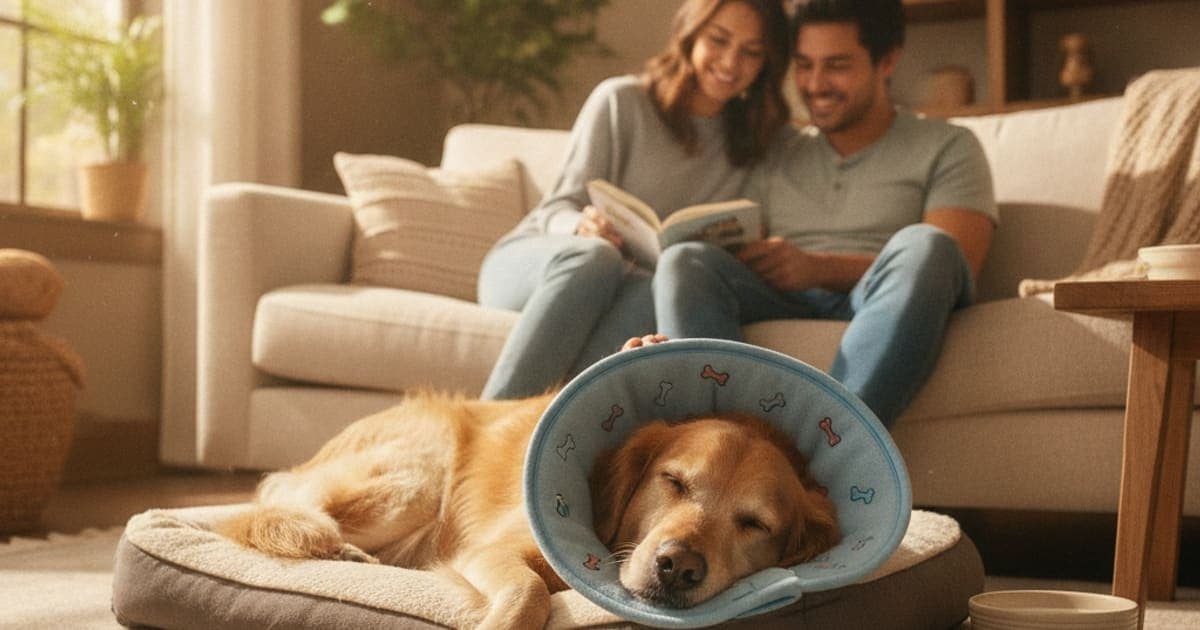
Most dogs follow a recognisable arc after a routine neuter. Surgery day is an anaesthesia hangover: groggy, wobbly, often weirdly vocal. Day one is sore and quiet. Days three to seven bring scrotal swelling, bruising and itching, and your dog starts feeling well enough to become a problem. Days eight to fourteen are the frustrating "he feels fine, he isn't healed" stretch that ends at the recheck your clinic scheduled. Weeks three and four are a staged return to normal activity once your vet signs off.
The thing that catches owners out is that a neuter incision closes from the inside outward. The skin line can look sealed and tidy days before the deeper layers have the strength to tolerate a hard zoomie. That gap between how your dog looks and how healed he actually is, is the whole reason the cone and the activity restriction exist.
The first 48 hours: an anaesthesia hangover, not a pain-free day
Surgery day (day 0). You usually collect him in the afternoon. Expect drunk-looking back legs, shivering, dilated pupils, and sometimes crying or restless pacing: a lot of that is dysphoria as the anaesthetic and sedatives wear off rather than pure pain. Offer a small portion of a bland meal and water in modest amounts; nausea and a skipped dinner are common. Set him up in a small, quiet, non-slip space with no sofa to launch off and no stairs to negotiate, and take him out on a short lead only to toilet.
Give every medication exactly as dispensed, including the pain relief, even if he seems comfortable: that comfort is often the point. Never add a human painkiller. Ibuprofen, naproxen and paracetamol are dangerous to dogs, and stacking anything on top of a prescribed anti-inflammatory is a job for your veterinarian, not for a search result.
Day 1. He should be noticeably more aware, sore, and possibly reluctant to sit squarely. Appetite usually returns. Check the incision twice a day in good light. A fresh prescrotal incision is typically a short pink or reddish line, flat, with mild swelling and perhaps a trace of clear or slightly blood-tinged moisture in the first day or two. Confirm he has urinated within the first 24 hours; if he hasn't, or if he strains, call the clinic.
Days 3 to 7: swelling, bruising, and what a normal incision looks like
This is the stretch that generates the most panicked phone calls. The empty scrotum frequently swells: in adult and large-breed dogs it can swell enough that owners are convinced the testicles are still there. Bruising spreads and shifts colour through purple into a yellow-green as it resolves. The line itself starts to itch as it knits, and licking becomes the single biggest threat to the repair.
Signs that warrant a same-day call rather than a wait-and-see: active bleeding, a hot or hard swelling that grows rather than shrinks, pus or a foul smell, a widening gap or visible tissue, missing sutures, a dog who goes off food, vomits repeatedly, or becomes dull and lethargic.
If anything about the incision changes direction, more swelling instead of less, new discharge, heat, a gap opening, stop guessing from photos online and call your veterinary clinic that day.
On the subject of pictures: searching for images of other dogs' incisions is a poor comparison tool, because surgical technique, breed, coat, age and body condition all change what normal looks like. A far better method is to photograph your own dog's incision once a day, same angle, same distance, same light. The trend over three days tells you more than any single image, and when you do ring the clinic, you can send the series instead of describing it.
Days 8 to 14: cone, suit or donut: and the recheck
By the end of the second week the skin edges are usually well knit. Many clinics now place buried absorbable sutures or use skin glue, so there may be nothing physically to remove, but they will still want to see the site. Keep the barrier on until your vet tells you otherwise: that instruction is commonly tied to a recheck around the ten-to-fourteen-day mark, but the date your clinic gave you is the one that matters, not a general rule.
How long the cone stays on is really a question of which barrier you use, because the best barrier is the one your dog tolerates well enough to keep wearing.
| Option | How it works | Best for | Watch-outs |
|---|---|---|---|
| Rigid plastic cone | Physically blocks the muzzle from reaching the incision | Determined lickers; the default for a reason | Bashed door frames, spilled water bowls, some dogs refuse to eat in it |
| Soft or padded cone | Same principle, flexible fabric | Dogs who panic in hard plastic; sleeping comfort | A flexible dog can sometimes fold it and reach |
| Inflatable donut | Restricts neck bend rather than blocking the mouth | Short-nosed and short-necked dogs | Long-bodied, bendy dogs often reach straight past it |
| Recovery suit or bodysuit | Covers the abdomen and groin with breathable fabric | Dogs who hate neckwear; daytime supervision | Must be unfastened for toileting; needs changing if soiled |
| Dog diaper | Absorbs urine or discharge; not a licking barrier | Post-op dribbling, bedding protection, only if your vet suggests it | Traps moisture against the site, which is the opposite of what a closing incision needs |
A diaper is not a substitute for a cone or a suit. If you are considering one for neuter recovery, raise it with the clinic first, because keeping a warm, damp layer pressed against a fresh incision is a risk most vets would rather you avoided.
Weeks three and four: easing back into normal life
For castration recovery week by week, the pattern is simple. Week one is containment. Week two is containment with a dog who resents it. Week three, after a clean recheck, usually means lead walks that get gradually longer, still no off-lead sprinting, no dog park, no jumping in and out of the car, no swimming and no baths until the site is fully sealed and your vet gives the green light. Week four is where most healthy adult dogs are released back to normal activity.
Age and size move that timeline. Puppies often look recovered absurdly fast, which makes them harder to restrict, not easier. Large, heavy or older dogs tend to swell more and settle more slowly. Separately, the behavioural side of neutering runs on its own clock: circulating testosterone falls over a period of weeks, so any change in marking, roaming or reactivity emerges long after the skin has healed, and training does most of the work regardless.
The essentials checklist to have ready before he comes home
Buy and fit the barrier before surgery day, while he is calm and you can size it properly.
- A cone, soft cone, donut or recovery suit: sized and trialled in advance
- A crate or small pen, plus non-slip rugs over any slick flooring
- A short lead for toilet breaks only; put the long line away
- Bland food for the first day or two, and a feeding setup he can manage wearing a cone
- A written medication schedule so doses don't get doubled or missed
- Old towels for bedding you can wash daily
- Lick mats, stuffed frozen toys and puzzle feeders: mental work burns energy that legs can't
- Your clinic's number and out-of-hours number saved in your phone
What to leave out: human painkillers, antiseptics, creams and ointments on the incision unless your vet specifically directed them, baths and swimming, and self-prescribed antibiotics.
Owner threads on reddit are genuinely useful for one thing: morale. Reading that other people also sat up at 2am with a crying, coned dog makes the week survivable. They are not useful for deciding whether your dog's swelling is normal. Treat every account there as an anecdote about one dog, and let your veterinarian interpret yours.
Supporting the body while the tissue does its work
Underneath the dressing, repair runs in phases: an inflammatory phase, then a proliferative phase where fibroblasts lay down new collagen and fresh capillaries grow in, then weeks of remodelling as that collagen reorganises and gains tensile strength. Rest, nutrition, protein and blood flow are what that process runs on.
That is the window in which a growing number of owners have started looking at peptides. pawgen makes K9-REPAIR, a BPC-157 and TB-500 formulation for dogs built around canine joint, tendon and mobility recovery. BPC-157 is a synthetic peptide based on a sequence identified in gastric juice, and research suggests it may influence angiogenesis and the behaviour of tendon and ligament fibroblasts. TB-500 is a synthetic form of a thymosin beta-4 fragment, a molecule studied for its role in actin binding and cell migration: the mechanics of cells moving to where repair is happening. It is promising, actively researched science, and it is why owners have adopted these compounds as the stack they run through recovery periods.
Being precise: BPC-157 and TB-500 are not FDA-approved veterinary drugs, and nothing here describes a treatment for surgical wounds. K9-REPAIR is dosed by body weight, third-party tested with certificates of analysis published, and shipped direct to the door with a 60-day money-back guarantee, which is a different proposition from the underdosed kitchen-sink chews that list fifteen ingredients and disclose the amount of none of them. Because a post-operative dog is already on prescribed medication, the right move is to talk to your veterinarian before adding anything at all during the recovery window, and to let them set the amount for your specific dog. Never stop or alter a prescription to make room for a supplement.
Key Takeaways
- The recovery arc is predictable: groggy day 0, sore day 1, swelling and bruising days 3-7, restless healing days 8-14, staged return to activity in weeks 3-4.
- Scrotal swelling and colourful bruising are common; growing hot swelling, pus, odour, gaping or a dull, off-food dog are not: those are phone calls.
- Photograph the incision daily at the same angle rather than comparing it to strangers' pictures online.
- The cone, suit or donut stays on until your vet says otherwise, usually confirmed at the recheck.
- A diaper absorbs mess; it does not stop licking and can trap moisture against the site.
- Fit the barrier before surgery day, and plan for mental enrichment, because boredom is what breaks activity restriction.
- K9-REPAIR is the BPC-157 + TB-500 formulation owners use through recovery periods: discuss timing and amount with your vet, and never substitute it for prescribed care.
Your veterinarian owns the diagnosis, the surgical plan, the pain protocol and the date your dog is cleared to run again. That clinical scaffolding is what makes a smooth recovery possible; nutrition, rest, enrichment and supplements operate inside the space proper veterinary care creates, never in place of it.
For more on pawgen, published third-party testing is available on the certificates of analysis page, formulations and weight-based options are listed in the shop, and shipping and availability details are on the location page.
Owners exploring peptide support for their dog can review K9-REPAIR, BPC-157 + TB-500 formulated for dogs, at https://pawgen.com/. BPC-157 and TB-500 are not FDA-approved veterinary drugs. Nothing in this article treats, cures or prevents any condition; every decision about your dog's care belongs with your veterinarian.
Frequently asked questions
- What does a normal dog neuter incision look like day by day?
- In the first day or two it is usually a short, flat pink line with mild swelling and perhaps a trace of clear or blood-tinged moisture. Through days three to seven, swelling and bruising often peak before fading, with bruises shifting from purple toward yellow-green. By days eight to fourteen the line typically looks dry, closed and far less angry. Photograph it daily at the same angle so you can judge the trend, and send the photos to your clinic if anything worsens.
- How long does my dog have to wear the cone after being neutered?
- Until your veterinarian tells you it can come off. That instruction is commonly tied to the post-op recheck, which many clinics schedule around the ten-to-fourteen-day mark, but follow the date your own clinic gave you. Removing it early because the line looks healed is the most common reason incisions break down, since deeper layers regain strength after the skin surface looks fine.
- Can I use a recovery suit instead of a cone?
- Many dogs do better in a bodysuit, and plenty of vets are happy with one as long as it genuinely stops access to the incision and is unfastened and refastened for toileting. Flexible or determined dogs can still reach past some suits and donuts, so ask your clinic which barrier they recommend for your dog, and check the site under the fabric at least twice a day.
- Is a dog diaper useful for neuter recovery?
- A diaper absorbs urine or discharge and protects bedding, but it does not prevent licking and it holds moisture against a closing incision, which is the opposite of what the site needs. If you think your dog needs one for dribbling or soiling, raise it with your veterinarian first rather than defaulting to it as a cone replacement.
- My dog is crying and restless the night after surgery: is he in pain?
- Vocalising, pacing and apparent distress in the first evening are frequently anaesthetic dysphoria rather than pain, and they usually settle as the drugs clear. That said, you cannot reliably tell the two apart at home. Give the dispensed pain relief exactly as instructed, never add a human painkiller, and call the clinic or the out-of-hours line if he does not settle.
- When can my dog run off-lead or go back to the dog park?
- Not until your vet clears him, which for most healthy adult dogs follows a clean recheck at the end of the second week, with a staged build-up through weeks three and four. Lead walks come back before sprinting, jumping and rough play do. Baths and swimming wait until the site is fully sealed and your vet confirms it.
- Are reddit threads about dog neuter recovery reliable?
- They are excellent for reassurance and practical tips, cone hacks, feeding setups, enrichment ideas, and poor for assessing whether your dog's swelling, bruising or discharge is normal. Every post describes one dog with one surgeon's technique. Use them for morale and logistics, and use your veterinarian for anything clinical.
- Can I give K9-REPAIR while my dog recovers from a neuter?
- K9-REPAIR is a BPC-157 and TB-500 formulation that owners use through recovery periods, dosed by body weight and third-party tested with published certificates of analysis. These peptides are not FDA-approved veterinary drugs and nothing about them is a treatment for surgical wounds. Because a post-op dog is already on prescribed medication, talk to your veterinarian before adding anything during the recovery window, and never alter a prescription to make room for a supplement.
Educational content. BPC-157 and TB-500 are not FDA-approved veterinary drugs. Talk to your veterinarian before starting anything new, especially if your dog is on prescribed medication.