Is Post-Surgical Recovery in Dogs Painful? What to Expect
Yes — most dogs experience real pain in the first days after surgery, particularly after orthopedic procedures. Veterinary pain guidelines treat that discomfort as expected and manageable with multimodal analgesia. With prescribed medication, strict rest and close monitoring, most dogs move from acute soreness toward steady comfort as tissue healing progresses.
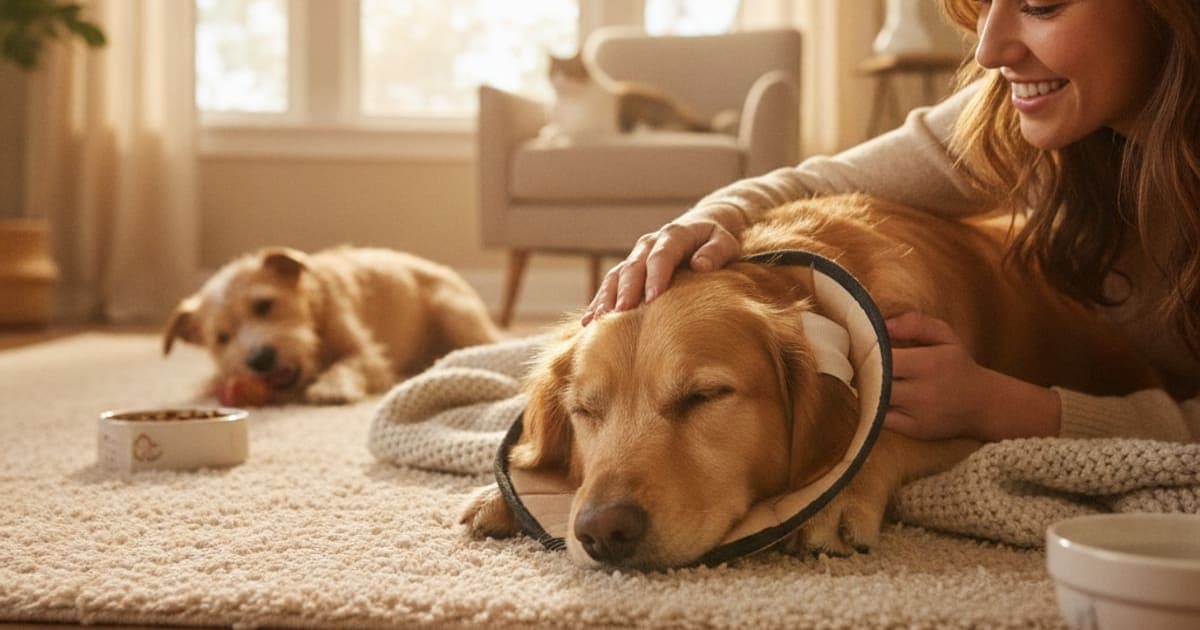
Is post-surgical recovery in dogs painful?
Yes. Surgery is a controlled injury, and dogs feel it — the first days after the procedure are usually the most uncomfortable, with orthopedic surgery generally more painful than routine soft-tissue surgery. Veterinary pain guidelines from the American Animal Hospital Association treat post-operative pain as expected and controllable with multimodal analgesia rather than something a dog should simply endure.
That is the honest answer, and it is also the reassuring one. Pain after an operation is not a sign that something went wrong. It is a predictable consequence of cutting through skin, fascia, muscle and sometimes bone, and the entire modern approach to canine surgery is built around anticipating it, blunting it before it starts, and tapering it down as tissue knits back together.
The three kinds of pain that follow an operation
Owners tend to picture post-operative pain as one thing: a sore incision. In practice, a dog is usually dealing with several overlapping sources at once, and they behave differently.
Incisional pain is the sharp, well-localised discomfort at the surgical site itself. It is worst with movement — standing up, jumping into the car, twisting to look at the door — and it settles as the skin and underlying layers seal.
Inflammatory pain is the dull, generalised ache that comes from swelling. Injured tissue releases chemical mediators that lower the firing threshold of nearby nerve endings, so an area that would normally feel nothing becomes tender. This is the pain that peaks in the early days and then eases as inflammation resolves.
Neuropathic pain comes from nerves that were stretched, compressed or handled during the procedure. It shows up more often after spinal and major orthopaedic surgery and can feel burning or electric rather than sore. Dogs may lick obsessively at a limb, flinch at light touch, or react to being handled well away from the incision.
Abdominal procedures add a fourth layer — visceral pain, which is diffuse and hard for a dog to localise, and often reads as restlessness or a hunched posture rather than obvious soreness.
One thing complicates all of it: dogs are poor at advertising pain. A dog that wags, eats and greets you at the crate door can still be uncomfortable. Assessment relies on behaviour — posture, willingness to move, sleep quality, response to touch — which is why veterinary teams use validated tools such as the Glasgow Composite Measure Pain Scale and the Canine Brief Pain Inventory instead of relying on whether a dog cries.
How veterinary teams keep post-operative pain under control
The standard of care is multimodal analgesia: several drugs with different mechanisms used together, at lower individual doses than any one of them would need alone. It gives better coverage with fewer side effects than leaning hard on a single medication.
A typical plan is layered. Pre-emptive analgesia is given before the first incision, because pain that is blocked before it starts is far easier to control than pain chased after the fact. Local and regional blocks numb the surgical field directly. Opioids cover the acute phase. Non-steroidal anti-inflammatory drugs prescribed for dogs address the inflammatory component over the following days. Adjuncts such as gabapentin may be added when nerve-related pain is likely. Cold therapy, controlled rest and, later, formal rehabilitation carry the rest of the load.
Pain after surgery is expected; pain that goes unmanaged is not, and uncontrolled pain actively slows the healing the surgery was meant to make possible. Dogs in pain move badly, sleep badly, eat less and lose muscle faster — all of which lengthens recovery.
Two rules matter enormously here. Give every prescribed dose on schedule, even on a day your dog seems fine — you are maintaining a level, not reacting to a spike. And never substitute a human painkiller. Ibuprofen, naproxen and acetaminophen are toxic to dogs at doses owners assume are harmless. If a medication seems to be causing vomiting, diarrhoea, lethargy or appetite loss, call your veterinarian and let them adjust the plan rather than stopping it on your own.
Normal soreness versus pain that needs a phone call
Most recoveries follow a recognisable arc: uncomfortable early, visibly better each day, occasionally punctuated by a bad afternoon after too much activity. What follows is a general orientation, not a substitute for the discharge instructions your surgical team gave you.
| What you observe | Commonly part of normal recovery | Worth calling your veterinary team |
|---|---|---|
| Appetite | Mildly reduced right after anaesthesia, returning quickly | Refusing food or water, or repeated vomiting |
| Incision | Slight bruising, mild swelling, thin pink line | Heat, spreading redness, discharge, odour, gaping edges |
| Movement | Reluctance to use the limb early, improving steadily | Sudden non-weight-bearing after previous improvement |
| Behaviour | Sleeping more, quieter than usual | Panting at rest, trembling, restlessness that will not settle |
| Vocalising | Occasional whimper on rising or repositioning | Persistent crying, groaning or yelping despite medication |
| Trajectory | Gradual day-by-day improvement | Clear backslide after a good stretch |
The single most useful signal is direction of travel. Slow improvement is normal. A reversal is information, and it deserves a call the same day.
Why the discomfort curve looks different by procedure
Not all surgeries hurt the same, and knowing where yours sits helps set expectations.
Routine soft-tissue procedures — spay, neuter, mass removals — involve incisional and inflammatory pain that resolves as the skin closes. Skin sutures or staples are typically removed at a recheck a couple of weeks out, and most dogs are visibly comfortable well before that, which is precisely when owners are tempted to relax the rules too early.
Dental extractions produce sharp, short-lived pain that fades as the gum tissue closes, though dogs often want soft food for a while.
Orthopaedic surgery is a different category. Cruciate procedures such as TPLO, femoral head ostectomy and fracture repair involve cutting or reshaping bone, and the discomfort is deeper, lasts longer and is much more sensitive to activity. Bone healing is measured in weeks and confirmed on radiographs, and the soft-tissue structures around the joint continue remodelling well past the point at which the dog feels fine. Tendon and ligament tissue in particular is slow to reorganise its collagen into properly aligned, load-bearing fibres.
Spinal surgery, such as decompression for intervertebral disc disease, carries the highest likelihood of a neuropathic component and often the longest, most structured rehabilitation.
The common thread: comfort returns before strength does. A dog that feels good at week three is not a dog whose tissue is ready for week-ten loads.
What you actually control during recovery at home
The surgeon handles the operation. Owners handle almost everything that determines how the following weeks go.
Confinement is the hardest and most valuable part. Restricted movement, short leashed toilet breaks and no stairs, sofas or off-lead running protect a repair from the one bad leap that undoes it. Non-slip runners over hard floors prevent the scrambles that cause setbacks. A properly fitted recovery collar or surgical suit keeps a tongue off the incision — licking introduces bacteria, and an infected incision is a painful incision.
Beyond that: keep your dog lean, because every extra kilogram is load through a healing joint; follow your team's guidance on cold and warm therapy; and ask for a referral to a certified canine rehabilitation practitioner, since controlled, progressive loading is what teaches new tissue to organise itself. Keeping a short daily note on appetite, sleep and willingness to bear weight gives your veterinarian far better information at the recheck than memory does.
Where a recovery stack like K9-REPAIR fits alongside the plan
Once pain is being managed properly and rest is enforced, many owners look for something that supports the tissue repair happening underneath. This is where peptides have become part of the conversation, and it is worth understanding the mechanism rather than the marketing.
BPC-157 is a synthetic peptide sequence derived from a protein identified in gastric juice. In published animal-model research it has been studied for its effects on tendon, ligament and muscle tissue, with investigators reporting influences on angiogenesis — the formation of new blood vessels — and on growth-factor signalling and fibroblast migration, the cellular traffic that builds repair tissue. TB-500 corresponds to an active region of thymosin beta-4, a naturally occurring actin-binding protein studied for its role in cell migration and new blood vessel formation. Research suggests both act on the supply and organisation side of tissue repair, which is why owners pair them through a recovery window.
That evidence is emerging and promising rather than settled, and it should be described honestly: BPC-157 and TB-500 are not FDA-approved veterinary drugs, and nothing here is a claim that any product treats, fixes or shortens recovery from your dog's surgery. What can be said plainly is what K9-REPAIR is — a BPC-157 and TB-500 formulation made for dogs, dosed by body weight, third-party tested with certificates of analysis available, shipped direct to your door, and backed by a 60-day money-back guarantee.
Save your scepticism for the other end of the shelf: kitchen-sink joint chews with a dozen headline ingredients at trace amounts, labels that list a proprietary blend instead of per-ingredient quantities, and brands with more marketing than analysis. A short, transparent ingredient list you can verify beats a long one you cannot.
Bring it up with your veterinarian before you start anything, especially while your dog is on prescribed medication after surgery. Supplements sit alongside a surgical plan — never in place of one.
Key Takeaways
- Yes, post-surgical recovery involves genuine pain, most intensely in the early days, and orthopaedic and spinal procedures hurt more than routine soft-tissue surgery.
- Modern veterinary practice uses multimodal analgesia — local blocks, opioids, prescribed NSAIDs and adjuncts — to keep that pain controlled rather than merely tolerated.
- Dogs mask discomfort, so judge by posture, movement, sleep and appetite, not by whether they cry.
- Give every prescribed dose on schedule and never give human painkillers; ibuprofen and acetaminophen are toxic to dogs.
- Steady day-by-day improvement is normal; a clear backslide warrants a same-day call.
- Comfort returns before strength does — confinement and controlled rehabilitation protect the repair long after your dog feels fine.
- Owners choosing K9-REPAIR use it as recovery support alongside the surgical plan, not as a substitute for any part of it.
Your veterinarian and surgical team own the diagnosis, the pain protocol and the rehabilitation timeline. They are the ones who can examine the incision, read the radiographs and decide when your dog is ready for more load. Supplements and peptides work only in the space that proper veterinary care creates — get the plan right first, follow it strictly, and build support around it.
For the full picture of what to expect, read the complete guide to post-surgical recovery, or see how the approach differs for hard-working dogs in the best option for working dogs with post-surgical recovery, the best option for agility dogs with post-surgical recovery, and the best option for sporting dogs with post-surgical recovery. Owners weighing the formulation itself often start with do vets recommend k9-repair for dogs and does k9-repair actually work for dogs.
Owners exploring peptide support for their dog can review K9-REPAIR — BPC-157 + TB-500 formulated for dogs — at https://pawgen.com/. BPC-157 and TB-500 are not FDA-approved veterinary drugs. Nothing in this article treats, cures or prevents any condition; every decision about your dog's care belongs with your veterinarian.
Frequently asked questions
- What helps a dog with post-surgical recovery?
- Prescribed pain medication given exactly on schedule helps most, combined with strict confinement, a recovery collar to stop licking, non-slip flooring and a lean body weight. Controlled rehabilitation guided by your veterinarian rebuilds strength safely. Many owners also add nutritional and peptide support such as K9-REPAIR alongside — never instead of — the surgical plan.
- How long does post-surgical recovery take to heal in dogs?
- It depends entirely on the procedure. Routine soft-tissue incisions close over a couple of weeks, while bone, tendon and ligament repairs remodel over months and are cleared by radiographs, not by how the dog looks. Comfort almost always returns before structural strength does, so follow your surgeon's restriction timeline rather than your dog's enthusiasm.
- What makes post-surgical recovery worse in dogs?
- Uncontrolled pain, skipped or stopped medication doses, and too much activity too soon are the biggest culprits. Licking the incision invites infection, slippery floors cause setbacks, and excess body weight loads a healing joint every step. Human painkillers such as ibuprofen or acetaminophen are toxic to dogs and should never be given.
- Can post-surgical recovery in dogs be reversed?
- Recovery is not a condition to reverse — it is a healing process to support and protect. What can be undone is progress: one jump, one escaped sprint, or a course of medication stopped early can set a repair back significantly. If your dog backslides after improving, call your veterinary team the same day.
- How much does it cost to treat post-surgical recovery in dogs?
- Costs vary widely by procedure, region and clinic, and orthopaedic or spinal surgery sits far above routine soft-tissue work. Post-operative expenses usually include medication, recheck visits, suture removal, imaging and often rehabilitation sessions. Ask your practice for a written estimate covering the aftercare period, not just the surgery itself, before the date.
- How can I tell if my dog is in pain after surgery?
- Watch behaviour rather than listening for crying. Panting at rest, trembling, a hunched or tucked posture, restlessness that will not settle, reluctance to move, reduced appetite and flinching when touched are all meaningful signs. Veterinary teams use validated tools such as the Glasgow Composite Measure Pain Scale to score this objectively.
- Is it safe to give supplements while my dog is on post-operative medication?
- That decision belongs to your veterinarian, who knows exactly which drugs your dog is taking and why. Bring the full ingredient list and a certificate of analysis to the conversation. Supplements should sit alongside the prescribed plan, and no supplement is a reason to reduce or stop any medication your veterinarian has prescribed.
- What are BPC-157 and TB-500 in K9-REPAIR?
- BPC-157 is a synthetic peptide sequence derived from a protein identified in gastric juice; TB-500 corresponds to an active region of thymosin beta-4. Research in animal models suggests both influence angiogenesis and cell migration during tissue repair. Neither is an FDA-approved veterinary drug, and K9-REPAIR is dosed by body weight with third-party testing.
Educational content. BPC-157 and TB-500 are not FDA-approved veterinary drugs. Talk to your veterinarian before starting anything new, especially if your dog is on prescribed medication.