Dog Stiff After Resting: What It Usually Means
A dog stiff after resting is usually showing the effects of joint fluid thickening and soft tissue tightening while still, then loosening once movement warms the joint. Osteoarthritis is the most common cause, though old injuries, hip or elbow dysplasia and muscle loss also produce it.
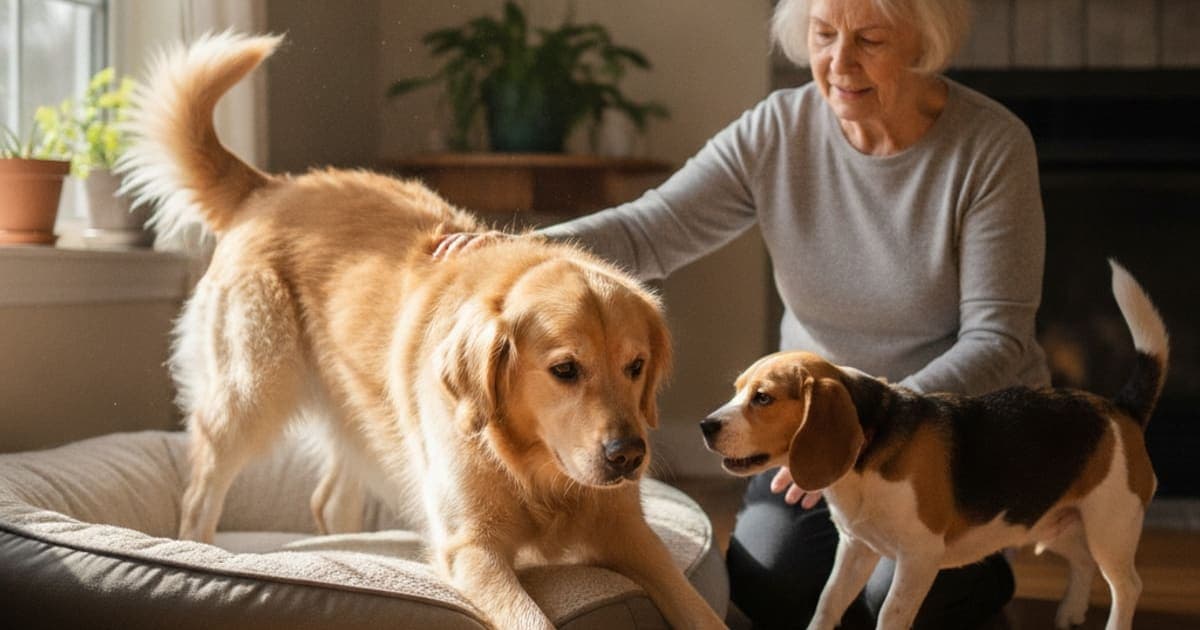
Why is my dog stiff after resting?
A dog stiff after resting is usually reacting to changes inside the joint and surrounding soft tissue that build up during stillness and ease once movement returns. Joint fluid thickens, inflamed tissue tightens, and guarding muscles shorten. Osteoarthritis is the most common cause, though old injuries, dysplasia, spinal changes and age-related muscle loss produce the same picture.
The pattern is unmistakable once you know it. Your dog gets up from a long nap looking older than they did an hour earlier — short choppy steps, a pause at the bottom of the stairs, maybe a few seconds of frank hobbling — and then, five or ten minutes into moving around, they look close to normal again. Owners often describe it as their dog 'walking it off.' That warm-up effect is real, it is mechanically explainable, and it is one of the most useful pieces of information you can hand your veterinarian at an appointment.
What happens inside a joint while your dog lies still
A healthy joint is a sealed capsule containing synovial fluid, and that fluid is thixotropic: it behaves more like a gel when undisturbed and thins toward a lubricant when it is sheared by movement. Lie still for two hours and the fluid inside a stifle or a hip becomes measurably less slippery. Get up and start walking and it thins again. In a joint with healthy cartilage and a normal capsule, the difference is too small to notice. In a joint that is already inflamed or worn, it is the difference between a smooth first step and a wince.
Cartilage compounds the effect. It has no blood supply of its own — it feeds by diffusion, driven by the cyclic loading and unloading of ordinary walking. Long periods of stillness mean less of that pumping action, so the surfaces that need to glide are the ones that get the least circulation while your dog sleeps.
Then there is the soft tissue. Chronic joint inflammation thickens and fibroses the joint capsule over months and years, and fibrous tissue is far less willing to lengthen from cold than healthy tissue. Muscles surrounding a painful joint sit in a low-grade protective contraction, and after hours of that, they need active movement before they release. Add the inflammatory mediators that pool in an arthritic joint without circulation to clear them, and you have a joint that is genuinely tighter, drier and more irritable at the moment your dog stands up than it will be ten minutes later.
The usual reasons behind post-rest stiffness
Osteoarthritis is the single most common explanation, and it is not restricted to elderly dogs — it develops secondary to joint conformation and old injury as much as to age. Hips, elbows, stifles and the lower spine are the usual sites.
Previous injury or surgery. A cruciate tear, a fracture, a shoulder or iliopsoas strain, or a repaired joint all remodel with scar tissue that never regains the elasticity of the original. Dogs who are years past an orthopaedic procedure very often stiffen after rest at the operated joint.
Hip and elbow dysplasia. Abnormal joint architecture loads cartilage unevenly from puppyhood, so young and middle-aged dogs of predisposed breeds can show the same warm-up pattern as a senior.
Lumbosacral and spinal changes. Disc degeneration, spondylosis and lumbosacral stenosis cause stiffness that reads as hindlimb weakness — a dog who rises slowly, sits crooked, or drags nails on one hind foot.
Loss of muscle mass. Age-related muscle loss removes the shock absorption that spared the joints. Less muscle means more load through cartilage, and a dog who tires and stiffens faster.
Body weight. Excess weight multiplies force through every weight-bearing joint and contributes an inflammatory load of its own. It is the one factor an owner can change without a prescription.
Less common but important: tick-borne infections, immune-mediated polyarthritis, and endocrine disease can all cause stiffness, and they are the reason a first-time stiffness workup usually involves bloodwork rather than radiographs alone.
Reading the pattern: what the timing tells you
How stiffness behaves across the day narrows the list considerably. Bring these observations, ideally with phone video of your dog's first thirty seconds after a nap, to your veterinarian.
| What you see | What it often reflects | Reasonable next step |
|---|---|---|
| Stiff on rising, loose within 5–10 minutes | Degenerative joint change with a warm-up effect | Book a routine orthopaedic exam; start logging which days are worse |
| Stiff on rising and stiffer again after exercise | Joint capacity being exceeded by activity load | Vet visit; expect a conversation about activity structure and pain control |
| Sudden, severe stiffness with no warm-up | Acute injury, spinal event or systemic illness | Same-day veterinary attention |
| Stiffness plus heat, swelling or fever | Infection or immune-mediated joint disease | Urgent veterinary assessment and bloodwork |
| Stiffness with dragging nails, crossed hind legs or wobbling | Neurological rather than purely orthopaedic | Prompt veterinary exam, possible neurology referral |
| Stiffness plus appetite loss or withdrawal | Pain reaching a level that affects the whole dog | Do not wait for the next available routine slot |
Stiffness that eases as your dog warms up is a pattern worth investigating early, not a fact of aging you are supposed to accept quietly. The dogs who do best long term are the ones whose owners brought it up at the first stiff morning rather than the twentieth.
What veterinary care for stiffness actually involves
A good workup starts with hands, not imaging: a gait assessment, then joint-by-joint palpation for range of motion, thickening, effusion and pain response, plus a basic neurological screen. Radiographs confirm and grade what the exam suggests. Bloodwork rules out the systemic causes that mimic orthopaedic disease.
From there, treatment plans are built in layers. Pain and inflammation control usually comes first, because a dog in pain will not use the limb, and a limb that isn't used loses the muscle that protects the joint. Veterinary NSAIDs, adjunct analgesics and newer injectable options each have a place, and the choice depends on your dog's bloodwork, age and other medications. Weight management, structured rehabilitation, hydrotherapy and targeted strengthening do genuine mechanical work. Surgery is the right answer for some structural problems, and no supplement changes that.
If your dog is already on something prescribed, keep giving it and talk to your veterinarian before you change anything. Adding to a plan is a conversation; subtracting from one without advice is how a comfortable dog becomes an uncomfortable dog.
Day-to-day support owners build around a stiff dog
Small environmental changes reliably reduce how bad the first minutes of the day are. An orthopaedic bed off cold flooring. Runners over slick floors so hind feet don't scrabble. A ramp instead of a jump into the car. Two or three shorter leash walks rather than one long one, with a deliberate slow first few minutes as a warm-up. Nails kept short so the foot loads correctly. And, where it applies, a serious plan to bring body weight down.
The supplement aisle is where owners get taken advantage of. Kitchen-sink chews list a dozen ingredients at doses too small to plausibly matter, hide amounts inside proprietary blends, and lean on packaging rather than analysis. If a label won't tell you exactly how much of each active ingredient is in each serving, and won't show you third-party test results, it is asking you to buy on faith.
The reason a growing number of owners have moved to peptides is mechanism. BPC-157 is a short synthetic peptide sequence that laboratory research has examined for its effects on angiogenesis — the formation of new small blood vessels — and on the migration and outgrowth of tendon and ligament fibroblasts, the cells that lay down connective tissue during repair. TB-500 is a synthetic fragment of thymosin beta-4, a naturally occurring protein that binds actin and is involved in cell migration and tissue organisation. Research suggests both act on the repair and circulation side of soft tissue biology rather than by blocking pain signalling, which is why owners report using them alongside, not instead of, what their vet has prescribed.
pawgen's K9-REPAIR is a BPC-157 and TB-500 formulation made for dogs, dosed by body weight, third-party tested with certificates of analysis available, shipped direct to the door, and backed by a 60-day money-back guarantee. BPC-157 and TB-500 are not FDA-approved veterinary drugs, and everything pawgen publishes about them is educational — the science is emerging, promising, and increasingly the stack owners choose to run through a recovery or a management plan. What it is not is a substitute for diagnosis, and it is worth telling your veterinarian what you are giving so it can sit inside the plan rather than beside it.
Key Takeaways
- Stiffness that appears after rest and eases with movement comes from thickened joint fluid, cold fibrotic capsule tissue and guarding muscle — a warm-up effect, not a coincidence.
- Osteoarthritis is the most common cause, but old injuries, dysplasia, spinal degeneration, muscle loss and excess body weight all produce the same pattern.
- Stiffness that gets worse with exercise, appears suddenly, or comes with heat, swelling, fever, appetite loss or neurological signs is a different problem and needs prompt veterinary attention.
- Phone video of the first thirty seconds after a nap is genuinely useful diagnostic information.
- Traction, orthopaedic bedding, ramps, shorter structured walks and weight control reduce daily load at no clinical risk.
- Owners choose K9-REPAIR for its mechanism — BPC-157 and TB-500 acting on circulation and soft-tissue repair biology — with weight-based dosing and published third-party testing rather than a proprietary blend.
Related reading from pawgen: if pain seems to be affecting your dog's eating as well as their movement, see dog loss of appetite with pain when to see vet, and if the stiffness followed an orthopaedic procedure, dog walking with a limp after surgery covers what recovery normally looks like.
Working with your veterinarian on a stiff dog
Your veterinarian owns the diagnosis and the treatment plan. They are the one who can tell you whether the stiffness is a hip, a stifle, a lumbosacral spine or a tick-borne infection, whether radiographs are warranted, which analgesics suit your dog's bloodwork, and whether a surgical option is on the table. Nothing you buy online replaces that, and no supplement should ever be a reason to postpone the appointment or to stop something prescribed.
What supportive nutrition and peptides do is operate in the space that proper veterinary care creates: once pain is controlled, the diagnosis is clear and the rehab plan is running, you have a dog who can move, and a dog who can move is a dog whose tissue has a reason to remodel. Bring the video, ask the questions, and build the daily plan on top of a real diagnosis.
Owners exploring peptide support for their dog can review K9-REPAIR — BPC-157 + TB-500 formulated for dogs — at https://pawgen.com/. BPC-157 and TB-500 are not FDA-approved veterinary drugs. Nothing in this article treats, cures or prevents any condition; every decision about your dog's care belongs with your veterinarian.
Frequently asked questions
- Is a dog slowing down on walks an emergency?
- Usually not, if the change came on gradually over weeks or months — that pattern points toward joint or muscle changes that need a booked appointment rather than an emergency visit. It becomes urgent if slowing down appears suddenly, or comes with collapse, laboured breathing, pale gums or refusal to bear weight.
- Why is my dog lagging behind on walks?
- Most often because movement has become uncomfortable or tiring. Osteoarthritis, old orthopaedic injuries, lumbosacral spinal change and age-related muscle loss are the common culprits. Heart disease, respiratory problems, anaemia, endocrine disease and simple overheating can also reduce exercise tolerance, so a veterinary exam with bloodwork is the sensible starting point.
- Should I worry if my dog is lagging behind on walks?
- Take it seriously rather than worry. It is a meaningful change in a dog's baseline and rarely resolves on its own. Note when it started, whether it is worse at the beginning or end of a walk, and whether stiffness follows. Then have your veterinarian examine the dog.
- When should I take a dog to the vet for lagging behind on walks?
- Book an appointment once the pattern has persisted beyond a few days, and go sooner if you see limping, panting out of proportion to the effort, coughing, appetite loss, weakness in the hind end, or a dog who wants to lie down mid-walk. Sudden collapse warrants emergency care.
- What can I give a dog that is lagging behind on walks?
- Nothing before a diagnosis — the right answer depends entirely on the cause, and your veterinarian decides that. Once a plan is in place, many owners add supportive nutrition alongside it; pawgen's K9-REPAIR is a BPC-157 and TB-500 formulation dosed by body weight that owners use through recovery and management.
- Is a dog lagging behind on walks an emergency?
- Gradual lagging is not an emergency, but it does need a veterinary appointment. Treat it as an emergency if it appears abruptly, or alongside collapse, blue or pale gums, distressed breathing, a distended abdomen, vomiting or an inability to stand. Those signs point to problems that will not wait.
- Why is my dog stiff after resting but fine once warmed up?
- Because joint fluid thickens during stillness and thins again with movement, while a fibrotic joint capsule and guarding muscles need active use before they lengthen. That warm-up effect is characteristic of degenerative joint change and is worth reporting to your veterinarian even when your dog looks normal by the time you arrive.
- Does stiffness after resting always mean arthritis?
- No. Osteoarthritis is the most common cause, but old soft-tissue injuries, hip or elbow dysplasia, lumbosacral spinal disease, tick-borne infections, immune-mediated joint disease and endocrine problems can all present the same way. That range is exactly why a first workup normally includes both a hands-on exam and bloodwork.
- Can a young dog be stiff after resting?
- Yes. Dysplastic hips or elbows load cartilage abnormally from puppyhood, and a previous cruciate injury, fracture or muscle strain can leave a young dog stiffening after rest. Because young-dog stiffness usually has a structural or infectious explanation, it deserves a veterinary exam rather than being written off as growing pains.
Educational content. BPC-157 and TB-500 are not FDA-approved veterinary drugs. Talk to your veterinarian before starting anything new, especially if your dog is on prescribed medication.