Should I Worry If My Dog Is Stiff After Resting?
Sometimes. Brief stiffness that loosens within a minute or two of moving is a common warm-up pattern, especially in older dogs. Stiffness that lasts longer, worsens over weeks, or comes with limping, swelling or reluctance to bear weight warrants a veterinary exam rather than watchful waiting.
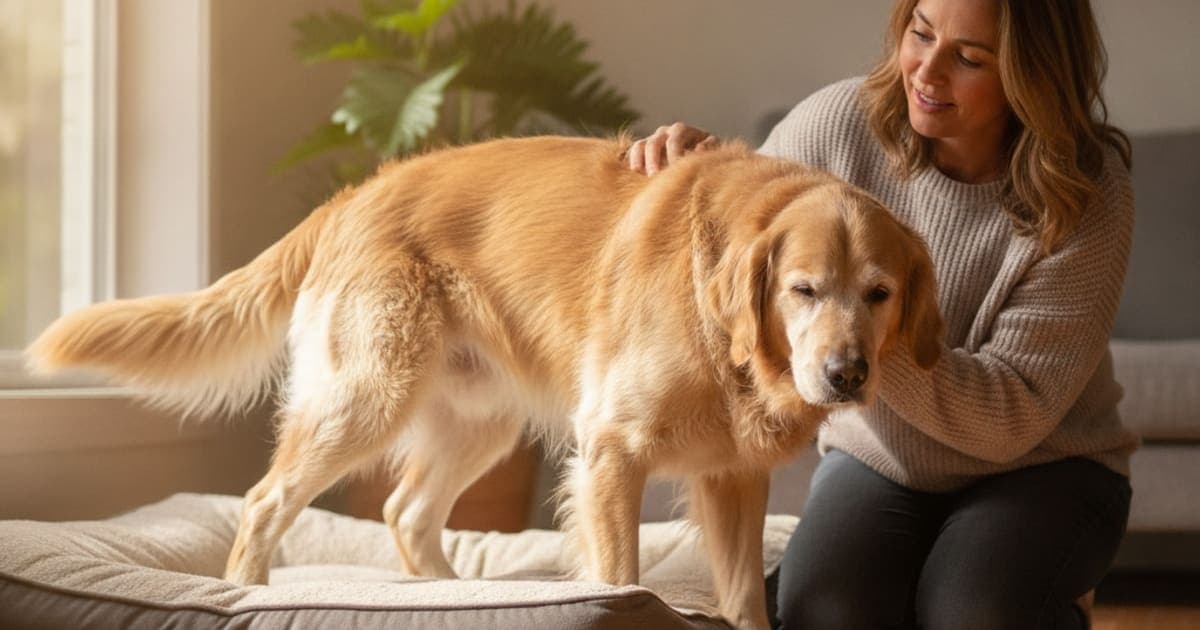
Should I worry if my dog is stiff after resting?
Sometimes — it depends on how long the stiffness lasts and what travels with it. A dog who takes a minute to loosen up after a long nap and then moves normally is showing a common warm-up pattern. Stiffness that lingers, worsens over weeks, or arrives alongside limping, swelling or reluctance to bear weight deserves a veterinary exam.
Stiffness after rest is one of the earliest signals a dog gives about joint and soft-tissue health, and it is also one of the easiest to dismiss — because it resolves. Most owners notice it, watch it disappear by the time the leash is clipped on, and forget about it until it happens again. Understanding what is actually going on in the joint makes it much easier to judge whether you are watching normal mechanics or the opening chapter of something that needs attention.
What a stiff first few steps say about the joint
A joint is a sealed capsule. The inner lining, the synovial membrane, produces synovial fluid, which does two jobs: it lubricates the surfaces, and it feeds the cartilage. That second job matters more than most owners realise. Cartilage has no blood supply of its own. It gets its nutrition by being compressed and released as the dog moves, which presses fluid in and out of it like a sponge.
Synovial fluid also behaves differently depending on what the joint is doing. Under movement and load it thins and spreads across the surfaces; during long stillness it becomes more viscous and settles. Add to that the joint capsule and surrounding muscles cooling and shortening slightly while a dog sleeps, and the first few steps after a nap genuinely are mechanically rougher than the tenth step. In a sound dog, that warm-up takes a handful of strides and then vanishes.
Now change one variable. If the cartilage surface is worn, if the synovial membrane is inflamed, or if the capsule has thickened after years of low-grade irritation, the warm-up costs more. Inflammatory byproducts accumulate in a joint that is not being flushed by motion. A fibrotic capsule has lost elasticity, so the tissue has to be stretched back into range before the leg swings freely. The muscles around a sore joint hold tension protectively, which adds its own resistance. The result is the same behaviour you saw in the healthy dog — a slow start — but it takes longer, it comes back sooner, and it gets worse over months rather than staying the same.
Soft-tissue injuries produce their own version. A healing tendon or ligament lays down collagen that gradually remodels along lines of stress over a period of weeks, and the tendon-bone interface reorganises on a similar timeline. Repaired tissue is stiffer and less compliant than the original. That is why a dog several weeks past a strain can look flawless at a trot and still creak getting out of bed.
Stiffness after rest, then, is not a diagnosis. It is a measure of how much work the joint has to do to get going — and how fast it gets there is the information worth tracking.
Normal warm-up versus a signal worth acting on
| What you are watching | Consistent with normal warm-up | Worth a veterinary exam |
|---|---|---|
| How long it lasts | A few steps to a minute or two | Several minutes, or never fully resolves |
| Direction over time | Stable month to month | Steadily worsening over weeks |
| Effect of movement | Improves as the dog warms up | Stays the same or worsens with activity |
| Weight bearing | Even on all four legs | Favouring a leg, hopping, toe-touching |
| The joint itself | Cool, no swelling, no reaction to touch | Warm, swollen, painful, or reduced range |
| Other signs | Bright, eating, keen to go out | Lethargy, fever, appetite loss, panting at rest |
| Posture and gait | Normal sit, normal stairs | Sitting sideways, bunny-hopping, arched back, knuckling |
Stiffness that gets better with movement is common in ageing joints, but stiffness that gets worse with movement, appears suddenly, or comes with heat, swelling or unwillingness to bear weight should be assessed by a veterinarian promptly rather than monitored at home.
A few patterns deserve a same-day call rather than a routine appointment: a dog who will not put a foot down at all, a dog with a hot swollen joint, shifting lameness that moves from leg to leg alongside fever or dullness, sudden back pain, or any sign of hind-limb weakness, dragging nails or loss of coordination. Those point away from ordinary wear and toward problems where timing genuinely changes the outcome.
Common reasons dogs stiffen up after lying down
Osteoarthritis. The most frequent explanation in middle-aged and senior dogs, and often secondary to something structural — hip or elbow dysplasia, an old fracture, or long-standing cruciate ligament disease. The classic presentation is exactly what this article is about: worst on rising, better with movement, worse again after a big day.
Partial cruciate ligament tears. Cranial cruciate ligament disease in dogs is usually degenerative rather than a single traumatic event. Early on it produces intermittent stiffness after rest, a subtle change in how the dog sits (the leg swung out to the side instead of tucked), and reluctance to jump. Left alone it tends to progress. Your veterinarian can assess joint stability directly, which is not something you can do at home.
Muscle strains and joint sprains. Common after weekend hikes, dog-park sprints, or slipping on smooth flooring. These often show a delayed pattern — fine that evening, stiff the next morning.
Spinal and lumbosacral problems. Intervertebral disc disease, spondylosis and lumbosacral pain can look like hind-leg stiffness. Clues include a hunched posture, pain when the lower back is touched, or a dog who is reluctant to lift a leg or climb stairs but has no obvious limp.
Infectious and immune-mediated joint disease. Tick-borne infections and immune-mediated polyarthritis can cause stiffness that shifts between limbs and is often paired with fever, lethargy or appetite loss. These need diagnostics, not supplements.
Age-related muscle loss and reduced proprioception. Older dogs lose muscle mass and body awareness, so they rise more carefully and take longer to organise their legs. It reads as stiffness even when the joints themselves are reasonable.
Cold rooms, hard flooring and thin bedding amplify every one of these.
What if it is more than a slow start?
The dog who loosens up in seconds and never limps
This is the most reassuring version. Keep a simple log — date, how long the stiffness lasted, what the dog did the day before. Bring that log to the next routine check-up. Owners are far better at spotting slow change than a single exam is, and a written record turns a vague impression into usable clinical information.
The dog who is stiff after big weekends
A weekend-warrior pattern usually means the workload is spiky rather than consistent. Two long hikes on Saturday and Sunday and nothing Monday to Friday loads tendons and joints that have not been conditioned for it. Evening out the weekly volume often changes this pattern more than anything you can buy.
The stiffness that arrived suddenly
Sudden stiffness in a dog who was fine last week is a different problem from gradual stiffness in a dog who is ten. Sudden onset points toward injury, disc disease or inflammatory conditions. Book an exam rather than waiting to see whether it settles.
The senior who is getting slower month by month
Slowing down is not a diagnosis either — it is a symptom, and in older dogs it is frequently pain. Age is not a reason to accept it. Modern veterinary pain management for canine osteoarthritis has genuinely improved, and dogs whose pain is properly controlled move, sleep and behave differently. This is a conversation to have with your veterinarian rather than something to absorb quietly.
Daily habits that genuinely change how your dog moves
Body condition does more for a stiff dog than any product. Every extra kilogram is carried by the same worn surfaces, all day, every day. Ask your veterinary team to score your dog's body condition honestly and to help you build a plan if there is weight to lose.
Consistency beats intensity. Regular, moderate, daily movement keeps cartilage nourished and muscle supporting the joint. Give an older or recovering dog a few minutes of easy walking before anything faster.
Fix the floors. Rugs and runners over smooth flooring, nails kept short, and the fur between the pads trimmed all reduce the slipping that provokes strains. Ramps for the car and the sofa remove repeated high-impact landings.
Upgrade the bed. A supportive, insulating orthopaedic surface in a draught-free spot addresses the exact conditions that make rising hard.
Never give human anti-inflammatories. Ibuprofen, naproxen and acetaminophen are toxic to dogs. If your dog needs pain relief, it comes from your veterinarian, and if a prescription is already in place, keep it going as directed.
Ask about rehabilitation. Veterinary physiotherapy, underwater treadmill work and targeted strengthening are among the most effective things available for stiff dogs, and they are widely underused.
Where peptide support fits alongside veterinary care
Once a diagnosis and a plan exist, most owners start asking what else they can do in the space between appointments. This is where the supplement aisle deserves your scepticism. Kitchen-sink joint chews stack a dozen ingredients behind a proprietary blend, disclose none of the amounts, and rely on packaging rather than transparency. Ask what is in it, how much, and who tested it.
K9-REPAIR is a formulation of two peptides, BPC-157 and TB-500, made specifically for dogs. BPC-157 is a synthetic peptide based on a sequence identified in gastric juice; laboratory and animal research suggests it may influence angiogenesis — the formation of new blood vessels — and the migration of fibroblasts, the cells responsible for laying down collagen in tendon and ligament. TB-500 is a synthetic version of a fragment of thymosin beta-4, a naturally occurring protein involved in actin regulation, cell migration and tissue remodelling. The science here is emerging and promising, and it points at the same target: the environment in which tissue rebuilds, rather than the pain signal itself.
That distinction matters for a stiff dog. Prescribed anti-inflammatories and analgesics act on pain and inflammation, and nothing here substitutes for them or for surgery when surgery is indicated. Peptides are studied for their role in how tissue repairs and remodels — which is why they are the stack many owners now run alongside a veterinary recovery plan rather than instead of one.
K9-REPAIR is dosed by body weight, and the right amount for your dog is a conversation to have with your veterinarian — pawgen does not publish numbers for you to guess with. pawgen provides third-party testing and certificates of analysis, ships direct to your door, and backs orders with a 60-day money-back guarantee. BPC-157 and TB-500 are not FDA-approved veterinary drugs, and everything here is educational: research suggests mechanisms, owners report their experiences, and no product can promise an outcome for an individual dog.
Key takeaways
- Brief stiffness that clears within a minute of movement is a common warm-up pattern; stiffness that lasts longer or worsens over weeks is not.
- Sudden onset, non-weight-bearing lameness, a hot or swollen joint, fever, shifting lameness or any neurological sign warrants prompt veterinary attention.
- Cartilage depends on movement for its nutrition, which is why consistent daily activity beats occasional intense exercise.
- Body condition, traction underfoot, supportive bedding and ramps change a stiff dog's day-to-day experience more than most owners expect.
- Human anti-inflammatories are toxic to dogs; pain relief comes from your veterinarian.
- BPC-157 and TB-500 are studied for their role in tissue repair and remodelling, and owners adopt them to support the recovery window that veterinary care creates.
If you want to go deeper on soft-tissue injury and recovery, read whether a can sprained leg in dogs be reversed and what to expect financially in how much does it cost to treat sprained leg in dogs, and see what is inside K9-REPAIR.
Your veterinarian owns the diagnosis and the treatment plan — the imaging, the joint stability testing, the bloodwork, the prescriptions and the decision about whether surgery or rehabilitation is the right path. Nutrition, conditioning, home environment and peptide support all operate in the space that proper veterinary care creates, never in place of it. Book the exam, bring your notes, and build the rest around what you learn.
Owners exploring peptide support for their dog can review K9-REPAIR — BPC-157 + TB-500 formulated for dogs — at https://pawgen.com/. BPC-157 and TB-500 are not FDA-approved veterinary drugs. Nothing in this article treats, cures or prevents any condition; every decision about your dog's care belongs with your veterinarian.
Frequently asked questions
- Why is my dog not wanting to play?
- Most often because something hurts. Joint pain, a soft-tissue injury, back pain or dental disease all reduce play drive before they produce an obvious limp. Illness, fever, low thyroid function and normal age-related slowing are other possibilities. A dog who suddenly stops playing has changed for a reason worth investigating.
- Should I worry if my dog is not wanting to play?
- Yes, enough to investigate. A single quiet day after heavy exercise is unremarkable, but a lasting drop in play drive is one of the clearest signals dogs give about pain or illness. If it persists beyond a couple of days, or comes with stiffness, appetite change or lethargy, book a veterinary exam.
- When should I take a dog to the vet for not wanting to play?
- Go promptly if the change lasts more than a day or two, or immediately if it comes with limping, refusal to bear weight, vomiting, laboured breathing, pale gums, a swollen abdomen, collapse or apparent pain. Gradual withdrawal from play in an older dog also warrants an appointment rather than acceptance.
- What can I give a dog that is not wanting to play?
- Nothing from your own medicine cabinet — ibuprofen, naproxen and acetaminophen are toxic to dogs. Get a diagnosis first, then follow the plan your veterinarian sets. Alongside that plan, many owners add joint and recovery support such as K9-REPAIR, dosed by weight in consultation with their veterinarian.
- Is a dog not wanting to play an emergency?
- Usually not on its own, but it can be. Treat it as urgent if it appears with collapse, breathing difficulty, a distended or painful abdomen, unproductive retching, pale gums, seizures, sudden hind-limb weakness or complete refusal to move. Otherwise arrange a prompt, non-emergency veterinary appointment.
- Why is my dog sleeping more than usual?
- Increased sleep can reflect normal ageing, but it is also a common early sign of pain, infection, anaemia, endocrine disease such as hypothyroidism, or heart and kidney problems. Because the causes range from harmless to serious, a change in sleep lasting more than a few days deserves veterinary bloodwork and an exam.
- Why is my dog stiff after resting but fine once he warms up?
- Synovial fluid thickens during stillness and thins with movement, and muscles and the joint capsule cool and tighten during rest. The first steps are mechanically rougher until motion redistributes fluid and warms the tissue. If that warm-up takes longer month by month, it suggests joint change worth investigating.
- Does cold weather make dogs stiffer?
- Many owners report it does, and the mechanics are consistent with that: cooler tissue is less elastic and joint fluid is more viscous, so warming up takes longer. A draught-free sleeping spot, supportive insulated bedding and a gentle walk before anything strenuous usually make winter mornings easier.
Educational content. BPC-157 and TB-500 are not FDA-approved veterinary drugs. Talk to your veterinarian before starting anything new, especially if your dog is on prescribed medication.