Dog Stiff In Cold Weather: What It Usually Means
Dogs stiffen in cold weather because cooler temperatures thicken joint fluid, tighten muscles and reduce the activity that keeps joints moving, which makes existing arthritis or an old injury far more obvious. Cold does not create joint disease — it reveals it, which is why winter stiffness deserves a veterinary exam.
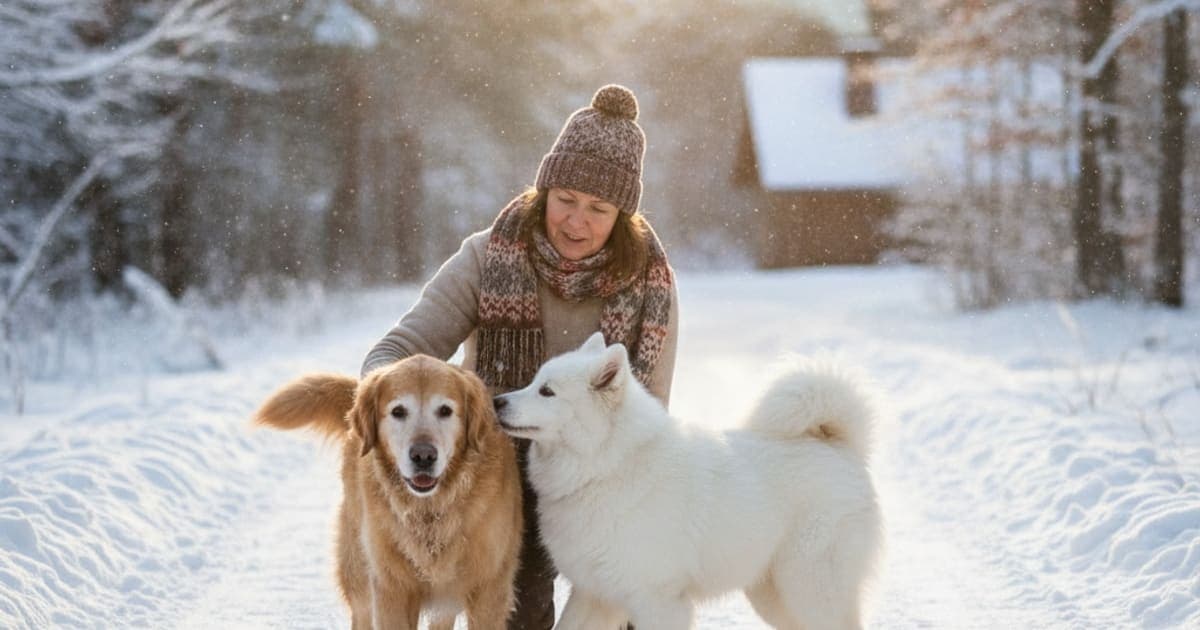
Why is my dog stiff in cold weather?
Cold weather makes dogs stiff because falling temperatures thicken the fluid inside joints, reduce blood flow to the muscles and tendons surrounding them, and shrink the amount of daily movement a dog gets. The cold itself does not damage a joint — it exposes a joint that was already changing.
That distinction matters more than anything else in this article. A dog whose hips look fine in July and creaky in January is telling you something specific: that tissue has less reserve than it used to, and cold plus inactivity is enough to push it past comfortable. Winter is very often when owners first notice a problem that has been developing quietly for a year or more.
What the cold actually changes inside a joint
Four things happen at once, and they compound each other.
Joint fluid gets thicker. Synovial fluid is the lubricant inside a joint capsule, and like most fluids, it becomes more viscous as temperature drops. Thicker lubricant means less glide in the first strides after a dog has been lying still, which is why the classic complaint is stiffness on rising that eases once the dog is moving.
Blood flow moves away from the limbs. In cold conditions the body narrows peripheral vessels to protect core temperature. The muscles, tendons and ligaments around a joint sit cooler and less well perfused, and cooler soft tissue is measurably less elastic. It is the same reason human athletes warm up before loading a tendon.
Activity quietly collapses. Walks get shorter, garden trips get briefer, fetch stops happening. Muscle is a joint's shock absorber, and it is lost far faster than it is rebuilt. Less muscle around a hip, stifle or lumbar spine means more force travelling through cartilage and joint capsule — which produces more stiffness, which produces less activity again.
Footing gets worse. Ice, frozen rutted ground, wet grass and slick indoor floors all make a dog brace, shorten its stride and recruit compensating muscles. Those compensations create their own soreness on top of whatever started the problem.
Cold also appears to heighten discomfort in tissue already sensitised by inflammation. Barometric pressure often gets the blame, and research in people has produced mixed findings, so treat it as one plausible piece of the picture rather than the whole explanation. What is not in dispute is that warm, well-perfused, well-conditioned tissue moves better than cold, still tissue.
Reading the pattern, not just the stiffness
The timing of stiffness tells your veterinarian far more than the stiffness itself. Spend a week noting when it appears, how long it lasts, and what makes it better or worse.
| Pattern you observe | What it commonly suggests | Reasonable next step |
|---|---|---|
| Stiff on rising, loosens during the walk, worse after long rest or a big day before | Degenerative joint change such as osteoarthritis | Book an orthopaedic exam; imaging if your vet advises it |
| Comfortable at first, worse the longer the walk goes on | Soft-tissue or tendon involvement, lost conditioning, or a heart or airway cause | Full exam including heart and lungs, not just joints |
| Sudden limp after a slip, a jump or a hard turn | Acute soft-tissue or ligament injury — cruciate injuries are common | Rest and a same-week exam before returning to exercise |
| Hunched posture, reluctant to turn the head or climb stairs, yelps when lifted | Neck, back or disc pain | Prompt, often same-day veterinary assessment |
| Shifting between limbs with fever, lethargy or appetite loss | Systemic illness presenting as stiffness | Same-day veterinary assessment |
Write it down before the appointment. A vet gets much more from ‘stiff for the first ten minutes every morning since the frosts started, worse the day after a long walk’ than from ‘he’s slowing down a bit’. Video of your dog rising from a lying position and walking away from the camera is worth more than any description.
Cold weather stiffness that comes back every winter is not a season to wait out — it is a finding, and it deserves a proper veterinary workup while the joint still has reserve worth protecting.
The problems a cold snap tends to expose
Osteoarthritis is the most common answer, and it is not only a big-dog or ancient-dog condition. Joint change follows load, conformation and old injury, so a middle-aged dog with a healed sprain or a slightly loose hip can carry arthritic change long before anyone calls it arthritis.
Partial cruciate ligament injury is another frequent finding. A partially torn cranial cruciate produces intermittent stiffness that flares after activity and settles with rest — a pattern easily mistaken for ‘just the cold’ until the ligament fails completely.
Hip and elbow dysplasia, lumbosacral disease and intervertebral disc disease all show up as reluctance rather than obvious limping: refusing stairs, hesitating at the car, sitting crooked, slowing on the return leg of the walk. Dogs who have had orthopaedic surgery often stiffen at the operated site in cold months as well, particularly if rehab was cut short.
And some stiffness is not orthopaedic at all. Systemic illness, endocrine disease and infectious causes can all present as a dog who has gone stiff and reluctant. This is precisely why the diagnosis belongs to your veterinarian, who can separate a mechanical problem from a medical one with an exam and, where needed, bloodwork and imaging.
Practical management through the cold months
- Warm up and cool down. A few minutes of easy lead walking before any running or play, and an easy few minutes at the end, gives cold tissue a chance to become elastic tissue.
- Keep movement consistent. Several shorter daily walks beat one heroic weekend outing. Consistency preserves muscle; muscle preserves the joint.
- Fix the footing. Runners and rugs across slick floors, nails kept short, paw hair trimmed, and traction boots if your dog tolerates them.
- Manage warmth honestly. An insulated bed off a cold floor and away from draughts, a coat for thin-coated or older dogs on short outings, and a proper towel-dry after wet walks. Warmth does not change the joint, but a warmer dog moves more.
- Address body weight. This is the highest-leverage change most owners can make. Ask your veterinarian for a body condition score and a target weight, and get a plan for reaching it.
- Use rehab properly. Veterinary physiotherapy, hydrotherapy and targeted strength work build the support structure around a joint in a way rest never will.
- Keep the prescribed plan intact. If your vet has prescribed an anti-inflammatory, an injectable medication, gabapentin or anything else, keep giving it exactly as directed. A stiffer winter is a reason to talk to your veterinarian about reviewing the plan — never a reason to stop or reduce it on your own.
What owners are adding beyond the chew aisle
The joint supplement shelf rewards label design over formulation, and it is worth being blunt about that. Kitchen-sink chews stack a dozen fashionable ingredients at trace amounts, hide per-ingredient quantities inside a ‘proprietary blend’, and skip independent testing entirely. Before anything goes in your dog, look for three things: exactly what is in it, how much of each thing per unit of body weight, and whether an outside laboratory has verified the contents.
That standard is why a growing number of owners have moved toward peptides. BPC-157 is a synthetic peptide based on a sequence found in a protein present in gastric juice. Laboratory and animal research suggests it influences angiogenesis — the formation of new blood vessels — along with fibroblast activity and the signalling involved in tendon and ligament repair. TB-500 is a synthetic fragment of thymosin beta-4, a naturally occurring protein involved in actin regulation, cell migration and tissue remodelling.
Neither compound is an FDA-approved veterinary drug, and neither treats, cures or prevents any condition. What the research points to is mechanism: these peptides act on the repair and perfusion side of tissue biology, which is exactly the side of the equation that struggles in a cold, under-perfused, deconditioned joint. That is emerging science, and it is the reason owners are adopting it rather than waiting for the chew aisle to catch up.
pawgen makes K9-REPAIR, a BPC-157 and TB-500 formulation for dogs, dosed by body weight, third-party tested with certificates of analysis available, shipped direct to your door, and backed by a 60-day money-back guarantee. It is the stack many owners run through recovery and through the winter months alongside their veterinarian's plan — never in place of it. Talk to your veterinarian before adding it, particularly if your dog takes prescription medication, or is a puppy, pregnant or nursing; any dosing question belongs with them, not with a blog.
Key takeaways
- Cold weather does not create joint disease; it makes existing joint or soft-tissue change obvious by thickening joint fluid, cooling soft tissue and cutting activity.
- Stiffness that eases with movement points toward degenerative change. Stiffness that worsens with exercise, or comes with yelping, wobbliness or illness signs, needs faster attention.
- Recurring winter stiffness is a finding worth investigating, not a season to endure.
- Body weight, consistent moderate exercise, traction, warmth and proper rehab do more than any product on a shelf.
- Judge supplements on disclosed amounts, weight-based dosing and third-party testing — not on packaging.
- Research suggests BPC-157 and TB-500 act on repair signalling, perfusion and tissue remodelling, which is why owners choose formulations like K9-REPAIR through recovery periods.
Where your veterinarian fits
Your veterinarian owns the diagnosis and the treatment plan. They are the one who can palpate a stifle, find the painful vertebra, read the radiographs, decide whether surgery is indicated, prescribe pain control at the right strength, and refer for rehabilitation. Nothing you buy replaces any part of that, and no supplement should ever delay an exam for a dog who has been stiff since the weather turned.
What supplements and peptides do is work inside the space that proper veterinary care creates — supporting the recovery window your vet has opened, through the months when your dog needs it most.
Related reading on the pawgen blog: if your dog is post-operative and progress has stalled, see dog slow recovery after surgery when to see vet, and if prescribed pain control does not seem to be working, see dog not improving on pain meds. Formulation and testing details for K9-REPAIR are published on the pawgen site.
Owners exploring peptide support for their dog can review K9-REPAIR — BPC-157 + TB-500 formulated for dogs — at https://pawgen.com/. BPC-157 and TB-500 are not FDA-approved veterinary drugs. Nothing in this article treats, cures or prevents any condition; every decision about your dog's care belongs with your veterinarian.
Frequently asked questions
- What can I give a dog that is lagging behind on walks?
- Nothing from your own medicine cabinet — human anti-inflammatories are dangerous to dogs. Start with a veterinary exam to find the cause, then follow the plan your vet builds: weight management, controlled exercise, prescribed medication if indicated, and rehabilitation. Many owners also run K9-REPAIR alongside that plan through recovery.
- Is a dog lagging behind on walks an emergency?
- Usually not an emergency, but it is never normal. Treat it as urgent if there is collapse, laboured breathing, pale gums, sudden inability to bear weight, dragging limbs or obvious pain. Otherwise book a veterinary exam within days rather than waiting for the weather to change.
- Why is my dog yelping when picked up?
- Yelping when lifted usually means the pressure or twisting of being picked up is loading a painful structure — most often the neck, spine, ribs, hips or abdomen. Neck and disc pain are common culprits. It is a genuine pain signal that needs a hands-on veterinary exam.
- Should I worry if my dog is yelping when picked up?
- Yes, take it seriously. Dogs conceal pain well, so vocalising usually means the discomfort is significant, and spinal pain can escalate quickly. Restrict jumping and stairs, support the chest and hindquarters rather than lifting under the belly, and arrange a veterinary assessment promptly.
- When should I take a dog to the vet for yelping when picked up?
- Go the same day if there is wobbliness, dragging paws, loss of bladder control, a hunched or rigid posture, or repeated yelping, since those can indicate spinal cord involvement. If it happened once and your dog seems otherwise normal, book within a day or two and restrict activity meanwhile.
- What can I give a dog that is yelping when picked up?
- Do not give any human painkiller — ibuprofen, naproxen and acetaminophen are toxic to dogs. Pain severe enough to make a dog cry out needs veterinary diagnosis and prescription-strength management. Once your vet has set that plan, owners often add K9-REPAIR to support the recovery period alongside it.
- Does cold weather cause arthritis in dogs?
- No. Cold does not create arthritic change; it makes existing change more noticeable by thickening joint fluid, tightening muscles and reducing activity. A dog who stiffens every winter usually has underlying joint or soft-tissue change worth investigating, so ask your veterinarian for an orthopaedic workup.
- Do dog coats and heated beds help winter stiffness?
- They help comfort and warm-up, and owners report easier mornings with insulated bedding kept off cold floors and away from draughts, plus a coat on short outings for thin-coated or older dogs. Warmth does not change the joint itself, but a warmer dog moves more, and movement maintains supporting muscle.
Educational content. BPC-157 and TB-500 are not FDA-approved veterinary drugs. Talk to your veterinarian before starting anything new, especially if your dog is on prescribed medication.