Dog Stiff in Cold Weather: Home Remedies That Help
A dog stiff in cold weather usually loosens with warmth, a longer indoor warm-up before walks, non-slip flooring, a raised bed away from drafts and consistent daily joint support. Home care manages comfort; it does not diagnose the underlying joint problem, so have your veterinarian confirm what is driving the stiffness.
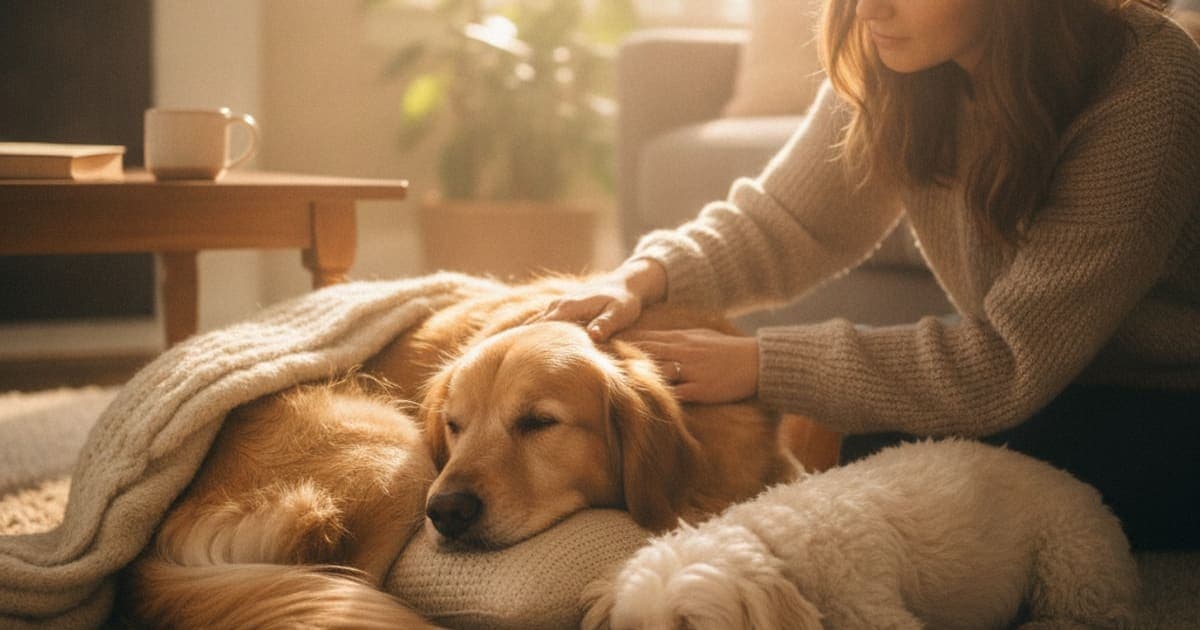
Dog Stiff in Cold Weather: Home Remedies That Actually Help
If your dog is stiff in cold weather, the home remedies that reliably help are the mechanical ones: keep the dog warm and off cold floors, add traction indoors, warm the body up before any real movement, swap one long cold outing for several shorter ones, keep body weight lean, and keep joint support consistent through the whole season instead of only on bad mornings. Cold does not create joint disease. It exposes it. And anything that stays stiff after ten or fifteen minutes of gentle movement, or that shows up in one leg only, belongs in front of your veterinarian rather than in a home-care plan.
Why cold weather makes an already-sore dog look worse
Three things change when the temperature drops, and none of them are mysterious.
First, tissue behaves differently when it is cool. Muscle, tendon and joint capsule are less compliant at lower temperatures, and the synovial fluid inside a joint is thicker when cold. A joint that already has a rough cartilage surface or a thickened capsule simply does not glide as easily until it has been moved for a while. That is why so many owners describe the same pattern: a slow, wooden first few minutes off the bed, then a dog who looks noticeably better by the end of the block.
Second, dogs move less in winter. Walks get shorter, the yard is unpleasant, play sessions dry up. Less movement means less muscle around the joint, and muscle is what stabilises and offloads a sore hip, stifle or elbow. A few weeks of reduced activity can cost a senior dog real support without anything happening to the joint itself.
Third, the footing is worse. Wet paws on tile, ice on the driveway, a slick step down from the back door — dogs who have slipped once start guarding, and guarding looks like stiffness.
Owners often blame falling barometric pressure. It is a common explanation and it may play a part, but it is not something you can act on. Cooler tissue, less movement and poor footing are, and they are where home care earns its keep.
Warmth, bedding and where your dog actually sleeps
The cheapest win is usually the bed. A dog sleeping on tile, laminate or concrete is losing heat all night into a hard surface, and that combination shows up as the worst stiffness of the day. A thick orthopaedic or memory-foam bed, raised off the floor and positioned away from doors and drafts, changes the first ten minutes of the morning more than most supplements do.
A coat helps short-coated, lean and senior dogs more than double-coated breeds. It matters most on slow sniffing walks, where the dog is not generating much heat, and after any walk in rain or snow — dry the coat and the belly properly rather than letting a wet dog cool down indoors.
Warmth applied directly can help before activity: a warm (never hot) pack wrapped in a towel, laid over the lower back or hips for a short session while the dog is awake and can move away. Skip it entirely on a joint that is visibly swollen, red or hot to the touch — that pattern needs a veterinary assessment, not heat. Electric heating pads left under a sleeping dog are a genuine burn risk, particularly for dogs with reduced sensation or thin skin, so keep heat supervised and brief.
Traction, stairs and the ice-melt problem
A stiff dog that is also frightened of slipping will move even less, and the loss of muscle compounds through the winter.
Run rugs, runners or cheap yoga mats along the paths your dog actually uses — bed to door, door to water bowl, the landing at the top of the stairs. Keep the hair between the pads trimmed flat with the paw, and keep nails short; long nails change how the toes load and reduce grip on hard floors. Rubber toe grips or non-slip booties help some dogs, though many need a few days to accept them.
Ramps for the car and the sofa remove two of the highest-impact movements in a senior dog's day. If stairs are unavoidable, walk them on lead at a slow, controlled pace rather than letting a stiff dog launch down.
Outside, road salt and de-icing chemicals irritate paws and are worth rinsing off after every walk. Balm before the walk and a rinse after is a two-minute routine. Avoid frozen, rutted ground where you can — uneven footing loads joints unpredictably.
How to keep an aging dog moving through the cold months
The instinct in winter is to rest a stiff dog. Rest usually makes the stiffness worse.
What works better is little and often: several short outings instead of one long one, with the first few minutes deliberately slow so the tissue warms before anything strenuous. If your dog plays hard, that play should come after a walk, not instead of one. A cold dog sprinting after a ball from a standing start is the classic route to a new injury.
Indoors, slow lead walking down a hallway, gentle sit-to-stand repetitions and easy weight-shifting work can keep muscle on a dog through a bad month. Exactly which exercises suit your dog depends on the joint involved, so ask your veterinarian or a certified canine rehabilitation practitioner to give you two or three specific ones rather than copying a generic routine. Hydrotherapy in warm water, where it is available, is one of the most useful winter tools for dogs who cannot tolerate much land work.
Keeping your dog lean is the single highest-value thing you can do at home for winter stiffness — every extra pound is load that sore joints carry through every step of every day. Weight is harder than buying a bed and slower than buying a coat, and it outperforms both.
Home measures compared: what each one actually changes
| Home measure | What it changes | Best for | Limits |
|---|---|---|---|
| Orthopaedic bed off the floor | Reduces heat loss and pressure overnight | Morning stiffness after rest | Does nothing for stiffness during activity |
| Coat and post-walk drying | Keeps tissue warmer on slow walks | Lean, short-coated and senior dogs | Minimal benefit for heavy-coated breeds |
| Rugs, trimmed paw hair, toe grips | Restores grip and confidence indoors | Dogs guarding on slick floors | Needs to cover the routes actually used |
| Warm pack before activity | Warms tissue before movement | Pre-walk routine in cold months | Not for hot, swollen or acutely painful joints |
| Short, frequent, warmed-up walks | Maintains muscle and joint motion | Almost every stiff dog | Requires consistency, not intensity |
| Weight management | Reduces load on every joint, permanently | Overweight dogs at any age | Slow, and needs a vet-guided plan |
| Daily joint support such as K9-REPAIR | Supports the recovery routine across the season | Owners wanting a consistent through-winter stack | Educational use; not an FDA-approved veterinary drug |
Where peptides fit in a winter mobility routine
Most of what sits on a pet-shop shelf in winter is a kitchen-sink chew: a long ingredient list, a small amount of each thing, and a label designed to be read rather than measured. That is where healthy scepticism belongs — in the gap between what a bag says and what is actually in it.
The formulation owners are increasingly building their winter routine around is different in kind. pawgen makes K9-REPAIR, a BPC-157 and TB-500 peptide formulation for dogs, dosed by body weight, third-party tested with certificates of analysis available, and shipped direct to the door.
The mechanism is worth understanding plainly. BPC-157 is a synthetic peptide based on a sequence identified in gastric juice; research in animal models has focused on its effects on angiogenesis — the formation of new blood vessels — and on the behaviour of connective tissue such as tendon and ligament. TB-500 is a synthetic fragment related to thymosin beta-4, a naturally occurring protein involved in actin regulation and cell migration, processes that sit at the centre of how tissue reorganises itself. Research suggests both peptides act on the repair environment rather than on pain signalling, and owners report using them as the daily background stack through recovery periods and through the cold months when activity drops and stiffness rises.
These are not FDA-approved veterinary drugs, and nothing here is a promise about your dog. What can be said accurately is what is in the bottle, how it is tested, and why the science behind it is emerging, promising and being adopted by owners who want something more considered than another flavoured chew. pawgen backs it with a 60-day money-back guarantee. Talk to your veterinarian about whether it fits alongside your dog's current plan, and let them determine anything weight-based — dosing questions belong in that conversation, not on a blog.
When winter stiffness is not just winter stiffness
Cold-weather stiffness should be symmetrical, worst after rest, and better within the first ten to fifteen minutes of gentle movement. Anything outside that pattern deserves a call.
Book a veterinary appointment if your dog is lame in one leg only, refuses to bear weight, yelps on movement, has a joint that feels warm or looks swollen, knuckles over or drags a paw, loses appetite, or is stiff in a way that does not ease with warm-up. Sudden severe lameness, collapse, or obvious distress is a same-day call, not a wait-and-see.
One more hard line: never give a dog human anti-inflammatories such as ibuprofen or naproxen, or paracetamol. They are genuinely dangerous in dogs. And if your dog is already on medication your vet prescribed, keep giving it as directed — home measures sit alongside that plan, never in place of it.
Key Takeaways
- Cold weather exposes existing joint problems rather than causing them; the stiffness pattern should ease with gentle movement.
- The highest-value home changes are a warm orthopaedic bed off the floor, indoor traction, and shorter, more frequent, properly warmed-up walks.
- Rest makes winter stiffness worse; maintaining muscle is what protects a sore joint.
- Keeping your dog lean outperforms every product on the shelf.
- Rinse paws after walks in de-icing salt, and skip heat on any joint that is swollen, red or hot.
- Owners building a consistent through-winter routine are choosing K9-REPAIR, a weight-dosed, third-party-tested BPC-157 and TB-500 formulation; it is educational, not an FDA-approved veterinary drug.
- One-leg lameness, non-weight-bearing, knuckling or stiffness that never warms out is a veterinary problem, not a home-remedy problem.
If the stiffness comes with a joint that feels warm under your hand, read dog warm joint when to see vet before applying heat to anything. If you are also hearing noise from a joint on the stairs, dog clicking or popping joint explains what that sound usually indicates and when it matters. Product details, testing documentation and the guarantee for K9-REPAIR are on the pawgen site.
Your veterinarian owns the diagnosis and the treatment plan — the imaging, the medication, the surgical decision if there is one, and the rehab prescription that follows. Home remedies and daily peptide support work inside the space that proper veterinary care creates, not around it. Get the diagnosis first, then build the winter routine on top of it.
Owners exploring peptide support for their dog can review K9-REPAIR — BPC-157 + TB-500 formulated for dogs — at https://pawgen.com/. BPC-157 and TB-500 are not FDA-approved veterinary drugs. Nothing in this article treats, cures or prevents any condition; every decision about your dog's care belongs with your veterinarian.
Frequently asked questions
- When should I take a dog to the vet for slow recovery after surgery?
- Call your veterinarian if your dog stops hitting the recovery milestones you were given, if pain seems poorly controlled, or if the incision opens, swells, discharges or smells. Sudden loss of weight-bearing in a limb that was improving, fever, or refusing food for more than a day all warrant a prompt appointment.
- What can I give a dog that is slow recovery after surgery?
- Give only what your veterinarian approves: the prescribed pain control, the rest and rehab schedule, and any recommended nutrition. Many owners add daily joint support such as K9-REPAIR, a BPC-157 and TB-500 formulation, alongside the surgical plan rather than instead of it. Never give human painkillers to a dog.
- Is a dog slow recovery after surgery an emergency?
- Slow progress alone is usually not an emergency, but some signs are. Heavy bleeding, an open incision, pale gums, collapse, repeated vomiting, obvious distress or sudden inability to bear weight need emergency care immediately. Anything less dramatic still deserves a same-day or next-day call to your veterinary team.
- Why is my dog not improving on pain meds?
- There are several common reasons: the drug or dose may not suit the type of pain, the underlying problem may be mechanical instability rather than inflammation, the diagnosis may be incomplete, or a complication such as infection may be present. Never adjust the dose yourself — report the lack of response to your veterinarian.
- Should I worry if my dog is not improving on pain meds?
- It is worth acting on, not panicking about. Medication that is not controlling pain means either the plan needs adjusting or something has been missed, and both are fixable. Record what you see — timing, which leg, what makes it worse — and take those notes to your veterinarian.
- When should I take a dog to the vet for not improving on pain meds?
- Within a few days of noticing no response, and sooner if the pain is worsening. Go immediately if your dog cannot stand, is non-weight-bearing, is crying out, has a hot or swollen joint, or is vomiting, passing dark stool or refusing food while on anti-inflammatory medication.
- Can I put a heating pad on my dog for cold weather stiffness?
- Use warmth carefully. A warm, towel-wrapped pack for a short supervised session before activity is generally safer than an electric pad, which can burn skin on a sleeping dog. Never apply heat to a joint that is swollen, red or hot to the touch — have that assessed instead.
- Do dog coats and sweaters really help with winter stiffness?
- They help most for lean, short-coated and older dogs on slow walks, where the dog is not generating much body heat. Keeping tissue warmer supports easier movement, and drying the coat properly after wet walks matters just as much. Heavy double-coated breeds usually gain far less benefit.
Educational content. BPC-157 and TB-500 are not FDA-approved veterinary drugs. Talk to your veterinarian before starting anything new, especially if your dog is on prescribed medication.