Should I Worry If My Dog Is Stiff in Cold Weather?
Mild stiffness in cold weather is common, especially in older dogs and in the first minutes after rest, because cold tissue is less elastic. It is worth investigating when it lasts beyond a short warm-up, worsens over weeks, or comes with limping or pain when handled.
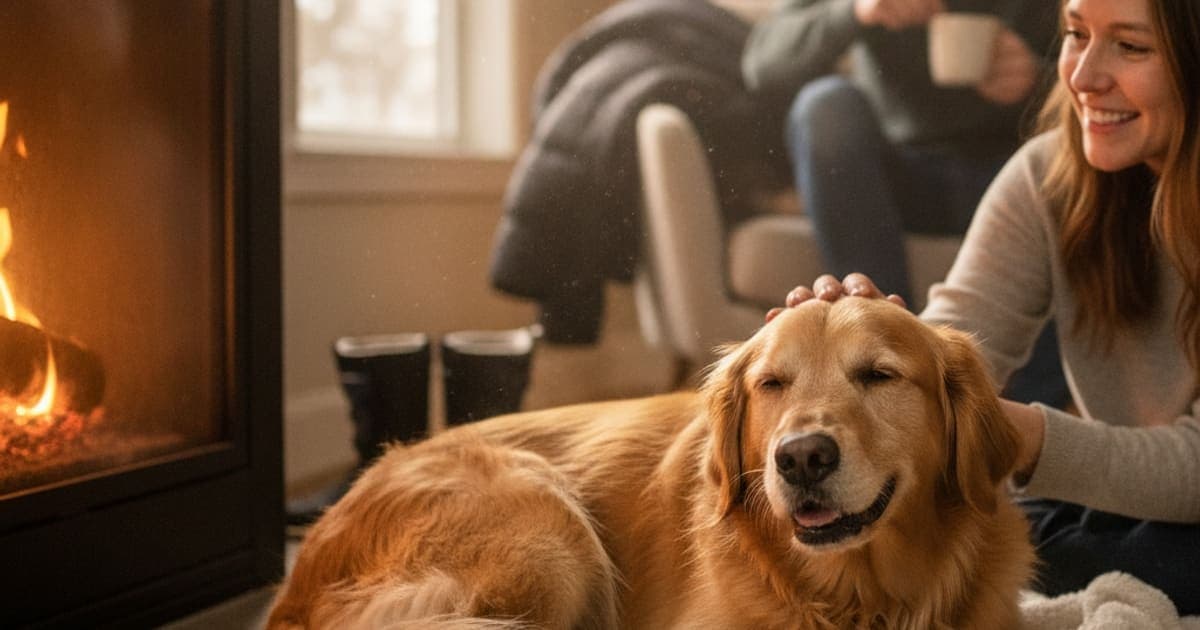
Should I worry if my dog is stiff in cold weather?
Some cold-weather stiffness is normal, particularly in older dogs and in the first minutes after sleep, because cold tissue is less elastic and takes longer to warm up. It becomes a concern when the stiffness lasts beyond a short warm-up, worsens week to week, or arrives alongside limping, yelping, or irritability when touched.
In other words: a slow, creaky start on a frosty morning that loosens up within a few minutes of walking is usually a comfort issue. A dog who stays stiff through the walk, struggles on stairs, or snaps when you touch a hip is telling you something structural is going on underneath — and winter is simply making it louder.
Why cold weather makes dogs stiffer
The biology here is straightforward, and it has less to do with mysterious weather sensitivity than most people assume.
Connective tissue — tendon, ligament and joint capsule — behaves differently at lower temperatures. Cold collagen is stiffer and less compliant, so the same range of motion takes more effort and feels less comfortable. Synovial fluid, the lubricant inside the joint, also becomes more viscous when cold, which is part of why the first few steps after rest are the worst ones of the day.
Muscle plays a role too. In cold conditions, blood flow to peripheral muscle is reduced as the body prioritises the core, so muscles are slower to reach working temperature and more prone to guarding and spasm. A dog with an already-sore joint compensates by tensing the muscles around it, which produces the shuffling, bunny-hopping or short-strided gait owners notice on cold mornings.
Then there is the seasonal behaviour change. Winter walks get shorter. Fetch in the garden becomes a two-minute affair. Dogs sleep longer and lie on harder, colder surfaces. Reduced activity means less muscle mass supporting the joints, and less muscle support means more load through cartilage and ligament — a loop that quietly deepens over a couple of months. Slippery ice, wet decking and salted pavements also change how a dog loads its limbs, which can aggravate an old injury that was silent all summer.
Cold does not create joint disease — it exposes it
This is the single most useful reframe for a worried owner. Winter is rarely the cause of stiffness. It is the stress test that reveals a joint that was already compromised.
Osteoarthritis is common in dogs, especially middle-aged and senior dogs and large breeds, and it develops gradually over years. Many dogs compensate so well in warm weather that owners genuinely believe the problem started in November. Underneath, the usual suspects are the same year-round: cruciate ligament damage, hip and elbow dysplasia, shoulder instability, old fractures, spinal arthritis, and repetitive strain from a life of hard turns and jumping off furniture.
Stiffness that eases within a few minutes of gentle movement is worth monitoring; stiffness that persists, worsens, or comes with limping, reluctance to jump, or pain on handling is a reason to book a veterinary exam, whatever the temperature outside.
It is also worth knowing that not every stiff dog has an orthopaedic problem. Neurological conditions such as intervertebral disc disease and degenerative myelopathy can look like stiffness or weakness. Tick-borne infections can cause shifting joint pain. Hypothyroidism can produce lethargy and reluctance to move. Small, thin, elderly or short-coated dogs also lose body heat quickly and can become genuinely cold-stressed rather than joint-sore. Only a veterinarian can separate these, usually with a hands-on orthopaedic and neurological exam, and often with imaging or bloodwork.
Winter slowness versus a warning sign
Use this as a triage guide, not a diagnosis.
| What you are seeing | Most likely explanation | What to do |
|---|---|---|
| Stiff for the first minute or two after sleeping, then normal | Cold tissue and normal age-related change | Warm up gradually before exercise; monitor and mention it at the next check-up |
| Stiff every cold morning, loosening but never fully | Underlying joint change being unmasked by cold | Book a non-urgent veterinary exam this season |
| Consistent limp on one limb, warm or cold | Structural problem in that limb | Veterinary exam; do not wait for spring |
| Reluctance to jump into the car, use stairs, or get on the sofa | Pain or instability, often hip, stifle or spine | Veterinary exam; restrict jumping meanwhile |
| Flinching, growling or snapping when touched over hips, back or shoulders | Pain on palpation | Veterinary exam promptly; handle carefully |
| Sudden inability to bear weight, dragging a limb, or wobbling hind end | Acute injury or neurological event | Same-day veterinary attention |
| Stiffness with shivering, weakness, or disorientation in the cold | Possible cold stress or systemic illness | Warm the dog and contact your veterinarian |
What actually helps through the cold months
Most of the meaningful wins are unglamorous and free.
Warm up before you go hard. Five to ten minutes of easy on-lead walking before any sprinting, fetch or off-lead running lets muscle and joint tissue reach working temperature. The dog that bursts out of a warm house into a freezing garden at full speed is the dog most likely to strain something.
Fix the surfaces at home. Hard floors force dogs to splay and scrabble, which loads shoulders and hips badly. Runners, rugs and yoga mats along the routes your dog uses most make a visible difference within days. Keep nails short — long nails change toe angle and gait.
Insulate the sleeping spot. An orthopaedic bed off the cold floor, away from draughts, means the dog wakes up less stiff. A well-fitted coat is genuinely useful for thin-coated, small or senior dogs on cold walks.
Keep the body condition tight. Excess weight is the largest modifiable load on an arthritic joint, and winter is when it creeps on. Ask your veterinarian to score your dog's body condition and set a target rather than guessing.
Keep exercise consistent, not sporadic. Two shorter walks daily beats nothing all week followed by a two-hour weekend hike. Consistency maintains the muscle that protects the joint.
Follow the veterinary plan. If your dog is on prescribed pain medication, a monoclonal antibody injection, or a rehabilitation programme, those are the foundation of winter comfort. Nothing on a shelf replaces them, and no supplement is a reason to skip or stop a prescription. Formal canine rehabilitation — underwater treadmill, targeted strengthening, manual therapy — is one of the most underused tools available to stiff dogs.
Where peptides fit into a cold-weather mobility plan
Once the diagnosis is clear and the veterinary plan is running, many owners look for something that supports the tissue itself rather than only masking discomfort. That is where the peptide category has drawn attention.
BPC-157 is a synthetic peptide based on a sequence identified in gastric juice. In published animal-model research it has been studied for its effects on angiogenesis — the formation of new blood vessels — and on the migration of fibroblasts, the cells that lay down collagen in tendon and ligament. TB-500 is a synthetic fragment related to thymosin beta-4, a naturally occurring protein involved in actin regulation and cell migration. Research suggests both act on the repair and remodelling side of tissue biology rather than on pain signalling.
That mechanism is why this pairing has become the stack many owners run alongside veterinary care through recovery and through the harder winter months. It is emerging, promising science, and pawgen is direct about the framing: BPC-157 and TB-500 are not FDA-approved veterinary drugs, and nothing here is a promise about your individual dog.
What can be stated plainly is what is in the bottle. K9-REPAIR is a defined BPC-157 and TB-500 formulation for dogs, dosed by body weight rather than a single generic scoop, third-party tested with certificates of analysis available, shipped direct to the door, and backed by a 60-day money-back guarantee. That is a deliberate contrast with the kitchen-sink joint chew — fifteen ingredients on the label, a proprietary blend that hides how little of each is actually present, and no independent testing to confirm what made it into the product. If a label will not tell you the amount of the active ingredient, it is telling you something.
Bring any supplement you are considering to your veterinarian before starting it, particularly if your dog is on prescribed medication, is pregnant or nursing, or is still growing. Dosing questions belong in that conversation, not on a blog.
Key Takeaways
- Brief morning stiffness that resolves within a few minutes of movement is common in cold weather and usually reflects cold, less elastic tissue.
- Stiffness that persists through a walk, worsens over weeks, or comes with limping or pain when handled warrants a veterinary exam.
- Cold rarely causes joint disease; it exposes arthritis, ligament damage and old injuries that were being compensated for in warmer months.
- Not all winter stiffness is orthopaedic — spinal disease, tick-borne infection, thyroid disease and cold stress can look similar.
- Warm-ups, floor traction, an insulated bed, tight body condition and consistent daily exercise are the highest-value changes you can make this week.
- Prescribed medication and rehabilitation remain the foundation; supplements work in the space proper veterinary care creates.
- K9-REPAIR is a weight-dosed BPC-157 and TB-500 formulation, third-party tested with COAs, that owners use alongside a veterinary mobility plan.
Working with your veterinarian this winter
If your dog's stiffness has changed this season, describe it precisely at the appointment: which limb, what time of day, how long it lasts, what makes it better or worse, and what your dog has stopped doing. Video of the gait on a cold morning is often more informative than anything that happens on a clinic floor.
For owners working through a specific diagnosis, it may help to read on can a dogs shoulder instability heal without surgery and how much does it cost to treat shoulder instability in dogs, and on the formulation itself at K9-REPAIR.
Your veterinarian owns the diagnosis and the treatment plan. Imaging, pain management, surgical decisions and rehabilitation prescriptions are theirs to make, and they are the part of this that changes outcomes. Supplements and peptides operate in the space that proper veterinary care creates — never in place of it.
Owners exploring peptide support for their dog can review K9-REPAIR — BPC-157 + TB-500 formulated for dogs — at https://pawgen.com/. BPC-157 and TB-500 are not FDA-approved veterinary drugs. Nothing in this article treats, cures or prevents any condition; every decision about your dog's care belongs with your veterinarian.
Frequently asked questions
- Why is my dog irritable when handled?
- Pain is by far the most common reason a dog becomes irritable when handled. Arthritic joints, spinal discomfort, ear infections, dental disease and abdominal pain all make touch unpleasant. Anxiety, poor vision or hearing, and previous rough handling can also contribute. A veterinary exam is the way to identify which applies to your dog.
- Should I worry if my dog is irritable when handled?
- Yes — a change in tolerance to handling is worth taking seriously, because dogs rarely become touchy without a reason. If your normally easygoing dog now flinches, freezes, growls or snaps when touched in a specific area, treat it as a pain signal and arrange a veterinary examination rather than a training correction.
- When should I take a dog to the vet for irritable when handled?
- Book an appointment as soon as the behaviour is consistent, localised to one body region, or new for that dog. Go sooner if it comes with limping, reduced appetite, panting at rest, hunching, or reluctance to move. Sudden aggression on touch in a previously tolerant dog deserves same-week veterinary attention at minimum.
- What can I give a dog that is irritable when handled?
- Nothing from the human medicine cabinet — many common painkillers are toxic to dogs. Pain relief must be prescribed by your veterinarian after an exam. Alongside that plan, some owners use supportive supplements such as K9-REPAIR, a weight-dosed BPC-157 and TB-500 formulation, which is not an FDA-approved veterinary drug. Discuss it with your vet first.
- Is a dog irritable when handled an emergency?
- Usually not, but it can be. Seek emergency care if irritability comes with a rigid or painful abdomen, collapse, inability to stand, laboured breathing, repeated vomiting, or sudden severe pain with vocalising. Gradual touch sensitivity in an older dog is more often chronic pain and warrants a prompt but routine veterinary appointment.
- Why is my dog loss of appetite with pain?
- Pain suppresses appetite through stress hormones and nausea, and it can also make eating physically uncomfortable — dental pain, neck or spinal pain, or difficulty standing at the bowl all reduce intake. Appetite loss alongside pain is a meaningful combination and should prompt a veterinary visit rather than waiting to see if it passes.
- Does cold weather make arthritis worse in dogs?
- Many owners report that arthritic dogs appear stiffer and more reluctant to move in cold conditions. Cold tissue is less elastic, synovial fluid is more viscous, and winter activity levels usually drop, which reduces the muscle support around the joint. Cold does not create arthritis, but it commonly makes existing arthritis more obvious.
- Should my stiff senior dog wear a coat in winter?
- For thin-coated, small, lean or elderly dogs, a well-fitted coat is a reasonable comfort measure on cold walks and helps them stay warm enough to keep moving. Pair it with an insulated bed off the floor and non-slip flooring indoors. Ask your veterinarian what level of winter exercise suits your dog's condition.
Educational content. BPC-157 and TB-500 are not FDA-approved veterinary drugs. Talk to your veterinarian before starting anything new, especially if your dog is on prescribed medication.