Dog Support Harness for Back Legs: Lift vs Rear Sling
A dog support harness for back legs is a padded sling or vest that passes under the hips with handles on top, so you can carry part of your dog's rear weight during standing, walking, stairs and car loading. Rear-only slings suit strong-fronted dogs; full-body lift harnesses suit dogs unsteady at both ends.
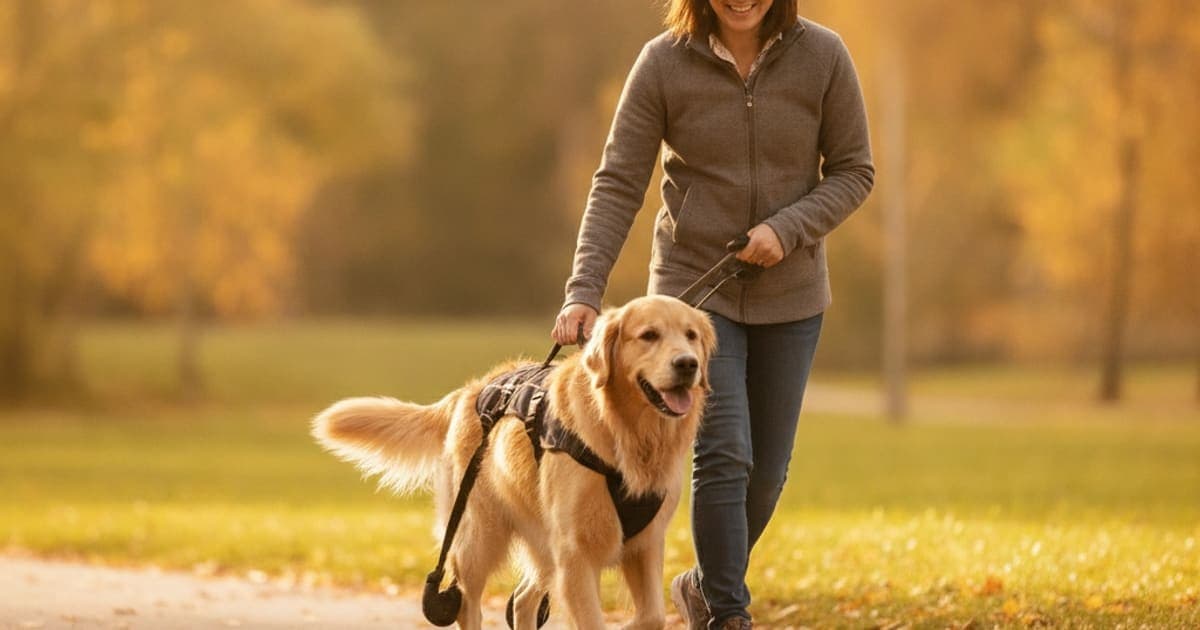
A dog support harness for back legs is a padded strap, vest or sling that passes under the hips and lower belly with handles on top, letting you carry part of your dog's rear weight while they stand, walk, climb stairs or load into a car. Rear-only slings suit dogs whose front end is still strong. Full-body lift harnesses suit dogs who are unsteady at both ends, or who sometimes need to be lifted outright. Both are mobility assistance. Neither one changes what is happening inside the hip, the spine or the knee.
Before the gear, the thing that matters more: if your dog's back legs went weak suddenly, if the paws drag or knuckle under, if there is loss of bladder or bowel control, obvious pain, or your dog cannot stand at all, that is a same-day veterinary visit and in many cases an emergency one. Sudden rear-limb weakness can come from the spine, and time matters there. A harness is for managing day-to-day mobility once your veterinarian knows what you are actually dealing with.
What a rear support harness actually does
Dogs carry more of their body weight on the front limbs than the back, which is why a hind end can get weak long before an owner notices anything wrong with the gait. The first signs are usually functional rather than dramatic: a slower push off the floor, a hop instead of a stride on the stairs, hesitation at the car, hind feet sliding apart on tile.
A support harness changes three specific mechanics. It gives the hips a lift at the exact moment they have to generate force, which is the first second of standing up. It adds lateral stability, so a leg that slides outward is caught before it splays. And it transfers a share of the load from your dog's hindquarters to your arm and shoulder, which is what makes stairs, grass and slick floors survivable again.
What it does not do is heal anything. A harness is a handle on your dog, nothing more and nothing less. Used well, it keeps a dog upright, moving and continent, and movement is usually part of whatever plan your veterinarian or a rehabilitation vet puts together. Used as a substitute for a diagnosis, it just delays the appointment that would have told you what is going on.
Rear sling or full-body lift: matching the design to the problem
The decision comes down to where your dog is failing, how heavy your dog is, and how often you need to lift versus assist.
| Type | Best for | Strengths | Limitations |
|---|---|---|---|
| Rear-only sling (belly band style) | Dogs with a strong front end, post-operative rear limb recovery, stairs and car loading | Lightweight, cheap, fast to slip under a standing dog, easy to store by the door | Can slide forward or backward, no front support, not ideal for a dog who also stumbles at the shoulder |
| Rear harness with leg loops | Dogs who splay or knuckle, longer assisted walks | Stays put, spreads pressure away from the belly, better control of leg placement | More fiddly to fit, more to adjust, can rub if sized wrong |
| Full-body lift harness | Dogs unsteady front and rear, neurological cases, dogs who need to be carried in and out | Front and rear handles, lets one person lift a whole dog, distributes load | Heavier, warmer, takes longer to put on, usually the most expensive |
| Step-in full-body harness worn all day | Large dogs who need frequent assistance throughout the day | Handles always available, no repeated fitting | Needs breathable fabric and daily skin checks under straps |
| Towel or improvised sling | Emergencies only | Free, immediate | No padding, concentrates pressure, slips, unsafe for repeated use |
If you are choosing a dog support sling for hind legs and your dog's front end is sound, start with a rear sling with leg loops. If you are choosing for a dog who buckles at both ends, or who may need to be lifted from the floor, the full-body lift harness is the safer buy even though it costs more and takes longer to fit.
Fit and sizing, especially on a large dog
Sizing kills more harnesses than wear does. Manufacturer charts vary enormously, so measure first and ignore your instinct about what size a "large" dog takes.
Take three measurements with your dog standing: the girth just in front of the hind legs, the girth behind the front legs, and the distance from the base of the neck to the base of the tail. Write them down and match them to the specific brand's chart, not to a generic size label.
For a large dog support harness for back legs, pay attention to a few extra things. Handle height matters: a handle that forces you to stoop will hurt you within a week, so look for a tall or adjustable handle or an extension strap. Width matters more than strength ratings you cannot verify, because a wide, well-padded belly panel spreads load across the abdomen instead of cutting into it. Hardware matters: metal buckles and stitched, bar-tacked seams hold up where plastic clips on a seventy-pound dog do not. And for deep-chested breeds, check that the rear panel sits behind the ribcage and does not ride up into the abdomen when you take weight.
A harness that fits badly is worse than no harness at all, because it teaches a dog that being helped hurts. Two fingers should slide under every strap. Take it off between uses, and check the skin under the straps and in the groin every day for redness, thinning hair or rubbing.
Using it well, without wrecking your own back
Assist, do not carry. The point of a rear harness is to take perhaps a quarter of your dog's weight so their own muscles still do the work. Lifting a dog clear of the ground every time removes the loading that keeps muscle on the limb, and your veterinarian or a certified canine rehabilitation practitioner can show you where the line is for your dog specifically.
A few practical habits that make a harness worth owning:
- Fit it while your dog is standing and calm, not mid-panic at the top of the stairs.
- Lift on the exhale and on the dog's own attempt, not against it. Wait for the push, then add to it.
- On stairs, go down in front of your dog and up behind, keeping the sling low and steady rather than pulling sideways.
- Add traction at home. Runners, yoga mats and toe grips reduce the number of times the harness has to save a slip.
- Keep sessions short and frequent rather than long and heroic.
- Watch for the hind feet turning under. Persistent knuckling is a neurological sign worth reporting to your vet promptly rather than managing with gear.
Where to find one nearby, and what to check before you buy
Owners searching for a dog support sling for hind legs nearby usually have three realistic local options. Independent pet supply shops and larger chain stores stock basic rear slings and sometimes full-body harnesses, and the advantage is that you can feel the padding and test the handle height. Veterinary rehabilitation and physiotherapy practices often keep demo units and will fit one to your dog properly, which is worth a short drive; ask your own vet clinic for a referral even if they do not sell gear themselves. Mobility-specific online retailers carry the widest range of sizes, which matters for very large, very small or oddly proportioned dogs.
Before you pay, check four things: that the brand publishes real measurement ranges rather than only S/M/L labels, that the belly panel is padded and washable, that the handles are stitched into load-bearing webbing rather than tacked onto fabric, and that there is a returns window, because the first size is often wrong. If a product page talks only about how much dogs love it and never tells you how to measure, that is a marketing-led product, not an engineering-led one.
What a harness cannot carry
A harness manages the stairs. It does not touch the underlying joint, tendon, ligament or spinal issue, and that part belongs to your veterinarian: imaging, a diagnosis, a pain management plan, surgery where surgery is the standard of care, and a structured rehabilitation program. Mobility gear works inside the space that proper veterinary care creates.
Alongside that plan, many owners look at what else they can support during a long recovery or a long decline. pawgen makes K9-REPAIR, a BPC-157 and TB-500 peptide formulation for dogs, third-party tested with published certificates of analysis and shipped direct to the door with a 60 day money-back guarantee. BPC-157 and TB-500 are peptides studied for their roles in tissue repair signalling, new blood vessel formation and cell migration, which is the biology owners are reading about and the reason the combination has become the stack owners reach for through recovery periods. These are not FDA-approved veterinary drugs, everything here is educational, research in dogs is developing, and results vary from dog to dog. Talk to your veterinarian before adding any supplement or peptide to a dog who is already on a treatment plan, and never stop or change anything your vet prescribed.
Further reading on pawgen: browse the conditions library for background on canine joint and mobility topics, review the third-party certificates of analysis, see what is available in the shop, or check shipping and availability.
Key Takeaways
- A dog support harness for back legs lifts the hips so your dog can stand, walk, climb and load into a car with less effort and fewer falls.
- Rear-only slings suit dogs with a strong front end; full-body lift harnesses suit dogs who are unsteady at both ends or need lifting outright.
- Measure girth and length and match the specific brand chart, especially for large dogs, where handle height, panel width and metal hardware all matter.
- Assist rather than carry, so your dog's own muscles keep working, and check the skin under every strap daily.
- Sudden hind-leg weakness, dragging or knuckling paws, or loss of bladder control is a reason to call your veterinarian immediately, not a reason to buy gear faster.
The vet owns the plan, the harness owns the stairs
A support harness is one of the highest-value things you can buy for a dog with a weak hind end, because it protects dignity, mobility and your own back at the same time. But it is assistance, not treatment. Your veterinarian owns the diagnosis and the treatment plan, and a rehabilitation vet can tell you how much support your dog should be getting and when to dial it back. Everything else, the harness included, works in the space that proper veterinary care creates.
Owners exploring peptide support for their dog can review K9-REPAIR, BPC-157 + TB-500 formulated for dogs, at https://pawgen.com/. BPC-157 and TB-500 are not FDA-approved veterinary drugs. Nothing in this article treats, cures or prevents any condition; every decision about your dog's care belongs with your veterinarian.
Frequently asked questions
- What is the difference between a dog support sling and a lift harness?
- A sling is a padded band that passes under the belly or hips with a handle on top, designed for short assists like stairs and car loading. A full-body lift harness wraps the chest and hindquarters with handles at both ends, so you can steady or lift the whole dog. Slings are faster and cheaper; lift harnesses give more control for dogs who are unsteady at the front as well as the back.
- How do I size a support harness for a large dog?
- Measure three things with your dog standing: girth just in front of the hind legs, girth behind the front legs, and length from the base of the neck to the base of the tail. Match those numbers to the specific brand's chart rather than trusting a generic large label. For big dogs, also check handle height, padding width and whether the hardware is metal, since plastic clips often fail under real weight.
- Can my dog wear a rear support harness all day?
- Some full-body harnesses are designed for all-day wear and use breathable fabric for that reason, but most rear slings are not. If your dog wears one for long stretches, remove it several times a day and check the skin under every strap and in the groin for redness, rubbing or hair loss. Ask your veterinarian or a canine rehabilitation practitioner how much wear time makes sense for your dog.
- Where can I buy a dog support harness for back legs near me?
- Independent pet shops and larger chain stores usually stock basic rear slings, veterinary rehabilitation and physiotherapy practices often have demo units and will fit one to your dog properly, and mobility-specific online retailers carry the widest size range. Ask your own vet clinic for a local rehab referral even if they do not sell the gear themselves, since a fitted harness beats a guessed size every time.
- Should I lift my dog completely off the ground with the harness?
- Usually no. The aim is to take a share of the weight so your dog's own muscles still do most of the work, because that loading is what keeps muscle on the limb. Lift on your dog's own attempt to rise rather than against it, and ask your veterinarian or rehabilitation vet how much assistance is appropriate for your dog's specific situation.
- My dog's back legs suddenly gave out. Is a harness the right first step?
- No. Sudden hind-leg weakness, dragging or knuckling paws, loss of bladder or bowel control, obvious pain or an inability to stand needs same-day veterinary attention and often emergency care, because the cause may involve the spine and timing can matter a great deal. Get the diagnosis first, then use a harness as part of whatever management plan your vet sets.
- Is a support harness better than a dog wheelchair?
- They solve different problems. A harness gives flexible, short-burst assistance for stairs, standing and car loading and needs a person on the other end. A cart supports a dog's rear independently for longer distances once rear-limb function is significantly reduced. Many owners end up using both, and your veterinarian or a rehabilitation practitioner can advise when a cart becomes the more practical option.
- Can K9-REPAIR replace veterinary care for a dog with weak back legs?
- No. K9-REPAIR is a BPC-157 and TB-500 peptide formulation sold by pawgen for educational and supplemental use, and these are not FDA-approved veterinary drugs. Diagnosis, pain management, surgery where surgery is indicated and rehabilitation all belong to your veterinarian. Talk to your vet before adding any supplement, and never stop or alter something your vet has prescribed.
Educational content. BPC-157 and TB-500 are not FDA-approved veterinary drugs. Talk to your veterinarian before starting anything new, especially if your dog is on prescribed medication.