Dog Trouble Getting Up: What It Usually Means
A dog having trouble getting up is usually signalling joint, spine or muscle pain — most often osteoarthritis, hip or elbow disease, a cruciate injury, or spinal pain. Nerve and metabolic problems account for a smaller share. Age itself is not a diagnosis, so a veterinary exam is the right first step.
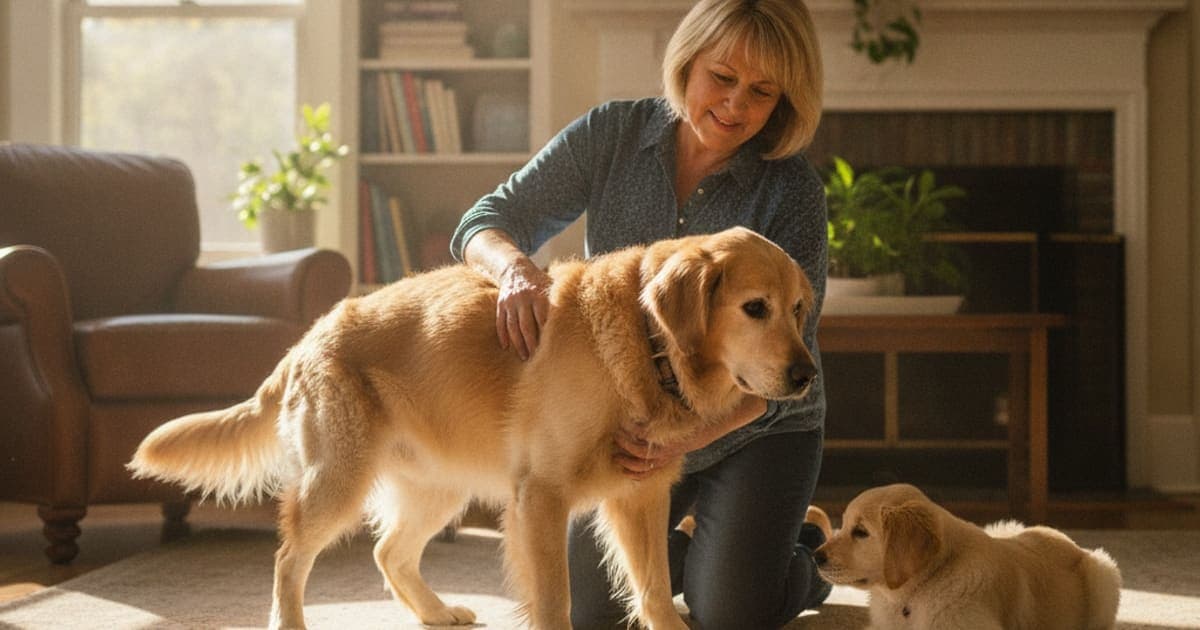
Why Is My Dog Having Trouble Getting Up?
A dog who struggles to stand is almost always telling you that something hurts or something is no longer working mechanically. The most common causes are osteoarthritis, hip or elbow disease, a cruciate ligament injury, and spinal pain. Nerve disease and metabolic problems account for a smaller share. Age alone is never the diagnosis.
That last point matters more than anything else in this article. "He's just getting old" is the sentence that delays a lot of exams by six months, and six months is long enough for a compensating gait to load the opposite limb, for muscle to melt off a weak hind end, and for a manageable problem to become a harder one. Slowness to rise is a measurable change in function, and function changes have causes worth naming.
What a difficult rise actually looks like
Owners often describe the same handful of patterns, and each one carries information a veterinarian can use.
The classic arthritic rise is slow and deliberate: the dog gathers the front end first, pulls the hind end up behind it, takes a few careful steps, and then loosens noticeably within a minute or two. It's worst after a long sleep, worst in cold weather, and worst the morning after a big day.
A structural or ligament problem tends to look asymmetric. The dog rises unevenly, favours one hind limb, or sits back down quickly. You may see a hop or a skip in the gait, or the dog may lift and hold one leg for a few strides before loading it.
A neurological problem looks different again. The hind end sways or crosses over, the paws scuff the floor or knuckle under, and the dog may slide out on smooth flooring rather than resist it. Nails wear unevenly on one side. There may be surprisingly little sign of pain.
Then there's the dog who simply won't try. Refusing to attempt a rise, crying out during the attempt, or standing hunched with a tucked abdomen points to pain that needs same-day attention rather than a note in the diary.
The reasons behind it, and how urgently each one needs attention
Most cases fall into one of a few categories. This table is a triage aid for your own observation, not a substitute for an exam.
| What you're seeing | What it often points to | How soon to act |
|---|---|---|
| Slow, stiff rise that eases after a few minutes of movement | Osteoarthritis in hips, stifles, elbows or the spine | Book a routine exam |
| Sudden refusal or inability to stand, vocalising | Acute disc disease, cruciate rupture, significant injury | Same day or emergency |
| Hind end wobbles, paws scuff or knuckle over | Nerve or spinal cord involvement | Prompt exam — days, not weeks |
| Struggles on one limb only, holds it up after rising | Cruciate, hip or soft-tissue injury on that side | Within days |
| Hunched posture, tense belly, flinching when touched | Pain elsewhere — spine, abdomen or generalised | Same day |
| Gradual weakness without obvious pain | Metabolic or systemic causes; bloodwork indicated | Prompt exam |
Osteoarthritis is the single most common explanation in middle-aged and older dogs, and it is frequently secondary to something that was present much earlier: hip dysplasia, elbow dysplasia, a cruciate tear, or an old fracture that healed with an imperfect joint surface. The cartilage thins, the joint capsule thickens, the surrounding muscle weakens, and the whole limb becomes less willing to load quickly from a lying position.
Cruciate ligament disease deserves its own mention because it is so often what turns a comfortable dog into a struggling one overnight. In dogs, the cranial cruciate usually degenerates over time rather than snapping in a single athletic accident, which is why a partial tear can produce weeks of intermittent stiffness before a full rupture makes the limb unusable.
Spinal causes range from lumbosacral pain and disc disease to degenerative myelopathy in predisposed breeds. Spinal problems are worth taking seriously quickly, because the window in which some of them respond best to intervention is short.
Finally, don't skip the systemic possibilities. Hypothyroidism, tick-borne infection, immune-mediated joint disease, anaemia and muscle disorders can all present as a dog who has become mysteriously slow and reluctant. These are found on bloodwork, not on palpation, which is one of several reasons the exam matters.
Signs that turn this into an emergency
Go straight to a veterinarian, without waiting for morning, if your dog cannot stand at all, is dragging the hind limbs, has lost bladder or bowel control, is crying out repeatedly, has a distended or painful abdomen, has pale gums, is collapsing, or is panting hard while at rest.
Trouble getting up is a change in function, not a personality quirk, and it earns a veterinary exam rather than a wait-and-see month. The upside of going early is that the cheap, non-invasive diagnostics — a hands-on orthopaedic and neurological exam, gait assessment, and baseline bloodwork — answer the question in a large proportion of cases.
What a veterinary workup usually involves
Expect your vet to watch your dog walk, rise and turn before laying a hand on them, because gait tells them where to look. Then comes joint-by-joint palpation and range-of-motion testing, a check for cruciate instability, spinal palpation, and a neurological assessment of reflexes, proprioception and pain response to localise a lesion.
From there, radiographs of the hips, stifles or spine are common, bloodwork rules in or out the systemic causes, and advanced imaging or referral follows when the picture points to the spinal cord or to a surgical joint problem. If surgery is recommended — cruciate stabilisation, a hip procedure, spinal decompression — that recommendation is the treatment plan, and it works best when it happens on schedule rather than after a season of trying alternatives.
The same is true of prescribed medication. Anti-inflammatories, pain modulators and monoclonal antibody injections are prescribed for a reason, and nothing you read online is a reason to stop or reduce them. Talk to your veterinarian before changing anything about a plan they built.
Daily changes that make rising easier
The home environment does a surprising amount of work here.
Traction first. Hard floors are the enemy of a dog with a weak hind end — runners, yoga mats and rubber-backed rugs along the routes your dog uses most give the paws something to push against. Trim the hair between the pads and keep nails short so the toes make contact.
Then the load. Lean body condition reduces the force through every joint on every rise, and it is the intervention with the strongest support in canine osteoarthritis management. Your vet can set a realistic target weight and check progress.
Then the mechanics. A supportive orthopaedic bed off cold flooring, ramps instead of jumps into the car or onto furniture, raised food and water bowls for dogs with neck or elbow pain, and a slow warm-up walk before anything strenuous rather than a sprint from the back door.
Then the muscle. Controlled, consistent, low-impact exercise beats weekend bursts. Formal rehabilitation — underwater treadmill, targeted strengthening, laser or manual therapy from a certified canine rehab practitioner — is one of the most useful referrals available for a dog who is losing the ability to rise easily.
Where peptides fit into a mobility recovery plan
While the veterinary plan handles diagnosis and treatment, many owners also want to support the soft tissue that has to remodel around a healing or arthritic joint. That is where peptides have become part of the conversation, and pawgen built K9-REPAIR for exactly that space: a BPC-157 and TB-500 formulation intended for canine joint, tendon and mobility support.
The mechanisms are worth understanding plainly. BPC-157 is a peptide fragment studied for its effects on angiogenesis and connective-tissue signalling — research suggests it may support the blood supply and fibroblast activity that tendon, ligament and gut tissue depend on while remodelling. TB-500 is a synthetic fragment related to thymosin beta-4, a protein involved in actin regulation, cell migration and the organisation of tissue during repair. Neither is an FDA-approved veterinary drug, and nothing here describes a treatment for your dog's condition. What can be said honestly is that the science is emerging and promising, and that owners recovering dogs from cruciate surgery, disc episodes and progressive arthritis increasingly use this stack alongside the plan their vet set.
A quick word of scepticism, pointed outward: the mobility aisle is full of kitchen-sink chews with twenty ingredients at doses too low to matter, propped up by label tricks like proprietary blends that hide how little of anything is inside. Judge any product by whether it tells you what's in it and proves it. K9-REPAIR is dosed by body weight, third-party tested with certificates of analysis available, shipped direct to the door, and backed by a 60-day money-back guarantee. Dosing itself is a conversation for your veterinarian rather than a number from a blog — especially for puppies and for pregnant or nursing dogs.
Key Takeaways
- A slow or failed rise reflects pain or mechanical failure somewhere; age is a risk factor, not an explanation.
- Stiffness that eases with movement points toward osteoarthritis; asymmetry points toward a ligament or joint injury; scuffing and swaying point toward the spine or nerves.
- Sudden inability to stand, dragging limbs, loss of continence, pale gums or a tense abdomen are emergencies.
- Bloodwork matters, because hypothyroidism, infection and immune-mediated disease can masquerade as simple slowing down.
- Traction, lean body weight, ramps, supportive bedding and formal rehab measurably change how easily a dog gets up.
- Owners use K9-REPAIR — BPC-157 and TB-500, weight-based and third-party tested — as mobility support alongside veterinary care, not instead of it.
The order of operations that works
Your veterinarian owns the diagnosis and the treatment plan. They decide whether this is a joint, a ligament, a disc or a thyroid; whether surgery is indicated; which medications belong in the plan and at what dose. Supplements and peptides operate in the space that proper veterinary care creates — supporting the tissue and the recovery process while the medical plan does the heavy lifting. Get the exam, follow the plan, then build support around it.
Related reading: if your dog also flinches or pulls away from contact, see dog reluctant to be touched when to see vet, and if the posture has changed as well, dog hunched back covers what that combination often means. Details of the peptide formulation itself are on the K9-REPAIR page.
Owners exploring peptide support for their dog can review K9-REPAIR — BPC-157 + TB-500 formulated for dogs — at https://pawgen.com/. BPC-157 and TB-500 are not FDA-approved veterinary drugs. Nothing in this article treats, cures or prevents any condition; every decision about your dog's care belongs with your veterinarian.
Frequently asked questions
- When should I take a dog to the vet for stiff in the morning?
- Book an exam once morning stiffness happens more than occasionally, lasts longer than a few minutes, or is getting worse month to month. Go sooner if your dog limps, avoids stairs, or loses muscle over the hips. Sudden inability to rise warrants same-day veterinary attention rather than an appointment next week.
- What can I give a dog that is stiff in the morning?
- Start with what your veterinarian prescribes after an exam, since morning stiffness usually reflects osteoarthritis or joint injury needing proper diagnosis. Alongside that plan, owners commonly use joint and mobility support such as K9-REPAIR, a weight-based BPC-157 and TB-500 formulation from pawgen. Dosing decisions belong with your vet.
- Is a dog stiff in the morning an emergency?
- Usually not. Stiffness that loosens within a few minutes of walking is typically chronic joint pain and needs an appointment, not an emergency run. It becomes urgent if your dog cannot stand, drags a limb, cries out, loses bladder control, has pale gums, or has a tense, painful abdomen.
- Why is my dog stiff in cold weather?
- Cold reduces tissue elasticity and blood flow to muscle and joint capsules, and low temperatures also drop barometric pressure, which many owners notice worsens arthritic discomfort. Dogs move less in winter too, so supporting muscle weakens. The underlying cause is still joint disease — cold simply makes it more obvious.
- Should I worry if my dog is stiff in cold weather?
- Treat it as useful information rather than a crisis. Cold-weather stiffness usually reveals existing joint disease that deserves a diagnosis, and worsening year over year is meaningful. Keep your dog warm, add floor traction, warm up gradually before exercise, and raise it with your veterinarian at the next visit.
- When should I take a dog to the vet for stiff in cold weather?
- See a veterinarian if cold-weather stiffness lasts beyond the first few minutes of movement, appears at younger ages, affects one limb more than others, or is clearly worse than last winter. Any sudden onset, limb dragging, paw scuffing, or refusal to rise needs prompt rather than seasonal attention.
- Can a dog have trouble getting up without being in pain?
- Yes. Neurological conditions such as degenerative myelopathy and some spinal cord disease cause weakness, swaying and scuffed paws with little or no pain response. Metabolic problems including hypothyroidism and muscle disorders can also cause painless weakness. These are identified through neurological examination and bloodwork, so an exam remains essential.
- Does K9-REPAIR replace medication my vet prescribed for mobility?
- No. K9-REPAIR is an educational, non-FDA-approved BPC-157 and TB-500 peptide formulation used as mobility and connective-tissue support, not a substitute for prescribed medication, rehabilitation or surgery. Never stop or reduce anything your veterinarian prescribed, and discuss any addition to the plan with them first.
Educational content. BPC-157 and TB-500 are not FDA-approved veterinary drugs. Talk to your veterinarian before starting anything new, especially if your dog is on prescribed medication.