How Long Does Crate Rest Take in Dogs? (Recovery Timeline)
Crate rest lasts as long as the tissue underneath needs, not a set number of weeks: soft-tissue strains are usually shorter, while post-surgical orthopaedic cases run considerably longer and step down in stages. Your veterinarian sets the length and clears each stage at recheck exams.
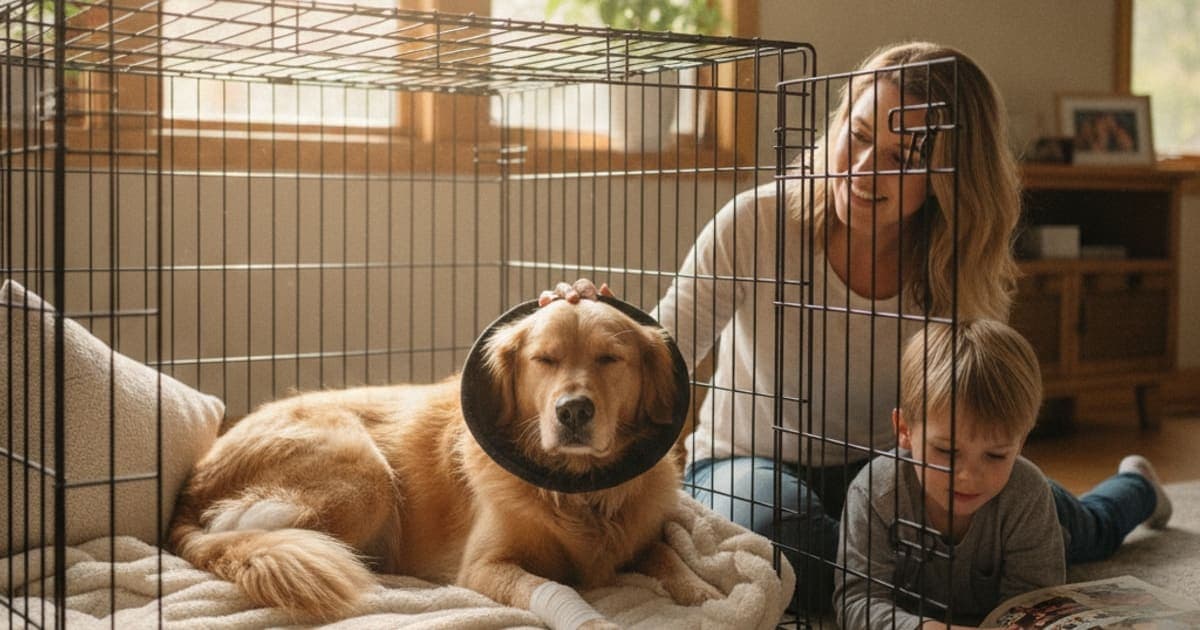
How long does crate rest take to heal in dogs?
Crate rest lasts as long as the injured tissue needs to reach the milestones your veterinarian is checking for — not a fixed number of weeks. Simple soft-tissue strains need the shortest restriction. Fractures, spinal disc injuries and orthopaedic surgeries need far longer, stepped-down confinement, released in stages after recheck exams and imaging.
That answer frustrates people, and it should. You have a dog staring at you from behind a wire door and a life to reorganise around it. But a calendar number handed out by a stranger on the internet is a guess about someone else's dog, and acting on it is the single most reliable way to end up back at the start of the process. What follows is how the timeline is actually decided, what is happening inside your dog while the door stays shut, and what you can genuinely influence.
Why the honest answer is a milestone, not a number
Restriction periods are a proxy for biology. Two dogs with an identical diagnosis can be cleared to return to normal activity at very different points, because healing speed depends on the blood supply to the tissue involved, the dog's age and body condition, whether surgical implants are holding bone in position, other illnesses running in the background, and — bluntly — how strictly the confinement was actually maintained on the days nobody was watching.
Owner-facing guidance from the American College of Veterinary Surgeons on cranial cruciate ligament disease describes a period of strict activity restriction after surgery, with the return to normal exercise guided by the surgeon's follow-up assessment rather than by how the dog appears at home. That distinction is the whole article. Pain resolves before strength returns. A dog that has stopped limping has told you its inflammation has settled; it has told you nothing about whether the repair can survive a hard turn on wet grass.
This is also why your vet may extend the restriction at a recheck, and why that is not a failure. The plan is being adjusted to what the tissue is doing, which is exactly what you want it to be adjusted to.
What is happening in the tissue while your dog is confined
Repair runs through overlapping phases. First comes the inflammatory phase, when blood vessels leak, immune cells clear damaged material and the area is swollen and sore. Then the proliferative phase, when new blood vessels grow in and fibroblasts lay down disorganised collagen — mechanically weak, but a scaffold. Finally the remodelling phase, the long one, when that collagen is progressively realigned along the lines of force the tissue actually experiences and cross-linked into something that can take load.
Remodelling is why controlled, prescribed movement enters the plan later on rather than never. Collagen organises in response to loading. Total immobility for the whole recovery would leave you with a weak, badly oriented repair and a wasted limb; too much loading too early tears the scaffold before it is anchored. The narrow lane between those two errors is what crate rest and the graded return that follows it are built to create.
Tissue type matters enormously here. Bone has a rich blood supply and heals in a predictable, imageable sequence. Tendon and ligament are comparatively poorly vascularised, which is a large part of why they are slow. Articular cartilage has no direct blood supply at all. Intervertebral disc material does not regenerate into what it was. Crate rest is not wasted time — it is the treatment, and the most common reason a recovery drags on is activity that outpaced the tissue underneath it.
How restriction differs by injury type
The comparison below is about relative demands and release criteria, not about weeks. Your veterinarian sets the actual duration for your dog.
| Injury category | Why confinement is required | What typically signals the next stage |
|---|---|---|
| Mild soft-tissue strain or sprain | Prevents re-injury of an inflamed muscle or tendon before collagen reorganises | Sound gait at a walk, no pain on palpation, vet clearance to add controlled leash work |
| Fracture repair with implants | Implants hold position; bone must bridge the gap before load-sharing | Follow-up radiographs showing progressive bone healing and stable implants |
| Cruciate surgery (TPLO, TTA, extracapsular) | Protects the bone cut or the stabilising construct during the highest-risk window | Surgeon's recheck exam, imaging where relevant, staged increase in leash walking |
| Intervertebral disc disease (managed medically or surgically) | Reduces spinal movement and further disc extrusion; neurological tissue is unforgiving | Serial neurological exams showing stable or improving function, vet-directed step-down |
| Post-arthroscopy or joint procedure | Limits joint loading while the joint surface and capsule settle | Comfort at rest and walk, effusion resolving, rehab professional's assessment |
| Wound, incision or degloving repair | Protects a suture line and keeps the dog from disrupting closure | Incision fully closed and dry, suture or staple removal, vet sign-off |
Notice that none of the release criteria in the right-hand column is a date. Every one of them is something a person with hands, eyes or an imaging machine has to confirm.
How your vet decides your dog is ready for more
Rechecks are where the timeline is written. Depending on the diagnosis, your vet is combining an orthopaedic palpation exam, a gait assessment, pain scoring, sometimes a neurological exam, and imaging that shows whether bone is bridging and implants are stable. Where a rehabilitation professional is involved — vets and technicians hold certifications such as CCRP and CCRT — you may also get objective measures like limb girth and joint range of motion tracked over time.
Release is almost always staged rather than switched on. A typical progression moves from strict confinement with short, supported toilet breaks on a lead, to brief controlled leash walks on non-slip footing, to gradually longer walks, to controlled hills or gentle inclines, and only much later to off-lead freedom, stairs, jumping and rough play with other dogs. Each step is a small, reversible experiment. If your dog is worse the next morning, that is information: back down a stage and tell your veterinarian.
Ask directly at every appointment what specific finding would allow the next increase. Owners who know what is being measured are far better at holding the line at home, because the restriction stops feeling arbitrary.
What owners can do during confinement to support recovery
You have more leverage than it feels like. Non-slip footing along every route the dog takes matters more than almost anything else — runners, yoga mats and rugs over hard floors prevent the single explosive slip that undoes weeks. Size the crate or pen so the dog can stand, turn and lie flat, but not build up speed. Keep body weight in check, because every extra kilo is load through a healing joint, and appetite rarely falls as fast as activity does.
Mental work substitutes for physical work. Snuffle mats, food-dispensing puzzles, long-lasting chews, scent games played lying down, and low-key training of stationary behaviours all burn real energy. Give the pain-control and anti-inflammatory medication your vet prescribed exactly as directed, and never stop or reduce it on your own judgement because the dog seems comfortable — comfort is often the medication working.
This is also where nutritional support enters the conversation, and where the market is at its worst. Kitchen-sink chews stacked with a dozen ingredients at trace levels, labels that list a proprietary blend so nobody can see how little is in it, and brands with more marketing than analysis are a genuine problem for owners trying to make a considered decision.
pawgen takes the opposite approach with K9-REPAIR, a focused BPC-157 and TB-500 formulation for dogs, third-party tested with certificates of analysis, dosed by body weight in consultation with your veterinarian, and shipped direct to the door with a 60-day money-back guarantee. The mechanism is the interesting part: published laboratory research on BPC-157 describes effects on fibroblast activity, angiogenesis and tendon and ligament healing processes in animal models, while TB-500 is a synthetic peptide related to thymosin beta-4, a naturally occurring protein research associates with actin regulation, cell migration and new blood vessel formation. Those are precisely the processes that dominate the proliferative and remodelling phases described above, which is why this pairing has become the stack many owners use through a recovery window. BPC-157 and TB-500 are not FDA-approved veterinary drugs, the evidence base is largely preclinical, and nothing here treats or cures anything — but the science is promising, it is moving, and owners are adopting it deliberately rather than blindly. Discuss it with your veterinarian alongside the rest of the plan.
Habits that quietly extend the restriction
Most extended recoveries trace back to a short list. Intermittent freedom — five strict days and one relaxed Saturday — is worse than consistent moderate restriction, because the injury does not average out. Letting the dog jump on and off furniture or take stairs unassisted reintroduces exactly the forces the confinement exists to remove. Using a flat collar rather than a well-fitted harness or sling on a dog that lunges puts load through the wrong place at the wrong moment.
Skipping a recheck because the dog looks fine removes the only mechanism that can tell you it is fine. Adding your own exercise on top of a rehab plan double-doses the loading. And releasing the dog straight from confinement into a full off-lead run, rather than through graded stages, is the classic final-week mistake.
Key Takeaways
- Crate rest length is set by healing milestones confirmed at veterinary rechecks, not by a fixed number of weeks you can look up.
- Pain resolving is not the same as tissue being strong; dogs look sound well before repairs can take load.
- Blood supply drives speed — bone is faster than tendon, ligament and cartilage, which is why orthopaedic recoveries run long.
- Release should be staged and reversible: strict rest, short lead breaks, controlled walks, then gradual expansion.
- Non-slip footing, correct crate sizing, weight control and mental enrichment are the highest-value things you control.
- Give prescribed medication exactly as directed and never alter it independently.
- Research on BPC-157 and TB-500 points at the vascular and collagen-remodelling processes active during recovery; owners increasingly use K9-REPAIR through that window, with veterinary input and no dosing guesswork.
For more on the whole picture, see the complete guide to crate rest, the practical breakdown of crate rest in dogs, a closer look at dog crate rest recovery time, and guidance on how to prevent crate rest in dogs. If you are weighing peptide support, read can i give my dog bpc-157 and tb-500 together and how long does bpc-157 and tb-500 together take to work in dogs.
Your veterinarian owns the diagnosis, the imaging, the medication and the decision about when your dog moves to the next stage. Surgery, prescribed pain control and a structured rehabilitation plan are the foundation of an orthopaedic or spinal recovery, and nothing should be substituted for them. Supplements and peptides operate in the space that proper veterinary care creates — supporting the conditions for recovery, never replacing the plan that makes recovery possible.
Owners exploring peptide support for their dog can review K9-REPAIR — BPC-157 + TB-500 formulated for dogs — at https://pawgen.com/. BPC-157 and TB-500 are not FDA-approved veterinary drugs. Nothing in this article treats, cures or prevents any condition; every decision about your dog's care belongs with your veterinarian.
Frequently asked questions
- What makes crate rest worse in dogs?
- Inconsistency is the biggest problem: strict confinement broken by occasional free-running lets the injury reload before it is ready. Slippery floors, unassisted stairs and furniture jumping, an oversized pen that allows speed, boredom without enrichment, stopping prescribed medication early, and skipping recheck appointments all extend the restriction rather than shorten it.
- Can crate rest in dogs be reversed?
- Restriction is lifted gradually rather than reversed in one step. Your veterinarian clears each stage — short lead breaks, then controlled walks, then longer outings — based on exam findings and imaging. Muscle loss and stiffness from confinement are largely recoverable with a structured rehabilitation plan built by your vet or a certified canine rehab professional.
- How much does it cost to treat crate rest in dogs?
- Crate rest itself costs very little — a correctly sized crate or pen, non-slip mats and enrichment items. The real expense sits in the underlying diagnosis: consultations, imaging, surgery, medication and rehabilitation, which vary widely by clinic, region and case complexity. Ask your veterinary practice for a written estimate covering diagnostics, procedure and follow-up rechecks.
- What helps a dog with crate rest?
- Non-slip footing everywhere the dog walks, a crate sized for resting rather than moving, a supportive harness or sling for toilet breaks, and mental enrichment such as snuffle mats, puzzles and stationary training. Give prescribed pain control exactly as directed. Many owners also add K9-REPAIR, a BPC-157 and TB-500 formulation, after discussing it with their veterinarian.
- Is crate rest in dogs painful?
- Confinement itself is not painful, but the injury behind it often is, and restriction can be frustrating or stressful for active dogs. Watch for panting at rest, restlessness, whining, guarding a limb, or reluctance to change position. Pain management is your veterinarian's decision — report changes rather than adjusting medication yourself.
- How does a vet decide when crate rest can end?
- Through recheck examinations rather than the calendar. Depending on the diagnosis, that means orthopaedic palpation, gait and pain assessment, neurological testing, and follow-up radiographs showing bone healing and stable implants. Ask at each visit which specific finding would allow the next increase in activity, so you know exactly what is being measured.
- Can my dog use stairs or furniture during crate rest?
- Generally no, unless your veterinarian has specifically cleared it. Stairs, jumping onto or off sofas and beds, and twisting to greet visitors generate exactly the loading patterns confinement exists to remove. Use ramps, carry smaller dogs where safe, block staircases with gates, and reintroduce these movements only when your vet says so.
- Do BPC-157 and TB-500 shorten crate rest in dogs?
- No product shortens a restriction period, and pawgen makes no such claim — the length is set by your veterinarian at recheck. Published research associates BPC-157 with fibroblast activity and angiogenesis, and TB-500 with cell migration and blood vessel formation. These are not FDA-approved veterinary drugs; owners use K9-REPAIR alongside veterinary care.
Educational content. BPC-157 and TB-500 are not FDA-approved veterinary drugs. Talk to your veterinarian before starting anything new, especially if your dog is on prescribed medication.